
GPT-6 Sol is worth switching to if your workload is high-volume coding, automation, or agent loops where cost per task decides the budget — and worth skipping if you need the highest knowledge-work ceiling or an agent that never abandons a task. The half-price rate card is real: $2 per million input tokens and $10 per million output tokens, half of GPT-5.6 Sol's promotional rates, verified on OpenAI's model card on September 23, 2026. But the interesting part of this review is not the price. It is how the model got more accurate: Artificial Analysis measured its hallucination rate dropping from 92% to 60% while the share of questions it attempts fell from 99% to 83%. The new Sol is, in a precise sense, a model that answers less.
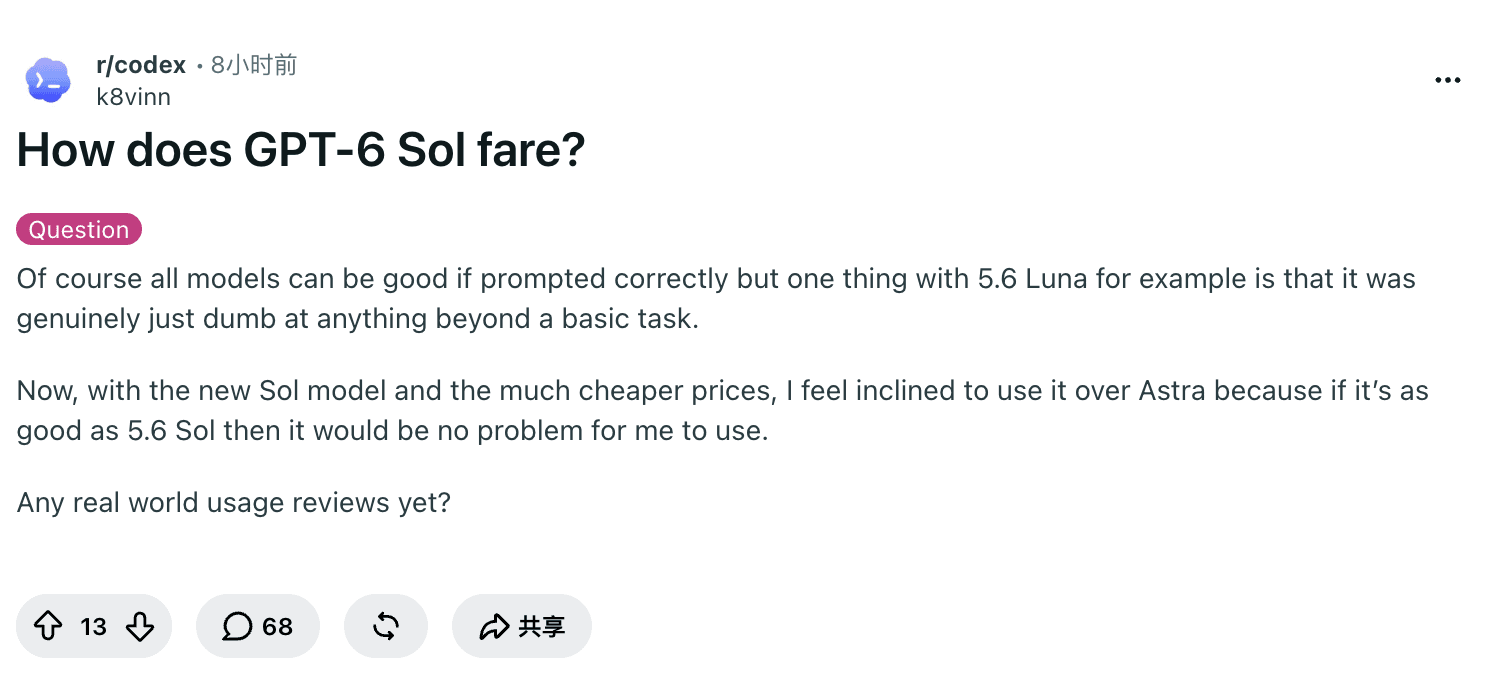
That trade-off is exactly what the launch community is fighting about. Four hours after release, u/k8vinn opened a thread on r/codex asking the question this review answers: "Now, with the new Sol model and the much cheaper prices, I feel inclined to use it over Astra because if it's as good as 5.6 Sol then it would be no problem for me to use. Any real world usage reviews yet?" (Reddit)
I reviewed the GPT-6 Sol rate card separately, and our GPT-6 Sol vs Claude Opus 5.5 comparison handles the two-model selection problem. OpenAI's sibling release has its own GPT-6 Astra review. This post is the model's verdict: where GPT-6 Sol genuinely improves, where it falls down, and which workloads should switch, stay, or walk away. If you want to run the model against live web pages instead of test harnesses, I'll point to a browser-level route at the end.
Key takeaways
The intelligence is level; the price is halved. Artificial Analysis lists GPT-6 Sol (max) at 48 on its Intelligence Index — level with GPT-5.6 Sol — at $1.06 per task versus $1.99, on a rate card cut from $4/$20 to $2/$10 per million tokens.
The accuracy gain is an abstention play. The hallucination rate on AA-Omniscience fell from 92% to 60% because Sol attempts 83% of questions versus 5.6 Sol's 99%; accuracy on attempted questions dipped from 59% to 54%.
Token efficiency is the quiet upgrade. Sol (max) generated 77M tokens across AA's suite against an 88M median, and practitioners report Codex tasks that barely dent weekly limits.
It is not a knowledge-work upgrade. Sol dropped roughly 100 Elo on GDPval-AA v2.1, and its 48 II sits below GPT-6 Astra (53) and Claude Opus 5.5 (58).
Platform reality matters this week. Sol is in ChatGPT Work and Codex but not Chat; subscription users report Plus quotas burning fast on the 6-generation; API teams on Chat Completions lose function calling above
reasoning_effort: none.
The one number that decides this review: accuracy by answering less
Benchmarks launched GPT-6 Sol with a shrug: Artificial Analysis's release note reads "Intelligence Index and Coding Agent Index scores remain level with GPT-5.6, with progress in some evaluations and regressions in others." Then, two lines later, the same note drops the number that actually changes behavior: on AA-Omniscience, its knowledge and hallucination benchmark, GPT-6 Sol (max) cuts its hallucination rate from 92% to 60%, while attempting 83% of questions versus 99% for GPT-5.6 Sol (max) — cutting wrong answers by about a quarter but lowering accuracy on attempted questions from 59% to 54% (Artificial Analysis, checked September 23, 2026).
Translated into engineering terms: OpenAI traded coverage for correctness. The model raises its hand less often, and when it does raise its hand it is slightly less accurate per answer than its predecessor — but the total volume of confident wrong answers collapses. OpenAI's own factuality evaluation tells a compatible story: on de-identified conversations where users had flagged mistakes, "GPT-6 Sol makes about half as many mistakes as its predecessor, approaching Astra-level reliability" (announcement). Note the caveats OpenAI attaches: those conversations were selected because they induced errors, so they are not representative of typical usage, and scores were not controlled for length.
Every judgment in this review sorts by one question: is your cost dominated by wrong answers, or by missing answers? If wrong answers are expensive — code review, compliance, data extraction feeding other systems — the abstention trade is a genuine upgrade. If coverage is the job — agent pipelines where a refusal means a stuck task and a page you never finish — the same design shows up as a regression. Keep that axis in mind; it returns in the verdict.
The benchmarks, and how much to trust them
All independent figures below come from one Artificial Analysis snapshot taken September 23, 2026, with effort levels named, because effort is where launch-day comparisons quietly cheat. Vendor price rows come from OpenAI's model card and our same-day pricing guide.
| Dimension | GPT-6 Sol (max) | GPT-5.6 Sol (max) | GPT-6 Astra (max) | Claude Opus 5.5 (max w/ fallback) | What it means |
|---|---|---|---|---|---|
| API price, in / out per 1M | $2 / $10 | $4 / $20 (promo to Nov 21) | $10 / $50 | $4 / $20 | Sol matches Opus 5.5's input rate at half its output rate. |
| AA Intelligence Index | 48 | level with Sol | 53 | 58 | You are buying the same tier of intelligence cheaper, not more intelligence. |
| AA cost per II task | $1.06 | $1.99 | $3.26 | $5.98 | Half of 5.6 Sol, a third of Astra, ~18% of Opus 5.5 at max settings. |
| Hallucination rate, AA-Omniscience | 60% | 92% | not reported | not reported | The headline accuracy win. |
| Attempt rate, same benchmark | 83% | 99% | — | — | …and the catch: it answers less. |
| GDPval-AA v2.1 (knowledge work) | ~100 Elo drop vs frontier | not reported | not reported | 1846 Elo (Anthropic-reported) | Don't hire Sol for expert knowledge work. |
| Output speed (AA median) | 131 tok/s | not reported | 58 tok/s | not reported | Mid-pack: faster than Astra or Fable 5.1, far slower than Flash-class models. |
| Context / max output | 1.05M / 128K | 1M / 32K | 1.05M / 128K | 1M / 128K | Specs via vendor model pages; the 272K billing threshold applies family-wide. |
Before trusting any row, three cold-water checks:
Vendor scores run on vendor harnesses. OpenAI's launch benchmarks — AutomationBench, Agents' Last Exam (Sol max 56.4%, above Opus 5's best at 60% lower cost), DeepSWE (68.8% vs Fable 5's 69.9% at ~80% lower cost), OSWorld 2.0 offline (60.5% ≈ Opus 5 medium's 60.3% at ~80% lower cost) — are all self-reported, and the announcement's own footnote concedes evaluations ran in a research environment or API that "may provide slightly different output from production ChatGPT," with competitor scores pulled from public reports. Directionally useful, not gospel.
Index values drift. Our GPT-6 Astra review, written one day earlier, cites AA Intelligence Index values of 61.2 for Astra and 60.9 for 5.6 Sol; the same tracker now lists Astra at 53 and Sol at 48. Artificial Analysis versions and rebases its index — compare models within a single snapshot, never across weeks.
Effort mismatch is the launch-week cheat code. Sol's published numbers are mostly max effort; Opus 5.5's headline numbers are often its medium default. Any "Sol wins/loses" claim that doesn't name both settings is marketing. Our comparison post does the aligned-cost version of that math.
Benchmarks are a directional signal here, not a ruler. What carries more weight this early is what people measuring real tasks report — and the first 24 hours produced a surprisingly consistent set.
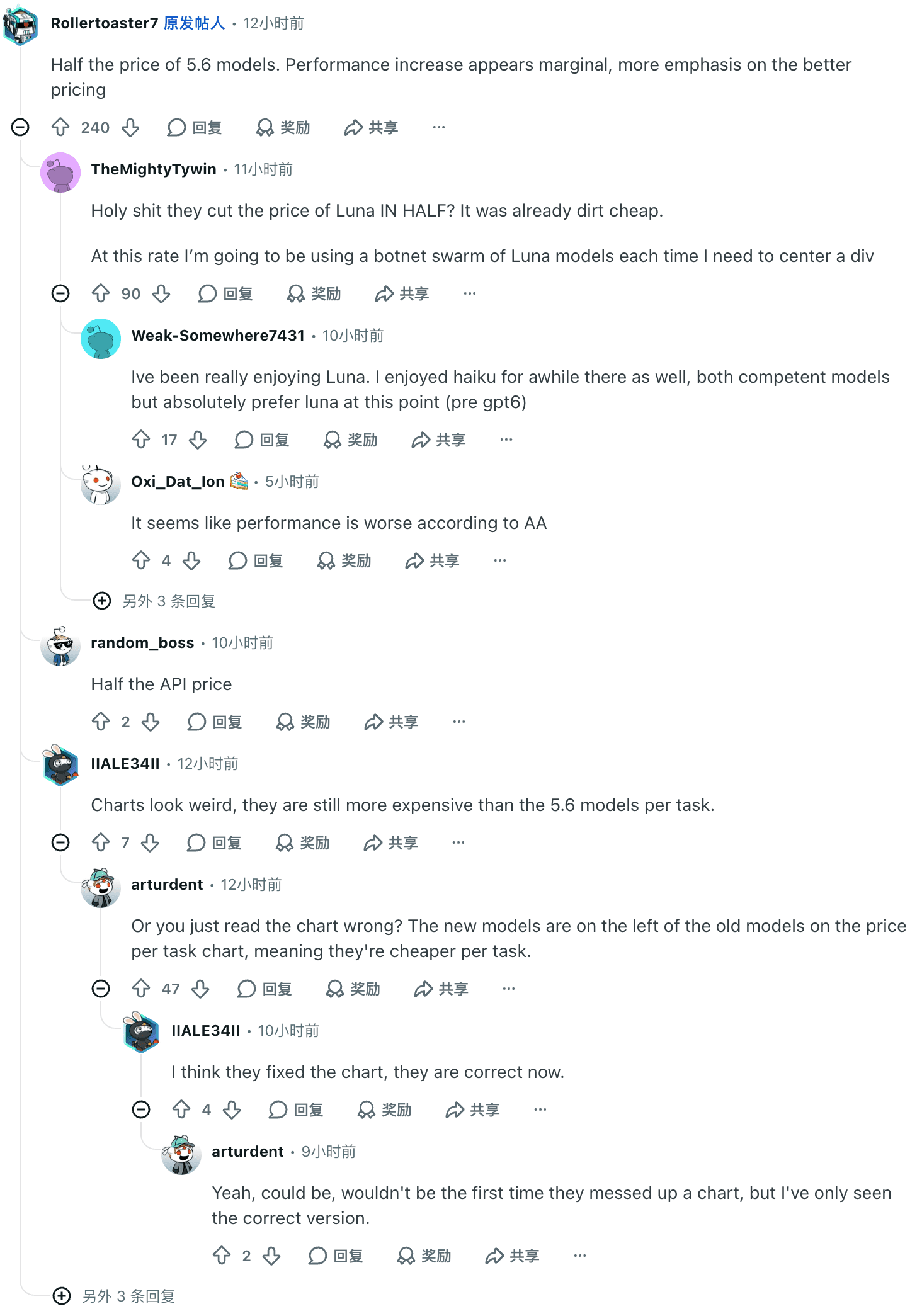
The "prices halved, performance marginal" read was the top comment on r/codex's launch discussion within hours: u/Rollertoaster7, the original poster, scored 240 on "Half the price of 5.6 models. Performance increase appears marginal, more emphasis on the better pricing" — with another user pointing to AA's mixed evals directly (Reddit). Vals AI, an independent evaluator, landed on the same plateau from its own bench: "GPT-6 Sol… ranks #8 on the Vals Index, approximately on par with GPT 5.6 Sol at 1/2 of the cost" (X).
Where GPT-6 Sol is genuinely good
1. Factuality: fewer confident wrong answers
The abstention mechanism is not just a benchmark artifact — it shows up in real pipelines as a model that pushes back instead of piling on. One Hacker News commenter described using Sol as a second opinion on another model's code review: "i used it for code review and it flagged twenty issues, sol checked the review and found 75% of them were hallucinations. sol was much closer to reality" (HN). One anecdote proves nothing about rates, but it rhymes exactly with the AA measurement and OpenAI's "half as many mistakes" claim from three independent directions. If your workload punishes wrong answers — review, extraction, compliance — this is the upgrade that matters more than any index point.
2. Token efficiency: the quiet bill-cut
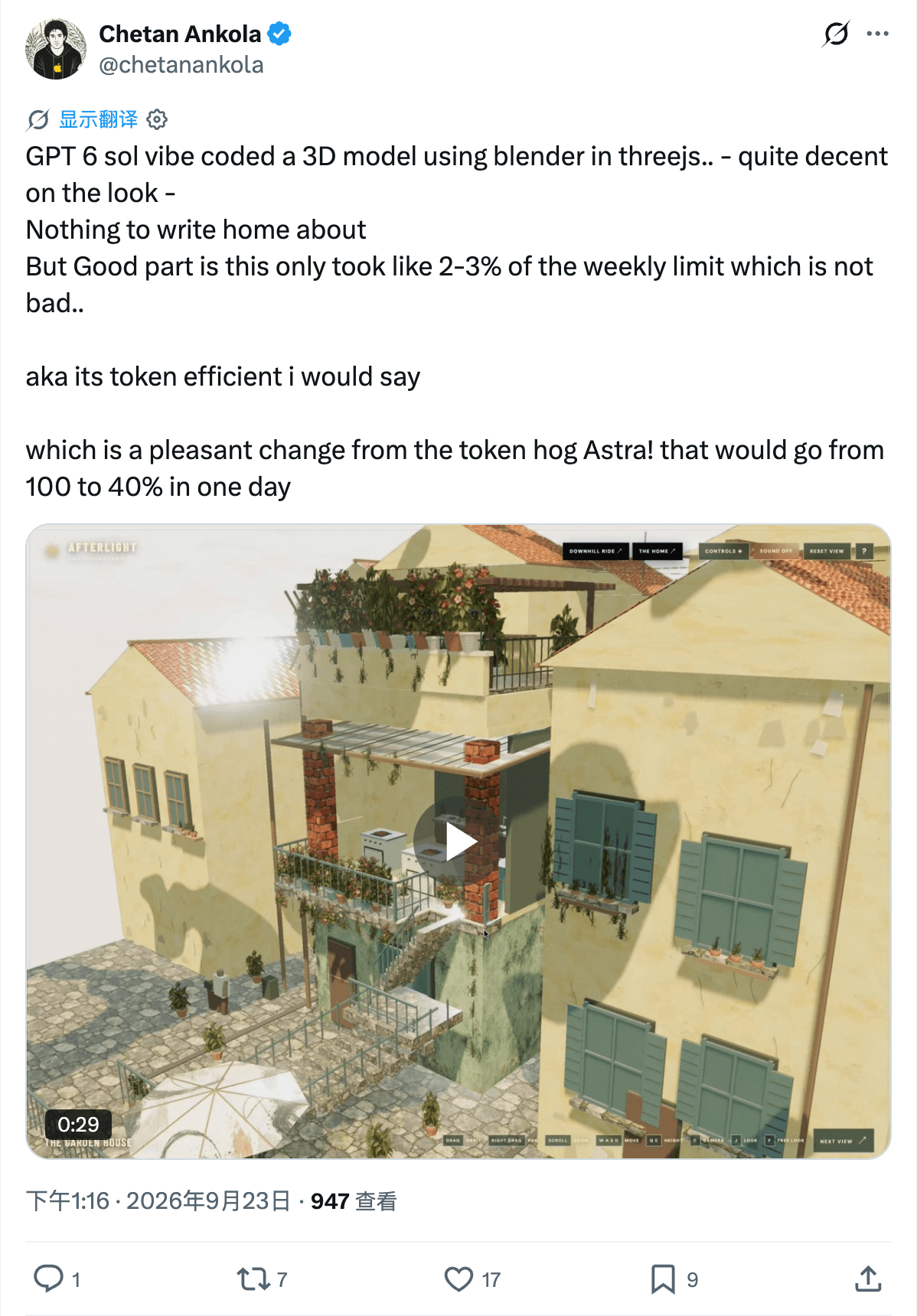
Reasoning models bill twice — once for the answer, once for the thinking. Sol's generation volume on AA's suite ran 77M tokens against an 88M median, and practitioners noticed the same leanness on subscription plans: r/codex joked "My token usage (Codex) < Black Hole," and on X, one developer measured a Blender/Three.js task at "like 2-3% of the weekly limit… aka its token efficient i would say which is a pleasant change from the token hog Astra! that would go from 100 to 40% in one day" (X). Combined with the rate card, this is why OpenAI's claim that Sol(xhigh) beats Opus 5 (max) on AutomationBench at 9% of its per-task cost is at least plausible: fewer tokens, cheaper tokens, on automation-shaped work.
3. Writing and collaboration style
OpenAI says Astra's improved communication style — "more clarity, less jargon" — carries over to Sol, and this is the rare vendor claim an independent blind test echoed within a day: Claire Vo's blind bench on How I AI flagged "clear writing, readable PRDs, and price" as where Sol still wins (Lenny's Newsletter). For teams that ship documents alongside code — specs, PRDs, review summaries — this is a daily-quality improvement that no leaderboard row captures.
Where GPT-6 Sol falls down
1. The abstention tax
Every strength above has a mirror image. A model that attempts 83% of questions, in an unattended agent pipeline, is a model that returns 17% empty slots — and each empty slot is a stuck task, a retry, or an escalation to a human. AA also measured the per-answer cost: accuracy on attempted questions fell from 59% to 54%, and on GDPval-AA v2.1, its benchmark of economically valuable knowledge work, Sol dropped roughly 100 Elo versus frontier peers. It even lost ground on AA-Briefcase's multi-week projects relative to nothing — it held level there while Luna fell, but the knowledge-work ceiling is simply not what this model is for. If your pipeline cannot tolerate refusals, budget a fallback model from day one.
2. Part of the community reads it as "Terra in a new box"
The sharpest negative reports converged on the same theme: this is a reprice, not a new tier. A Hacker News developer who switched back wrote: "Update: Sol 6 is a heaping pile of garbage. Just epic levels of slop. And r/codex etc is full of people noticing the same. I've switched back to 5.6 Sol. What they're selling as Sol 6 is really what would have been Terra before, and it's awful" (HN). On r/codex, the same intuition: "After having worked with it it's definitely dumber. Feels more like Terra." The measured middle ground: the index is level on average, but "progress in some evaluations and regressions in others" means individual workflows can and do regress. If your prompt mix happens to sit on a regressed eval, your experience will contradict the average — and that's consistent with both sides being right.
3. Launch-week platform friction
Three practical frictions temper the switch this week. First, availability: Sol is in ChatGPT Work and Codex for paid plans, but not yet in Chat, and Free/Go users only get GPT-6 Luna (announcement). Second, subscription economics: one Plus user reported "it went through my Plus usage in minutes, while I could cruise for hours with 5.6. It would churn on a basic prompt for minutes and then just give up on usage limits" (HN) — reasoning-token burn is real even when API prices fall. Third, API surface: on the legacy Chat Completions endpoint, function calling only works at reasoning_effort: none — tool-calling workflows belong on the Responses API — and fine-tuning is not supported (model card). If you stay on 5.6 Sol for its usage behavior, note its promo rates run at least through November 21, 2026, and our 1M-context configuration guide still applies.


What people actually said
Twenty-four hours of community signal splits cleanly along the axis from section two — not along skill or seniority.
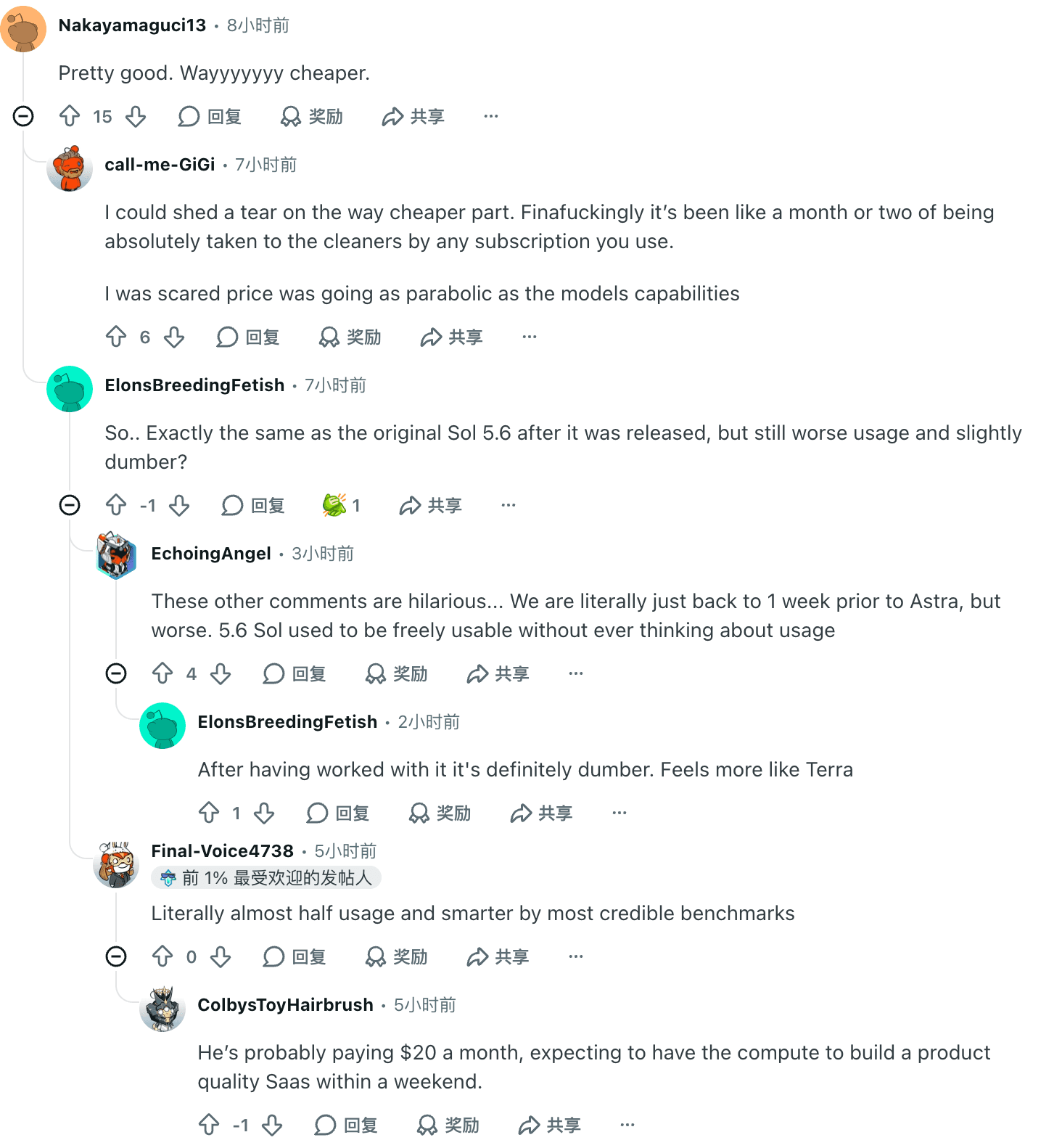
Camp one: "half price is the upgrade." "Pretty good. Wayyyyyyy cheaper." (u/Nakayamaguci13). "Literally almost half usage and smarter by most credible benchmarks" (u/Final-Voice4738). The wait-and-see majority topped r/codex's thread at 159 points: "Price cuts is what we want, now lets see if it translates to better usage, going for 6-Sol" (u/commandedbydemons).
Camp two: "this is a reprice, not a successor." "It's definitely dumber. Feels more like Terra" (u/ElonsBreedingFetish). "It seems like performance is worse according to AA" (u/Oxi_Dat_Ion). cmrdporcupine's revert, quoted above, is the camp's strongest statement.
The middle holds the real information. u/mchusma on Hacker News named the actual comparison most teams face: "I personally am preferring Opus 5.5 at medium over GPT-6 Sol Max, in very very early tests. Similar price range, more capability" (HN).
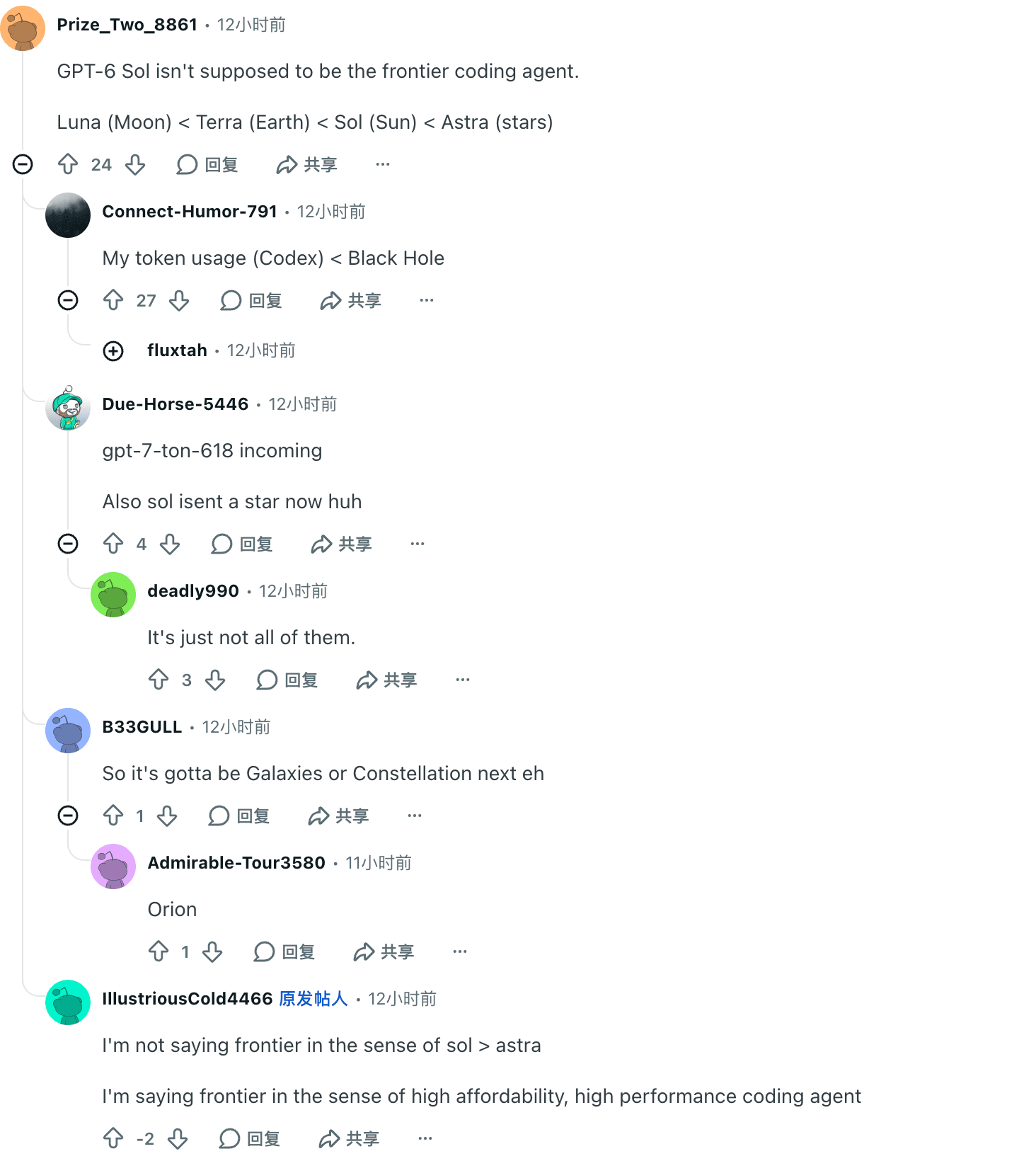


Our editorial read: both camps are describing the same design choice from opposite workloads. Where wrong answers are expensive, Sol looks smarter than its predecessor; where coverage is precious, it looks dumber. The benchmarks say "level," and both camps are correct about their own half of that average.
The verdict: choose by workload shape
| Your workload | Best fit | Why | Watch out for |
|---|---|---|---|
| High-volume routine automation, agent loops on a budget | GPT-6 Sol (xhigh) | Beats Opus 5 (max) on AutomationBench at 9% of its per-task cost; ~$0.53/task at xhigh | Keep contexts under the 272K billing cliff; cache window is 30 minutes |
| Everyday coding and second-opinion code review | GPT-6 Sol (high–max) | FrontierCode parity with Fable 5.1 xhigh at much lower cost; catches hallucinated findings | Give it a fallback path for abstentions; verify citations |
| 30+ minute stubborn self-debugging, long-horizon autonomy | GPT-6 Astra | Endurance is what the premium buys — see the GPT-6 Astra overview and our Astra review | 3x+ cost per task; TTFT stretches at high effort |
| Expert knowledge work: legal, finance, deep analysis | Claude Opus 5.5 | Sol regressed ~100 Elo on GDPval; Opus leads the II at 58 | Highest cost per task; verbosity at max effort |
| ChatGPT-side daily chatting | Stay on 5.6 for now (Luna free tier, 5.6 Sol on Plus) | Sol isn't in Chat yet; 6-generation quota burn is real | If you stay, our GPT-5.6 Sol overview, 1M-context config, and the promo pricing deadline all still apply |
| Research and automation across live browser tabs | Tabbit + Sol (when in your picker) | Runs the model next to your tabs and files — see below | Availability depends on your account's model picker |
The one-line ruling: switch your automation and coding budgets to GPT-6 Sol; do not switch your knowledge-work ceiling or your unattended long-horizon agents. It is the same intelligence you were already buying from OpenAI, at half the sticker, with a new personality: it would rather leave a question unanswered than answer it wrong. Hire it for exactly that job. And note the fine print before you commit a budget: the GPT-5.6 baseline in every "50% cheaper" claim is promotional at least through November 21, 2026.
Run GPT-6 Sol where your work already lives: Tabbit
A score sheet is not a browser workflow. Most real work — the research, the comparisons, the extraction, the review — lives across twenty open tabs, local files, and web apps that a raw API call never sees. Wiring Sol into that by hand means copying page content into prompts, managing context windows yourself, and rebuilding the plumbing every time.
This is where Tabbit Browser earns its place in a model review. Tabbit is an agentic AI browser that runs model workflows directly against your browsing context: multi-tab research, agentic reasoning and deep research tasks, and automation across live pages. When GPT-6 Sol shows up in your account's model picker, you can point those workflows at it without writing an orchestrator — and flip to a cheaper or stronger model per task, which is exactly the discipline a half-price, level-intelligence model rewards.
Two honest boundaries: model availability inside Tabbit depends on your connected account and its plan — check the picker before you build a workflow around Sol — and the client doesn't change OpenAI's billing; the $2/$10 card bills the same either way. To see what the model is actually being asked in practice, browse the GPT-6 Sol model page, its prompt directory, and the community review evidence base.
Ready to run GPT-6 Sol against your own tabs instead of a benchmark?
 Tabbit Browser
FAQ
Is GPT-6 Sol better than GPT-5.6 Sol?
On independent measurements they are roughly level in intelligence: Artificial Analysis lists GPT-6 Sol (max) at 48 on its Intelligence Index, with GPT-5.6 Sol described as level, at half the cost per task ($1.06 vs $1.99). GPT-6 Sol also cuts its hallucination rate from 92% to 60% on AA-Omniscience, but it gets there by attempting 83% of questions versus 99%. Whether that trade suits you depends on whether wrong answers or missing answers cost you more.
Why does GPT-6 Sol refuse or skip more questions?
Artificial Analysis attributes the hallucination improvement to abstention: GPT-6 Sol (max) attempts 83% of AA-Omniscience questions versus 99% for GPT-5.6 Sol (max), which cuts wrong answers but lowers accuracy on attempted questions from 59% to 54%. In an agent pipeline, an abstention usually surfaces as a stuck or escalated task, so budget for a fallback path rather than treating refusal as failure.
How much does GPT-6 Sol cost per task?
On Artificial Analysis's Intelligence Index, GPT-6 Sol costs about $1.06 per task at max effort, with the effort ladder running from roughly $0.13 at low effort to $1.06 at max on the same $2/$10 rate card. Your effort choice therefore swings cost about 8x before you change anything else. The full rate card, cache rules, and the 272K long-context threshold are in our GPT-6 Sol pricing guide.
GPT-6 Sol vs GPT-6 Astra: which should I use?
Use GPT-6 Sol for high-volume coding and automation where cost per task matters, and GPT-6 Astra for long-horizon autonomous runs where stubbornness matters. Sol posts 48 on the AA Intelligence Index versus Astra's 53 at roughly a third of the cost per task, and both share the 272K long-context pricing threshold. Our GPT-6 Astra review covers when the premium is justified.
Is GPT-6 Sol available in ChatGPT?
Not yet in Chat. At launch, GPT-6 Sol is available in ChatGPT Work and Codex for Plus, Pro, Business, Enterprise, and Edu plans, while Free and Go users get GPT-6 Luna in the desktop app. OpenAI says rollout to Chat is gradual, and the model is on the API as gpt-6-sol. Check your plan's model picker before committing a workflow to it.
Can I use GPT-6 Sol in Tabbit Browser?
Tabbit Browser supports multi-model workflows across your open tabs, local files, and live web sessions, and GPT-6 Sol appears in the model picker when your connected account or API access includes it. Availability depends on your account, and using the client does not change OpenAI's billing. You can browse task recipes in the GPT-6 Sol prompt directory before downloading.