
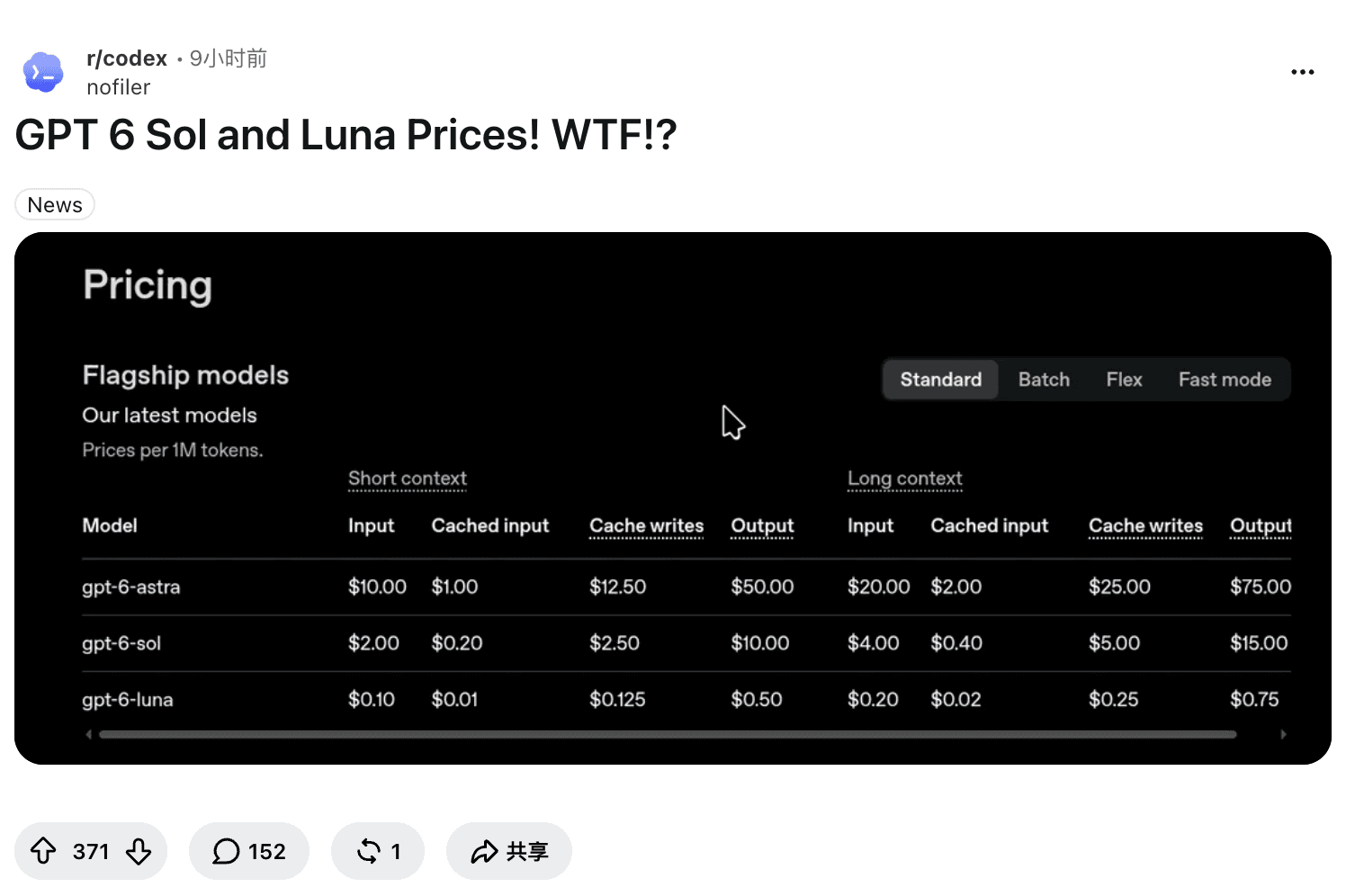
GPT-6 Sol costs $2 per million input tokens and $10 per million output tokens on OpenAI's standard API rate card, checked September 23, 2026. Cached input is $0.20 per million and cache writes are $2.50. The number that changes the budget is 272,000 input tokens: above it, the entire request moves to higher long-context rates. One launch-day reaction on r/codex drew 371 upvotes within hours under the title "GPT 6 Sol and Luna Prices! WTF!?", and its top comment read the move plainly: "Sol now has terra pricing, Luna's price halved and terra is dead." The sticker shock is arithmetic: GPT-6 Sol's card is currently listed at $2/$10, while the GPT-5.6 Sol comparison rate is explicitly promotional through at least November 21. (Reddit discussion; OpenAI pricing)
This guide separates API invoices from ChatGPT and Codex subscriptions, shows the full rate card, and gives two reproducible budget examples. If you want to try the model while working with web pages or files, Tabbit Browser can be a client option when the model appears in your account's picker; it does not change OpenAI's billing.
Key takeaways
Standard short-context GPT-6 Sol costs $2 input, $0.20 cached input, $2.50 cache writes, and $10 output per million tokens.
Above 272K input tokens, OpenAI prices every token in the request at long-context rates: $4 / $0.40 / $5 / $15 per million.
Batch and Flex are listed at half of Standard; Fast is twice the applicable rate. Check that the service tier fits your latency and endpoint before estimating a discount or premium.
The headline comparison with GPT-5.6 Sol uses a rate that OpenAI says is promotional through at least November 21, 2026.
A token rate does not tell you a subscription's quota or a task's success-adjusted cost. Count output, cache writes, tools, and retries separately.
GPT-6 Sol API pricing at a glance
All prices are USD per one million tokens. The OpenAI model card and pricing table were checked on September 23, 2026. The long-context row applies when input is more than 272,000 tokens.
| GPT-6 Sol service tier | Context | Input | Cached input | Cache writes | Output |
|---|---|---|---|---|---|
| Standard | ≤272K input | $2.00 | $0.20 | $2.50 | $10.00 |
| Standard | >272K input | $4.00 | $0.40 | $5.00 | $15.00 |
| Batch / Flex | ≤272K input | $1.00 | $0.10 | $1.25 | $5.00 |
| Batch / Flex | >272K input | $2.00 | $0.20 | $2.50 | $7.50 |
| Fast | ≤272K input | $4.00 | $0.40 | $5.00 | $20.00 |
| Fast | >272K input | $8.00 | $0.80 | $10.00 | $30.00 |
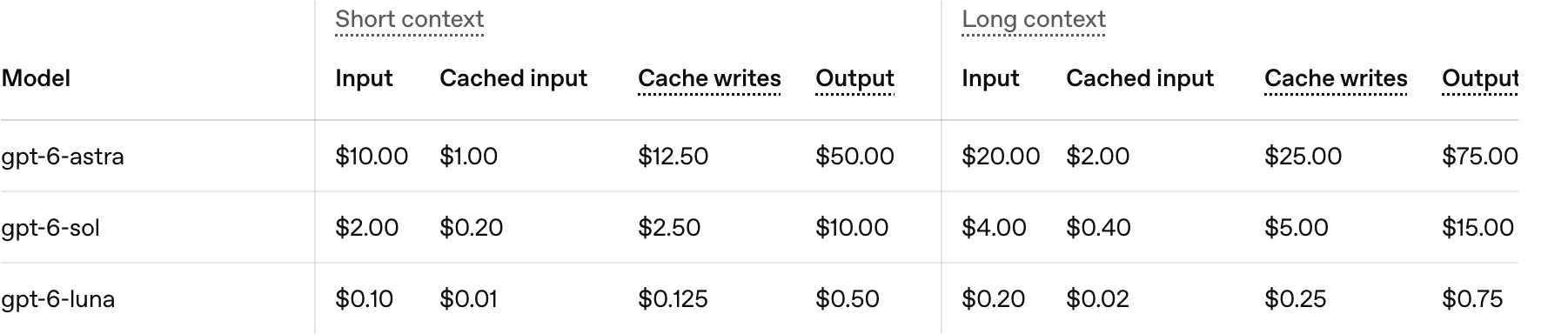
The first rate card is a list price, not the cost of a finished task. For the previous Sol model, OpenAI lists $4 input and $20 output per million tokens and says this promotional pricing is available through at least November 21, 2026. That makes today's GPT-6 Sol short-context input and output rates half as high. It does not guarantee that a workload will use half as many dollars: reasoning effort, retries, output length, caching, and context size affect the bill.
| Model | Input | Cached input | Cache writes | Output | What the row is useful for |
|---|---|---|---|---|---|
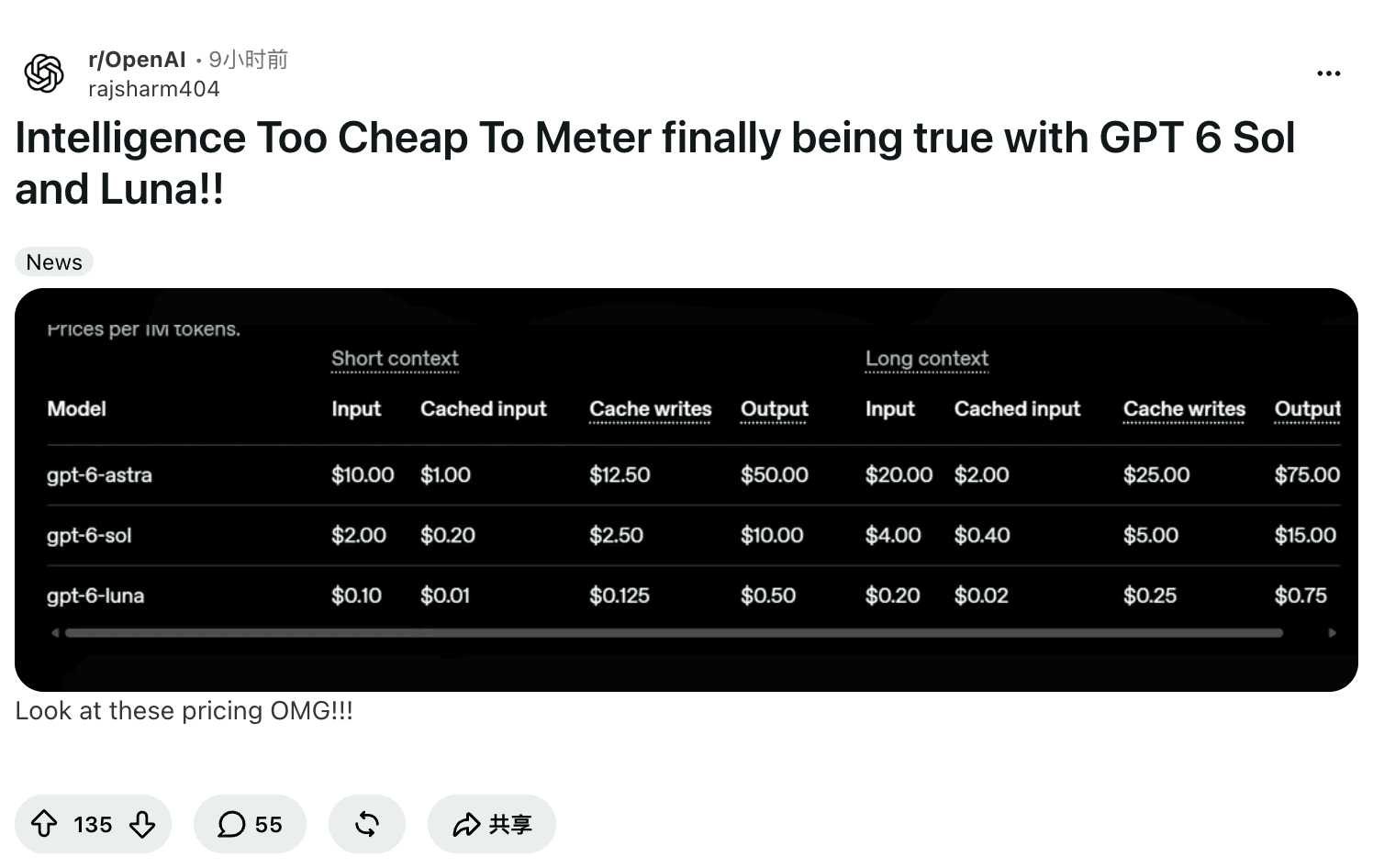
| GPT-6 Luna | $0.10 | $0.01 | $0.125 | $0.50 | Cost-sensitive or high-volume routing; validate task quality first |
| GPT-6 Sol | $2.00 | $0.20 | $2.50 | $10.00 | Mid-tier coding and agent workloads, per OpenAI's positioning |
| GPT-6 Astra | $10.00 | $1.00 | $12.50 | $50.00 | Higher-cost flagship option for harder work |
These are Standard short-context rates from the same OpenAI pricing table, not benchmark rankings. One structural detail from that page: the GPT-5.6 Terra and GPT-5.6 Luna rows no longer appear anywhere on the September 23 snapshot, while gpt-5.6-sol lives on under the Daybreak "Cyber models" section at its old promotional $4/$20. Read the GPT-6 Astra pricing breakdown for the separate higher-tier economics and the GPT-5.6 Sol cost guide for the predecessor's price history.
The one number that changes the whole request: 272K
OpenAI's model card says prompts with more than 272K input tokens are priced at 2× input and cache rates and 1.5× output for the full request. This is a threshold for the request, not a surcharge on the excess tokens alone.
That distinction matters most in large repository analysis, long document review, and agent loops that keep carrying a large history forward. A request with 273,000 input tokens does not pay the short-context rate for its first 272,000. Its input, cached input, cache-write, and output rates all use the long-context row. The context window is 1,050,000 tokens, so “fits in context” does not mean “same price per token.”
At exactly 272,000 input tokens, the model card's “more than 272K” condition has not been crossed. At 272,001, it has. Keep a margin below the threshold if a small addition to the prompt could push the request over it. Check the current GPT-6 Sol model card before shipping a hard-coded budget rule.
The effort dial: the same card bills $0.13 to $1.06 per task
The 272K threshold reprices a request. The reasoning-effort setting reprices the model. Artificial Analysis tracks GPT-6 Sol as six entries — one per effort tier — and their measured cost per Intelligence Index task, snapshotted September 23, 2026, looks like this:
| Reasoning effort | Intelligence Index | Cost per task | Output speed |
|---|---|---|---|
| low | 34 | $0.13 | 129 t/s |
| medium (default) | 40 | $0.25 | 114 t/s |
| non-reasoning | 28 | $0.33 | 109 t/s |
| high | 43 | $0.37 | 119 t/s |
| xhigh | 44 | $0.53 | 128 t/s |
| max | 48 | $1.06 | 115 t/s |
Read the outer columns together: max effort costs about 8x what low effort costs per task on identical token prices, for 14 index points of measured intelligence. The same snapshot put GPT-5.6 Sol (max) at $1.99 per task, so the successor halved the measured task cost at the top tier — but the dial between $0.13 and $1.06 is still yours to set, and the default is medium, not max. OpenAI's own numbers point the same direction: on its AutomationBench, GPT-6 Sol at xhigh effort scored 33.2% at $0.27 per task, which the announcement frames as 9% of Claude Opus 5's cost per task at max effort.
That is why launch-week switching talk is price-first. "With the new Sol model and the much cheaper prices, I feel inclined to use it over Astra," one Codex user wrote while asking for real-world reviews; the most-upvoted reply was three words long: "Pretty good. Wayyyyyyy cheaper." (r/codex thread)

Translating the 50% comparison
GPT-6 Sol's $2/$10 headline looks simple beside GPT-5.6 Sol's currently listed $4/$20. But the comparison has a time-sensitive baseline: OpenAI explicitly calls the GPT-5.6 Sol rate promotional, with availability through at least November 21, 2026. The pricing page does not label GPT-6 Sol's listed rate as promotional.
That makes “half the listed rate today” accurate. “Half the permanent predecessor price” is not. The most-upvoted launch thread put the trade bluntly: "Half the price of 5.6 models. Performance increase appears marginal, more emphasis on the better pricing." Artificial Analysis read it the same way — intelligence scores roughly flat against GPT-5.6 Sol, with progress on some evaluations and regressions on others — while its measured cost per task fell from $1.99 (GPT-5.6 Sol, max) to $1.06 (GPT-6 Sol, max). And in the same thread, one reply grumbled that "performance is worse according to AA." Price moved further than capability did; whether that is a problem depends on your task. (r/codex thread; Artificial Analysis release page)

To compare actual task costs, run the same prompt, context, tools, reasoning setting, and success criteria on each model. Record the total billed tokens across retries, then divide by completed tasks. Without that matched test, per-million-token rates are the honest comparison available.
Costs beyond the headline rate
Cached reads and cache writes are separate. At short context, a cached input token costs $0.20 per million; a cache-write token costs $2.50. Do not count the same token as both a cold read and a cache hit. If your workload writes a large prefix once and reuses it, enter the write volume once and estimate subsequent reads at the cached rate according to the actual API behavior.
GPT-6 also changed how caching behaves, not just how it is priced. OpenAI's launch-day caching post says eligible shared prefixes are reused within a 30-minute window, that GPT-6 serves higher cache-hit rates by default, and that new controls exist specifically because agents re-read the same context every turn: a caching dashboard, a cache-miss diagnostics tool, explicit cache breakpoints, prewarming, and the ability to change reasoning effort or tool availability without breaking the cache. GitHub reported cutting the share of prompt tokens needing fresh processing by more than 50% across billions of requests, and one customer in the same post attributed a 20% cost cut to a few points of extra hit rate. A quieter detail from the same launch: GPT-6 Luna now carries a $0.125-per-million cache-write fee where its predecessor had none. (OpenAI caching post)
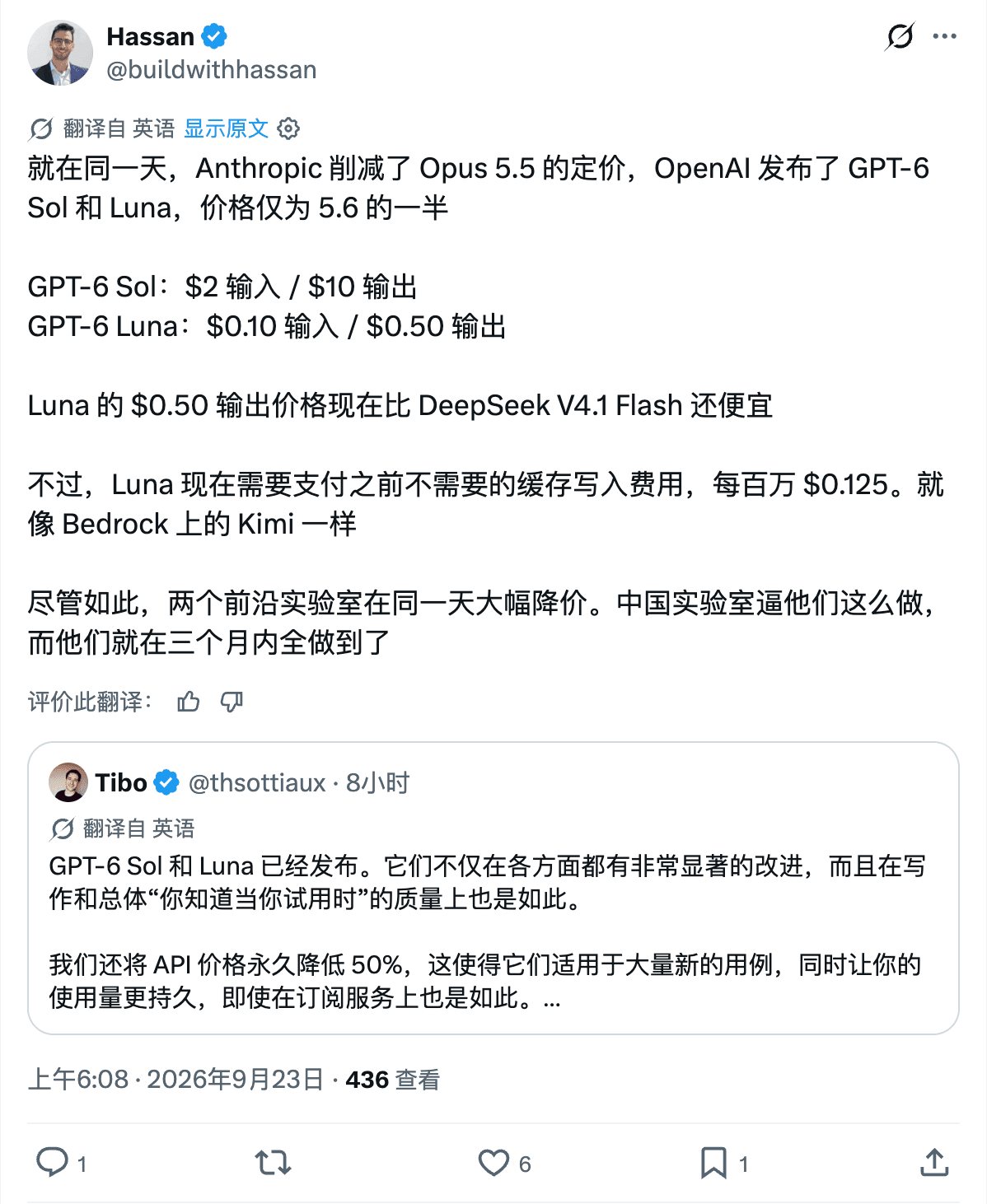
The post above also flags the competitive backdrop: Anthropic cut Opus 5.5 pricing the same week, so both frontier labs moved prices within hours of each other.
Batch and Flex trade the Standard rate for a different service tier. OpenAI lists both at 50% of Standard rates. Batch is for asynchronous work; do not budget the discount into an interactive request unless your integration uses an eligible tier. Fast mode is listed at 2× the applicable rates. The API page says priority remains accepted as an alias for Fast.
Regional processing can add 10%. OpenAI says eligible regional processing endpoints for models released on or after March 5, 2026 carry a 10% uplift. GPT-6 Sol's EU data residency is available only with Standard processing. Verify the chosen endpoint and tier before applying this line.
Tools and retries have their own cost impact. Tokens used by built-in tools are billed at the selected model's token rates; some tools or hosted sessions may also have separate fees. Failed attempts that consumed tokens still belong in the budget. Taxes and provider markups are outside OpenAI's direct rate card.
Which GPT-6 price tier fits the work?
OpenAI's same-page short-context table creates a wide family ladder: Luna is twenty times cheaper than Sol on input and output; Astra is five times more expensive than Sol on those rates. A cheaper row is useful only if it completes the task to the same acceptance standard. Treat the family table as a routing hypothesis to validate with your own examples.
The ladder also got steeper overnight, and the community's mental model of it is now the names themselves. When one user called the new Sol "underwhelming," the top reply explained the pecking order: "GPT-6 Sol isn't supposed to be the frontier coding agent. Luna (Moon) < Terra (Earth) < Sol (Sun) < Astra (stars)." (r/codex thread)
| Workload | Starting point | Cost driver | Check before choosing |
|---|---|---|---|
| High-volume classification or simple extraction | Test Luna first | Number of tasks and output size | Quality on a labeled sample; retries may erase savings |
| Coding or multi-step agent work | Test Sol at the lowest effort that meets your bar | Output, reasoning setting, retries, and context | Compare successful-task cost, not token rate alone |
| Hard tasks where a failed attempt is expensive | Compare Sol and Astra on a fixed test set | Completion rate and tokens to completion | Higher per-token price may still win if it needs fewer attempts |
| Background evaluation or enrichment | Check Batch or Flex eligibility | 50% service-tier rate | Queue and latency requirements |
| Large prompts near 272K | Reduce or summarize context where appropriate | Full-request long-context uplift | Budget the entire request at the higher row once crossed |
What the API rate card does not tell you
The API rate card is not a ChatGPT subscription calculator. ChatGPT and Codex plans define their own feature access and usage limits; a lower API price does not mathematically promise twice the subscription usage. A launch-day post put the concern concretely — claiming message allowances moved "from 25-200 messages to 15-150 while it is a cheaper model" and calling the new Sol "a post-trained Terra." The author labeled it speculation, and the live usage page for your plan is the only arbiter. (Critical Reddit post)
It also does not settle whether GPT-6 Sol is better value for every task. One critic said the model “uses more reasoning tokens compared to the previous model,” but provided no comparable token trace in the comment. That claim should not be repeated as a verified model property. It points to a testable question: does your real task use fewer or more billed tokens, retries, and human corrections? (Critical Reddit post)
The right budget includes API usage plus any separate tool fees, retries, and review effort. For a subscription, inspect its own allowance and reset rules instead. These are different purchasing choices.
Plan availability: API tiers and ChatGPT plans
On the API side, the free tier is closed: the model page's rate-limit table marks gpt-6-sol "Not supported" on Free, with paid access starting at Tier 1.
| API tier | RPM | TPM | Batch queue limit |
|---|---|---|---|
| Free | Not supported | — | — |
| Tier 1 | 500 | 500,000 | 1.5M tokens |
| Tier 2 | 5,000 | 1,000,000 | 3M tokens |
| Tier 3 | 5,000 | 2,000,000 | 100M tokens |
| Tier 4 | 10,000 | 4,000,000 | 200M tokens |
| Tier 5 | 15,000 | 40,000,000 | 15B tokens |
Source: OpenAI's gpt-6-sol model page, checked September 23, 2026.
On the consumer side, the announcement placed GPT-6 Sol and Luna in ChatGPT Work and Codex from day one for Plus, Pro, Business, Enterprise, and Edu users; Free and Go plans get GPT-6 Luna in the desktop app only, and neither new model was in Chat yet at launch, with rollout gradual through the day. The ChatGPT pricing page's model list already includes GPT-6 Sol, and plan prices move independently of API rates — Pro displayed "from $100" when checked on September 22–23, 2026. Excitement was immediate on r/OpenAI, where a 135-upvote post celebrated "Intelligence Too Cheap To Meter finally being true," and its top reply predicted "2027 will be the year when intelligence will be economical enough to use at most of the places." (announcement; ChatGPT pricing; r/OpenAI thread)

Two GPT-6 Sol API budget examples
The examples use Standard rates, no regional uplift, tools, retries, tax, or external provider fee. They are arithmetic illustrations rather than measured workloads.
Short request. 10,000 uncached input tokens and 2,000 output tokens:
(10,000 × $2 + 2,000 × $10) / 1,000,000 = $0.04Long context. 300,000 uncached input tokens and 8,000 output tokens. Since input exceeds 272K, every token uses the long-context row:
(300,000 × $4 + 8,000 × $15) / 1,000,000 = $1.32Warm loop. The same 300,000-token prompt, but 90% of it served from cache — written once and reused inside the 30-minute window — with 8,000 output tokens (long-context rates still apply, because input is over 272K):
(270,000 × $0.40 + 30,000 × $4 + 8,000 × $15) / 1,000,000 = $0.35 + the one-time writeCache discipline turned a $1.32 request into roughly $0.35 plus writes — the exact shape the launch-day caching improvements are built around.
For repeated tasks, estimate a month by multiplying per-task cost by task count. For a production system, include failed attempts in the numerator and count only successful tasks in the denominator.
Local calculator
Estimate GPT-6 Sol API cost
Official USD rates checked Sep 23, 2026. Values stay in this browser.
Excludes tools, retries, taxes, and regional processing. Cache writes are separate from cached reads. Check current rates
The calculator runs in the browser and does not send your entered values anywhere. It estimates token charges from your input, cache-hit share, cache writes, output, run count, and selected service tier. It does not include regional processing, tool fees, taxes, provider markups, retries, or subscription limits. It switches to long-context rates when input is above 272K.
Try the workflow in Tabbit after the budget is clear
If your next step is to use GPT-6 Sol on pages and files rather than wire an API integration, Tabbit Browser offers a browser workflow for selecting models alongside open web pages. The GPT-6 Sol model page and its prompt notes and review notes collect model-specific references.
Model availability depends on the live picker for your account and edition. Tabbit is a client; it does not change OpenAI's API rates or turn an API token estimate into a subscription cost. This article has no measured Tabbit bill, task-success rate, or latency result.
 Tabbit Browser
For browser-level research or automation workflows, see the AI browser guide, agentic browser overview, and what an agentic browser is. Those pages explain the client workflow; the API rate card above remains the source for token billing.
GPT-6 Sol pricing: which option should you choose?
| If your priority is… | Start with… | Keep in the estimate |
|---|---|---|
| Predictable API spend | Standard, with a fixed task set | Cache writes, output, retries, tool fees |
| Lowest listed rate for offline jobs | Batch or Flex if eligible | 50% rate, queue and latency constraints |
| Faster API processing | Fast only for latency-critical requests | 2× applicable token rates |
| Repeated long prefixes | Stable cached input and explicit write accounting | Cached reads are cheap; writes are a separate charge |
| Prompts near or above 272K | Context reduction or a long-context budget | Full request reprices when input exceeds 272K |
| A consumer ChatGPT/Codex workflow | The relevant subscription plan | Its product-specific limits, not API token prices |
Verdict
GPT-6 Sol's API card is attractive for coding and agent workloads when you compare today's standard short-context rates: $2 input and $10 output per million tokens, half the currently listed GPT-5.6 Sol rate. But the price cut is only the starting point. The request-wide 272K threshold, $2.50 cache writes, output volume, retries, and selected service tier shape the invoice — and the effort dial alone moves the same card between $0.13 and $1.06 per measured task, so set it deliberately. Build the budget from your own task traces; compare subscriptions on their published allowances; and use Batch/Flex only when their processing behavior fits the job.
The launch discussion is still preliminary. A reader welcomed the rate cut, another questioned whether it was permanent, and others questioned the value after accounting for usage limits. OpenAI's current pricing page is the authoritative source for API rates; check it again before setting a committed budget.
Sources
OpenAI GPT-6 Sol model card — rates, context threshold, service tiers, regional processing; checked September 23, 2026.
OpenAI API pricing — family rates and GPT-5.6 Sol promotional note; checked September 23, 2026.
OpenAI GPT-6 Sol and Luna announcement — 50% cut framing, vendor benchmarks, availability.
OpenAI: Better prompt caching for GPT-6 — 30-minute window, caching controls, GitHub and customer results.
Artificial Analysis GPT-6 Sol release page — effort-tier intelligence, speed, and cost-per-task snapshot, September 23, 2026.
OpenRouter GPT-6 Sol — provider rates and latency snapshot, September 23, 2026.
Community records with screenshots and conditions inline: r/codex 1wngvak, r/codex 1wnh5j8, r/codex 1wnhbb2, r/codex 1wnocd6, r/OpenAI 1wnh4gr, X post on the same-day price war, X post by Artificial Analysis.
r/codex: GPT-6 pricing actually has me optimistic about Codex usage again.
r/codex: GPT-6 Sol is actually a nerf to usage (speculation).

FAQ
How much does GPT-6 Sol cost per million tokens?
OpenAI's standard short-context API rates are $2 per million input tokens, $0.20 per million cached input tokens, $2.50 per million cache-write tokens, and $10 per million output tokens. Above 272,000 input tokens, the full request uses the long-context rates of $4, $0.40, $5, and $15 respectively.
What happens when a GPT-6 Sol prompt exceeds 272K tokens?
When input exceeds 272,000 tokens, OpenAI prices the entire request at the long-context rates, not only the tokens above the threshold. The model card lists input and cache rates at 2× and output at 1.5× the short-context rates.
How much does GPT-6 Sol prompt caching cost?
Cached input costs $0.20 per million tokens at short context, while cache writes cost $2.50 per million. They are separate billing categories; estimate writes separately from cached reads.
Are Batch and Flex cheaper for GPT-6 Sol?
OpenAI lists Batch and Flex at 50% of Standard rates. They suit work that can use their service semantics and timing; they are not a discount to assume for every interactive request.
Is GPT-6 Sol API pricing the same as a ChatGPT or Codex subscription?
No. The API rate card bills tokens, while ChatGPT and Codex plans use product-specific usage limits and billing. Do not convert a subscription fee into API tokens unless the plan publishes that allowance and method.
Is GPT-6 Sol half the price of GPT-5.6 Sol?
At the rates checked on September 23, 2026, GPT-6 Sol's standard short-context input and output rates ($2 and $10 per million) are half GPT-5.6 Sol's listed $4 and $20 rates. OpenAI labels the GPT-5.6 Sol rate promotional through at least November 21, 2026, so that comparison baseline can change.