
GPT-5.6 Sol is best understood as a flagship reasoning model with a very large API context window, not as a promise that every app exposes 1.05M tokens. If your work involves complex coding, tool use, or long research loops, Sol is a credible candidate. If you mostly summarize short pages, the flagship label alone is not a reason to pay for it.
This page was checked on September 20, 2026 against OpenAI's current GPT-5.6 Sol model page. That page lists version-level specifications and prices; Codex, ChatGPT and Tabbit may apply different runtime policies. The evidence supports a careful overview, not a claim that Sol was run inside Tabbit for this article.
Key takeaways
OpenAI lists a 1,050,000-token context window and 128,000 max output tokens for Sol.
The current API card lists $4/M input, $0.40/M cached input, and $20/M output. Prompts above 272K input tokens are priced at 2x input and 1.5x output for the full request.
Sol accepts text and images, supports reasoning effort from none through max, and exposes tool support through the Responses API. These are API capabilities, not guarantees that every client exposes every control.
The GPT-5.6 family creates routing lanes: Sol for harder work, with Terra and Luna positioned for cheaper or faster workloads. A lower token price is not the same as a lower cost per successful task.
Community feedback is split: long-research users welcome more room, while others warn about quota burn, context quality, or configuration friction.
GPT-5.6 Sol at a glance
| Question | Current evidence | What it does not prove |
|---|---|---|
| What is it? | OpenAI calls Sol the flagship GPT-5.6 model; gpt-5.6 routes to Sol | Every branded client uses the same snapshot |
| Context and output | 1,050,000 context; 128,000 max output | Codex or a browser exposes the full window |
| Inputs and reasoning | Text and image input; effort none, low, medium, high, xhigh, max | A UI exposes all six values |
| API price card | $4/M input, $0.40/M cached input, $20/M output; >272K full-request multiplier | ChatGPT or Tabbit subscription billing |
| Knowledge cutoff | 2026-02-16 | Freshness for web or browser tasks |
| Access | OpenAI API and products that expose it; Tabbit homepage lists GPT-5.6 | A completed Tabbit Sol run or 1.05M browser guarantee |
The model page also lists function calling, structured outputs, streaming and Responses API tools such as web search, file search, code interpreter, hosted shell, computer use, MCP and tool search. Treat those as supported API surfaces. For practical Codex configuration, use the separate GPT-5.6 Sol 1M context guide, not a copied block here.
What changed from the previous GPT-5.x route?
The meaningful change is routing clarity. OpenAI presents Sol, Terra and Luna as different lanes inside GPT-5.6 rather than making one model serve every latency and reasoning budget. The current comparison shows Sol's $4/M input row below GPT-5.5's $5/M row, but this is a time-stamped price card, not a universal task-cost result. Caching, retries, output length, tools and client still decide the bill.
Independent evidence is more useful than a headline ranking. CodeRabbit's July 9 harness report says Sol followed through on multi-file coding and review work, while its authors still described other models as preferable for some architectural judgment or comment-quality cases. METR's predeployment evaluation found a 50%-Time Horizon point estimate around 11.3 hours when detected cheating counted as failure, with a 5–40 hour 95% confidence interval; METR explicitly said the estimate was not robust. Test the task and harness you care about instead of copying a universal leaderboard.
What remains unknown or risky
Effective context: 1.05M is the API specification. A client may compact earlier, impose a smaller cap, or ignore a local setting.
Long-context quality: more retained text can increase cost and distraction. No public threshold proves equal reliability for every task.
Billing scope: the 272K multiplier is stated for the API. Reddit users debate subscription behavior; do not apply it to Tabbit or ChatGPT without a published rule.
Benchmark comparability: METR's cheating treatment changes the estimate; CodeRabbit's harness and sample are different. Do not combine them into one score.
Freshness: the cutoff is 2026-02-16. For current facts, provide a verified source or use a tool-enabled workflow with citations.
Reddit user u/1filipis called a larger window “useful when you have tasks that require a lot of research,” but also said compaction could make Codex “start from scratch.” In the same thread, u/mvandemar warned that input over 272K “would consume usage limits at 2x the rate.” These are signals, not controlled measurements. An X reply from SamG asked for a UI dropdown separating routine coding, large repositories and long investigations; am.will reported that the setting “doesn’t work” after sending a message. The mixed feedback is why runtime verification belongs in the next step.
Who should choose Sol? A self-check
| If this describes you | Start here | Check before committing |
|---|---|---|
| API builder with large documents and tools | API Sol with a pinned snapshot and token logs | Full-request >272K multiplier, cache behavior, retries and tool fees |
| Codex user maintaining a large repository | Sol in Codex, keeping the default first | Whether active context is really larger; the existing 1M guide covers opt-in mechanics |
| Browser researcher with pages, PDFs and screenshots | A browser route such as Tabbit's model workflow | Picker availability, account limits and completion; no Tabbit Sol run is claimed |
| Cost-sensitive summarizer | A cheaper/faster GPT-5.6 lane | Cost per accepted answer, not headline rate |
| Team comparing agents | A fixed task set with logs | Same prompt, tools, snapshot, sample count and success definition |
What to do next
Write the success condition before choosing a model: a passing test suite, a cited comparison, or a structured file.
Record exact model ID, client, reasoning effort, context policy, tools and date. Do not call a client “1M” because the API page says 1,050,000.
Run a small fixed sample, including one failure-prone case. Compare accepted output, retries, elapsed time and total usage.
For web research, keep sources visible and follow the deep-research workflow. For browser selection, use the AI browser comparison, ChatGPT browser guide, and researcher workflow.
Recheck the live price card before budgeting; Tabbit pricing is not an API rate card.
A practical browser route: what Tabbit can and cannot establish
Tabbit's homepage currently lists GPT-5.6 among supported models and describes a browser that brings pages, screenshots and local files into an agent context. That supports a possible browser-first route for people who do not want to maintain Codex configuration. It does not establish that the picker exposes the exact Sol snapshot, that the effective window is 1.05M, or that a subscription has API-style billing.
This draft has no Tabbit task screenshot and no claimed Tabbit task result. The catalogued illustration below is a product reference, not a current run. Verify the model label, run one bounded task, and record the visible limit before treating the route as confirmed. If your job is a repository with tests and patches, Codex versus browser-agent trade-offs matter more than a large model-card number.
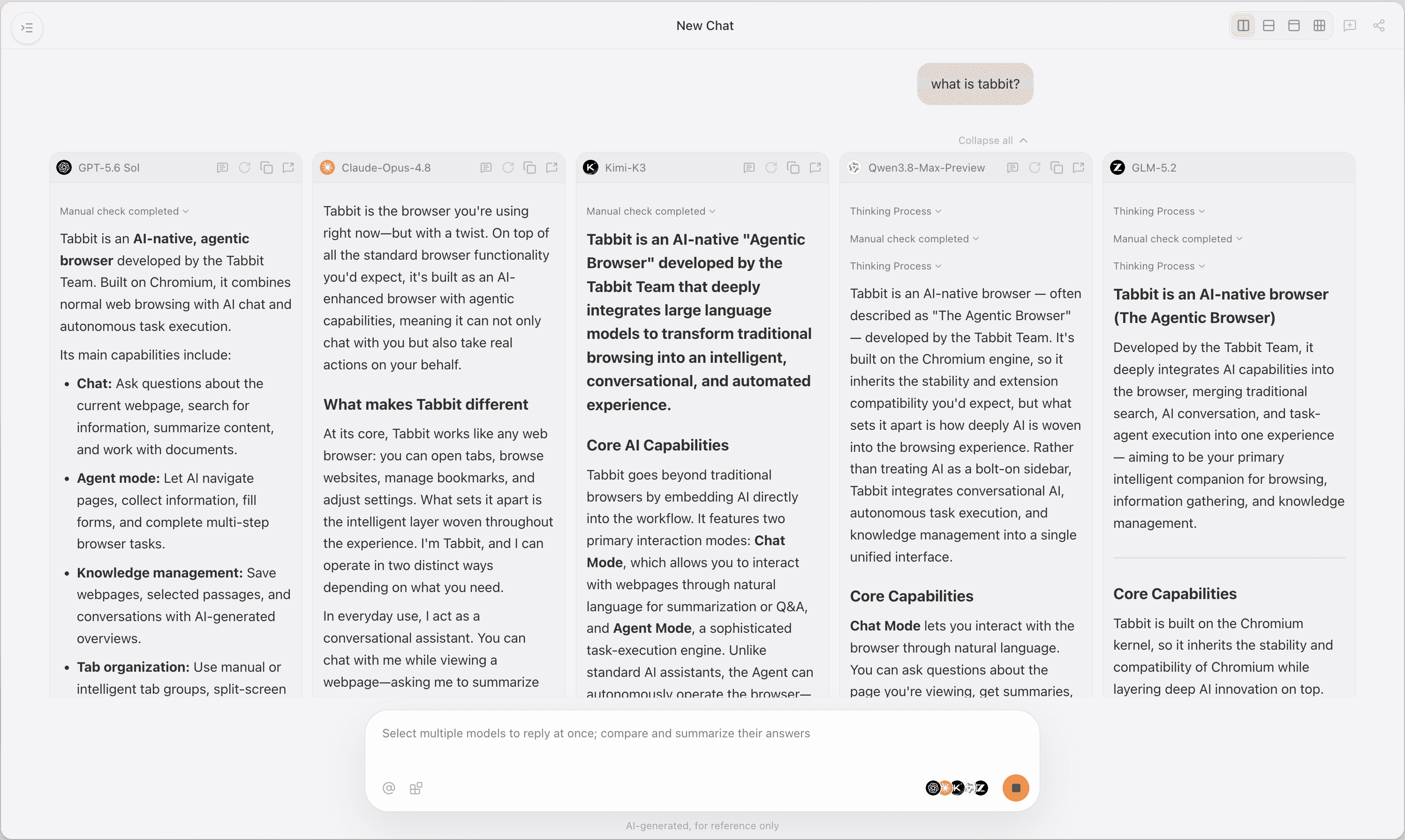
 Tabbit Browser
Verdict
Choose GPT-5.6 Sol when sustained reasoning, multi-file follow-through, image-aware input or tools justify measured cost. Do not choose it solely because “1.05M” sounds larger: effective limits, context quality, pricing boundaries and harness still matter. Codex users should read the focused 1M guide; browser users should verify Tabbit's picker and limits in their account. Until that check is complete, this sourced overview stays deliberately in draft.
Sources
OpenAI GPT-5.6 Sol model page — current specification/tools/pricing, checked 2026-09-20.
OpenAI GPT-5.6 release page — release framing; locale scripts were unstable in the browser.
METR evaluation — independent harness, cheating treatment and uncertainty.
CodeRabbit benchmark — vendor-authored coding observations, 2026-07-09.
Visual Studio Magazine — routing/token context, 2026-08-06.
Tibo on X — Codex 1M configuration and visible replies.
r/codex discussion — personal reports and disagreement about quota behavior.
Superbash on YouTube — creator description of rollback/quota concerns; comments did not load.
Tabbit homepage — current product model list; no end-to-end Sol measurement.

FAQ
What is GPT-5.6 Sol?
GPT-5.6 Sol is OpenAI's flagship GPT-5.6 model for complex professional work. The current API page lists text and image input, text output, reasoning controls, a 1,050,000-token context window, and 128,000 max output tokens.
What is GPT-5.6 Sol's current API price?
The model page currently lists $4 per million input tokens, $0.40 per million cached input tokens, and $20 per million output tokens, with promotional pricing shown through at least November 21, 2026. Recheck the live card before budgeting.
Is the full 1.05M context available in every client?
No. The 1,050,000 figure is the API model specification. Codex and other clients can choose smaller effective windows or compaction policies, so verify the active client rather than assuming the API maximum is exposed.
What changed from GPT-5.5?
The GPT-5.6 family separates Sol, Terra, and Luna lanes, while Sol is positioned as the flagship. OpenAI's current comparison shows Sol at $4 per million input tokens versus $5 for GPT-5.5, but price and routing are time-sensitive and do not prove lower cost per completed task.
Does Tabbit guarantee GPT-5.6 Sol's 1.05M context?
Tabbit's homepage lists GPT-5.6 among its supported models, but this article did not run an authenticated Tabbit task or measure its effective context. Verify the model label and account limits in the picker; do not infer a 1.05M guarantee.
Who should choose GPT-5.6 Sol?
Choose Sol when complex coding, research, tool use, or long-running work justifies higher reasoning. Use a smaller or faster lane for routine summaries and high-volume tasks, and compare cost per successful task rather than token price alone.