
On September 22, 2026, two frontier models landed on the same day. OpenAI shipped GPT-6 Sol (gpt-6-sol), a coding-and-agentic specialist in the GPT-6 family released alongside GPT-6 Luna. Anthropic shipped Claude Opus 5.5 (claude-opus-5-5), the successor to Opus 5 positioned as its strongest all-round model at a lower price. If you are choosing between them this week, you are not comparing a winner and a loser. You are comparing two different theories of how a model should be priced and tuned.
As an engineer who wires foundation models into autonomous agents and multi-page research systems daily, I do not evaluate launch-day models from press releases. What follows is based on official model cards and announcements plus independent measurements published in the first 24 hours — with every benchmark explicitly labeled by effort level, because that is where most launch-day comparisons quietly cheat.
If you only need the GPT-6 Sol rate card, read our dedicated GPT-6 Sol pricing guide. For OpenAI's sibling release, see our GPT-6 Astra review and the GPT-6 Astra overview. On the Anthropic side, our Claude Fable 5.1 review covers the mid-tier line that Opus 5.5 now sits above. You can also inspect raw specifications on the GPT-6 Sol model page and the Claude Opus 5.5 model page. This article is the direct engineering matchup.
Key takeaways
One vendor's default beats the other's ceiling: Claude Opus 5.5 at its default medium effort posts 51.2 Intelligence Index points at $1.34 per task, above GPT-6 Sol's highest max-effort setting (47.5 points, $1.06 per task). Above roughly 44 demanded intelligence points, Opus 5.5 wins at comparable spend.
Sol's headline 2× price discount has a hard expiration: uncached rates are exactly half of Opus 5.5 ($2.00/$10.00 vs $4.00/$20.00 per million tokens), but once a request's input exceeds 272K tokens, the entire Sol request flips to long-context rates of $4.00/$15.00 — parity, not discount.
Routine automation is Sol's home turf: on AutomationBench-AA, Sol at xhigh (61.7%) matches Opus 5.5 at medium (61.2%) at roughly 40% lower cost, and its
noneeffort level disables extended thinking entirely.Terminal and frontier-coding work belongs to Opus 5.5: it leads Terminal-Bench 4.0 by 8.6 points even at medium effort (52.5% vs 43.9% for Sol at max), and Anthropic reports 66.4% at xhigh.
Verbosity is a billing variable: at max effort Opus 5.5 generates roughly 119K output tokens per task versus Sol's ~31K. At $20 per million output tokens, that 3.8× gap compounds into a real invoice difference on open-ended tasks.
The one number that decides this matchup: default beats ceiling
The central tension of this comparison is a pairing that launch-day coverage mostly missed. Independent measurements current as of September 23, 2026 put Claude Opus 5.5 at its default medium effort at 51.2 Intelligence Index points, costing $1.34 per task. GPT-6 Sol at its highest setting — max effort — reaches 47.5 points at $1.06 per task.
Score per dollar (independent measurements, 2026-09-23):
Claude Opus 5.5  medium (DEFAULT):  51.2 pts   $1.34/task
GPT-6 Sol        max   (CEILING):  47.5 pts   $1.06/task

Crossover: below ~44 demanded points Sol is cheaper;
above ~44 points Opus 5.5 wins outright at comparable spend.
One vendor's out-of-the-box configuration beats the other's maximum setting on both score and score-per-dollar above the crossover. That is the "default beats ceiling" paradox, and it held up in early community testing within hours of launch.
The second number decides where Sol's price advantage actually survives. OpenAI's rate card is clean: $2.00 input and $10.00 output per million tokens on standard short-context requests — exactly half of Opus 5.5's $4.00/$20.00. But the model card carries a threshold most headlines skipped: once a request's input exceeds 272K tokens, the entire request is billed at long-context rates — $4.00 input, $0.40 cached read, $5.00 cached write, $15.00 output. At that point, Sol inside its own advertised 1,050,000-token context window costs the same as or more than Opus 5.5, whose 1M context has no equivalent cliff.
Effective input cost per 1M tokens:
Below 272K input:   Sol $2.00   vs  Opus 5.5 $4.00   --> Sol 2x cheaper
Above 272K input:   Sol $4.00   vs  Opus 5.5 $4.00   --> parity (output: $15 vs $20)
If your workloads are agent loops with compact contexts — the regime where agentic reasoning systems live — Sol's discount is real money. If your workloads stuff entire codebases or long document corpora into the prompt, the discount evaporates exactly when you need the context window most.
Specifications and pricing at a glance
Both models advertise million-token context and tiered effort levels, but the mechanics differ in ways that matter for cost engineering. Rates below are USD per 1M tokens, verified against both official model cards on September 23, 2026.
| Dimension | GPT-6 Sol | Claude Opus 5.5 |
|---|---|---|
| API identifier | gpt-6-sol | claude-opus-5-5 |
| Context window | 1,050,000 tokens | 1,000,000 tokens |
| Max output | Not separately capped below context | 128,000 tokens (300K in Batch beta) |
| Effort levels | none / low / medium (default) / high / xhigh / max | low / medium (default) / high / xhigh / max |
| Extended thinking toggle | Can be disabled (none) | Cannot be disabled |
| Input (uncached) | $2.00 ($4.00 above 272K input) | $4.00 |
| Cached input read | $0.20 ($0.40 above 272K input) | $0.20 (~60% discount vs Opus 5) |
| Cached input write | $2.50 ($5.00 above 272K input) | $5.00 |
| Output | $10.00 ($15.00 above 272K input) | $20.00 |
| Batch pricing | 50% of standard (Flex) | $2.00 input / $10.00 output |
| Fast tier | 2× standard | $8.00 / $40.00 (~2.5× speed) |
| Knowledge cutoff | GPT-6 family generation | 2026-06 |
| Vendor cost claim | — | ~40% cheaper than Opus 5 on typical workloads (vendor-reported) |
Three engineering details stand out. First, Sol's none effort level is unique: it disables extended thinking completely, giving you a deterministic, low-latency mode that Opus 5.5 cannot replicate — its thinking is always on. Second, both models price cached reads at $0.20 per million, so in high-cache-hit production pipelines the input side of the invoice is a wash and output verbosity becomes the deciding variable. Third, Anthropic's "~40% cheaper than Opus 5" claim is a vendor framing; the community recomputation covered later in this article found it closer to flat for one real workload.
A worked example makes the tier mechanics concrete. Consider an automation pipeline running 50,000 tasks per month, each with 40K input tokens at a 90% cache hit rate and 2K output tokens, matched at medium-class effort, entirely below the 272K threshold:
GPT-6 Sol (per task: 4K uncached input × $2.00 + 36K cached read × $0.20 + 2K output × $10.00): $0.008 + $0.0072 + $0.020 = $0.0352 → $1,760 / month
Claude Opus 5.5 (per task: 4K uncached input × $4.00 + 36K cached read × $0.20 + 2K output × $20.00): $0.016 + $0.0072 + $0.040 = $0.0632 → $3,160 / month
Sol runs the same pipeline for roughly 44% less — about 56% of the Opus 5.5 bill. Now re-run with 300K input tokens per task: Sol's entire request flips to long-context rates ($4.00 uncached / $0.40 cached read / $15.00 output), returning $12,900 versus $10,700 for Opus 5.5 — the nominally cheaper model now costs 20% more. The threshold is not a footnote; it is the deciding variable for long-context architectures.
Benchmarks, and how much to trust them
Launch-day benchmark tables are marketing documents until independent labs reproduce them. The table below mixes vendor-reported figures (labeled) with independent measurements, and the calibration notes that follow matter more than any single number.
| Benchmark | Claude Opus 5.5 | GPT-6 Sol | Reading |
|---|---|---|---|
| Intelligence Index (score / $ per task) | 51.2 / $1.34 (medium) | 47.5 / $1.06 (max) | Opus default above Sol's ceiling; Sol cheaper below ~44 pts |
| Terminal-Bench 4.0 | 52.5% (medium); 66.4% (xhigh, vendor, ±2.6 SE) | 43.9% (max); 44% (independent) | Opus leads terminal/agentic CLI work by ~9 points at equal-ish cost |
| AutomationBench-AA | 61.2% (medium) | 61.7% (xhigh) | Statistical tie; Sol delivers it at ~40% lower cost |
| GDPval-AA v2.1 | 1846 Elo (vendor) | ~100 Elo regression vs frontier (independent) | Opus stronger on knowledge-work evals |
| Humanity's Last Exam (with tools) | 67.7% (max, vendor) | not independently verified this cycle | Directional only |
Before treating any of these as decisive, four calibration caveats apply:
The effort-level mismatch is the most common cheat. Most Sol numbers circulating at launch came from max or xhigh effort, while Opus numbers came from its medium default. Any claim that does not name both levels is comparing a tuned setting against an untuned one. This article always names the level.
Vendor-reported conditions carry vendor-reported optimism. Opus 5.5's 66.4% Terminal-Bench and 67.7% HLE figures are Anthropic-reported under named conditions; the Terminal-Bench number carries a ±2.6 standard error. Sol's $1.06 per task and hallucination figures are independently measured by Artificial Analysis. Weight the independent numbers higher.
Sol's hallucination improvement is partly abstention. Independent measurement shows Sol's hallucination rate dropping from 92% to 60% — but achieved largely by refusing more often. In an agent pipeline, an abstention is not a free pass; it surfaces as a stuck task or a human escalation, which benchmark percentages hide.
Verbosity amplifies Opus's output-rate premium. At max effort Opus 5.5 produces ~119K output tokens per task against Sol's ~31K. Combined with a $20/M versus $10/M output rate, open-ended tasks on Opus at high effort can cost several times more than the list-price ratio suggests. At lower efforts the gap narrows substantially.
Where Claude Opus 5.5 genuinely wins
Opus 5.5 is not the cheaper model, and it does not try to be. It wins where the task quality ceiling, not the invoice, is the binding constraint.
1. Terminal and frontier-coding agent work
The clearest structural advantage is Terminal-Bench 4.0, which measures autonomous command-line software engineering. Opus 5.5 at medium scores 52.5%; Sol at max manages 43.9%. That is a 17% relative gap in the exact workload class — multi-step shell environments, build-fix loops, test-driven repair — that both vendors are explicitly targeting with these releases. Anthropic's xhigh figure of 66.4% widens the gap further, though it carries the vendor-report caveat above.
2. Knowledge work and general-intelligence evals
On GDPval-AA v2.1, a professional knowledge-work evaluation, Anthropic reports 1846 Elo. Independent measurement found Sol regressing roughly 100 Elo versus comparable frontier models on the same family of evals. This is consistent with Sol's positioning: it is a coding and automation specialist that trades general knowledge breadth for cost efficiency. For research synthesis, document analysis, and open-domain reasoning, Opus 5.5's ceiling is higher. Our coverage of Anthropic's mid-tier Claude Fable 5.1 gives useful context on how far that family has pushed general capability below the Opus price point.
3. The default-effort experience
Opus 5.5's most underrated feature is that its default is its strong setting. Medium effort outperforms Sol's max on score per dollar above the crossover, which means teams without the appetite to tune effort budgets get frontier behavior out of the box. Sol's best value requires deliberate configuration — choosing none for deterministic tasks, xhigh for automation, and accepting that max still trails Opus's default on general capability.
Where GPT-6 Sol genuinely wins
Sol's case is not "almost as good for less money." It is a different cost architecture with three concrete advantages.
1. Exactly half the list price, with a thinking-off switch
At $2.00 input and $10.00 output per million tokens, Sol undercuts Opus 5.5 by 50% on uncached short-context work — and it offers something no frontier competitor does: an effort level of none that disables extended thinking entirely. For high-volume structured extraction, classification, and template-driven generation, paying for a model that cannot stop thinking is waste. Sol lets you turn the reasoning meter off. For a broader look at how these rate cards compare across vendors, our Kimi K3 pricing analysis uses the same total-cost method.
2. Automation cost efficiency at the capability tie
On AutomationBench-AA, Sol at xhigh scores 61.7% against Opus 5.5 at medium's 61.2% — a statistical tie delivered at roughly 40% lower cost per task. If your pipeline is browser automation, DOM extraction, form navigation, and tool orchestration, Sol is the rational default: the capability is identical and the invoice is not.
3. Output discipline
Sol generates roughly 31K output tokens per task at max effort, versus ~119K for Opus 5.5. For agents that must produce bounded artifacts — JSON payloads, patch diffs, structured summaries — Sol's conciseness is a feature, not a limitation: fewer tokens to parse, fewer tokens billed, and less surface area for post-hoc correction loops.
What developers and the community actually say
Within 24 hours of the dual launch, developer forums produced more signal than most launch-day coverage. Six representative voices, collected September 23, 2026:






The pattern across these six voices is consistent with the measured data: the community did not crown a single winner. It split along workload lines — automation and cost efficiency toward Sol, frontier coding and general capability toward Opus 5.5 — and it immediately focused on effort-level alignment and total-cost accounting rather than raw leaderboard position.
The verdict: Workload decision matrix
| Workload profile | Recommended model | Deciding rationale | Cost note |
|---|---|---|---|
| Terminal agents & CLI-driven coding | Claude Opus 5.5 | Terminal-Bench 4.0 lead of ~9 points at medium effort (52.5% vs 43.9% for Sol max) | 2× list price, justified by capability gap |
| High-volume browser automation & extraction | GPT-6 Sol | AutomationBench-AA tie (61.7% xhigh vs 61.2% medium) with none effort for deterministic tasks | ~40% cheaper per task |
| Compact-context agent loops (< 272K input) | GPT-6 Sol | Full 2× uncached discount survives; cache reads priced identically ($0.20/M) | Half of Opus 5.5 list price |
| Long-context jobs (> 272K input) | Claude Opus 5.5 | Sol's long-context flip ($4/$15) erases its discount; Opus has no equivalent cliff | Parity or better vs flipped Sol rates |
| Open-ended research & knowledge work | Claude Opus 5.5 | Higher ceiling on GDPval-AA and HLE; default medium beats Sol max above ~44 points | Higher verbosity tax at max effort |
| Budget-constrained general assistant | GPT-6 Sol | $1.06 per task Intelligence Index at max; cheaper below the ~44-point crossover | Lowest cost per unit of intelligence |
From raw model tokens to browser execution: the Tabbit workflow
A benchmark score does not scrape a website, maintain an authenticated session, or reconcile conflicting documentation across forty open tabs. Raw foundation models reason about text; they do not manage tab sprawl, dynamic shadow DOMs, or multi-step web workflows on their own.
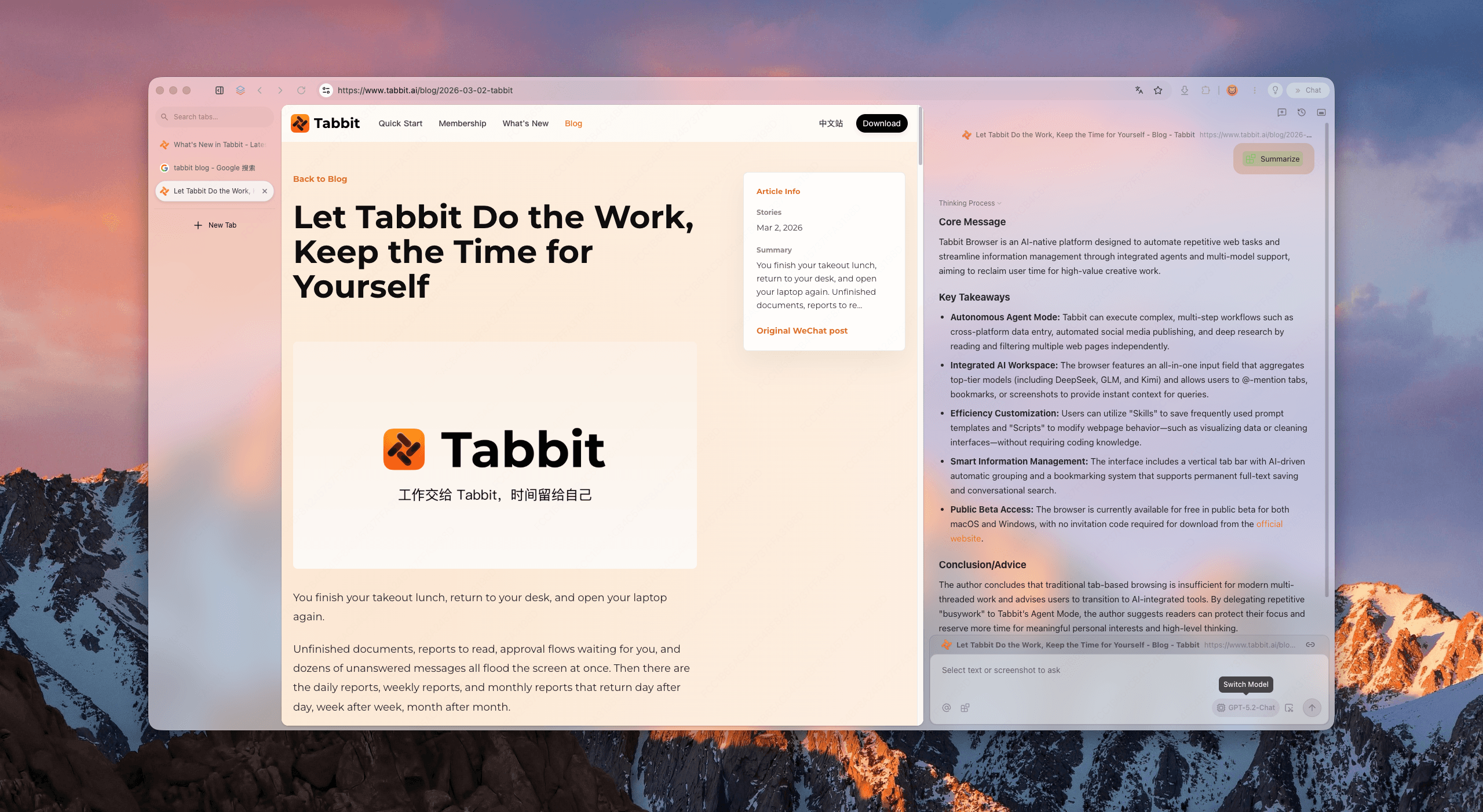
This is where orchestration environments matter. When running browser agents in Tabbit Browser, the model supplies the reasoning while the browser layer supplies memory, navigation, and execution. Whether you route compact automation loops through GPT-6 Sol or terminal-grade coding agents through Claude Opus 5.5, an AI-native agentic browser is what turns token pricing into finished work. See our roundup of the best AI browsers in 2026 for the broader landscape.
Note: in accordance with our platform policies, live model availability in Tabbit depends on your account's active model picker, supported integrations, and platform terms. This comparison is based on official materials and independent measurements, not on in-house benchmark runs.
 Tabbit Browser
FAQ
Which is cheaper, GPT-6 Sol or Claude Opus 5.5?
On uncached short-context rates GPT-6 Sol is exactly half the price: $2.00 input and $10.00 output per million tokens, versus $4.00 and $20.00 for Claude Opus 5.5. However, once a request's input exceeds 272K tokens, the entire Sol request is billed at long-context rates ($4.00 input / $15.00 output), erasing the discount. Cached input reads are $0.20 per million on both models.
Which model scores higher on benchmarks?
It depends on the effort level being compared. Claude Opus 5.5 at its default medium effort posts 51.2 Intelligence Index points at $1.34 per task, above GPT-6 Sol's max-effort 47.5 points at $1.06 per task. Opus 5.5 also leads Terminal-Bench 4.0 (52.5% at medium, 66.4% at xhigh per Anthropic) versus 43.9% for Sol at max, while Sol matches Opus medium on AutomationBench-AA at roughly 40% lower cost.
What are the effort levels of GPT-6 Sol and Claude Opus 5.5?
GPT-6 Sol offers none, low, medium (default), high, xhigh, and max — the none level disables extended thinking entirely. Claude Opus 5.5 offers low, medium (default), high, xhigh, and max, and its extended thinking cannot be disabled. Effort level changes both capability and cost per task, so any comparison must name the levels being used.
Why do comparisons pit Opus 5.5 medium against GPT-6 Sol max?
Because those are the settings where the two models land closest in total cost per task. Aligned-cost measurements show Opus 5.5 at medium outperforming Sol at max above roughly 44 points of demanded intelligence, while Sol becomes the cheaper option below that threshold. Comparisons that do not name both effort levels are usually marketing rather than measurement.
Is Claude Opus 5.5 really 40% cheaper than Claude Opus 5?
That is Anthropic's vendor-reported figure for typical workloads. One community recomputation from real usage logs with an 88% cache hit rate arrived at roughly $79 per unit of work on Opus 5.5 versus $80 on Opus 5.0 — essentially flat rather than 40% cheaper. Treat vendor cost claims as directional and recompute them against your own token mix.
Can I use GPT-6 Sol and Claude Opus 5.5 in Tabbit Browser?
Tabbit Browser provides an AI-native workspace for research, data extraction, and multi-model comparison. Availability of specific models in Tabbit depends on your account's live model selector and platform terms.