
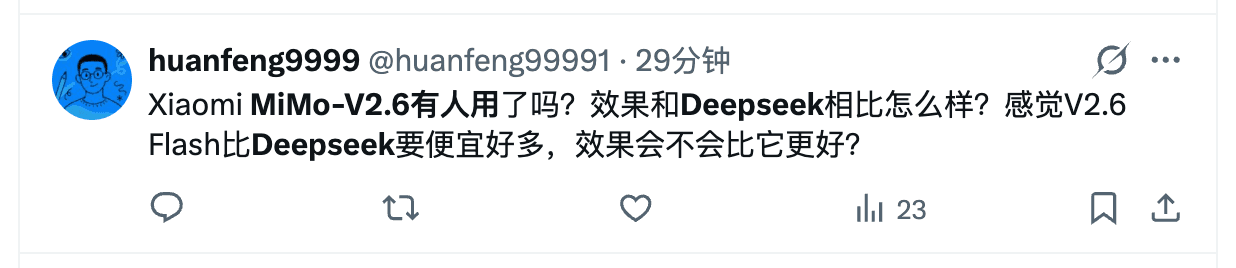
MiMo-V2.6-Pro is a good model to keep in the shortlist. Xiaomi released it on September 22, 2026, opened the weights, and the flagship scores 46 on the Artificial Analysis Intelligence Index — the highest of any open-weights model at that time — while listing at $0.435 per million input tokens and $0.87 per million output tokens. An independent OpenCode test by Kingy AI the day before scored it 23 of 23 on hidden coding checks at roughly $0.03 per run, matching Claude Opus 5's accuracy at about one thirty-fifth of the cost. A day-one question on X asked the whole comparison in one sentence: "Has anyone used Xiaomi MiMo-V2.6? How does it compare to DeepSeek? V2.6 Flash looks much cheaper than DeepSeek — could it actually be better?"
The reason to look past it comes from Xiaomi itself. The launch announcement reads: "However, there is still a gap when compared with the strongest closed-source models Claude Fable 5.1 and GPT-6 Astra." A vendor telling you its brand-new flagship still trails the closed frontier is rare enough to take at face value — on the same index, Fable 5.1 and GPT-6 Astra sit at 53, seven points above MiMo-V2.6-Pro, and Claude Opus 5 at max effort reaches 51 at $5.86 per index task versus roughly $0.13 for MiMo.
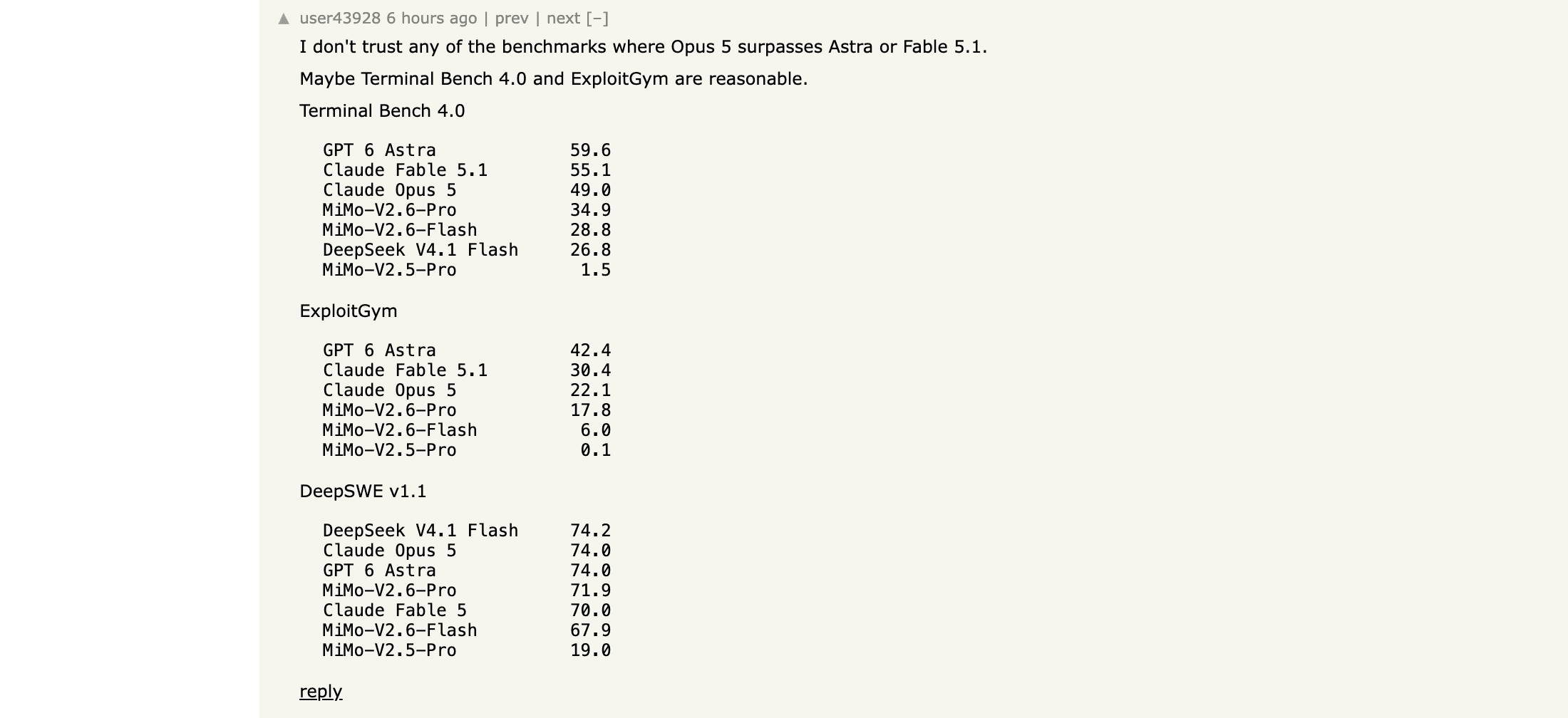
Those seven points hide two measurable costs. On Terminal Bench 4.0 — an agentic, terminal-driving benchmark — Xiaomi's own table puts MiMo-V2.6-Pro at 34.9 against 49.0 for Claude Opus 5 and 59.6 for GPT-6 Astra. And the reasoning that powers the score shows up on your invoice: a Hacker News tester could only complete runs at the lowest effort settings because "the other ones (medium/high) used way too many tokens and all requests timed out." This is not a claim that MiMo-V2.6-Pro is weak. It is a claim that "cheapest open-weights flagship" masks two real costs — an agentic gap and a token bill that grows with thinking — and both have concrete alternatives.
If your frustration is not the model itself but the plumbing around it — juggling API keys, price sheets, and side-by-side tests — the last section covers a third route: running the comparison inside Tabbit Browser. First, the candidates.
Key takeaways
MiMo-V2.6-Flash is the first alternative to test: the same 1M context, the same omnimodal input set, and the same API surface at $0.14/$0.28 per million tokens, with Xiaomi's own claim that it "comprehensively outperformed MiMo-V2.5-Pro."
DeepSeek V4.1 Flash is the scheduling play: off-peak rates of $0.15 input and $0.60 output are hard to beat for batch work, and DeepSeek tops the shared DeepSWE v1.1 table at 74.2.
Kimi K3 is the premium open-weights rival: a 2.8T-parameter reasoning model that costs roughly 17× more per evaluation task, which buys a different benchmark profile, not a clearly better one.
Qwen3.8 Max (0902) is the closed-weights peer at $2/$6 per million tokens — the route for teams that want Alibaba's flagship without open-weight operations.
GLM-5.3 is the always-on reasoner for code quality first: community feedback favors its "clean solutions" over faster rivals, at a promo price of $0.78/$2.46 on OpenRouter.
Treat every benchmark here as vendor-reported or third-party-indexed, and treat every community comment as one person's experience. Launch-day scores move.
How I picked these alternatives
Four criteria, applied in order:
Completed-task cost, not sticker price. A half-price model that thinks three times as long is not cheap. Each candidate is priced per million tokens on its own official or listed route, with cache, peak windows, and batch discounts noted where they change the math.
Agentic reliability on real work. The Artificial Analysis Intelligence Index separates open-weights ranks nicely, but Terminal Bench 4.0, ExploitGym, and DeepSWE v1.1 show where the index hides gaps. Candidates had to bring evidence from at least one of these.
Open weights and deployment fit. Self-hosting changes data residency, cost structure, and vendor lock-in. Each candidate is flagged as open or closed, because that single line decides half of the migration work.
Named community evidence. Preferences and failure modes come from specific, linkable posts on HN, Reddit, and X — not from launch press releases.
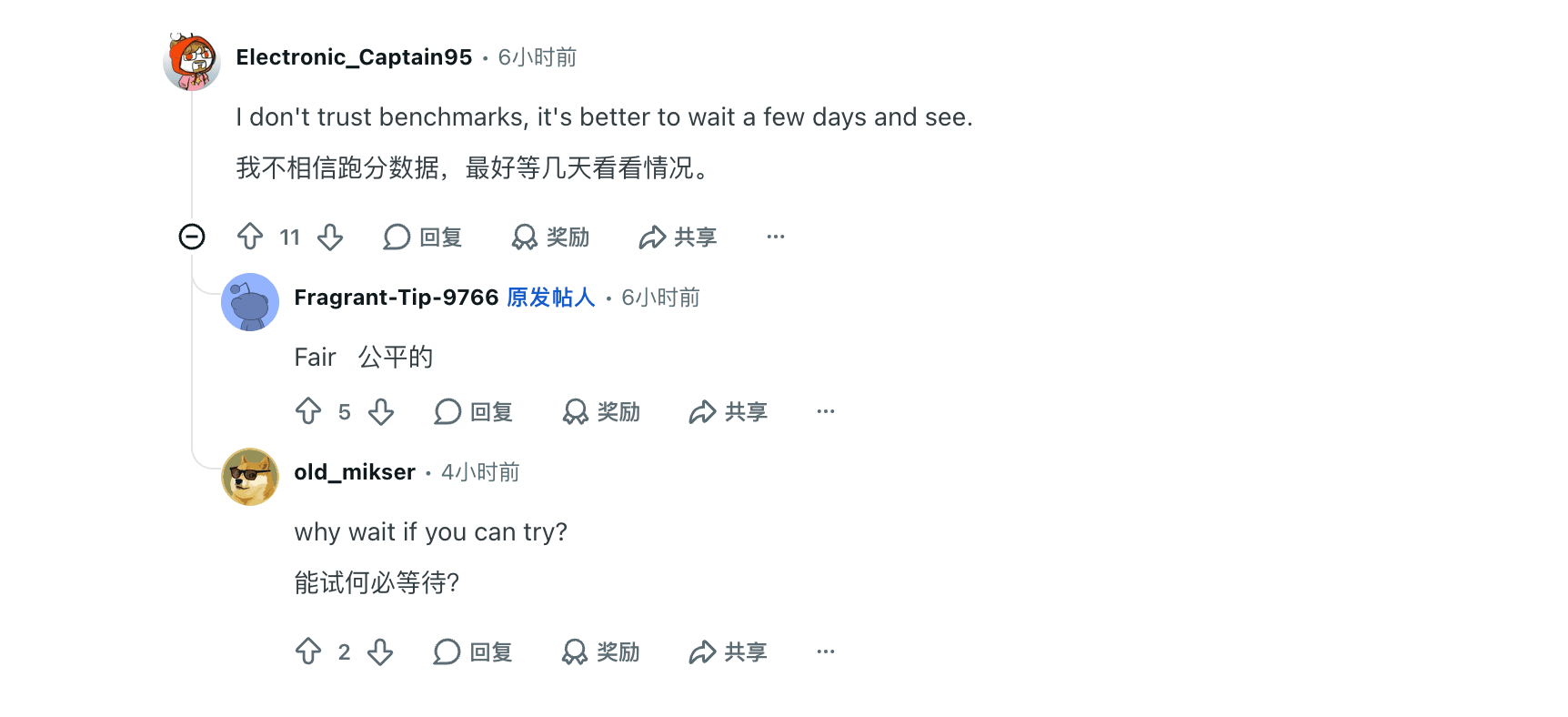
The screenshots below are original posts captured on September 22, 2026. One Reddit commenter put the calibration plainly, on a thread about adopting MiMo for code: "I don't trust benchmarks, it's better to wait a few days and see."
Five candidates at a glance
| Candidate | Best for | Published route | Price per 1M (checked 2026-09-22) | The main catch |
|---|---|---|---|---|
| MiMo-V2.6-Flash | Same-family cost cut with the least migration | mimo-v2.6-flash; 1M context / 131K output; open weights | $0.14 input / $0.0028 cache hit / $0.28 output | Less reasoning headroom than Pro on hard agent tasks |
| DeepSeek V4.1 Flash | Scheduled batch and off-peak budgets | deepseek-flash; 1M / 384K; API only | Off-peak $0.15 / $0.60; peak $0.30 / $1.20; cache hit $0.003–$0.006 | Peak windows (01:00–04:00, 06:00–10:00 UTC weekdays) double input and output rates |
| Kimi K3 | Premium open-weights reasoning and long-horizon agents | kimi-k3; 1.0M context; open weights | OpenRouter lists $1.50 / $7.50 (50% off; list $3 / $15) | Roughly 17× MiMo's evaluation cost for 2 points less on the AA index |
| Qwen3.8 Max (0902) | Closed-weights Alibaba flagship with multimodal input | qwen3.8-max-0902; 1.0M context | $2 / $6 | Closed weights — no self-hosting, no weight-level fallback |
| GLM-5.3 | Always-on reasoning for code quality | glm-5.3; listed 1.3M context | OpenRouter lists $0.78 / $2.46 (44% off) | Reasoning cannot be disabled; local serving is expensive |
Sources: Xiaomi MiMo pricing (update time September 21, 2026), DeepSeek pricing, and OpenRouter listings for Kimi K3, GLM-5.3, and Qwen3.8 Max. Output prices include reasoning tokens. OpenRouter prices carry provider promo badges on the day of checking; Moonshot's and Alibaba's own price pages were unreachable from this session, so their OpenRouter listings stand in with that boundary noted.
The full rate-card math for the MiMo family — cache levers, UltraSpeed, Batch API — lives in our MiMo-V2.6-Pro pricing guide. This page stays on the stay-or-switch decision.
MiMo-V2.6-Flash
Best for: cutting the token bill by two thirds without leaving Xiaomi's API, context window, or input types.
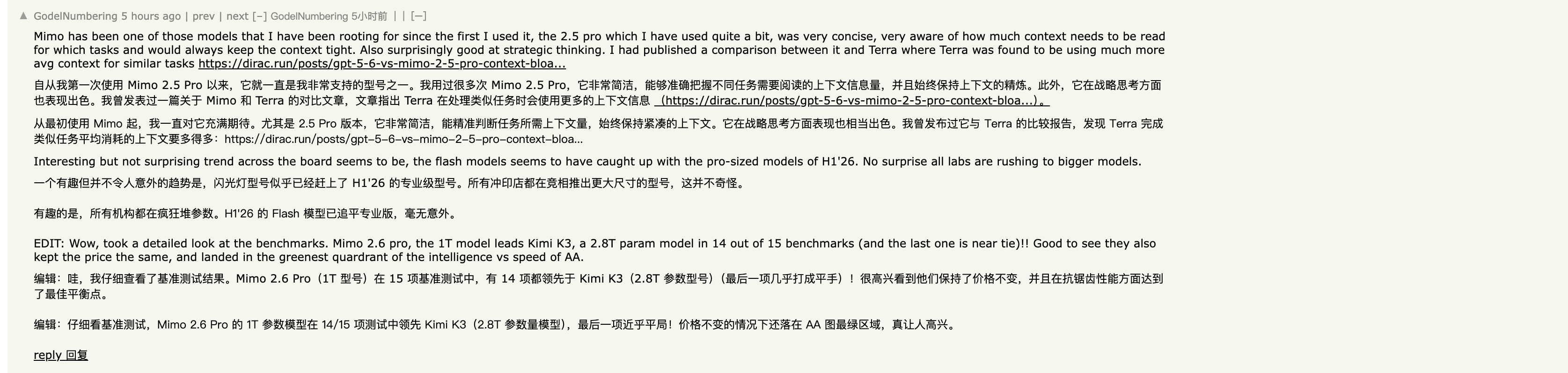
Pros: Flash shares Pro's 1,048,576-token context, 131,072-token output ceiling, and native multimodal input, at $0.14 input and $0.28 output per million tokens — and $0.07/$0.14 through the Batch API. It is the only alternative on this list whose upgrade claim comes from the vendor's launch post itself: "MiMo-V2.6-Flash has comprehensively outperformed MiMo-V2.5-Pro." On Xiaomi's shared agent table it scores 28.8 on Terminal Bench 4.0 — above DeepSeek V4.1 Flash's 26.8 — and Kingy's independent OpenCode run scored it 21 of 23 on a free route, two checks behind its bigger sibling. One Hacker News commenter who has tracked the family since V2.5 summarized the pitch: "the 2.5 pro… was very concise, very aware of how much context needs to be read for which tasks and would always keep the context tight," adding in an edit that "Mimo 2.6 pro, the 1T model leads Kimi K3, a 2.8T param model in 14 out of 15 benchmarks (and the last one is near tie)!!"
Cons: it is the smaller model. At 309B total / 15B activated parameters versus Pro's 1.02T / 42B, deep multi-step reasoning has less headroom — the same OpenCode test docked it two checks, and on ExploitGym it scores 6.0 to Pro's 17.8. If your workload lives in Pro's reasoning depth, Flash is a false economy.
Pricing: $0.14 input / $0.0028 cache hit / $0.28 output per 1M tokens; half that again via Batch API; UltraSpeed's 10× multiplier applies to Pro only. See the family rate card for worked examples.
Verdict: if your complaint about MiMo-V2.6-Pro is the bill rather than the ceiling, test Flash first — it is the official's own cheaper answer. If your complaint is quality on hard agent tasks, Flash will not fix it; look to DeepSeek or Kimi K3 instead.
The MiMo-V2.6-Flash model page keeps its specifications beside the migration notes.
DeepSeek V4.1 Flash
Best for: high-volume workloads that can run off-peak, and teams that want a 1M-context, vision-capable API at floor-level prices.
Pros: DeepSeek's current pricing page lists deepseek-flash (DeepSeek-V4.1-Flash) with both non-thinking and thinking modes, 1M context, 384K maximum output, vision, JSON output, tool calls, and both OpenAI- and Anthropic-compatible endpoints. Off-peak, input costs $0.15 and output $0.60 per million tokens — and with a warm cache, repeated prefixes bill at $0.003. On the agent benchmarks Xiaomi published, DeepSeek V4.1 Flash posts 74.2 on DeepSWE v1.1, the highest number in the shared table, ahead of Claude Opus 5 and GPT-6 Astra at 74.0 and MiMo-V2.6-Pro at 71.9. Concurrency is documented at 2,500, the highest tier on the page.
Cons: the schedule. Peak hours — 01:00–04:00 and 06:00–10:00 UTC on weekdays, excluding Chinese public holidays — exactly double every rate, and cache misses at peak cost $0.30 per million. Real-world code quality divides community opinion: on a LocalLLaMA thread comparing small open models, one long-time commenter argued "DeepSeek-V4.1-Flash was technically a lot more capable than GLM-5.3-Flash but it's worse in the real-world - it is capable of getting to a solution but it's still hacky as heck, while GLM-5.3 implements clean solutions… The benchmarks don't care if it's a code spaghetti." DeepSeek also reserves the right to change prices, so quote the page, not this article, when budgeting.
Pricing: off-peak $0.003 cache hit / $0.15 cache miss / $0.60 output; peak $0.006 / $0.30 / $1.20 per 1M tokens. Off-peak rates are half of peak by design.
Verdict: choose DeepSeek when your workload is schedulable — batch enrichment, nightly summarization, cron-driven agents — and your acceptance tests pass on its outputs. Keep MiMo-V2.6-Pro when you need peak-hour interactive latency at predictable prices, or when its deeper reasoning wins your own task suite.
The DeepSeek V4.1 Flash model page and our DeepSeek V4 Flash pricing breakdown cover the schedule in detail.
Kimi K3
Best for: teams already invested in Moonshot's ecosystem that want the strongest open-weights alternative to Xiaomi's ranking story — and can pay for it.
Pros: Kimi K3 is a 2.8T-parameter open-weight multimodal reasoning model with a 1.0M context window and a KDA-plus-attention-residual architecture, listed on OpenRouter at $1.50 input / $7.50 output per million tokens under a 50% promotion (list $3 / $15). On Artificial Analysis it remains an elite open model: 43.6 on the Intelligence Index at max effort, 76.2 on the Coding Index, and 50.0 on the Agentic Index — the agentic number sits above MiMo-V2.6-Pro's equivalent showing in several shared suites. For long-horizon repository work it retains a genuine fan base.
Cons: the price-to-index math is brutal this month. An OrcaRouter analysis measured the cost of running the same evaluation suite at $3,658.07 for Kimi K3 versus $206.66 for MiMo-V2.6-Pro — a factor of seventeen — while K3 scores 44 against MiMo's 46. And the hype has critics: "the 'best' models available from chinese labs right now (GLM 5.3 and Kimi K3) fall apart completely when you try to do real work with them. K3 is especially embarrassing because it is larger than Mythos yet performs worse than opus 5 and 5.6 sol in benchmarks they haven't been able to fake yet," one Hacker News commenter argued on launch day. That is one strong opinion without published test details — we could not verify it — but it is a reminder that K3's premium buys a different profile, not a guaranteed win.

Pricing: $1.50 / $7.50 per 1M tokens on OpenRouter's promoted listing on September 22, 2026; the list price is $3 / $15. Moonshot's own price page was unreachable during this research, so verify there before committing budgets.
Verdict: choose Kimi K3 when an existing K-series pipeline, its specific agentic strengths, or its multimodal profile wins your task suite and the budget is approved. Choose MiMo-V2.6-Pro when the same index performance matters more than the lab name — the seventeen-times cost gap is the whole decision.
Our Kimi K3 pricing guide and the Kimi K3 model page cover the rate structure and specifications.
Qwen3.8 Max (0902)
Best for: teams that want Alibaba's closed flagship — multimodal input, reasoning by default, 1M context — as a managed API with no open-weight operations.
Pros: the 0902 snapshot of Qwen3.8 Max is a 2.4T-parameter mixture-of-experts model that accepts text, image, and video input, posts a 1.0M context window, and supports tool calling, structured outputs, and configurable reasoning effort. On Artificial Analysis's index it sits at 45 — one point above MiMo-V2.6-Pro's 46 needs no spin, one below it — with a 76 Coding Index that matches the frontier tier. At $2 / $6 per million tokens it undercuts every Western flagship by a wide multiple while requiring zero weight-hosting responsibility. Xiaomi's own launch post names it as one of the two open-weights models MiMo-V2.6-Pro surpassed, which makes the comparison explicit rather than inferred.
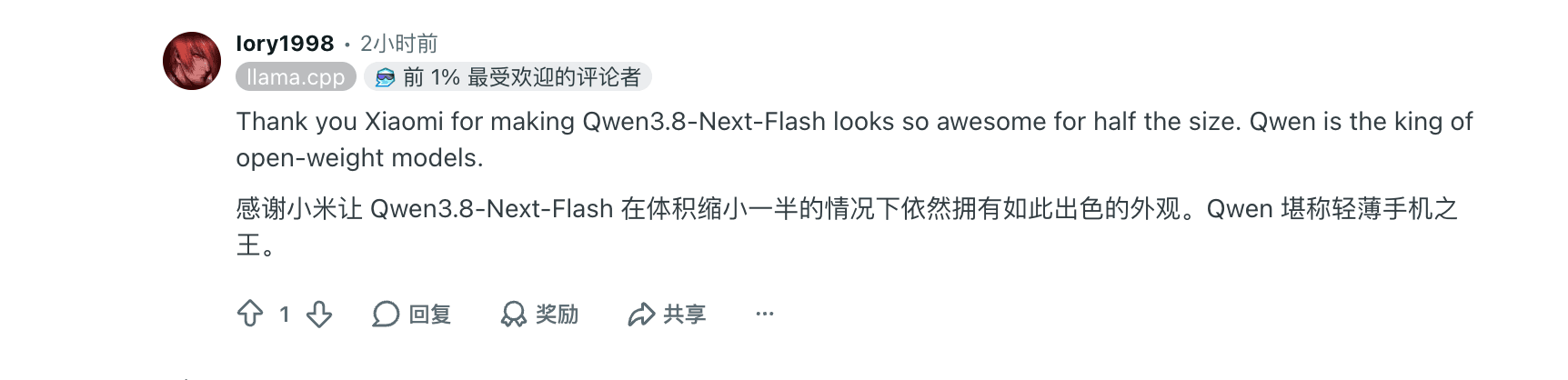
Cons: closed weights end the comparison for self-hosters — there is no checkpoint, no license file, and no fallback if Alibaba changes access terms. Qwen's own open-weights loyalists would rather you looked at the smaller models anyway: "Thank you Xiaomi for making Qwen3.8-Next-Flash looks so awesome for half the size. Qwen is the king of open-weight models," one r/LocalLLaMA regular wrote the day MiMo launched — a compliment to Qwen's open family that doubles as a reminder that Max is the family's closed exception.
Pricing: $2 input / $6 output per 1M tokens on OpenRouter's listing for the 0902 snapshot, checked September 22, 2026. Alibaba Cloud's own price page did not render during this research session; verify there before contracting.
Verdict: choose Qwen3.8 Max when you want a closed, managed, multimodal flagship and Alibaba's account terms fit your region and compliance needs. Stay with MiMo-V2.6-Pro when open weights, MIT licensing, or the lower rate card carry weight — or when your benchmark retests mirror Xiaomi's and favor the cheaper checkpoint.
The Qwen3.8 Max model page tracks the snapshot's specifications.
GLM-5.3
Best for: code generation where solution quality matters more than raw speed or price — with reasoning always on.
Pros: GLM-5.3 is Z.ai's large-scale reasoning model, built for complex software engineering and long-horizon agent tasks, with low, high, and max reasoning efforts (max is the default) and a listed 1.3M context window on OpenRouter. On Artificial Analysis it posts 44.8 on the Intelligence Index and — more tellingly — 53.1 on the Agentic Index, an elite agentic score. The qualitative feedback is the interesting part. The same LocalLLaMA commenter who called DeepSeek's output "hacky" praised GLM in the same breath: "GLM-5.3 implements clean solutions (develops an architecture and uses design patterns)." On OpenRouter's promoted listing it checked out at $0.7826 / $2.46 per million tokens — 44% off list — which lands it between MiMo-V2.6-Pro and Kimi K3 on price.
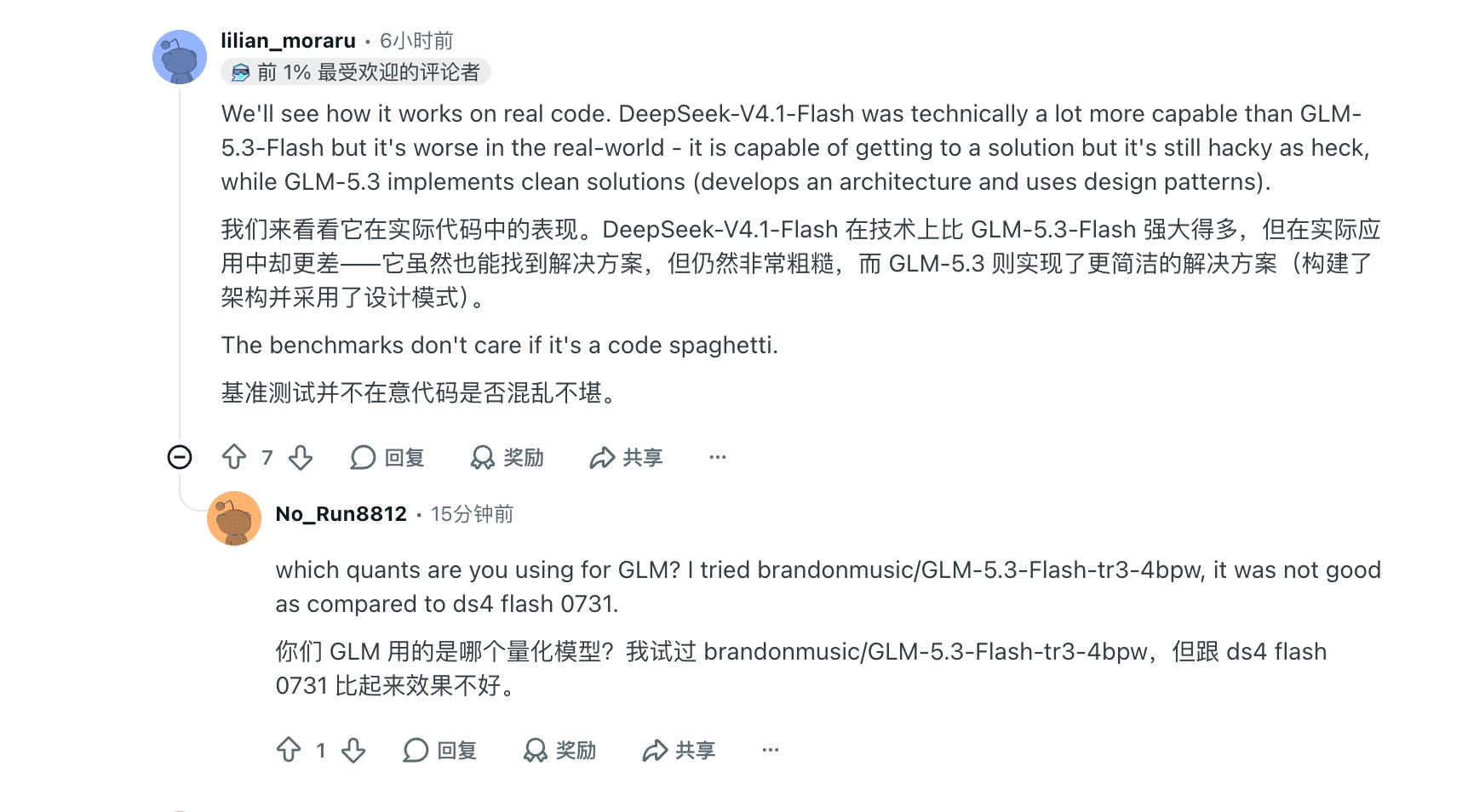
Cons: reasoning cannot be disabled, so there is no cheap non-thinking mode for extraction or classification workloads — every call pays the thinking tax. Local serving is its own project; as one commenter on the MiMo comparison thread put it, "GLM 5.3 flash should already not be on there. Extremely expensive to run local." And Z.ai's own documentation site was unreachable from this research session, so the listed prices carry an OpenRouter-only boundary.
Pricing: $0.7826 / $2.46 per 1M tokens on OpenRouter's 44%-off listing, checked September 22, 2026; list price is approximately $1.40 / $4.39.
Verdict: choose GLM-5.3 when code review quality, architecture sense, or the agentic index number wins your pilot and an always-on reasoning budget is acceptable. Choose MiMo-V2.6-Pro when you need a switchable, cache-friendly API at less than half the list price — or Flash when the bill dominates.
The GLM-5.3 model page keeps its specifications and route notes.
A third route: run the comparison inside Tabbit
Most switching projects fail on logistics, not model quality: spinning up API keys for five providers, normalizing outputs, and eyeballing results in five browser tabs. Tabbit Browser attacks that layer. Its multi-model view sends one prompt to several models at once and lays the answers side by side in columns you can read like a spreadsheet, and the model picker in the omnibox switches the active model per chat without re-authenticating anything.
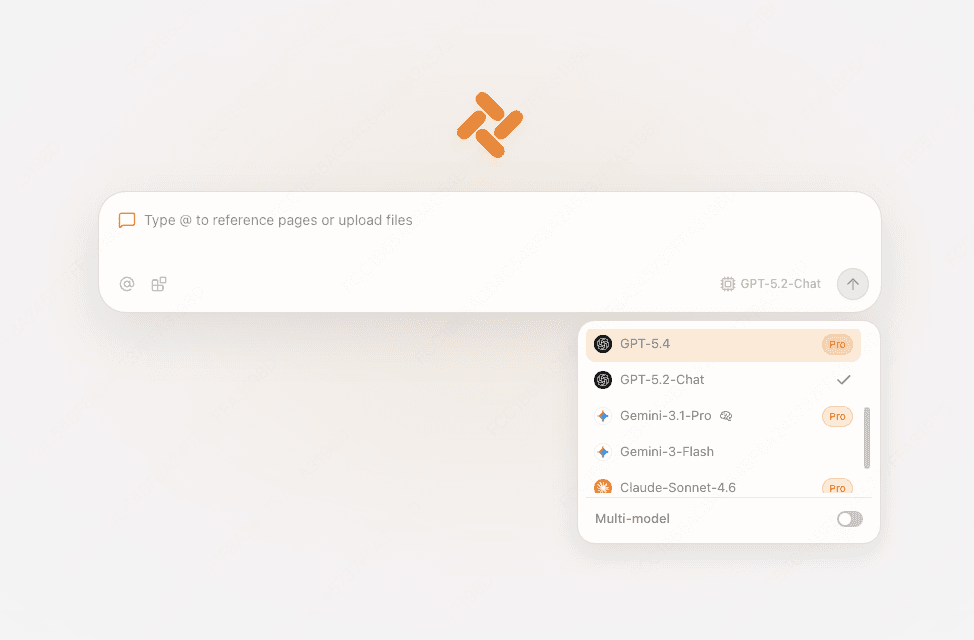
The practical pilot loop looks like this: reference the page or file you care about with @, select two or three candidate models, and compare their answers in one view — then repeat on the five real tasks you actually run. That is a decision-grade sample in an afternoon, with no billing spreadsheets. For what agentic browsing adds to this workflow, see what an agentic browser is and the 2026 AI browser comparison.
Two boundaries keep this honest. First, live model availability in Tabbit depends on your account's active model picker and platform terms — this article does not claim any specific model, including MiMo-V2.6-Pro, is built into every account, and Tabbit does not replace your external API billing relationship. Second, a browser-side comparison is a pilot, not a benchmark: it controls for prompt and page, not for token accounting or variance. Use it to pick a shortlist; use the pricing guide to pick a budget.
 Tabbit Browser
Run the same-task pilot
Whichever candidate survives the shortlist, test it the same way. Freeze two or three real tasks with their inputs, instructions, tools, output contract, and retry budget. Record tokens, first-token time, completion time, tool failures, and manual corrections — then compute completed-task cost, including the reasoning tokens that bill as output. One clean run proves nothing about rates or reliability; repeat until the variance stops surprising you. A changed context or tool route is a route difference, not proof that one model is universally better.
Verdict: keep or switch, by scenario
There is no overall winner on this page, and the launch-day leaderboards will not survive the month intact. The decision follows your constraint:
| Main constraint | First pilot | Success criterion | Main caveat |
|---|---|---|---|
| Cut the bill, keep the workflow | MiMo-V2.6-Flash | Same tasks pass within two thirds of the token budget | Less reasoning headroom on hard agent tasks |
| Cheapest scheduled batch | DeepSeek V4.1 Flash | Acceptance passes off-peak at under $0.20 per 1M blended | Peak windows double rates; schedule or pay |
| Open-weights benchmark parity at any price | Kimi K3 | Task suite wins justify 17× evaluation cost | Premium buys a profile, not a guaranteed win |
| Managed closed flagship, multimodal | Qwen3.8 Max (0902) | Compliance and account terms fit; tasks pass | No self-host fallback; snapshot can rotate |
| Code quality over speed | GLM-5.3 | Review scores beat rivals on your real repos | Reasoning always on; no cheap mode |
| Cache-friendly reasoning at $0.435/$0.87 | Keep MiMo-V2.6-Pro | Completed-task cost stays under rivals in your own runs | Watch effort settings; token bill grows with thinking |
If you keep MiMo-V2.6-Pro, set effort levels deliberately — the medium and high settings are where its token appetite lives — and keep prompts prefix-stable so the $0.0036 cache tier does its job.

If you switch, let the constraint pick the destination, not the leaderboard. And whichever way you go, the MiMo-V2.6-Pro pricing guide and the Gemini 3.8 Flash alternatives comparison are the companion reads for the broader rate-card and cross-family picture.
Sources
All facts, prices, and quotes in this guide were checked on September 22, 2026:
Xiaomi MiMo-V2.6 launch announcement and official API pricing
OpenRouter listings: Kimi K3, GLM-5.3, Qwen3.8 Max (0902)
Community posts as screenshotted and linked inline: X (@huanfeng9999), Reddit (r/DeepSeek, r/LocalLLaMA), Hacker News (items 49793293, 49794307, 49795049, 49795769)

FAQ
What is the closest alternative to MiMo-V2.6-Pro?
MiMo-V2.6-Flash is the closest same-family alternative because it shares the 1M context window, the omnimodal input set, and the same API surface at one third of the token price. Kimi K3 is the closest open-weights rival from another lab, but its list price is several times higher and its benchmark profile differs.
Which alternative has the lowest listed API price?
DeepSeek V4.1 Flash has the lowest off-peak rates at $0.003 cache hit, $0.15 cache miss, and $0.60 output per million tokens. MiMo-V2.6-Flash undercuts it on cache misses at $0.14, and both families get cheaper through Batch API or off-peak scheduling. The cheapest route depends on your cache hit rate and the hours you run.
Is MiMo-V2.6-Pro still the right pick if I keep it?
Often yes. Xiaomi lists it as the top open-weights model on the Artificial Analysis Intelligence Index at $0.435 input and $0.87 output per million tokens, and one independent OpenCode test scored it 23 of 23 at about three cents. Keep it when your tasks are reasoning-heavy, your prompts are cache-friendly, and you do not need the last few points of agent benchmark performance.
Can I self-host these alternatives?
MiMo-V2.6-Pro, MiMo-V2.6-Flash, and Kimi K3 publish open weights, and Z.ai's GLM models have an open-weights history, so local deployment is possible with serious hardware. Qwen3.8 Max is a closed-weights API model, and DeepSeek V4.1 Flash is consumed through DeepSeek's API. Verify each license and checkpoint before planning a self-hosted rollout.
Do I need to migrate off MiMo-V2.5-Pro?
Yes. Xiaomi documents that mimo-v2.5-pro and mimo-v2.5 will be deprecated at 10:00 Beijing time on October 21, 2026. The V2.6 series keeps the same API pricing, so most migrations are a model ID change plus retesting rather than a budget change.
Is MiMo-V2.6-Pro available in Tabbit Browser?
Live model availability in Tabbit depends on your account's model picker and platform terms, so this article does not claim built-in access. Tabbit's multi-model view lets you compare whichever models your account exposes side by side, which is a practical way to pilot alternatives on real pages.