
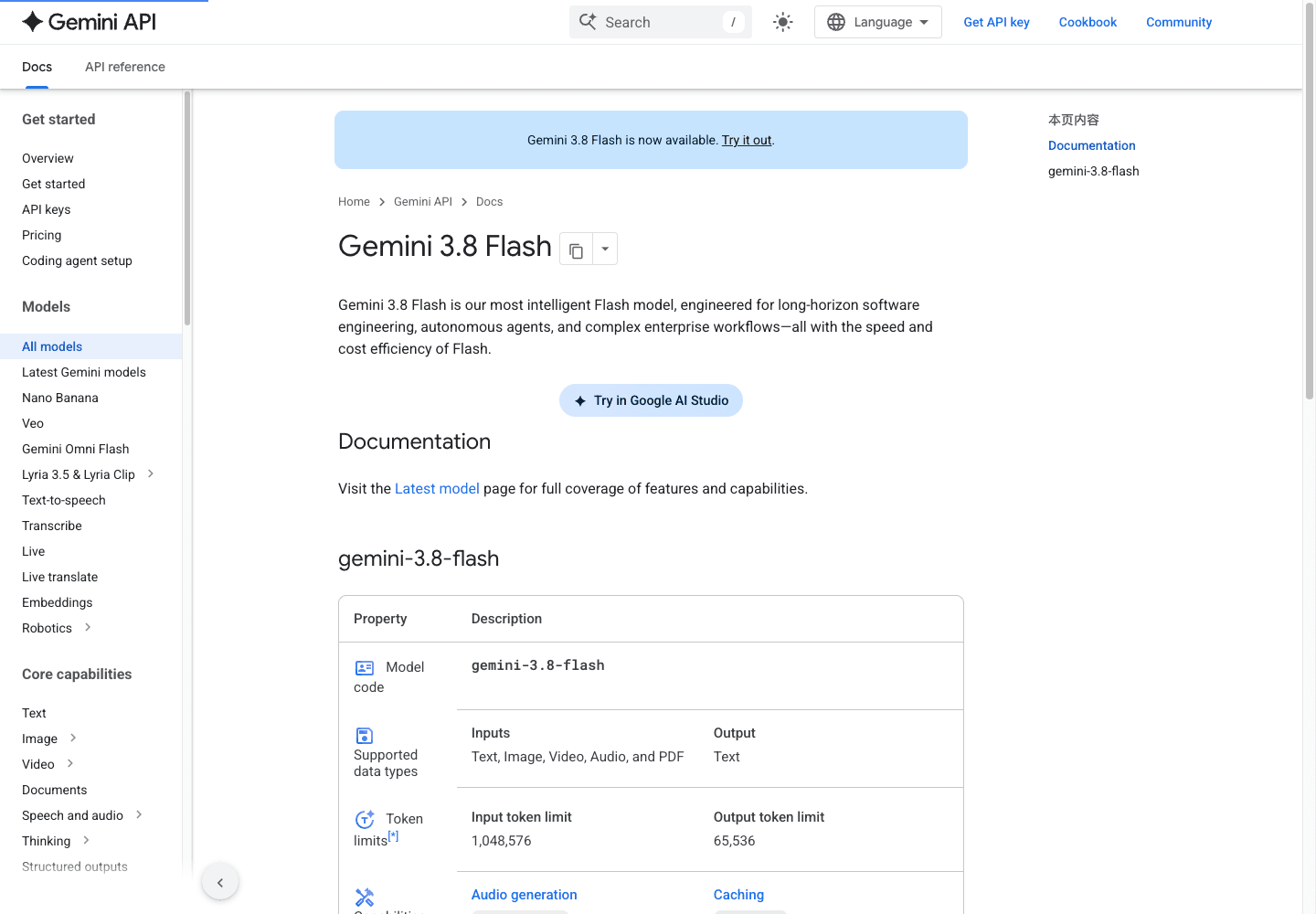
Gemini 3.8 Flash is a good model to keep in the shortlist. Google documents multimodal input, a 1,048,576-token input limit, a 65,536-token output limit, and low, medium, and high thinking. The reason to look elsewhere is conditional: a route may be unavailable in your client or region, another provider may fit your tools better, or your completed-task budget may point elsewhere.
This comparison uses one verifiable anchor: Gemini 3.7 and 3.8 have the same published introductory input/output price, but the task fit and generation differ. Prices and limits are not a quality ranking. The Gemini overview covers the model; this page covers the stay-or-switch decision.
Key takeaways
Test Gemini 3.7 Flash first when you need the smallest Gemini-family migration.
Test GPT-5.6 Luna when base API price is the binding constraint, then include supervision and retry cost.
Test Claude Sonnet 5 when adaptive thinking and Anthropic's tools fit the workflow.
Test DeepSeek V4.1 Flash when its think/non-think modes, 1M context, and pricing schedule fit your deployment constraints.
Treat every community comment as a subjective report, never as a benchmark.
How I screened these alternatives
Completed-task cost: include input, output, thinking, cache, tools, and retries.
A tolerable response path: measure first-token time and completion time on the same task; public throughput is not TTFT.
Provider and deployment fit: preserve the required input types and tools, or accept the operational work of a different route.
Original evidence: use provider pages for facts and named community posts for preferences and failure modes.
Four candidates at a glance
| Candidate | Best for | Published route | Price checked 2026-09-20 | The main catch |
|---|---|---|---|---|
| Gemini 3.7 Flash | Smallest Gemini-family change | gemini-3.7-flash; 1,048,576 / 65,536 tokens | $0.75 input / $3.75 output per 1M through 2026-12-31 | Previous generation; task fit may differ from 3.8 |
| GPT-5.6 Luna | Price-first high-volume API pilot | gpt-5.6-luna; 1.05M / 128K | $0.20 / $1.20 per 1M base price | Long-input multipliers and supervision can erase the saving |
| Claude Sonnet 5 | Adaptive thinking and Anthropic tools | claude-sonnet-5; 1M / 128K | $2 / $10 per 1M | Higher list price; API and subscription are separate |
| DeepSeek V4.1 Flash | Think/non-think and a low-cost scheduled route | deepseek-flash; 1M / 384K | Off-peak cache hit $0.003 / miss $0.15 / output $0.60; peak $0.006 / $0.30 / $1.20 per 1M | Peak schedule, residency, access, and price changes need checking |
Sources: Google Gemini 3.7, OpenAI Luna, Anthropic models, and DeepSeek current pricing. DeepSeek's current page supersedes older V4 Pro routing notes.
Gemini 3.7 Flash
Best for: keeping Gemini's multimodal inputs and thinking controls with minimal migration.
Pros: Google lists text, image, video, audio, and PDF input; 1,048,576 input tokens; 65,536 output tokens; thinking; function calling; code execution; file search; and computer-use preview. A September 2 HN comment from handzhiev called Gemini 3.7 a “workhorse” and “good enough for most tasks.” That is an individual preference, not a benchmark.

Cons: it is the previous generation. The same published introductory price as 3.8 does not mean the same task fit or output behavior.
Pricing: $0.75 input / $3.75 output per 1M through 2026-12-31 on Google's checked pricing route.
Verdict: choose it when compatibility matters more than moving providers; retain 3.8 for tasks that pass only on the newer model.
See the Gemini 3.7 model resource and the Gemini 3.8 review before writing the pilot.
GPT-5.6 Luna
Best for: a price-first API pilot for high-volume work.
Pros: OpenAI lists 1.05M context, 128K maximum output, text/image input, functions, web search, file search, computer use, and a $0.20/$1.20 base price. gundmc described Luna as a workhorse in an HN discussion.

Cons: OpenAI documents higher multipliers above 272K input tokens. refactor_master reported that Luna required enough guidance in a code-editing task that typing it themselves was faster.

Pricing: treat $0.20/$1.20 as base list pricing, then calculate long-input, output, tool, retry, and supervision costs.
Verdict: choose Luna when API economics dominate and your pilot stays within the supervision budget; do not infer quality or speed from the price.
The Luna model resource keeps the provider-specific limits beside the migration notes.
Claude Sonnet 5
Best for: adaptive thinking and Anthropic's tool route.
Pros: Anthropic lists 1M context, 128K output, adaptive thinking, vision, multilingual input, and tools. In an HN discussion, doctoboggan argued that Sonnet 5 medium could be preferable to higher effort in a cost-per-task comparison; jsnell countered that the plotted frontier was not Pareto-dominated.


Cons: its $2/$10 API list price is higher than Luna's, and consumer plans are separate products.
Pricing: $2 input / $10 output per 1M on the checked Anthropic overview; recheck current terms.
Verdict: choose Claude when adaptive effort and Anthropic tools fit better than Gemini's route; keep the cheaper candidate if the same task passes there.
The Sonnet 5 model resource is useful for checking the route available to your account.
DeepSeek V4.1 Flash
Best for: a 1M-context route with explicit thinking modes, vision, and scheduled low-cost pricing.
Pros: the current DeepSeek pricing page names the model deepseek-flash, version DeepSeek-V4.1-Flash, with both non-thinking and thinking modes, 1M context, 384K maximum output, JSON, tool calls, Responses API, Anthropic API, and vision. An HN user, eli, reported trying a temporary V4.1 Flash endpoint and called it fast; this is a preview-era personal report, not a benchmark.

Cons: the price schedule changes by peak window and cache status. The current page says peak is 01:00–04:00 and 06:00–10:00 UTC on weekdays excluding Chinese public holidays; all other times are off-peak. Verify residency and data-use terms for your workload. aftbit also raised a concern about unexpected V4 Pro routing during an earlier launch transition; that is a historical routing concern, not a claim about today's Flash pricing page.

Pricing: off-peak cache hit $0.003 input, cache miss $0.15 input, and $0.60 output per 1M; peak $0.006, $0.30, and $1.20. DeepSeek says prices may change. Use deepseek-flash; legacy names are routed to the current model according to the page.
Verdict: choose DeepSeek when its schedule, context, and deployment terms fit; keep Gemini when Google-specific multimodal behavior or a simpler pricing route matters more.
Use the Gemini pricing analysis to keep API and non-API budgets separate.
A practical Tabbit boundary
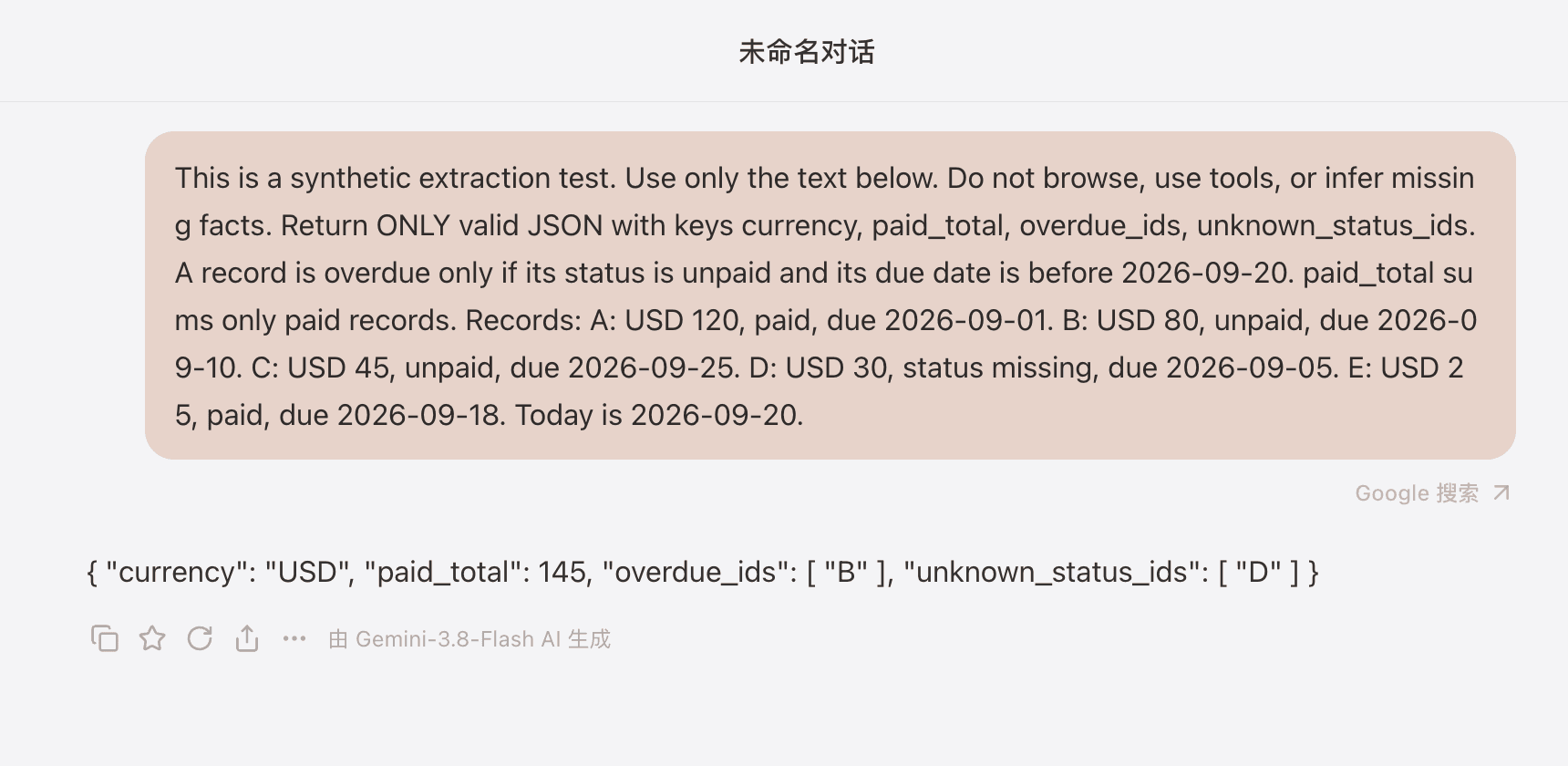
The supplied Tabbit record shows one synthetic extraction task: expected and actual JSON both had currency USD, paid_total 145, overdue ID B, and unknown-status ID D. The UI showed a “Google 搜索” marker. Sample size was one; thinking level, tokens, cost, TTFT, and actual search request were not independently measured. This is a four-field correctness check, not a performance or availability claim.
 Tabbit Browser
Tabbit Browser is relevant when the work spans browser pages. Read what an agentic browser is and browser automation, then verify the live route with a small non-sensitive task.
For a broader comparison, see AI browser options.
Run the same-task pilot
Freeze two real tasks, inputs, instructions, tools, output contract, retry budget, and billing route. Record first-token time, completion time, tokens, tool failures, retries, manual corrections, and completed-task cost. Repeat enough times to expose variance. A changed context or tool route is a route difference, not proof that one model is universally better.
Verdict
Keep Gemini 3.8 when its multimodal behavior, Google route, or task fit passes your contract. Try Gemini 3.7 for the smallest family migration, Luna for price-first API screening, Sonnet 5 for Anthropic's adaptive route, and DeepSeek V4.1 Flash for its current context, modes, and scheduled prices. The choice follows the constraint; the comments and screenshots above do not produce a global ranking.
Choose by the constraint you can measure
| Main constraint | First pilot | Success criterion | Main caveat |
|---|---|---|---|
| Preserve Gemini inputs and tools | Gemini 3.7 Flash | Existing workflow passes without tool regressions | Same price does not guarantee fewer retries |
| Reduce high-volume API spend | GPT-5.6 Luna | Lower total cost at the same acceptance threshold | Include supervision and long-input multipliers |
| Use Anthropic adaptive thinking | Claude Sonnet 5 | Required tool calls and outputs pass | Higher base rate and migration work |
| Schedule long-context workloads | DeepSeek V4.1 Flash | Data policy, peak window and output all fit | Check current provider terms and route |
| Current Gemini 3.8 workflow already passes | Keep Gemini 3.8 Flash | Stable task quality within the actual budget | A newer label alone is not a reason to switch |

FAQ
What is the closest alternative to Gemini 3.8 Flash?
Gemini 3.7 Flash is the closest same-family fallback because Google documents similar input types, limits, and thinking controls. It is a previous-generation model, so compare the same task before switching.
Which alternative has the lowest listed API price?
There is no always-cheapest route. DeepSeek V4.1 Flash off-peak uncached input/output are $0.15/$0.60 per million tokens, below Luna’s $0.20/$1.20 base rates. At peak, DeepSeek is $0.30/$1.20, so Luna has lower uncached input pricing. Cache, long-input multipliers, retries and tools change task cost.
Do the four alternatives support the same tools?
No. Google, OpenAI, Anthropic and DeepSeek expose different input types, tools and controls. Verify the API, client, account and region you will use.
Can API prices be compared with chat subscriptions?
No. API tokens, consumer subscriptions, team seats, and browser clients use different units and limits. Calculate the same completed task on the route you will actually use.
Can the Gemini 3.8 benchmarks be directly compared with these candidates?
Not from this article alone. The Artificial Analysis figures are a September 20, 2026 v4.3.2 snapshot by thinking level; the other candidates do not have a matched test here.
Is Gemini 3.8 Flash available in Tabbit Browser?
A signed-in test selector displayed Gemini-3.8-Flash and one synthetic extraction task matched the expected JSON. The task also showed a Google Search marker; this single non-performance test does not establish production availability, latency, cost, or tool behavior.