
The headline rate is not the cost of solving a task. It is the cost of one raw ingredient. Through December 31, 2026, paid Standard Gemini 3.8 Flash costs $0.75 per million input tokens and $3.75 per million output tokens, with thinking included in output. Cached reads are $0.075 per million tokens, while keeping a cache costs $0.50 per million tokens per hour. The single budget anchor is the 2027 change: Google lists each Standard token and cache rate at 2× from January 1, 2027. Google’s live pricing table is the source of truth; this page was checked on September 20, 2026.
The counterintuitive part is that the family rows are currently flat: Gemini 3.7 Flash and Gemini 3.6 Flash show the same published Standard rates as Gemini 3.8 Flash. That makes token volume, cache share, output effort, retries and request mode more important than the model name. The calculator below makes that comparison explicit. If you need a browser workflow around the model, see the Gemini 3.8 Flash overview; this page is about budgeting.
Gemini 3.8 Flash pricing at a glance
| Paid mode | Input / 1M | Output incl. thinking / 1M | Cached read / 1M | Cache storage / 1M token-hour |
|---|---|---|---|---|
| Standard, through 2026-12-31 | $0.75 | $3.75 | $0.075 | $0.50 |
| Standard, from 2027-01-01 | $1.50 | $7.50 | $0.15 | $1.00 |
| Batch, through 2026-12-31 | $0.375 | $1.875 | $0.0375 | $0.50 |
| Flex, through 2026-12-31 | $0.375 | $1.875 | $0.0375 | $0.50 |
Batch and Flex are selectable modes, not extra discounts. A request uses one row. Google’s pricing page also lists Priority at a higher rate; it is outside the simple calculator because it is a different latency and capacity choice. The model page confirms support for caching, Batch API and Flex inference.
The cost levers that change a task
Google labels the output row “including thinking tokens.” If a task returns 8,000 visible tokens and spends 12,000 thinking tokens, budget 20,000 output tokens once. There is no second thinking line item, but thinking is not free: it increases the output quantity. Lowering an effort or reasoning setting can reduce cost only when it actually reduces total output and still produces an acceptable result. The provider or client’s default effort matters, so record it with your token logs rather than assuming that “Flash” means a fixed task cost.
Use this formula for one attempt:
token cost = (uncached input × input rate
            + cached input × cached-read rate
            + total output, including thinking × output rate) / 1,000,000
monthly token cost = token cost × billable attempts
total budget = monthly token cost + cache storage + tool charges
Cache storage is separate. A 1M-token cache kept for 10 hours costs $5.00 at the 2026 Standard storage rate even before a request reads it. Batch and Flex halve token rates in the published 2026 rows, but their storage row remains $0.50 per million token-hours. That is why “50% cheaper” is a property of token lines, not necessarily of an entire workflow.
Family pricing: the flat step is the finding
| Model | Standard input / 1M | Standard output / 1M | Cached read / 1M | What to compare |
|---|---|---|---|---|
| Gemini 3.8 Flash | $0.75 | $3.75 | $0.075 | Current model fit and output volume |
| Gemini 3.7 Flash | $0.75 | $3.75 | $0.075 | Same published token cost; verify availability |
| Gemini 3.6 Flash | $0.75 | $3.75 | $0.075 | Same published token cost; verify availability |
These are the 2026 Standard rows visible on Google’s pricing page, checked September 20, 2026. Equal rates do not prove equal quality, latency or access. They only mean that switching among these published rows does not change the token arithmetic. The real lever is how many rounds the task needs, how much context can be cached, and how much output the selected effort produces.
Flex, Batch and tools: choose the boundary first
Batch is for work that can wait. Flex is a separate lower-cost capacity mode with its own service trade-offs. Select one mode, then use its row; never multiply a Batch discount by a Flex discount. Google currently publishes the same 2026 token rates for both modes, but that does not make them interchangeable operationally.
Tools sit outside this token-only estimate. Google gives 5,000 shared free Search grounding requests per month for paid Standard, then $14 per 1,000 requests; Maps has a separate request rule. URL context and File Search have their own billing details. Add tools to the budget instead of hiding them in a token multiplier.
What you do not pay for, and what still matters
There is no separate “thinking surcharge” because thinking is included in output. There is no free retry assumption either: a failed or abandoned request can still consume billable tokens. A subscription is not API credit. A cache read is not cache storage. Those boundaries prevent three common underestimates.
What cost-per-task discussions can and cannot prove
The Hacker News thread, posted September 2–3, is useful as a warning about task cost, not as a benchmark table. One commenter argued that Gemini 3.8 Flash was cheaper across cost-per-task benchmarks; another challenged that reading and pointed to different effort levels. A third said the models trade places as effort changes. Those are competing interpretations of linked Artificial Analysis views, not measurements reproduced here.
Source comments: gundmc, Sep 2, bermudi, Sep 2, criley2, Sep 2, and criley2, Sep 3.


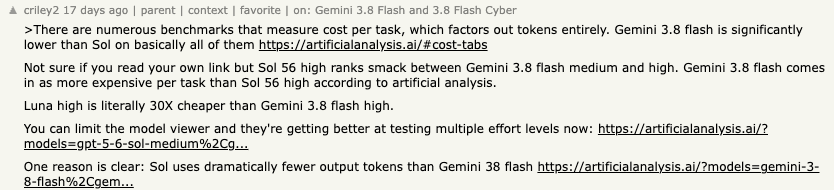

The practical conclusion is narrower: record effort and total output with each workload. Do not turn these four comments into a universal ranking, and do not use them to replace the official rate card.
Two workloads, with every assumption visible
These examples use 2026 Standard token rates. Output includes thinking once; storage, tools, retries and taxes are excluded. At the published 2027 Standard token rates, these token-only totals become $30 and $36 respectively.
| Workload | Input per task | Cached share | Total output per task | Tasks per month | Monthly token cost |
|---|---|---|---|---|---|
| Short extraction | 10,000 | 0% | 2,000 | 1,000 | $15 |
| Repeated document analysis | 1,000,000 | 90% | 10,000 | 100 | $18 |
Local calculation
Estimate your monthly token cost
Standard API rates through 2026-12-31. Include thinking in output once. Inputs stay in this browser.
Excludes cache storage, tools, retries and taxes. Equal rates do not mean equal tokens per task. Checked 2026-09-20. Verify current rates
The calculator uses 2026 paid Standard rates and compares the three published family rows. It does not send the numbers anywhere and does not include storage, tools or retries. If the task has a 1.2 attempt multiplier, multiply the monthly result by 1.2; do not pretend that “successful tasks” describes the invoice.
A practical place to run the workflow: Tabbit Browser
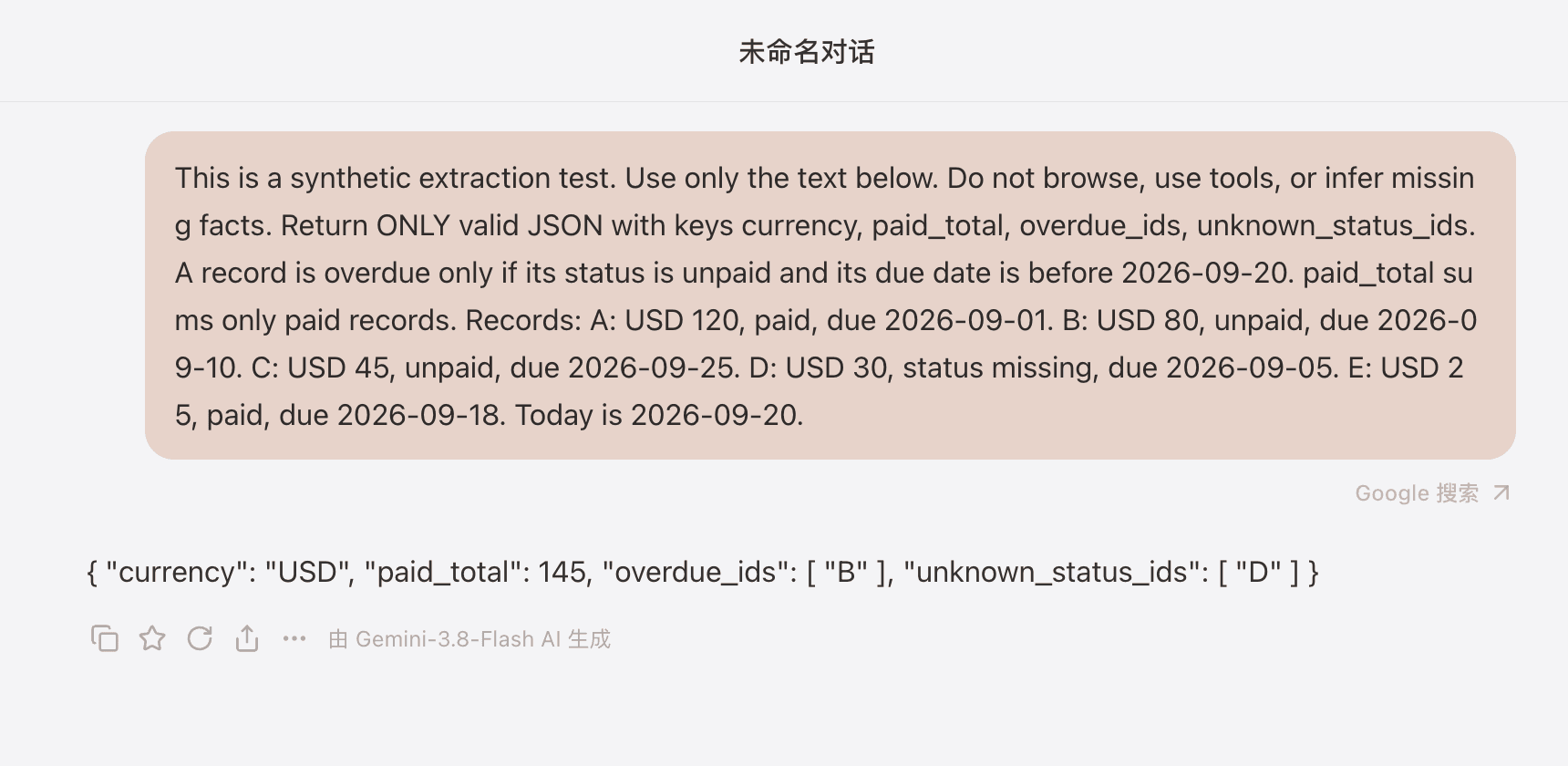
After you have priced the model calls, you still need somewhere to run the work. In Tabbit Browser Dev, using a signed-in test-site account, one synthetic payment-record extraction task returned the expected four fields: currency, paid total, overdue IDs and unknown-status IDs. The Google Search marker was visible in the UI, but whether a search request actually ran was not independently verified. This one sample measured neither cost, time nor stability, so it is a bounded workflow example rather than a production-access claim. Check the live model selector and product terms before assigning a Tabbit workflow a Gemini API bill.
 Tabbit Browser
For a lower-cost or different-latency choice, compare the Gemini 3.8 Flash alternatives; for evidence limits, read the review. You can also compare the AI browser guide, agentic browser explanation, browser automation guide, and AI browser shortlist before choosing a workflow.
Use the prompt and workflow guides to define a repeatable task before measuring token consumption.
Sources
The rate card and effective dates come from Gemini Developer API pricing, checked September 20, 2026. Model support comes from the Gemini 3.8 Flash documentation. Budget the 2026 task cost, then double the Standard token and cache terms for work crossing January 1, 2027. For a wider browser comparison, see AI browsers in 2026.

FAQ
How much does Gemini 3.8 Flash cost through December 31, 2026?
Paid Standard pricing is $0.75 per million input tokens and $3.75 per million output tokens, including thinking. Cached reads cost $0.075 per million tokens; cache storage costs $0.50 per million tokens per hour.
Are thinking tokens charged separately?
No. Google includes thinking tokens in the output price. Add visible and thinking output together once when estimating.
What are the Flex and Batch rates?
Through December 31, 2026, both published Flex and Batch token rates are $0.375 input, $1.875 output and $0.0375 cached read per million tokens. They are separate request modes and do not stack.
What changes on January 1, 2027?
The listed Standard input, output, cached-read and storage rates double to $1.50, $7.50, $0.15 and $1.00 respectively. Recheck the live rate card before a budget crosses that date.
What does Gemini pricing not include?
This token estimate excludes cache storage, tools, retries, taxes and any client subscription. Google lists separate rules for Search grounding, Maps, URL context and other tools.
Can Tabbit pay my Gemini API bill?
No. A Gemini consumer subscription, a Gemini Developer API account and Tabbit product terms are separate. Tabbit can be a place to use supported models, but it is not an API billing account.