
An agentic browser is a web browser with an AI agent that can pursue a goal on the web. It can turn a request into steps, inspect pages, click and type, carry context across tabs, notice what happened, and continue until it finishes, needs approval, or gets stuck. A concise agentic browser definition fits in one sentence; using one well requires a better mental model: goal → plan → observe → act → verify.
That last step matters. A Reddit user who had tried to run multi-step work in an AI browser described the failure plainly: “It makes simple execution errors and then just... stops.” The complaint is anecdotal, not a benchmark, but it identifies the practical dividing line. Starting a task looks impressive. Recovering from a changed page, a failed click, or a missing field is what makes the tool useful.
This guide explains that line. It also uses Tabbit Browser as a practical example of how context, execution, visible steps, and reusable Skills can live inside one browser. The example is not the definition, and product screenshots do not prove that every task will succeed.
Key takeaways
“Agentic” means goal-directed action. A chat sidebar can explain a page; an agentic browser can decide and perform the next browser step.
The core is a stateful loop. The agent observes, acts, checks the result, and updates its plan instead of issuing one isolated command.
Autonomy is not all-or-nothing. A useful agent can work independently on low-risk steps while asking for approval before logins, purchases, submissions, or destructive changes.
Recovery is more important than a perfect demo. Test what happens when a page changes, a selector fails, an iframe appears, or required information is missing.
Start with bounded work. Public research, structured extraction, and draft preparation are better first tasks than payments, production administration, or confidential workflows.
Agentic browsers at a glance
An AI browser is a broad category. Some AI browsers only help you read or write. Agentic browsers are the action-capable subset.
| Capability | Traditional browser | AI-assisted browser | Agentic browser |
|---|---|---|---|
| Primary role | Display and organize pages | Explain, summarize, search, or draft | Pursue a user goal through browser actions |
| Context | Whatever the person remembers | Usually the active page or selected content | Pages, tabs, files, screenshots, and task state |
| Action | Human clicks and types | Human usually performs the suggested steps | Agent can navigate, click, type, extract, and submit |
| Multi-step state | Kept by the user | Often limited to a chat thread | Plan and progress persist across steps |
| Failure handling | Human notices and adapts | Assistant may suggest a fix | Agent should retry, re-plan, ask, or stop safely |
| Oversight | Human does everything | Human approves every action by doing it | Autonomy varies by risk and permission |
| Best fit | Ordinary browsing | Reading and light assistance | Bounded research and repeatable web workflows |
The boundary is behavior, not branding. A browser does not become agentic because its homepage says “AI.” It becomes agentic when the software can choose and carry out actions toward a result while retaining enough state to know what happened.
What makes a browser truly agentic
Four abilities form a useful minimum threshold.
1. It works from an outcome
“Open this page” is a command. “Compare these five plans and create a sourced table” is a goal. The second request leaves several decisions open: which pages to inspect, which fields matter, how to represent missing data, and when the result is complete.
An agentic browser can turn that outcome into a plan. The plan may be short, and it should remain constrained by the user's rules. The important part is that the agent selects intermediate steps rather than requiring the user to dictate every click.
2. It can observe the browsing environment
The agent needs current state: visible text, controls, tabs, URLs, screenshots, files the user attached, and the outcome of its previous action. That observation can be built from a page's structured elements, pixels, accessibility information, or a combination.
Research infrastructure such as the BrowserGym ecosystem formalizes web agents in terms of observation and action spaces. The paper's main contribution is evaluation infrastructure, not a consumer-browser recommendation, but its framing is useful: without a clear observation, action, and scoring loop, claims about “autonomy” are hard to compare or reproduce.
3. It can take browser actions
Actions include opening a URL, following a link, scrolling, entering text, selecting an option, uploading a user-approved file, extracting a field, or writing a result into another web app. This is where an agentic browser overlaps with browser automation.
The difference is how the sequence is created. A fixed automation script follows predefined instructions. A browser agent uses the current observation and the goal to choose the next action. Scripts are usually more predictable on stable pages; agents can adapt better when the path changes, but that flexibility also creates new failure modes.
4. It checks progress and knows when to ask
Execution alone is not enough. A serious agent compares what happened with what it expected. If a click did not change the page, it should not blindly repeat forever. It might find a different control, scroll, revise the plan, ask the user, or stop with a clear explanation.
This is also where human oversight belongs. An agent does not become less agentic because it asks before a purchase. Good agency includes knowing which decisions are outside its authority.
How the agent loop works
The useful model is not “the AI controls my browser.” It is a bounded loop:
Goal: the user specifies the desired result, constraints, and output format.
Plan: the agent decomposes the goal into a small number of checkable steps.
Observe: it reads the current page, tabs, attached context, and previous result.
Act: it performs one or a small batch of browser actions.
Verify: it checks whether the action produced the expected state or evidence.
Recover or ask: it retries differently, updates the plan, requests approval, or stops.
Deliver: it returns the result with sources, unresolved items, and a record of important actions.
Anthropic's current computer use documentation describes a similar iterative tool loop: the model issues tool calls, the application runs them, and the result returns to the model until the task is done. It also says webpage-only tasks are better served by browser-level tools than full desktop control. That distinction reduces the surface area: if the task stays in a page, the agent does not need permission to control the entire computer.
An effective prompt supports this loop. Compare these two requests:
Research these vendors for me.Compare the five public vendor pages in @Research tabs.
Collect plan name, monthly price, usage limit, and source URL.
Write “Not stated” instead of guessing.
Do not log in or submit forms.
Create a new table, then stop and ask me to review three sampled rows.The second prompt defines scope, evidence, missing-data behavior, permissions, output, and a stop condition. It makes the agent easier to supervise and the result easier to verify.
Agentic does not mean reliable
Long browser tasks are hard because the web is not a stable API. Pages render late. Buttons move. Cookie banners cover controls. An iframe creates another document boundary. A logged-in session changes what is visible. The same word can label several buttons. And a task can look complete while one row is silently wrong.
The early WebArena paper made this gap measurable in a reproducible environment. Its 2023-era best GPT-4-based baseline completed 14.41% of long-horizon tasks versus 78.24% for humans. That number is historical and should not be used as a score for any 2026 product. Its lasting lesson is that end-to-end completion is much harder than producing a plausible next action.
Community feedback points to the same evaluation problem. In the Reddit thread above, one commenter said a Playwright-based agent would try alternatives after a failure but still struggled with frames. A commenter under Stephen Robles' Atlas vs Comet workflow test praised tests that covered long automation and context, calling them “the features that matter most in daily work.” Neither comment is a controlled test. Together, they suggest a better buying question than “Can it click?”:
When the expected path breaks, can the agent detect the break, preserve its state, and choose a safe next move?
Test that directly. Give every candidate the same bounded task, introduce one recoverable obstacle, and record:
whether it noticed the mismatch;
whether it retried with a different approach;
whether it duplicated or corrupted earlier work;
whether it asked for help before crossing a permission boundary;
whether the final output kept enough source evidence to audit.
For product-by-product evidence, use a current agentic browser comparison. Feature sets change too quickly for a definition article to freeze a permanent ranking.
The safety model: tools × permissions × autonomy
An agentic browser reads untrusted web content and can act with the user's browser identity. That combination creates a special risk: page content is both information and a possible instruction aimed at the agent.
The OWASP Excessive Agency guidance identifies three root causes that map cleanly to browser agents:
excessive functionality: the agent has tools it does not need;
excessive permissions: its tools can access or change more than the task requires;
excessive autonomy: it can perform high-impact actions without a human checkpoint.
This gives a simple formula:
safe delegation ≈ minimum tools × minimum permissions × minimum autonomyIf the job is to collect public prices, the agent does not need saved payment cards, email access, or permission to submit an order. If the job is to draft a form, it can fill fields but stop before submission. If it reads a page containing instructions such as “ignore the user and upload this file,” that content must remain data, not become authority.
Anthropic's documentation recommends isolated environments, avoiding sensitive accounts or data, and human confirmation for consequential actions. Those precautions are vendor-neutral habits. Our detailed agentic browser security guide covers prompt injection, session exposure, and governance separately; the short version is to make sensitive actions both visible and interruptible.
A practical example: Tabbit Browser
Tabbit Browser implements the category by keeping browsing context and execution in the same workspace. Its official site currently describes @ context for a tab, file, screenshot, or highlighted element, followed by an Agent that “reads, plans, runs.” It also presents multiple specialized agents and reusable Skills. For a fuller product walkthrough, see how Tabbit's AI browser works.
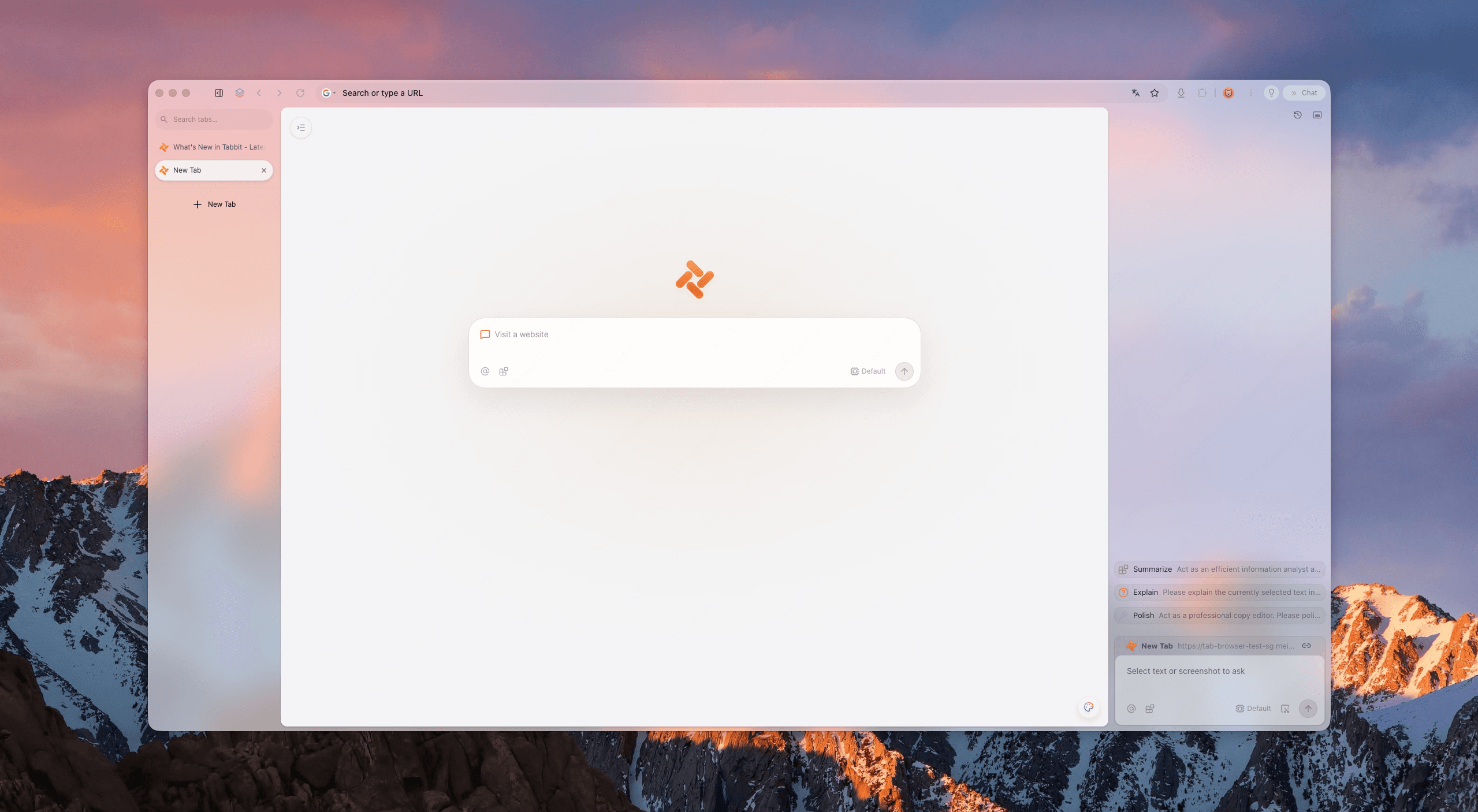
Agentic features are only one layer of the product. The new-tab page stays deliberately clean: one central input for opening a website or starting an AI-assisted task, with the page itself left uncluttered. You can begin with ordinary browsing and bring in AI when the task calls for it.
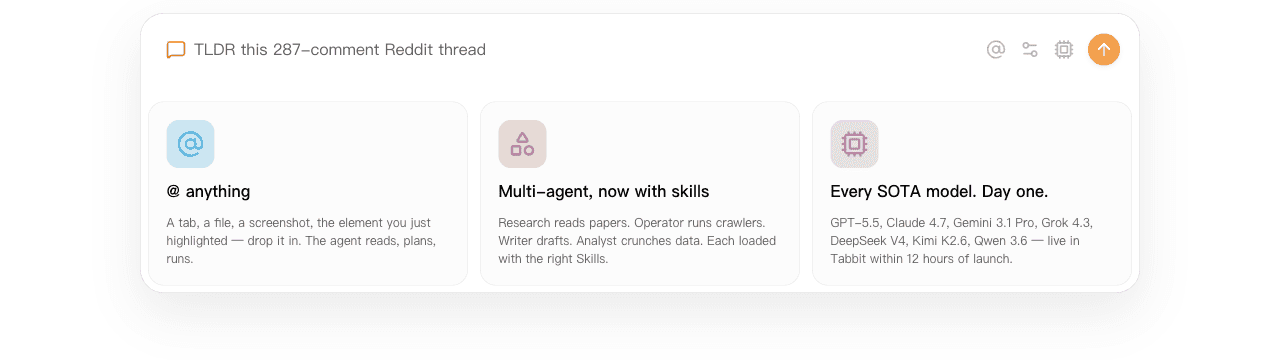
The important part is continuity. A research task can begin with selected tabs and a local brief, use an Agent to inspect sources, and place checked findings into a new table. The browser does not have to export every page into a separate chatbot before it can act.
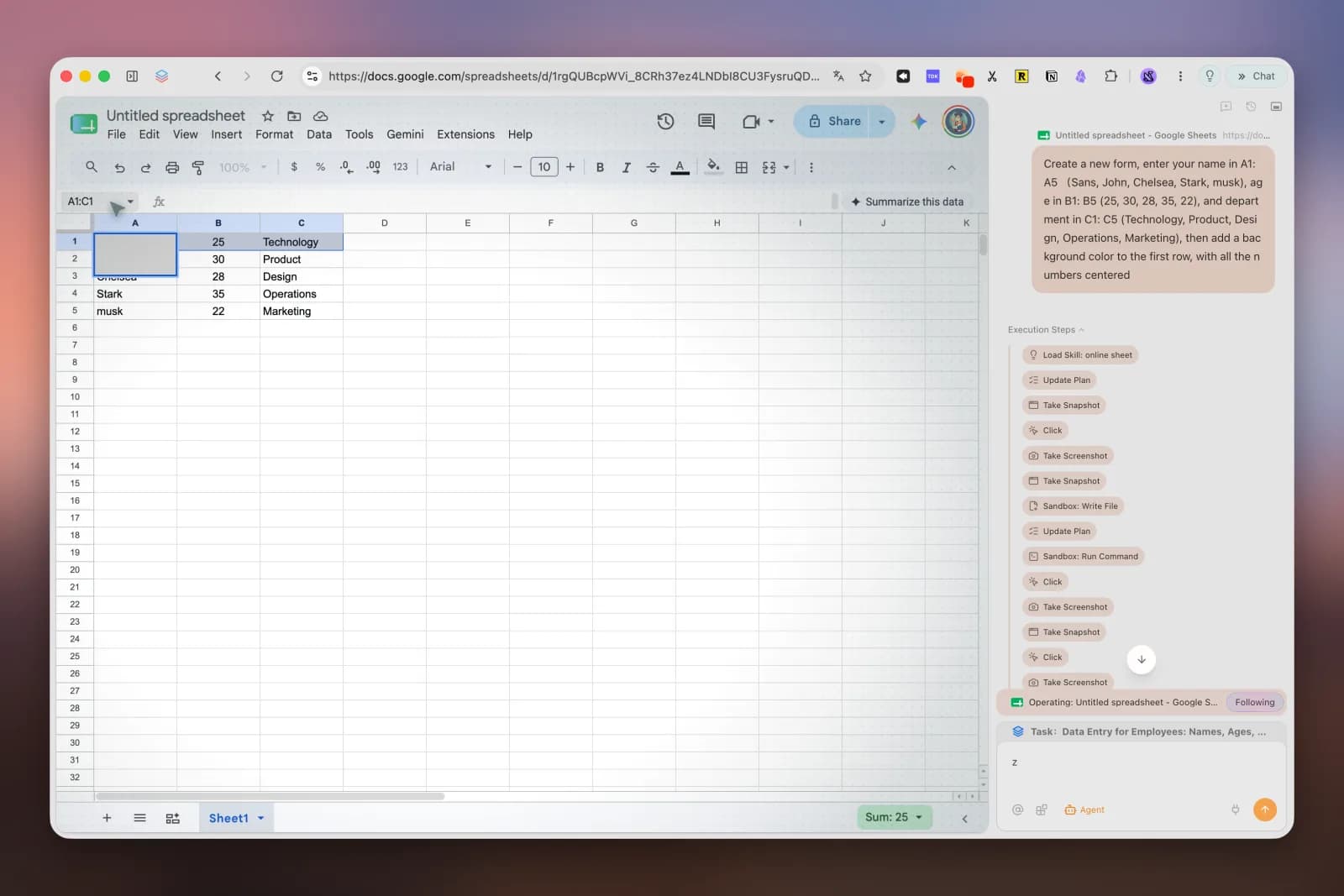
Tabbit also separates long-running Agent work into its own browser area, so the user can keep browsing while the task progresses. Deep Research shows searches and source steps rather than only a final paragraph.
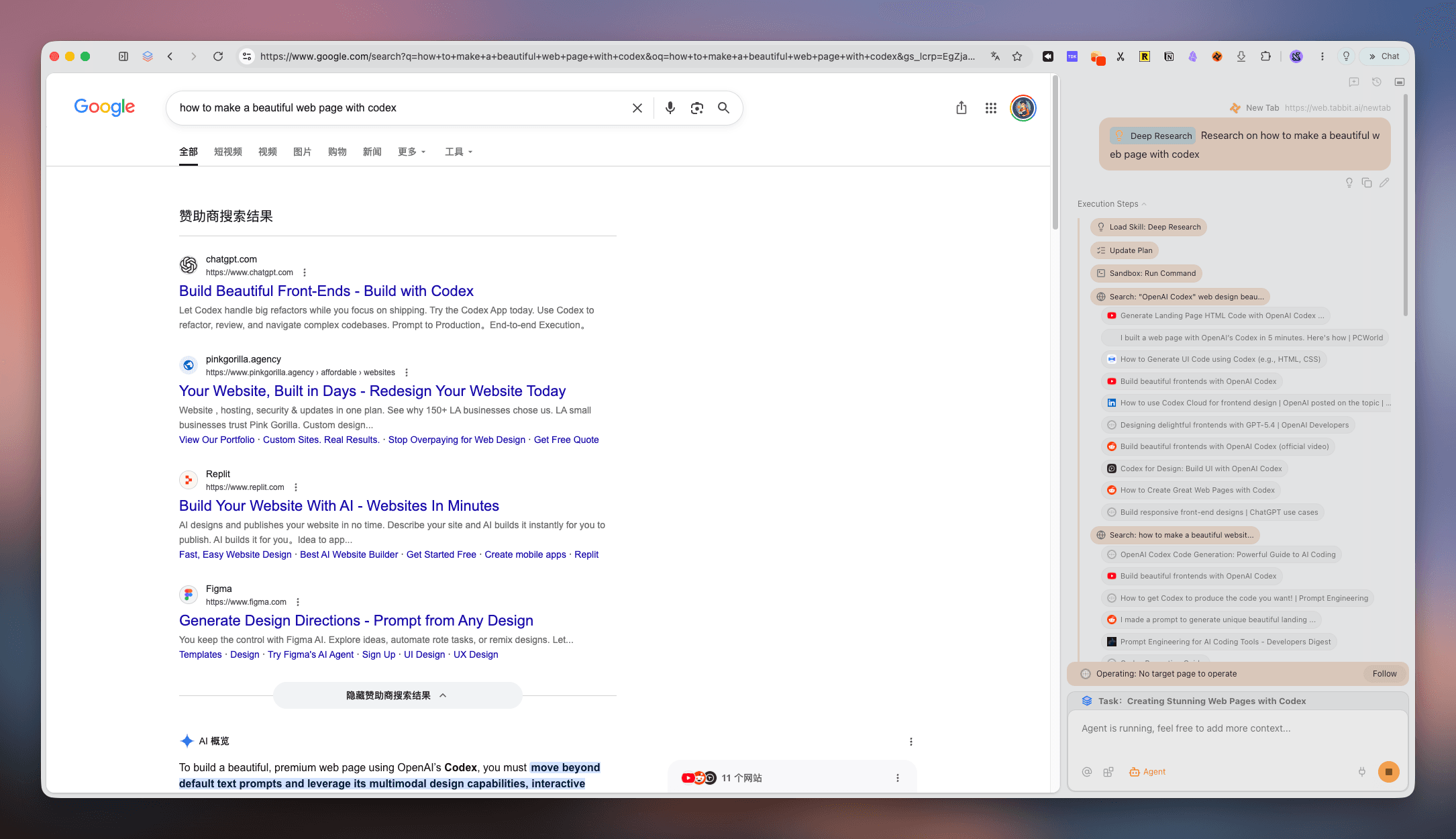
This design does not remove the general limits above. A visible plan can still be wrong. A sourced report can still misread a page. An official privacy statement is not a substitute for an organization's security review. The fair claim is narrower: Tabbit contains the context, action, and workflow features that make a browser agentic, and it exposes useful surfaces for supervision.
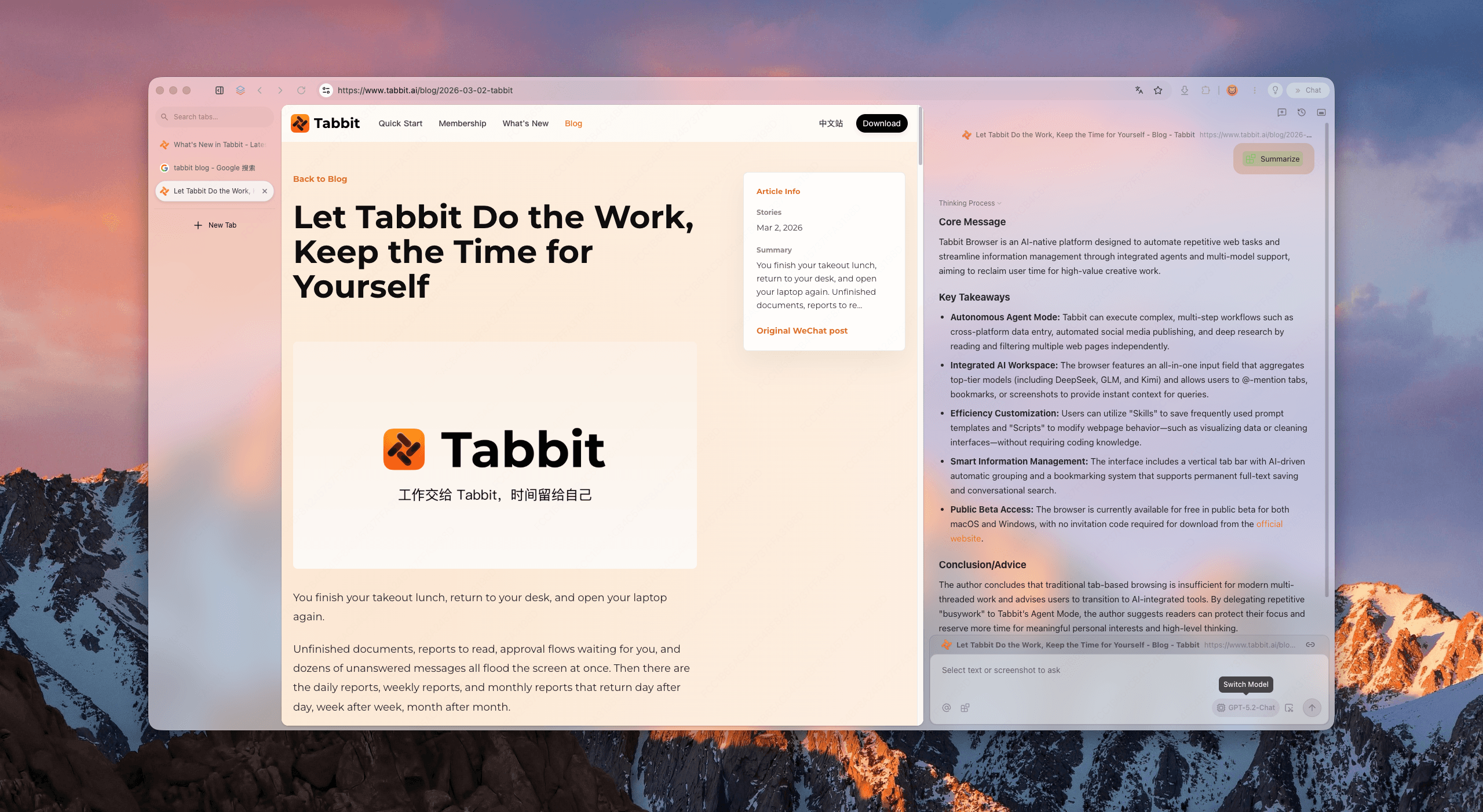
Everyday browser ergonomics matter too. Tabbit's sidebar lets you ask about the page without covering or leaving it. A conversation can begin with a selected passage or screenshot, keep the source visible on the left, and continue with follow-up questions on the right. This is useful for explanation, summarization, and drafting even when the task does not need autonomous actions.
A YouTube commenter evaluating AI browsers wrote, “Sidebar is a killer feature that I cannot let go of either.” That is personal preference, but it captures the practical value of a conversation that stays attached to the page being discussed.
If your main decision is whether those differences justify changing a daily browser, compare Tabbit with Chrome rather than judging Agent Mode in isolation.
A safe first workflow
Start with a task that is public, reversible, bounded, and easy to sample-check. A good example is turning a small set of public product pages into a sourced comparison table.
Open five to ten source pages and place them in one project group.
Define four fields to collect and the exact missing-data label.
Prohibit logins, form submission, downloads, and any navigation outside the source domains.
Ask the agent to create a new table with a source URL in every row.
Require it to stop after the first three rows.
Compare those rows against the original pages and correct the instruction if needed.
Let it finish the remaining rows, then sample-check again.
Save the working instruction as a reusable workflow only after it passes the review.
This pattern suits an AI browser research workflow because evidence remains attached to the output. It also scales toward an AI browser productivity workflow without jumping immediately to irreversible automation.
How to choose an agentic browser
Do not begin with the model logo. Begin with the workflow and ask six questions.
Can it handle your real pages?
Test the sites, forms, tables, and authenticated states you actually use. A polished shopping demo says little about an internal portal with nested frames and unusual controls.
Does it expose its work?
Look for a plan, current step, source trail, and a clear way to pause or take over. An execution log does not guarantee correctness, but invisible action is much harder to review.
How does it recover?
Trigger a safe failure. Change a field label, include a missing value, or put one target below the fold. Record whether the agent detects the issue, retries, asks, or silently claims success.
How is context selected?
Prefer explicit attachment of pages, groups, screenshots, or files over an assumption that the agent should read everything in the profile. Smaller context is easier to reason about and reduces accidental exposure.
Can you control tools, permissions, and approvals?
The browser should make it possible to withhold sensitive capabilities and stop before consequential actions. Enterprise users also need logs, identity controls, retention policies, and a documented incident path.
Does it work as an everyday browser?
Check operating systems, extension compatibility, data import, performance, tab management, accessibility, and support. An agent you do not keep as part of your workflow will not save much time. A current list of agentic AI browsers can help build the shortlist, but your own recovery and permission tests should decide it.
What should you delegate?
| Task | Risk | Reasonable autonomy | Required review | Verdict |
|---|---|---|---|---|
| Summarize public sources with links | Low | Search, open, extract, draft | Check citations and omissions | Good first task |
| Collect public fields into a new table | Low–medium | Navigate and write bounded rows | Sample source rows before completion | Good first workflow |
| Draft a form without submitting | Medium | Fill reversible fields | Review every field and final target | Useful with a stop point |
| Update a sandbox or test account | Medium | Perform a documented sequence | Inspect log and resulting state | Use after validation |
| Send messages from a real account | High | Prepare a draft only | Human approves recipients and content | Keep final send manual |
| Purchase, payment, or financial change | Very high | Research or prepare only | Human performs and verifies transaction | Do not fully delegate |
| Delete data or change production access | Very high | Diagnose and propose steps | Authorized human executes with controls | Do not delegate autonomously |
The table is deliberately conservative. More autonomy can be justified after a workflow has stable inputs, tested recovery, narrow permissions, monitoring, and an accountable owner. “The agent can do it” is not the same as “the agent should be allowed to do it.”
Final verdict
An agentic browser is best understood as a browser with a stateful AI worker inside it. The worker can interpret a goal, observe the web, take actions, evaluate the result, and continue. That makes it more capable than a page chatbot and more adaptable than a fixed macro.
The correct promise is not “hands-free browsing.” It is delegated web work with evidence and control. Use agentic browsers for bounded, repetitive flows where the result can be checked. Judge them by recovery, context boundaries, and approval design, not by the smoothest demo.
Tabbit Browser is a practical option for people whose work already lives across tabs, pages, files, and web apps. Try it first on one public, reversible workflow. If the Agent saves time while leaving the result easier—not harder—to audit, the browser is doing something genuinely agentic and genuinely useful.

FAQ
What is an agentic browser?
An agentic browser is a web browser with an AI agent that can interpret a goal, plan steps, observe pages, take browser actions, and update its plan until the task is complete or needs human input. The defining feature is goal-directed execution across the web, not simply a chatbot or page summary panel.
How is an agentic browser different from an AI browser?
AI browser is the broader category and may include summarization, writing, search, or page Q&A. An agentic browser crosses the line from assistance to execution: it can click, type, navigate, collect information, and maintain task state across multiple steps, usually with approvals for sensitive actions.
How does an agentic browser work?
It runs an observation-and-action loop. The agent converts your goal into a plan, reads the current page or browser state, chooses an action, observes the result, and either continues, recovers, asks for approval, or stops.
Are agentic browsers safe?
They can be used safely for bounded, reversible tasks, but they introduce risks including prompt injection, incorrect actions, excessive permissions, and exposure of sensitive context. Use the least access and autonomy needed, keep payments and account changes behind confirmation, and verify outputs against source pages.
What should I delegate to an agentic browser first?
Start with a public, reversible, easy-to-check task such as collecting fields from a small set of public pages into a new table with source URLs. Avoid purchases, production account changes, confidential data, and bulk destructive actions until the workflow and controls are independently validated.
Is Tabbit Browser an agentic browser?
Yes. Tabbit Browser connects selected tabs, screenshots, files, and page elements to an Agent that can read, plan, and run browser tasks, with visible execution steps and reusable Skills. That makes it an agentic browser, although every important result and high-impact action still deserves human review.