
Reflection released Beam's weights on October 16, 2026, under Apache 2.0. The important change is concrete: developers can download the model, choose where it runs, and adapt the surrounding software. The release follows the October 5 introduction, when the weights were still promised for later in the month. The availability announcement confirms that they have shipped.
A developer in the r/LocalLLaMA release discussion, derdigga, immediately asked whether “a23b means it actually runs on consumer hardware”. That question gets to the difficult part. Beam activates about 23B parameters per token, but it remains a roughly 501B-parameter model to store and serve.
The release is worth watching for its deployment options and open agent tooling. It does not establish a universal coding winner. This article separates what shipped from what still needs testing, compares the relevant choices across DeepSeek, Qwen and Mistral, and uses Tabbit Browser for the source-reading workflow. It does not claim a Beam integration in Tabbit.
Key takeaways
October 5 was the introduction; October 16 was the weight release. Older articles saying the weights are unavailable describe an earlier state.
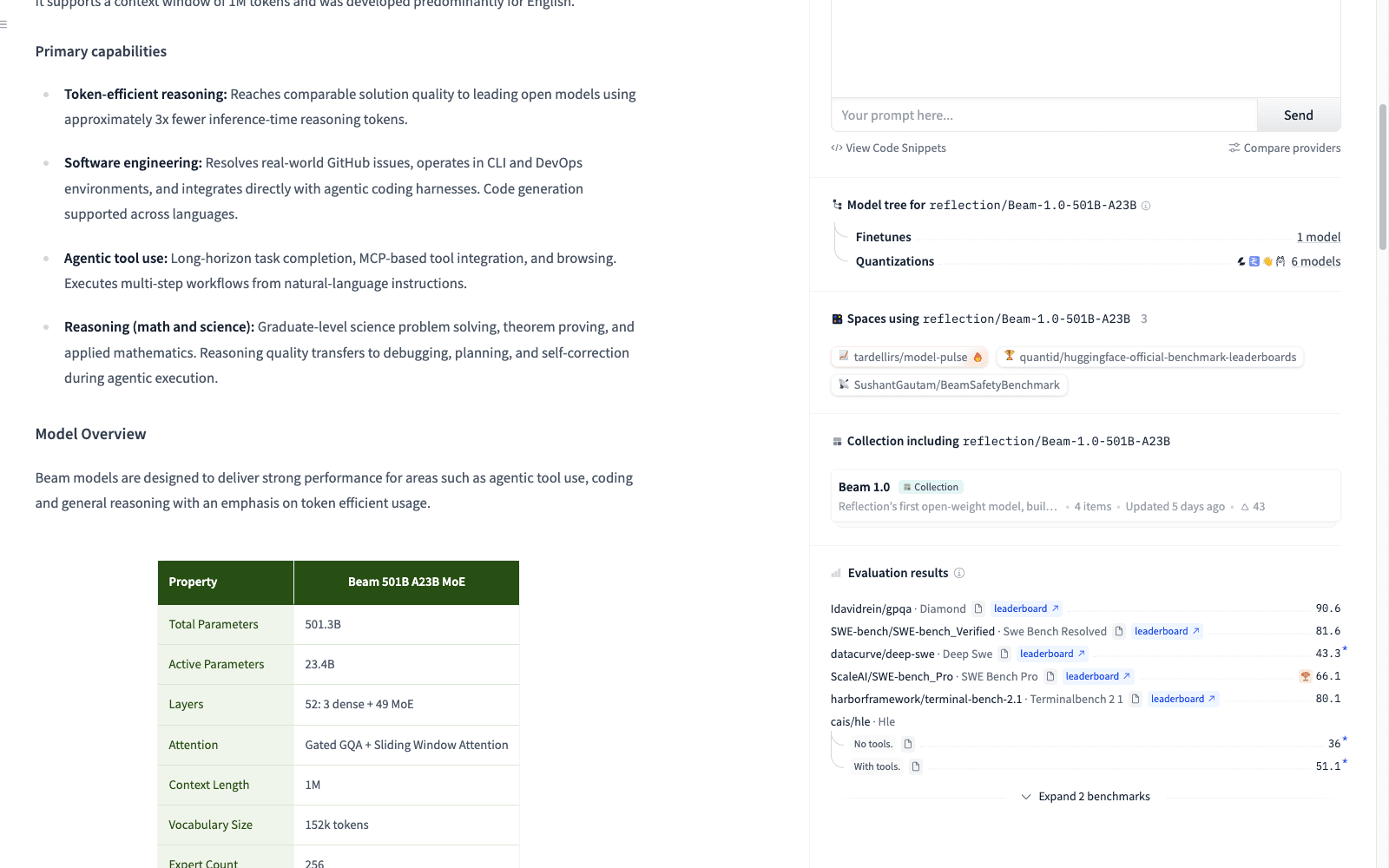
Beam is a text-only MoE model with 501B total parameters, 23B active per token, and a 1M-token context window, according to its model card.
Apache 2.0 weights, Mirror source code, inference integrations and customization recipes make the release useful beyond a hosted chat endpoint.
Active parameters influence compute per token. Total parameters, precision, context and concurrency influence deployment capacity.
Start with a bounded evaluation through an available endpoint. Commit infrastructure only after measuring successful tasks, latency and operating cost.
Reflection Beam at a glance
These are release facts checked on October 21, rather than results from a hands-on Beam benchmark.
| Item | What is available or documented | Why it matters |
|---|---|---|
| Identity | reflection/Beam-1.0-501B-A23B | Avoid confusing it with Apache Beam, beam search or other Beam products |
| Architecture | Sparse MoE; 501.3B total, 23.4B active in the detailed model card | Separate weight capacity from per-token computation |
| Input and output | Text; developed predominantly for English | Test multilingual work separately; do not assume native vision |
| Context | 1M tokens | A capacity limit, not proof of perfect retrieval over a million tokens |
| Weight formats | BF16, FP8 and NVFP4; a DFlash2 drafter is also released | Hardware compatibility and quality depend on the chosen format |
| License and tools | Apache 2.0 weights; Apache 2.0 Mirror repository | Inspect the actual artifacts and component notices |
| Access | Self-hosting, Reflection's API and partner offerings | Downloading weights and paying for hosted inference are separate choices |
Source: official model card and Mirror repository. For the distinction between a model and a system that acts on its output, see what an AI agent does.
What actually opened on October 16
The weights are the central artifact, but the supporting pieces deserve attention. The Beam collection provides the main checkpoint, FP8 and NVFP4 variants, and a speculative-decoding drafter. Different formats give operators a choice about memory and serving hardware. They are not interchangeable accuracy guarantees.
Reflection also published Mirror, its terminal coding agent. The public repository contains the agent, CLI and associated components. Mirror can read and edit files, execute commands, and work in separate repository worktrees. Its Python frontend talks to a Rust agent core. A team can inspect this execution loop rather than treating the entire agent as an inaccessible service.
The release announcement names inference support in Transformers, vLLM and SGLang, plus partners working on fine-tuning and reinforcement learning. AWS's deployment guide shows managed and Kubernetes-oriented deployment paths. These documents turn “the weights exist” into something an infrastructure team can evaluate.
There are still boundaries. The model card describes training data categories, including commercially obtained material, but that is not a downloadable reconstruction of the entire training set. Its technical-report link is marked as coming. The release post also says self-distillation recipes will follow. A published weight file, a training description and a fully reproducible training release are different deliverables.
Calling this an open-weight release with open-source tooling is accurate. Calling every part of the training process open would go beyond the artifacts verified here.
Why 23B active does not mean a small deployment
MoE routes a token through a subset of experts. That reduces the amount of computation compared with activating the complete network. It does not let a production server discard every expert that happened to be unused for the previous token.
A useful capacity distinction is:
Weight storage ≈ total parameters × bytes per stored parameter
Serving memory = weights + KV cache + runtime overhead + working buffers
Hugging Face's launch guide describes a roughly 1 TB BF16 checkpoint and an approximately 280 GB NVFP4 checkpoint. The second number is not a promise that 280 GB of device memory is sufficient for every workload. Long contexts and concurrent requests need additional space; NVFP4 also has hardware-specific execution requirements.
Offloading to CPU memory or storage can change what is possible, at a cost in transfers and latency. This article has not measured an offloaded configuration. Claims about tokens per second from a Reddit thread should not become hardware recommendations without a reproducible setup.
The same discussion contains a useful positive response. User mindwip praised the release for “Listing your benchmarks at bf16,q8,q4 at release!!! Perfect”. The informal labels are the commenter's wording; the official formats are BF16, FP8 and NVFP4. The useful point is that operators care about results for the precision they can actually deploy.
How to compare Beam with DeepSeek, Qwen and Mistral
Compare named checkpoints rather than company names. For DeepSeek, DeepSeek-V4.1-Flash is a relevant large-model candidate; its repository identifies an MIT license and multimodal input. Our DeepSeek V4.1 Flash explainer covers that model's separate architecture and access story. None of its results can be transferred to Beam.
Qwen also provides much smaller coding models. Qwen3-Coder-30B-A3B-Instruct lists 30.5B total parameters, 3.3B active, an Apache 2.0 license and 256K native context. It is an earlier checkpoint selected here to illustrate a different deployment scale, not a claim about Qwen's latest flagship. Qwen3.8 Max is a separate product discussion.
Mistral's Devstral Small 2 24B is another concrete coding candidate, with Apache 2.0 weights and documented Mistral Vibe integration. Its smaller total size makes it a different capacity decision. Do not generalize one checkpoint's license to every Mistral release.
The comparison is therefore about what a team needs to own: a large model with a configurable serving stack, a smaller coding deployment, or an already working hosted endpoint. A universal leaderboard assembled from unrelated model cards would obscure that decision.
For agent workloads, the harness matters too. Tool schemas, retry policies, context management and command permissions can change outcomes. The DeepSeek Harness browser integration guide illustrates the model/runtime distinction; it is not evidence that Mirror or Beam has that integration. The broader agentic reasoning guide explains why evaluating only final text misses much of the work.
A practical role for Tabbit: keep the release evidence together
A model release often leaves readers with conflicting tabs: an early announcement, a revised model card, a serving recipe and a community thread. In Tabbit's browser workflow, related pages can be used as context for analysis. The immediate task is to reconcile those sources before choosing an endpoint or allocating GPUs.
Open the October 5 and October 16 posts, the model card and the deployment guide. Ask for a dated inventory of released artifacts, with a URL for every row and a separate column for promises. The official v1.13 notes document Tabbit CLI access for external code agents; configuration and regional availability still need checking.
This is a proposed research workflow, not a Beam-in-Tabbit test. A browser reading an announcement does not run the checkpoint or validate its coding scores. Keep repository execution in a suitable coding harness. For the browser's role in multi-step tasks, see the agentic browser guide.
What the release proves, and what an evaluation must establish
The evidence supports that the weights and useful surrounding tools are public. It does not establish that Beam is the fastest or cheapest model for your workload. Reflection's efficiency argument is about inference work under stated conditions. Fewer generated tokens alone cannot establish a lower end-to-end bill.
For an operational comparison, use:
Cost per accepted task = total run cost / tasks that pass acceptance checksInclude failed attempts, tool calls, infrastructure idle time and review effort when relevant. Keep the repository revision, tasks, harness, precision, reasoning budget and timeout fixed. Record whether a patch passes tests, whether an agent recovers from a tool error, and how long a human spends fixing its result. A small pilot can guide a decision without pretending to be a comprehensive benchmark.
Who should try Beam now?
| Your constraint | Sensible first step | What to establish before committing |
|---|---|---|
| Need control over a large coding model | Evaluate Beam through a documented endpoint, then a self-hosted pilot | Quality, serving capacity and operating ownership |
| Have one modest workstation | Compare smaller Qwen or Devstral checkpoints first | Full weight footprint and acceptable latency |
| Already run DeepSeek or Qwen successfully | Test Beam on the same tasks and harness | A measurable improvement that justifies migration |
| Need customization for a narrow domain | Inspect the available fine-tuning/RL recipes | Compute, data and evaluation costs |
| Mainly need to understand the announcement | Read the release and model card together | Which artifacts exist today and which are still promised |
Beam deserves evaluation because it adds a downloadable model and inspectable agent tooling to the available choices. That increases options for teams with deployment or customization requirements. It is not a reason to migrate a working system before a pilot succeeds.
The next step is small: choose one representative task, define its acceptance checks, and compare Beam with your current baseline. If your immediate work is collecting and checking sources, Tabbit can help organize that reading. If it is serving 501B parameters, start with the serving guide and the hardware budget.

FAQ
When were Reflection Beam's weights released?
Reflection introduced Beam on October 5, 2026, then released its weights on October 16. The October 16 announcement confirms Apache 2.0 weights on Hugging Face and the accompanying deployment and agent integrations.
Is Beam open source or open weight?
The precise description is an open-weight model with Apache 2.0 weights and open-source tools including Mirror. That does not establish that the full training corpus and an end-to-end reproducible training pipeline are public. The model card still labels the technical report as coming.
Can a 24 GB graphics card run Beam because only 23B parameters are active?
The active count describes work per token, not the complete weight footprint. Beam has roughly 501B total parameters; Hugging Face describes about 1 TB for BF16 and about 280 GB for NVFP4. Offloading changes the hardware trade-off, but it does not make the remaining weights disappear.
Is Beam better than DeepSeek, Qwen, or Mistral?
There is no universal result established by this article. Compare exact checkpoints with the same task set, harness, precision and budgets. Smaller coding checkpoints from Qwen and Mistral can also be more practical when hardware capacity is the main constraint.
Is Beam the same as Apache Beam or beam search?
No. Here Beam means Reflection's language model, identified by the Hugging Face repository reflection/Beam-1.0-501B-A23B. Apache Beam is a data-processing project, and beam search is a decoding method.
Can I choose Beam in Tabbit Browser?
This article does not confirm Beam availability in Tabbit's model picker. Tabbit can support the source-reading part of evaluating a model release, while Beam deployment and coding-agent execution require an appropriate endpoint and harness. Check the current client for supported models.