
MiMo-V2.6-Pro is worth a serious trial for long agentic runs, automation work and surprisingly, prose. It is also the most patient model with your time: on the day it launched, the strongest open-weight score came attached to one of the longest waits before the first word. Within hours, one developer reported it fixing a script that a rival frontier model could not, and another reported it stuck in a terminal loop for thirty minutes. Both reports are real. This review sorts them.
This review only counts evidence you can open and check: official claims, independently measured data and dated community reports, each labeled for what it proves. The launch facts live in the MiMo-V2.6-Pro model page; the money side lives in the pricing analysis. This one answers a narrower question — is it worth using, for whom, and at what cost in waiting.
At the end I look at what these findings mean for browser-level workflows, where models like this increasingly run. That part matters if your work is multi-page research, extraction and automation rather than a single chat box.
Key takeaways
MiMo-V2.6-Pro scores 46 on the Artificial Analysis Intelligence Index — #1 of 114 in its class and the top open-weight score — at the lowest measured cost per index task of the compared set ($0.13). (Artificial Analysis, checked 2026-09-22)
The flip side is the wait: 18.17 seconds to the first answer token on the Xiaomi provider (10k-input-token workload), most of it silent thinking. Generation itself runs at about 125 tokens/s. (AA provider benchmarks)
Thinking tokens are billed as output at $0.87 per million. On the index task set, reasoning tokens outnumbered answer tokens roughly 37,500 to 26,800.
Real reports from launch day split hard: one broken Python script fixed where GPT-6 Astra Light failed, one 30-minute grep loop where DeepSeek V4.1 Flash succeeded. Single runs, both directions.
The writing is the surprise — roleplay and long-form users praise scene flow and dialogue. The tooling loop is the risk. Verdict by workload in the decision table below.
What MiMo-V2.6-Pro actually is
Xiaomi released MiMo-V2.6-Pro and MiMo-V2.6-Flash on 2026-09-22 as "native omnimodal" open-weight models built around scaled reinforcement learning. The Pro checkpoint is a sparse Mixture-of-Experts with about 1.02T total parameters and 42B active per token, a 1M-token context window, text, image, audio and video input, text output, and an MIT license. Weights are on Hugging Face (XiaomiMiMo/MiMo-V2.6-Pro-RL); the API id is mimo-v2.6-pro, with mimo-v2.6-pro-ultraspeed as a separately priced speed tier. V2.5 endpoints are scheduled to shut down on 2026-10-21.
One caution before any number: parameter summaries disagree. The technical report says 1.02T total / 42B active; the Hugging Face summary also shows a 524B line; Artificial Analysis structured data lists 978B passive parameters. Treat 1.02T/42B as the architecture line from the official technical report, and verify the exact checkpoint before sizing hardware.
The question this review answers is not "is it smart" — the leaderboard already says yes. It is whether a model with this speed profile, this billing structure and these tool-loop characteristics belongs in your workflow, versus rivals like GPT-6 Astra, Claude Fable 5.1 or the cheaper Gemini 3.8 Flash.
The one number that decides this review: 18 seconds of silence
Here is the pair that organizes everything below. MiMo-V2.6-Pro posts the highest open-weight intelligence score Artificial Analysis measures (46, #1 of 114) at the lowest cost per task of the compared set ($0.13). It also takes 18.17 seconds to produce its first answer token on the only listed provider (Xiaomi, 10,000-input-token workload, checked 2026-09-22).
Those two numbers describe two different models depending on who is waiting. For a background agent chewing through thirty tool turns, 18 seconds of upfront thinking is amortized over minutes of unattended work — and the 125 tokens/s generation speed that follows is faster than every frontier rival in the same snapshot except one or two. For a human asking one question and watching a cursor, 18 seconds is an eternity, and the 22.2-second end-to-end time for a 500-token answer is worse than it sounds.
An earlier same-day Artificial Analysis snapshot breaks the wait into 15.41 seconds of thinking plus 2.17 seconds of input processing — 87.7% of the wait is the model reasoning before it speaks. The same structured data shows why the bill behaves oddly: about 37,520 reasoning tokens against 26,756 answer tokens per index task. You pay for nearly 1.4 tokens of hidden thinking for every token of visible answer.
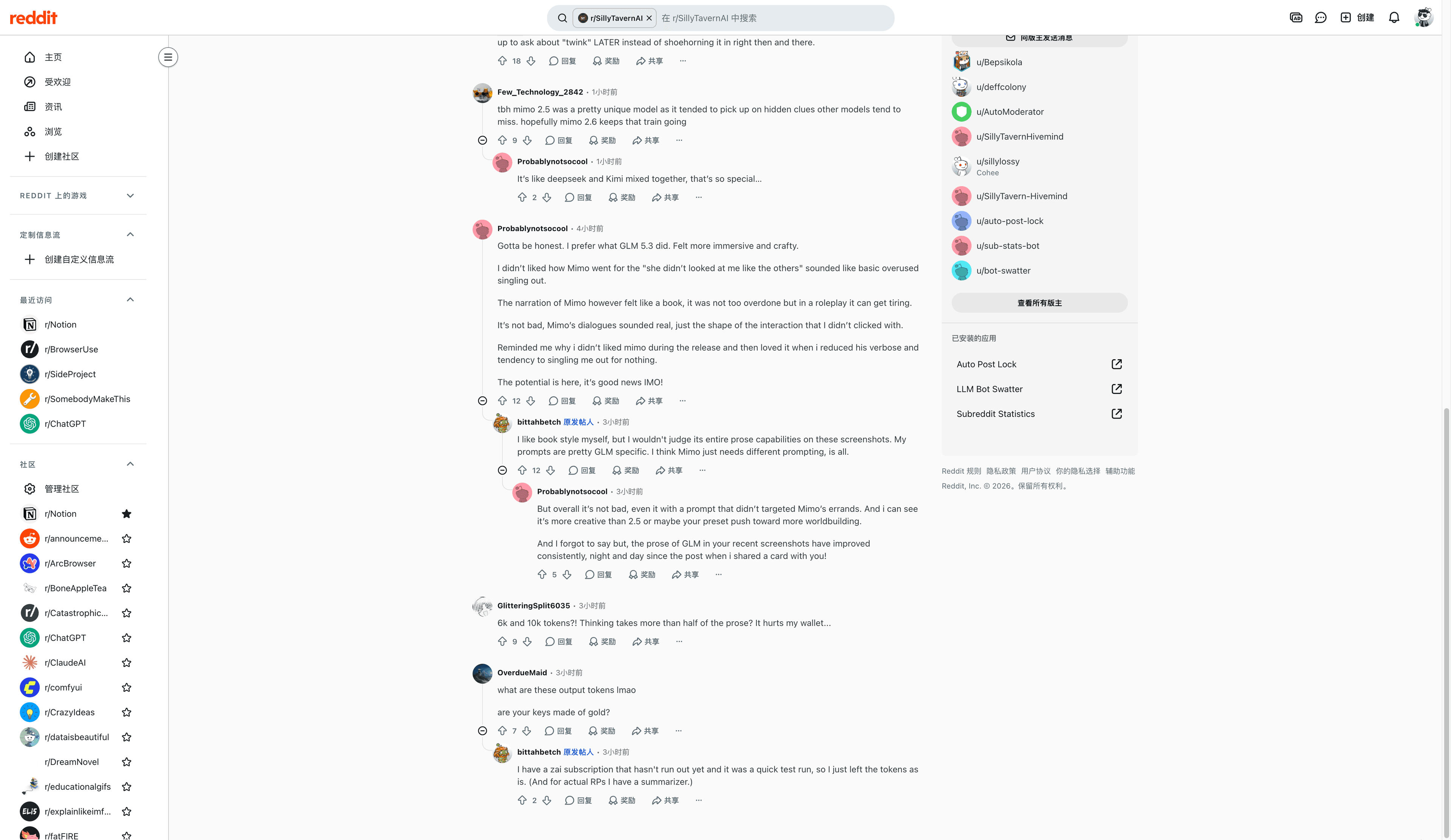
Reddit users hit the same wall within hours of launch:
"6k and 10k tokens?! Thinking takes more than half of the prose? It hurts my wallet..." — u/GlitteringSplit6035 (r/SillyTavernAI, 2026-09-22)
"what are these output tokens lmao are your keys made of gold?" — u/OverdueMaid (same thread)
Use the anchor to sort your workload: if the unit of work is a long run, buy the brains and eat the wait. If the unit of work is a human turn, the wait is the product.
What happened on real work, before the leaderboard
The most useful launch-day evidence is not a benchmark row. It is two small stories with specific tools and specific outcomes.
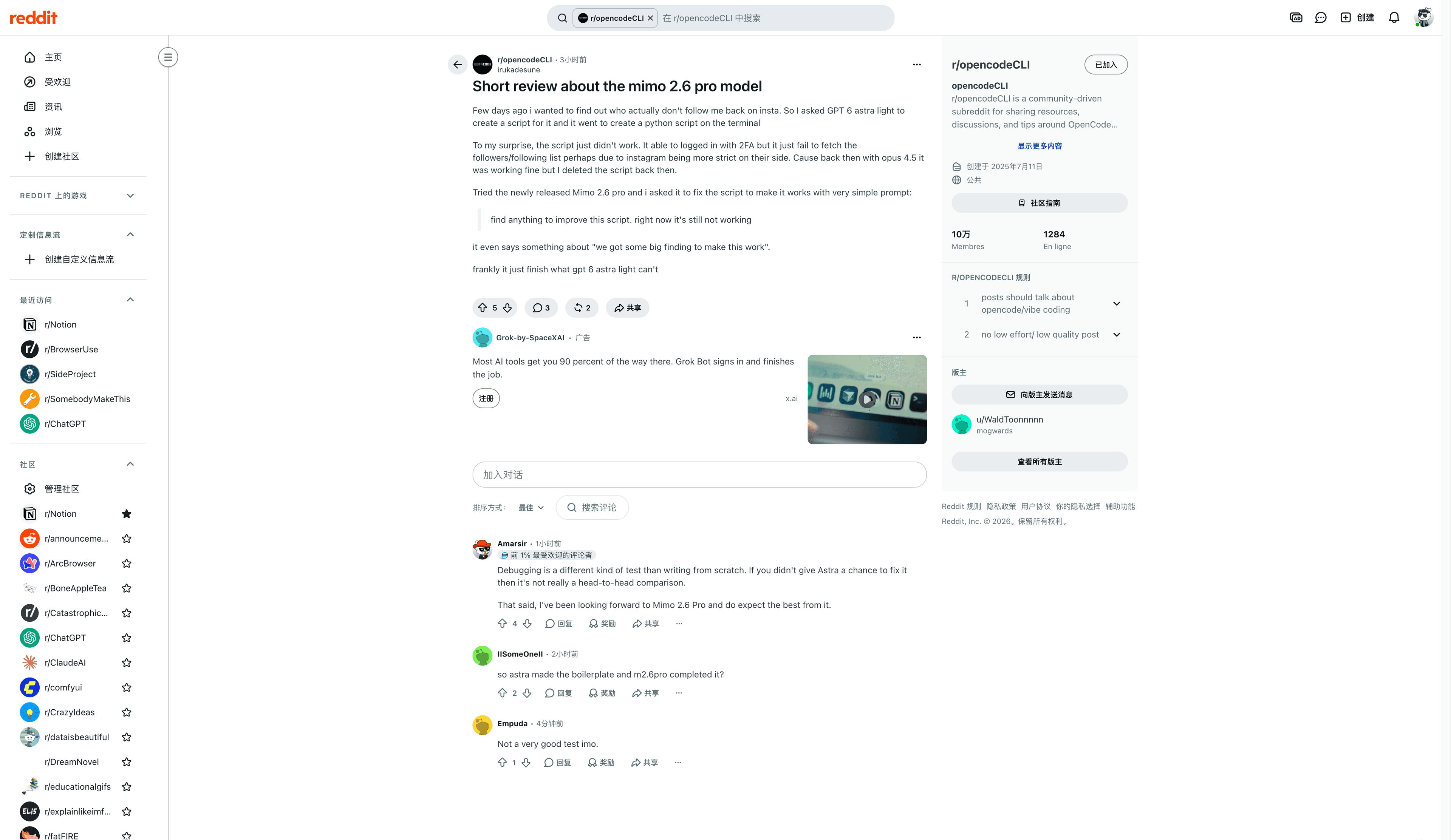
The win. u/irukadesune had a Python script that checks who does not follow them back on Instagram. GPT-6 Astra Light rewrote it and the script still failed at fetching the follower list. The prompt given to MiMo-V2.6-Pro was one line: "find anything to improve this script. right now it's still not working." It fixed it.
"frankly it just finish what gpt 6 astra light can't" — u/irukadesune (r/opencodeCLI, 2026-09-22)
The critique. The top reply points out what that story can and cannot prove:
"Debugging is a different kind of test than writing from scratch. If you didn't give Astra a chance to fix it then it's not really a head-to-head comparison." — u/Amarsir (same thread)
The loss. u/choiyoh assigned the same website UI/UX change to MiMo-V2.6-Flash and MiMo-V2.6-Pro in a terminal coding harness. Both started a grep loop and went nowhere.
"for 30 minutes no code was fixed." … "DS 4.1 Flash is still much better.." — u/choiyoh (r/CommandCode, 2026-09-22)
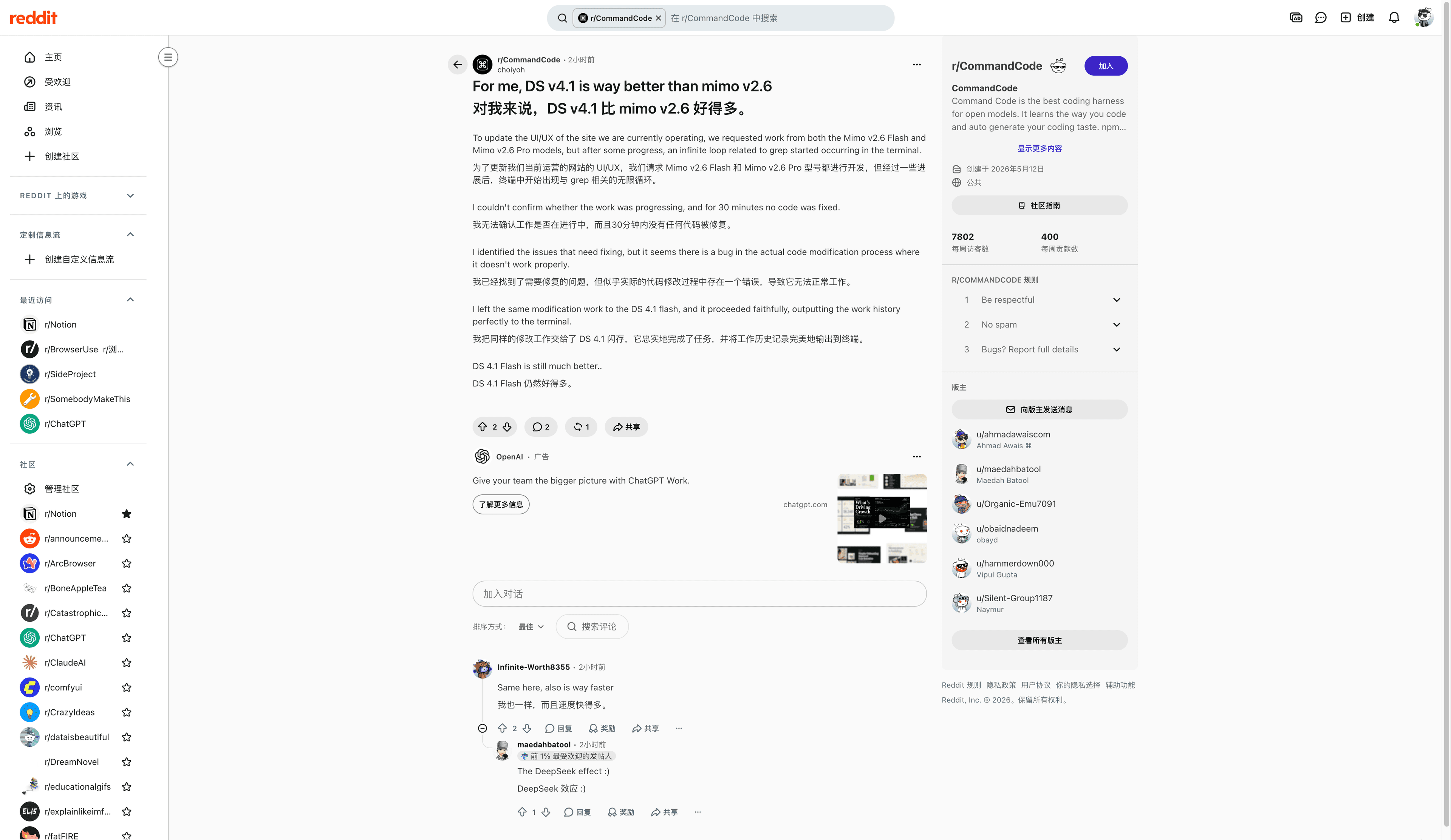
One run each, no logs, no repositories, no token counts. They establish that both outcomes exist in the wild — a rival-failing debug fix and a thirty-minute tool loop — and nothing about how often either happens. That is exactly the gap benchmarks are supposed to fill. Let us see how much they actually fill it.
The benchmarks, and how much to trust them
Xiaomi's technical report (Table 3, vendor-reported, checked 2026-09-22) compares Pro against its own family and three closed flagships. Values recorded as reported; - means not provided:
| Benchmark | MiMo-V2.6-Pro | MiMo-V2.6-Flash | MiMo-V2.5-Pro | Claude Opus 5 | GPT-5.6 Sol | Claude Fable 5 |
|---|---|---|---|---|---|---|
| DeepSWE v1.1 | 71.9 | 67.9 | 19.0 | 74.0 | 73.0 | 70.0 |
| AutomationBench v1.0.6 | 53.1 | 52.3 | 16.0 | 50.3 | 45.8 | 46.2 |
| Toolathlon-Verified | 76.9 | 73.6 | 49.1 | 80.6 | 74.9 | 77.9 |
| Agents' Last Exam | 31.6 | 27.6 | 13.2 | 31.6 | 30.8 | 25.7 |
| Terminal Bench 2.1 | 89.9 | 87.6 | 65.2 | 89.1 | 88.8 | 84.3 |
| Terminal Bench 4.0 | 34.9 | 28.8 | 1.5 | 49.0 | 39.9 | 42.4 |
| OSWorld-Verified | 82.0 | 80.8 | - | 83.4 | 83.0 | 86.0 |
| JobBench | 62.0 | 61.2 | 25.0 | 65.7 | 45.4 | 57.4 |
| MiMo Visual Coding (in-house) | 72.3 | 71.5 | - | 70.0 | 73.4 | 69.1 |
Now the cold water, in three parts.
The measurement conditions are thin. The report publishes aggregate scores but no per-question logs, prompts, seeds, sample counts or confidence intervals. Three rows (MiMo Code Bench, MiMo Cyber Bench, MiMo Visual Coding) are Xiaomi's own benchmarks. The widely repeated "58.4 → 72.6 on DeepSWE" is a training-curve change inside one RL run — about 30 steps and $2.62M of compute — not a model-versus-model comparison. The official release page's "comparable to Claude Opus 5 and GPT-5.6 Sol on most Agent benchmarks" is positioning, and its "1/20 to 1/60 the price" framing omits the comparison set and the token accounting.
The community distrusts training-time leaderboards by default:
"We'll see how it works on real code. DeepSeek-V4.1-Flash was technically a lot more capable than GLM-5.3-Flash but it's worse in the real-world … The benchmarks don't care if it's a code spaghetti." — u/lilian_moraru (r/LocalLLaMA, 2026-09-22)
"i mostly care about roleplay so those benchmark wins dont mean much if it still forgets details after a few messages." — u/Pure-Summer2818 (same thread)
Independent sources agree on shape, not on precision. Artificial Analysis ran its own hardware and gives MiMo-V2.6-Pro 46 on the Intelligence Index (v4.3.2, 10 evaluations), while Arena's Code Arena WebDev row shows an AutoEval score of 1628 (+18/-18) with Rank and Votes both N/A — that is a scripted result on a leaderboard of blind votes, and it cannot be written as "ranked Nth". Amarsir's methodological point above applies to every row here: debugging is not authoring, one harness is not your harness, and a directional signal is not a ruler.
What survives the dousing: the before/after gap over V2.5-Pro (DeepSWE 19.0 → 71.9) is too large to be a rounding trick, and the report's harness-transfer experiment (four training harnesses, then held-out Codex, Claude Code and mini-swe-agent, roughly 50% → 66% pass rate) is the kind of evidence that matters for real deployment. Just do not read any single row as your success rate.
Where MiMo-V2.6-Pro is genuinely good
The writing is the surprise
Coding models are rarely praised for prose first. On launch day, the loudest praise came from long-form roleplay writers, a crowd that punishes repetitive patterns hard.
"honestly I'm really enjoying it for RP so far. The responses have been surprisingly good, especially when it comes to keeping the flow of a scene going and actually giving me something interesting to work with instead of falling into the usual repetitive RP patterns." — u/Electrical_Mode_2489 (r/SillyTavernAI, 47 upvotes)
Another writer comparing it head-to-head with GLM 5.3 liked the dialogue and the restraint: the model "set[] up to ask about 'twink' LATER instead of shoehorning it in right then and there." If you write for a living — fiction, marketing copy, long interactive stories — this upgrade may matter more to you than any coding score.
The boundary: taste is personal. In that same comparison thread u/Probablynotsocool preferred GLM 5.3 ("Felt more immersive and crafty") and found MiMo's narration "like a book … in a roleplay it can get tiring." Two skilled users, opposite verdicts, same screenshots.
Automation and tool workflows beat the flagships on paper
This is where the benchmark shape genuinely favors MiMo. AutomationBench v1.0.6: 53.1, ahead of Claude Opus 5 (50.3) and GPT-5.6 Sol (45.8). Toolathlon-Verified: 76.9, within three points of Opus 5 and ahead of Sol. Terminal Bench 2.1: 89.9, the top score of the compared set. JobBench 62.0 doubles GPT-5.6 Sol's 45.4.
The engineering detail behind those rows matters for deployment: the RL stage trained across four minimal harnesses and then checked transfer on three unseen ones (Codex, Claude Code, mini-swe-agent). Models that only work in their own harness are demos; a model that transfers is infrastructure. For anyone building multi-step tool loops — browser agents, CI fixers, internal automations — this is the strongest reason to trial it.
Frontier-tier intelligence at commodity pricing, with MIT weights
The Artificial Analysis snapshot checked on 2026-09-22 puts MiMo-V2.6-Pro at 46 on the Intelligence Index — level with Grok 4.7 (46) and below Claude Opus 5 (51) — while it is the cheapest model per index task of the compared set at $0.13. List rates are $0.435 input / $0.87 output per million tokens, and prompt cache hits drop to $0.0036, a 120× discount that quietly transforms multi-turn economics (pricing math here; for a budget cross-check against another recent open flagship, see the Kimi K3 pricing breakdown).
A community comparison of the same-day flagships makes the trade concrete: against Grok 4.7, MiMo offers a 1M-token context versus 500k, roughly 125 tokens/s versus 42, MIT weights versus closed, and $0.435/$0.87 versus $2/$6 — with both models at 46 on the index. If your constraint is capability per dollar — batch agents, research pipelines, agentic reasoning workloads — this is the value proposition of the release.
Where it bites
The thinking tax: you pay for silence twice
Once in waiting, once on the bill. 18.17 seconds to the first answer token; roughly 37,520 reasoning tokens against 26,756 answer tokens per index task, all billed as output at $0.87 per million. On reasoning-heavy prompts, community users report thinking exceeding half of total generation — the raw material of those "6k and 10k tokens?!" reactions above.
Xiaomi's official escape hatch is mimo-v2.6-pro-ultraspeed: up to 20× generation speed at exactly 10× the price ($4.35 input / $8.70 output). That is a real option for interactive products with a budget, but it re-prices the model into frontier territory, which erases the headline value proposition. There is currently no "think less" switch documented in the official API materials — the pricing analysis works through the numbers.
Tool loops can run away
The grep-loop report above is the shape of failure that hurts most in agentic work: not a wrong answer, but no answer, with meter running. The technical report is honest that its own training infrastructure hit OOM events, unreachable graders and partial-rollout failures, and it publishes no unified failure rate per benchmark. One Reddit commenter under the same report corroborated the pattern ("Same here, also is way faster" — about the rival). If you adopt it for unattended runs, budget supervision, tool-call timeouts and a fallback model — the same discipline you would apply to any agentic browser stack.
Compliance, endpoints and deployment weight
Three practical snags that do not show up in scores:
Data handling. Launch-day users flagged that the only live endpoint is first-party and, in their reading, not zero-data-retention compliant: "very interesting, but 2.6 Pro's only endpoint is non-ZDR compliant" (u/total_ty), answered by "How trustworthy is a random tag on a website, honestly? How do we verify none of our data has been retained by the endpoint?" (u/starliteburnsbrite). Open weights mean third-party hosting is coming — "the weights are already up on huggingface" — but today the compliant route is self-hosting or a provider whose terms you have read.
Self-hosting is heavy. 1.02T sparse MoE; official vLLM examples assume
--tensor-parallel-size 8. This is not a laptop model. Budget multi-GPU nodes and read the parameter-count fine print first.Version and pricing churn. V2.5 endpoints die on 2026-10-21 (migration context); Artificial Analysis numbers drifted within the same day as measurements refreshed. Pin versions, and re-check rates before budgeting.
What people actually said
Launch-day conversation splits along two axes rather than one.
Axis one: delighted versus burned. The debug-win story and the grep-loop story are four hours apart on Reddit, and both rings filled instantly. u/irukadesune's one-line prompt fixed what a rival frontier model could not; u/choiyoh lost thirty minutes to a terminal loop and moved to DeepSeek V4.1 Flash. The enthusiasts read the same evidence and extrapolate — "I believe in mimo, mimo will replace GLM as THE rp model" (u/stopaskingforloginn) — while the skeptics ask for logs.
Axis two: thrilled about the price, annoyed by the thinking. The launch thread's first shock was economic — "They kept the prices!? It's over." (u/Pink_da_Web) — and then the token counts arrived:
Even the writing crowd, the model's happiest constituency, disagrees with itself:
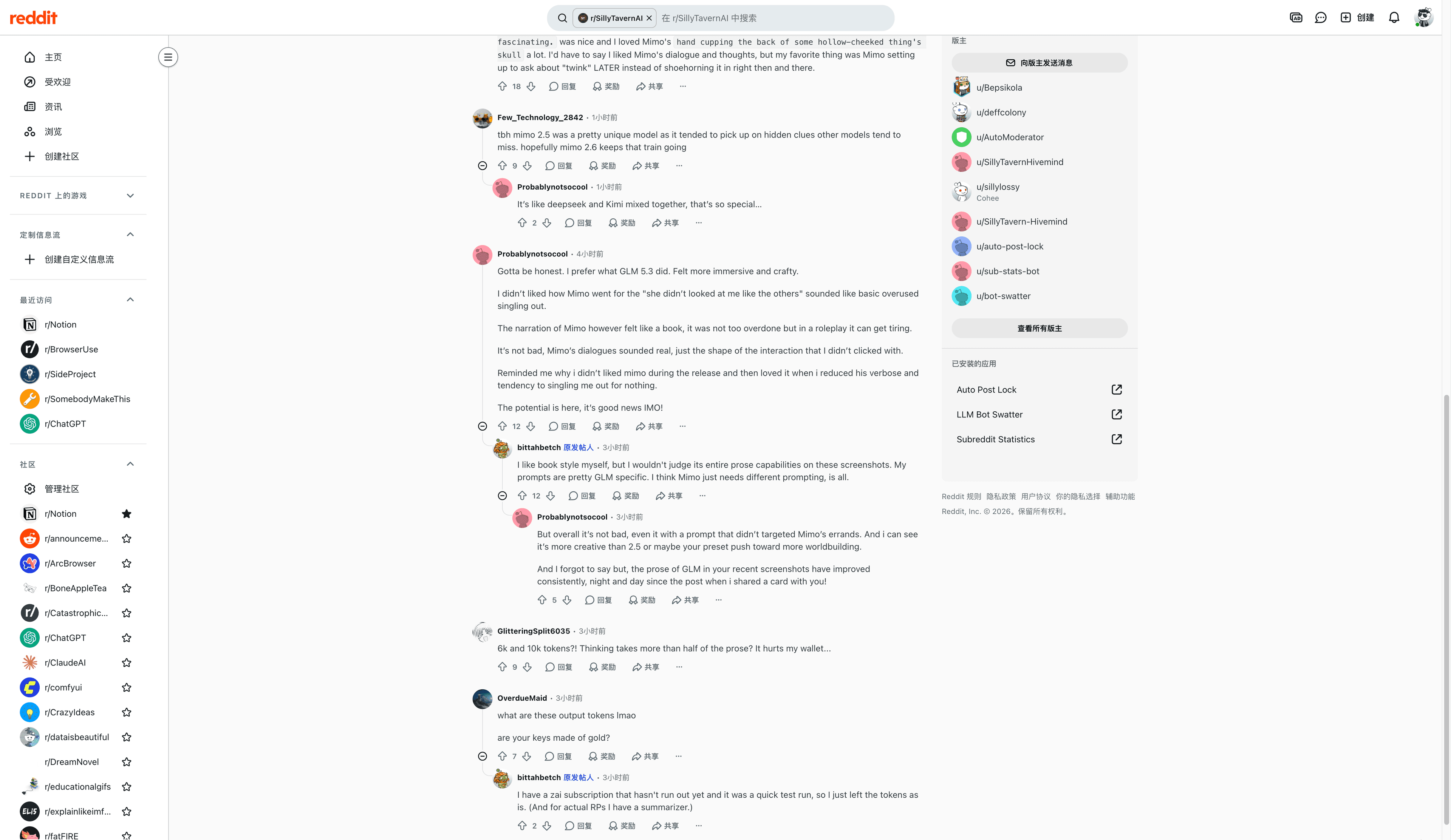
Where this review lands: u/Amarsir landed in the same place — enthusiasm for the model, impatience with sloppy comparisons. The pattern across nine verified voices is consistent with the numbers: serious capability, serious friction in the waiting and the bill, and tool-loop reliability unproven at n=1 in both directions.
The verdict: choose by workload, not by the score
| Workload shape | Verdict | Why | Main caveat |
|---|---|---|---|
| Long agentic coding runs, batch fixes, unattended tool loops | Trial it | AutomationBench 53.1 beats Opus 5 and Sol; harness transfer evidence; 1M context; $0.13 per index task amortizes the wait | Grep-loop failures are real; supervise runs and keep a fallback model |
| Interactive chat, roleplay and long-form writing | Yes, with caveats | The prose praise is specific and repeated; 1M context keeps long scenes coherent | 18s first answer + thinking tokens inflate both latency and cost per scene; some writers prefer GLM 5.3's style |
| Computer-use and browser automation | Strong candidate | OSWorld-Verified 82.0, JobBench 62.0, visual coding 72.3 (in-house); omnimodal input | Vendor rows dominate the evidence; verify on your own task set first |
| Regulated data / zero-retention requirements | Not yet | MIT weights allow self-hosting or compliant providers in principle | Today's first-party endpoint is the only listed route and its ZDR status is unverified |
| Single-GPU or laptop local inference | No | 1.02T sparse MoE; official serving examples assume 8-way tensor parallel | Flash-family or smaller distills are the realistic local options |
Two time-sensitive notes. First, Grok 4.7 launched the same day at a matching 46 on the Artificial Analysis index, and a community side-by-side found "neither one decisively dominates the other" — the comparison you should run is the one on your workload, ideally with two candidates answering side by side. Second, legacy V2.5 endpoints shut down on 2026-10-21, so migration planning is not optional if you built on them.
A practical route: run it where the work happens
Everything in this review points at one pattern: the wait hurts humans and not agents, the thinking tokens punish chatty single turns and reward sustained runs, and the tool-loop risk demands supervision. That profile is a poor fit for a chat box bolted onto a document, and a good fit for a browser-level workflow that reads pages, holds 1M tokens of context and works while you do something else.
That is the workflow Tabbit Browser is built around — multi-page research, extraction and automation as an agentic browser task rather than a single prompt. The honest boundary: this review round could not verify that MiMo-V2.6-Pro currently appears in Tabbit's live model picker, and no hands-on Tabbit run is claimed here. Check your account's model selector before planning around it, the same way you would verify any model's availability in any client.
If the profile above matches your work — long runs, heavy context, tool calls, cost discipline — the right question is not "which model scores highest" but "which model finishes my job". Run a fixed task set of your own across two candidates and count finished work per dollar. That test beats any leaderboard row in this article.
 Tabbit Browser
FAQ
Is MiMo-V2.6-Pro worth using?
Yes for long agentic coding, automation and creative writing workloads where completion quality matters more than instant responses. Think twice if you need fast first responses, verified zero-data-retention endpoints or a single-GPU local deployment, and compare at least one rival before committing.
How long does MiMo-V2.6-Pro take to answer?
Artificial Analysis measured 18.17 seconds to the first answer token on the Xiaomi provider with a 10,000-input-token workload, checked September 22, 2026. After the wait it generates quickly at about 125 output tokens per second, so most of the delay is silent reasoning time before the first token.
Do thinking tokens cost money on MiMo-V2.6-Pro?
Yes. Xiaomi bills internal reasoning tokens as standard output tokens at $0.87 per million. Artificial Analysis recorded roughly 37,500 reasoning tokens against 26,800 answer tokens per index task, so a large share of the output bill pays for thinking you never see.
How does MiMo-V2.6-Pro compare with Grok 4.7 and Claude Opus 5?
On the Artificial Analysis Intelligence Index checked September 22, 2026, MiMo-V2.6-Pro and Grok 4.7 both score 46 while Claude Opus 5 scores 51. Xiaomi's own report puts DeepSWE v1.1 at 71.9 versus about 73 for Grok 4.7 and 74 for Opus 5, at $0.435 per million input tokens versus $2 and $15 respectively.
Is MiMo-V2.6-Pro open source, and can I run it myself?
The weights are MIT licensed and downloadable from Hugging Face, which is stronger access than most frontier models offer. Self-hosting is heavy: the checkpoint is a 1.02T-parameter sparse MoE with 42B active parameters, and official vLLM and SGLang examples assume multi-GPU setups. Parameter summaries differ across sources, so verify the exact checkpoint before sizing hardware.
Can I use MiMo-V2.6-Pro in Tabbit Browser?
Tabbit runs browser-level AI workflows with models selected from your account's live model picker. This review could not verify whether MiMo-V2.6-Pro currently appears in that picker, so check your own selector and account terms before planning around it. Do not assume availability from a model page alone.