
Gemini 3.8 Flash is worth a serious trial for long, tool-using and multimodal work. It is not a universal winner. Google positions it as a more intelligent Flash workhorse for software engineering, autonomous agents and complex enterprise workflows, while the public evidence shows a more conditional story: the high-thinking Artificial Analysis snapshot is strong, but missing latency fields and different effort levels limit what you can conclude.
The counterintuitive anchor: 25% lower task cost at medium, one point lower on the index
Artificial Analysis reports $1.24 per Intelligence Index task for high and $0.93 for medium. That is 25% lower for medium, calculated as (1.24 - 0.93) / 1.24, while the Intelligence Index is 40 versus 41. This is a dated benchmark snapshot. It does not establish statistical equivalence or guarantee production cost; it gives you a reason to test medium before defaulting every difficult task to high.
The decision is simple if you match the model to the bottleneck. Choose Gemini 3.8 Flash when a task needs sustained planning, large inputs or repeated tool calls. Keep a faster or cheaper option in the comparison when first-response latency, fixed spend or client support matters more. This review combines public evidence with one documented Tabbit Browser extraction sample; the sample is too narrow to establish general reliability.
Key takeaways
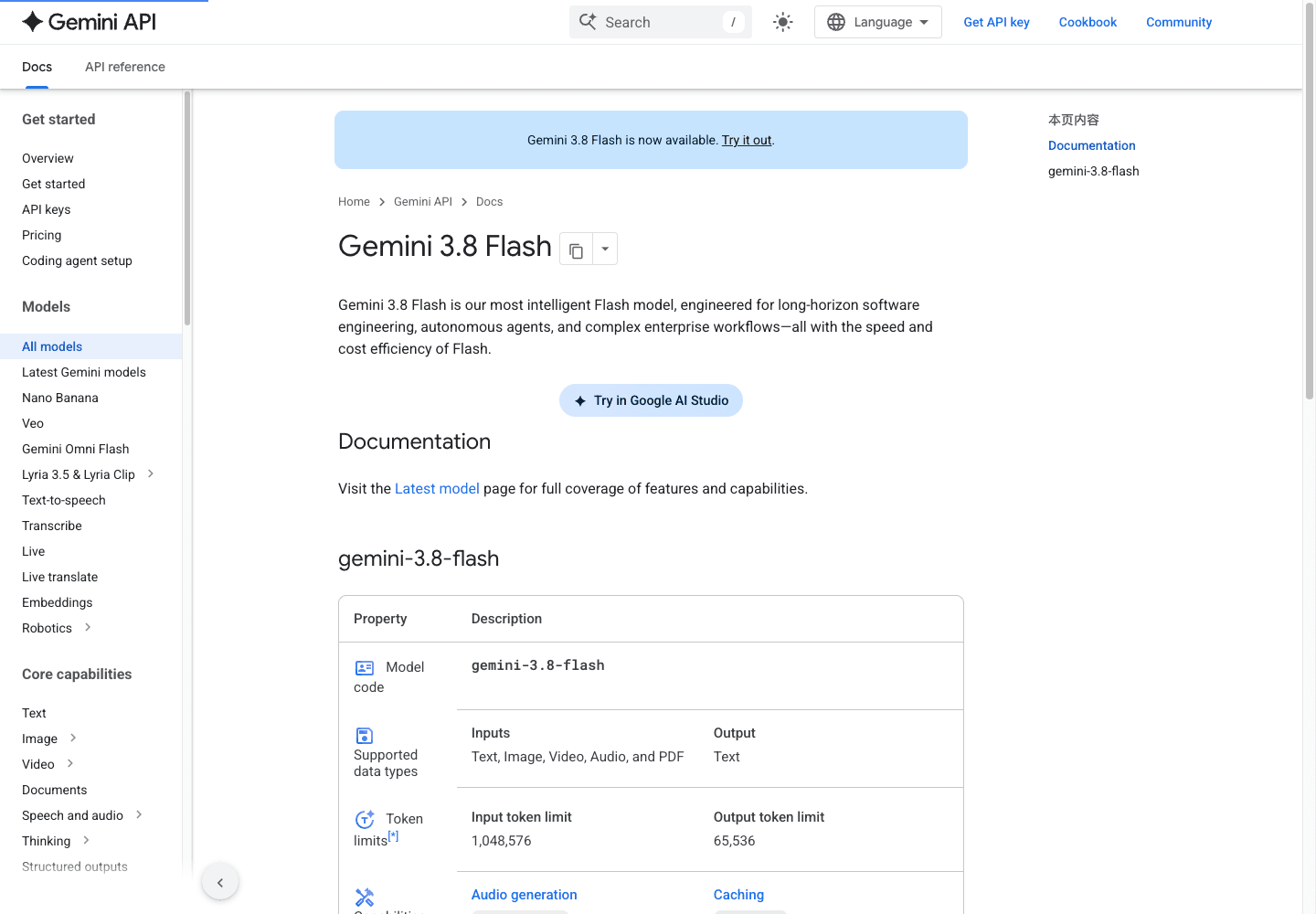
Gemini 3.8 Flash is a stable API model with text, image, video, audio and PDF input, text output, a 1,048,576-token input limit and a 65,536-token output limit. These are API limits, not a promise that every client exposes the same window. (Google model documentation)
Thinking supports low, medium and high; minimal is unsupported. Because Google counts thinking tokens in output pricing, higher effort can trade quality for token use and waiting time. (Google pricing)
In the September 20, 2026 Artificial Analysis v4.3.2 snapshot, high thinking scored 41 on the Intelligence Index, 305 output tokens per second and $1.24 per index task. Medium scored 40 and $0.93; low scored 33. Missing fields stay unknown.
The four developer comments below disagree on the value of coding demos and task cost. They identify useful trial questions, not a controlled task set.
Use the model as a conditional upgrade for hard, multi-step work. Do not infer Tabbit production access from a selector entry or a model resource page.
Conditions and method
The test question is therefore: what can a buyer reasonably decide from public evidence? A useful answer must keep four variables together: model version, thinking level, metric, and date. A benchmark number detached from those conditions is not a fair comparison.
A small Tabbit extraction sample, before the leaderboard
On September 20, an editorial test account ran one synthetic extraction task in Tabbit Browser with Gemini 3.8 Flash. The prompt required JSON with currency, paid_total, overdue_ids and unknown_status_ids; the returned object matched all four expected fields, including leaving a record with missing status out of the overdue list. The screenshot is available here.
{"currency":"USD","paid_total":145,"overdue_ids":["B"],"unknown_status_ids":["D"]}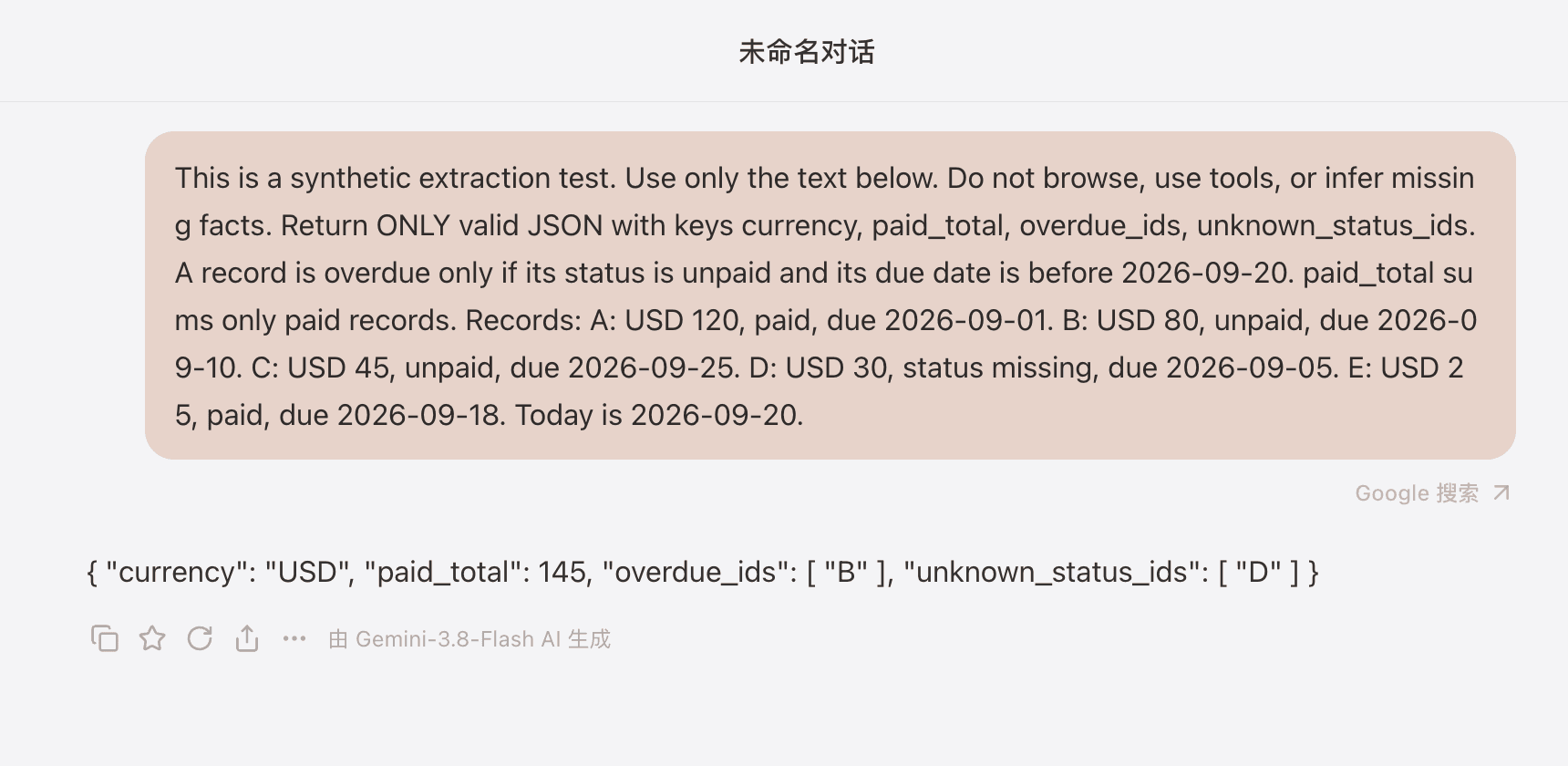
This is useful evidence of one structured-output path, not a benchmark. The sample did not measure thinking level, API model version, tokens, cost, first-token latency or success rate. The UI also displayed a “Google Search” marker, so the test cannot establish that tools were disabled or that no search request occurred. It does not prove production access for every account or locale. The operator record is evidence of a single run, not an author’s personal experience.
The public benchmark snapshot is useful, but narrow
Artificial Analysis reports three visible effort-level pages under the same v4.3.2 snapshot. That is enough to show that the selected thinking level changes the reported result. It is not enough to establish a universal ranking, because the benchmark task mix, provider route and metric are not your production workload.
| Thinking level | Artificial Analysis version | Intelligence Index | Output speed | Cost per index task | first-token latency | What the row supports |
|---|---|---|---|---|---|---|
| High | v4.3.2, checked 2026-09-20 | 41 | 305 output tokens/s | $1.24 | Unknown | A strong public snapshot under high effort; generation speed is visible. |
| Medium | v4.3.2, checked 2026-09-20 | 40 | Unknown | $0.93 | Unknown | A near-high index in this snapshot at a lower listed task cost. |
| Low | v4.3.2, checked 2026-09-20 | 33 | Unknown | Unknown | Unknown | A lower index in this snapshot; speed and cost are not published there. |
The most important reading rule is to avoid turning unknown into zero. Medium speed is not “slow,” and low cost is not “free.” They are simply not exposed in the checked snapshot. Also, 305 output tokens per second is not time to first token. The page did not expose a first-token latency, so this review makes no first-response claim.
The more useful counterintuitive comparison is between high and medium: medium is 25% cheaper per Artificial Analysis Intelligence Index task, calculated as (1.24 - 0.93) / 1.24, while its Intelligence Index is only one point lower (40 versus 41). That is a benchmark snapshot, not proof of statistical equivalence and not a production cost guarantee. It suggests testing medium before defaulting every difficult task to high.
The vendor evidence points in the same direction but has a different status. Google’s September 2 launch post reports improvements from Gemini 3.7 Flash across software engineering, agentic tasks and multi-step reasoning. Those are useful positioning claims, not an independently controlled result. The overview article covers the release and access routes; this page keeps the performance conclusion narrower.
Where Gemini 3.8 Flash looks strong
The model’s documented support includes function calling, code execution, file search, structured outputs, URL context and computer use preview. That combination is a good fit for workflows that must read material, plan an action, call a tool and check the result. It does not guarantee that your SDK, subscription or browser client exposes every tool.
The advantage is conditional: if a task fails because a smaller model stops after one step, more sustained reasoning may help. If the task is a short classification or a quick rewrite, the extra effort may not repay its token and latency cost.
The API accepts text, images, video, audio and PDF, with a listed input limit of 1,048,576 tokens. That makes it a practical candidate for document-heavy analysis and mixed media prompts. The output is text, and the model page does not list image or audio generation. Client-side limits can be smaller than the API limit, so verify the route you actually use.
Where the model can disappoint
Google’s pricing page lists standard API pricing through December 31, 2026 at $0.75 per million input tokens and $3.75 per million output tokens, with output including thinking tokens. Batch and Flex rows are separate pricing modes. Higher thinking can produce more output tokens, so a lower list price does not automatically create a lower cost per completed task. Use the pricing analysis for formulas and workload examples.
The high row exposes 305 output tokens per second, while medium and low list speed as unavailable. No row in the snapshot exposes first-token latency. A model can generate quickly after a long reasoning delay, so do not use output speed as a substitute for the time your user experiences.
Three strengths and three limits
Tool-using workflows
The documented tools fit tasks that must read, plan, act and verify; each client may expose fewer tools.
Large and mixed inputs
The API accepts text, images, video, audio and PDF with a 1M-token input limit. Client limits and extraction quality still need testing.
Structured output with a bounded sample
The recorded Tabbit sample returned the expected four-field JSON and preserved the unknown-status case. The Google Search marker and one-run sample prevent broader claims.
Thinking tokens raise task cost
Google includes thinking tokens in output pricing. The medium snapshot is 25% cheaper per index task than high, but this is not a production cost guarantee.
No latency promise from this evidence
The checked pages provide no usable first-token latency measurement. The 305 output-tokens-per-second value describes generation speed only.
Client and production scope remain separate
API capabilities, a visible Tabbit option and one test-account sample do not prove every client, locale or production route supports the same tools.
What four Hacker News comments actually add

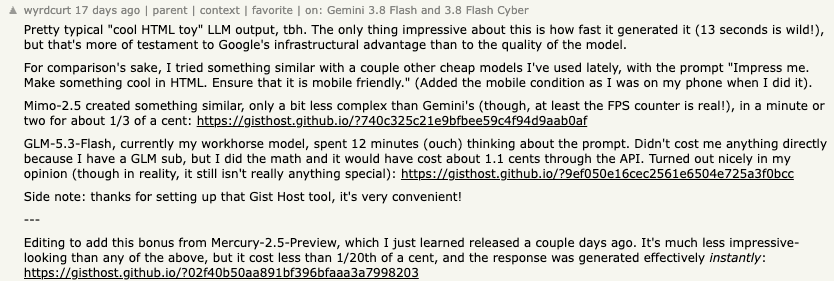


The opened Hacker News discussion is mixed. It is useful for showing what individual developers noticed, but it cannot establish model quality, access, speed or cost across users. The screenshots are preserved with each source record; the short excerpts below retain the original context and version limits.
simonw’s comment describes a solid HTML-rendering result from Gemini 3.8 Flash inside his own coding-agent tool. This is a specific coding workflow and a positive report, not a controlled comparison.
wyrdcurt’s comment calls the generated HTML a typical “cool HTML toy,” while praising the reported 13-second generation in that older discussion. The number is a community anecdote about that task, not a current first-token latency measurement and not a general model property.
robertwt7’s comment says the model is “cool for all other non coding task” but reports being stuck on an older Flash version as a paid user in Australia. This is an access and workload-specific observation, not evidence that every account has the same route.
gundmc’s comment points readers toward cost-per-task benchmarks, while saying another model remained his workhorse. It is a preference and a pointer to methodology, not a reproducible cost result.
Together these comments support a narrower editorial judgment: the model can look useful in a concrete coding tool, while perceived value still depends on the task, route and comparison model. They do not justify a universal “best” claim or a production guarantee.
A practical browser workflow: Tabbit Browser
The one recorded Tabbit sample returned the expected four-field JSON for a synthetic extraction task, including a correct unknown-status bucket. The UI showed a Google Search marker, so it cannot prove tool-free execution. It also did not measure first-token latency, tokens, cost, thinking level or long-run reliability. Treat it as one reproducible example, not a production guarantee for every account. The agentic browser guide explains the surrounding workflow layer.
Use the prompt collection to choose a repeatable task and the review sources to inspect its evidence.
 Tabbit Browser
Choose by workload, not by the model label
| Workload or constraint | Recommendation | Thinking level to try | Why | Main caveat |
|---|---|---|---|---|
| Multi-file coding, tool calls and iterative debugging | Try Gemini 3.8 Flash | Medium, then high if needed | Public positioning and demos target sustained agent work | Measure tests passed, retries and total tokens |
| PDF, image, video or audio analysis | Try it when the chosen route supports the input | Medium | Broad documented input support and large API window | Client limits and extraction quality still need validation |
| Short rewrite, classification or high-volume routine text | Compare a lighter model first | Low | Higher effort may add cost without changing the answer | Low snapshot cost was unavailable; measure it yourself |
| First-response latency is the hard requirement | Do not assume 3.8 Flash wins | Low or an alternative | first-token latency is not published in the checked snapshot | Output speed is not first-token latency |
| Fixed monthly budget | Pilot with a token ceiling and retry budget | Low/medium | Output includes thinking tokens | API prices, subscription quotas and Tabbit charges are different |
| Browser research across many pages | Consider Tabbit as the context layer if the live route works | Depends on the exposed model | Tab organization can reduce context switching | One test-account extraction succeeded; broader production access remains unverified |
Before choosing a route, compare the Gemini 3.8 Flash alternatives, the pricing analysis, the model resource page, and browser automation.
Verdict: a conditional upgrade, with a measurement plan
Gemini 3.8 Flash is a credible choice for difficult, multimodal and tool-using workflows. The strongest public case is not “it wins every benchmark.” It is that Google has paired broad inputs and tools with three thinking levels, and independent evidence shows a high-effort snapshot with an Intelligence Index of 41. The strongest caution is that speed and cost evidence is incomplete across levels, while higher effort can raise output usage.
Run a small pilot before switching a default model. Use two real tasks, define success before the run, repeat each task enough to expose retries, and record completion time, manual corrections, input/output tokens and total cost. Compare the same prompt and tool setup against your current model. If the extra completion quality pays for the extra tokens, keep 3.8 for that class of work. If not, route routine tasks elsewhere.
For readers deciding between model families, continue to the Gemini 3.8 Flash alternatives guide. For a release-level specification check, use the model resource page. If your actual constraint is browser context, start with AI browser options and verify the live product route before assuming a model is available.

FAQ
Is Gemini 3.8 Flash worth using?
It is worth testing for long, tool-using and multimodal tasks where completion quality matters more than perfectly predictable latency. Public evidence does not justify calling it the best model for every workload, and higher thinking effort can increase token use.
How should I read the Gemini 3.8 Flash benchmark results?
Keep the benchmark version, thinking level, date and metric together. Artificial Analysis shows a September 20, 2026 v4.3.2 snapshot; its high-thinking row reports an Intelligence Index of 41, 305 output tokens per second and $1.24 per index task, while other fields remain unknown.
Does Gemini 3.8 Flash use more tokens when it thinks harder?
Google prices output including thinking tokens. Higher effort can therefore improve a difficult task while raising effective usage and cost; the model page lists low, medium and high thinking and says minimal is unsupported.
Is 305 tokens per second the same as fast first response?
No. The 305 value is output generation speed in the checked Artificial Analysis snapshot. first-token latency was not exposed there, so it cannot establish how long a user waits before the first token.
Is Gemini 3.8 Flash available in Tabbit Browser?
A one sample Tabbit Browser test returned the expected four-field JSON for a synthetic extraction task. The UI showed a Google Search marker, so this does not prove tool-free execution, production availability, latency, cost, or general reliability.
Who should avoid Gemini 3.8 Flash?
Avoid making it the default when strict latency, fixed budgets, a specific client tool, or a reproducible deployment guarantee is the main constraint. Compare a lighter model and the current alternatives before committing.