
Inkling 2 Small's weights are available on Hugging Face under an Apache-2.0 license, but downloading them is only the first step. The official model card says local inference needs a GPU cluster with at least 500 GB of aggregate VRAM for NVFP4, or 800 GB for MXFP8. If that is outside your budget or infrastructure, a provider API is the more realistic route. Thinking Machines' release update · Official model card
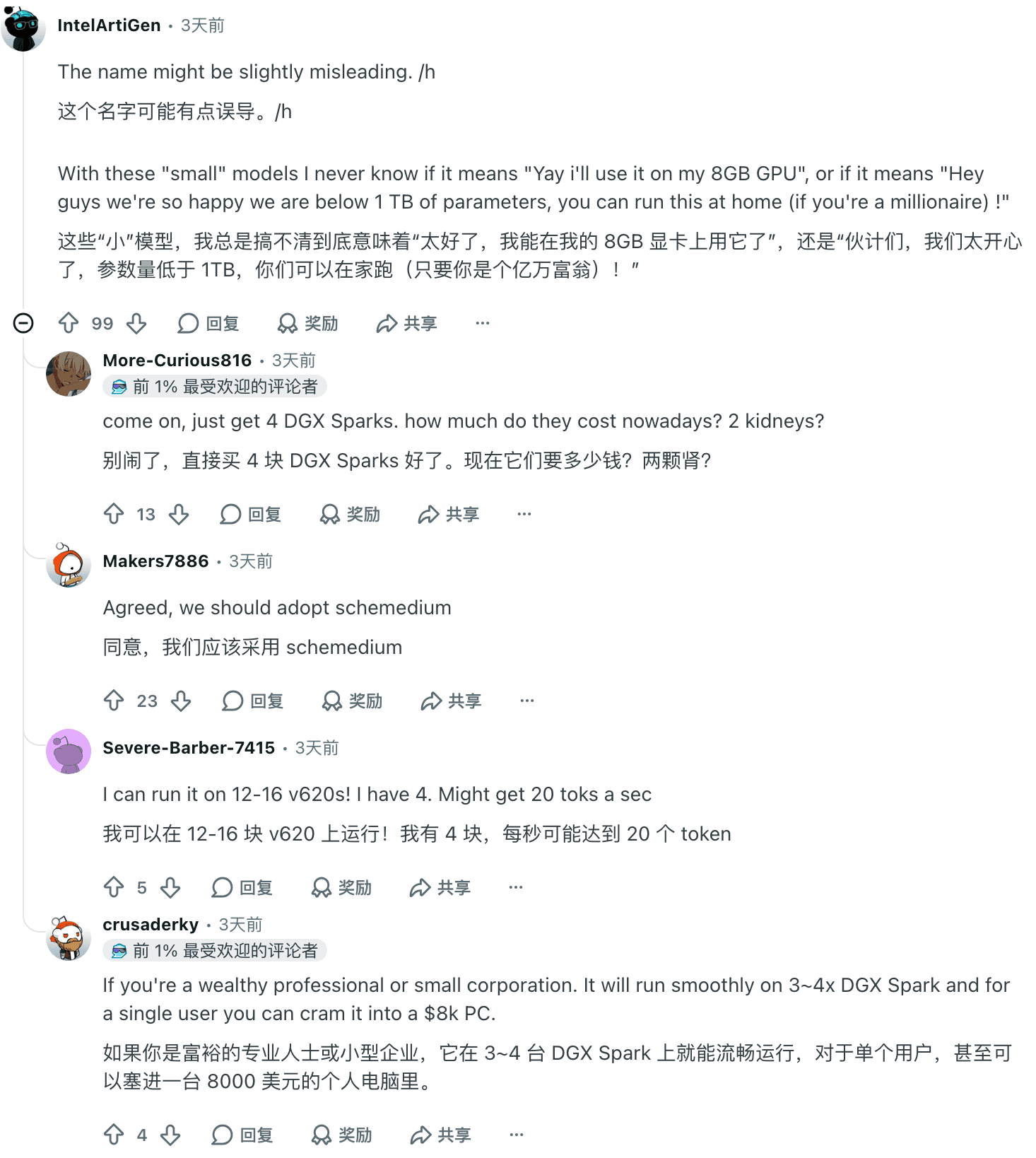
A Reddit commenter said the word "small" made them wonder whether the model would fit an 8 GB GPU. That is the right question to ask before pulling hundreds of gigabytes of model files. "Open weights" describes access to the parameters. It does not mean a typical desktop can serve the model. Read the original comment
Key takeaways
The Thinking Machines announcement says the weights became available on Nov 12, 2026, after external safety testing. The Hugging Face card labels them Apache 2.0.
Open weights do not mean that the whole training stack or training data is open source. Read the model's linked Acceptable Use Policy as well as the license.
The card specifies at least 500 GB aggregate VRAM for the NVFP4 checkpoint and 800 GB for MXFP8. The 17B active-parameter figure is not a desktop memory estimate.
Local inference uses a serving framework. An API provider runs the model for you, but its price, model ID, availability and data policy are provider-specific.
Tabbit Browser is not a model host. It can provide the browser side of a separate agent workflow, when that agent supports the Tabbit CLI or skill.
Inkling 2 Small access routes at a glance
| Route | What you get | What you need to check | Fits when |
|---|---|---|---|
| Download the weights from Hugging Face | Model files for a self-managed deployment or adaptation. | Apache-2.0 license, separate Model AUP, checkpoint files, GPU capacity, framework support. | You control the infrastructure and need to manage inference yourself. |
| Use a listed API provider | Hosted inference through a provider endpoint. | Current model ID, price, region, input limits, tool support, retention and service terms. | You want to try the model without operating a large GPU cluster. |
| Use Tinker | Thinking Machines' platform for sampling and fine-tuning. | Current access, platform terms, available model modes and pricing. | You want the publisher's training workflow or Tinker-hosted access. |
The routes are different. A download is a set of model files, not a running endpoint. An API is a hosted service, not proof that you have the weights. Fine-tuning is separate again. Thinking Machines says the weights are now on Hugging Face and its model card lists local-inference frameworks and third-party API providers. Its Tinker model documentation lists current Inkling 2 Small IDs, including a separate 256K variant; those identifiers belong to Tinker. The release update names other providers, while Cloudflare's model docs show one specific API route and mark it as requiring paid access. This article does not quote live rates or call a paid endpoint.
What the Apache-2.0 label does and does not tell you
The Hugging Face model card lists the license as apache-2.0. It also links a separate Model Acceptable Use Policy, which Thinking Machines says applies to accessing and using the model weights, parameters and associated materials. Read both before you use the model in a product. The license label alone does not answer every policy question.
"Open weights" is the careful description here. It means the model parameters can be downloaded under the stated terms. It does not establish that the training data, training code, or every part of the model-development process is public. Nor does the weights license set the price or data handling for a third-party API. Each service has its own terms.
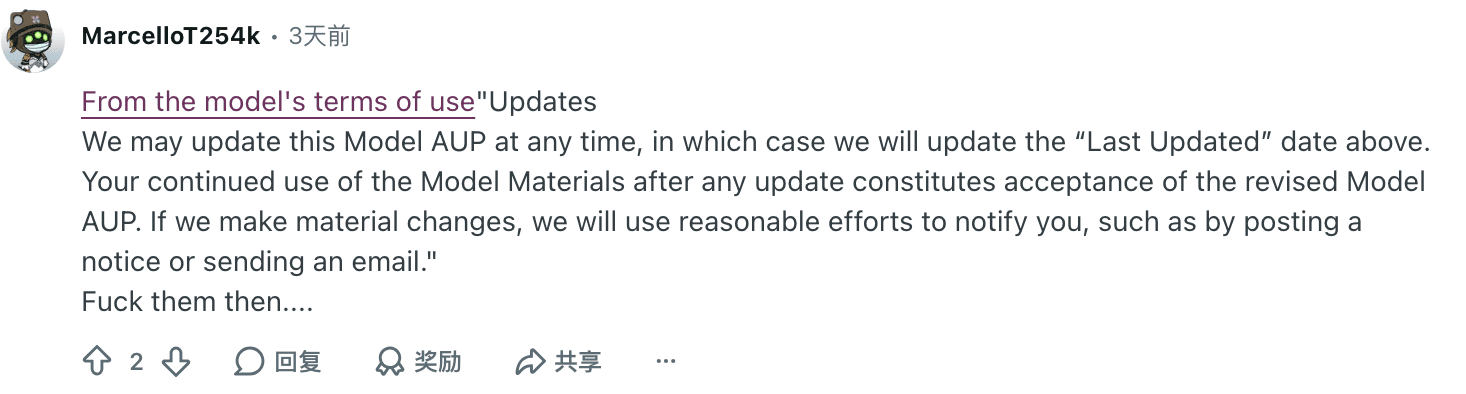
One commenter quoted the AUP's update language. That is a useful prompt to read the live policy instead of relying on a screenshot or summary. It is not a substitute for the current policy text. The AUP page is dated July 15, 2026, when checked on Nov 16. Original comment
Local inference requires a large GPU cluster
The card describes a 594-billion-parameter model with 17 billion active parameters. "Active" refers to the mixture-of-experts portion used for a token. It is not a claim that a 17-billion-parameter copy of Inkling 2 Small can be loaded into an ordinary desktop. For a deployment decision, use the publisher's checkpoint requirements, not the active count alone.
| Checkpoint | Publisher's aggregate VRAM requirement | Example configurations in the model card | Publisher's guidance |
|---|---|---|---|
| NVFP4 | At least 500 GB | 2× NVIDIA B300 or 4× NVIDIA H200 | Recommended by Thinking Machines; it says the model was trained in NVFP4. |
| MXFP8 | At least 800 GB | 4× NVIDIA B300 or 8× NVIDIA H200 | The card reports a 1–2 point evaluation gain over NVFP4, which it says is not meaningful for practical use. |
These are the model publisher's stated requirements and examples, not results from a test in this article. They refer to aggregate GPU memory, not ordinary system RAM. A single 8 GB graphics card is nowhere near the listed configurations. One release-thread commenter joked about running the model in a local datacenter after misreading the total parameter count; another asked when a GGUF version would be available. Neither comment proves what hardware will work or which formats are available. Local-datacenter joke · GGUF question

The model card lists SGLang, vLLM, TokenSpeed, Unsloth and Hugging Face as local inference options. Check the current framework recipe for the precise checkpoint, supported hardware and version requirements before downloading. The card recommends NVFP4; it does not say that every serving framework has identical setup steps or performance.
When an API is a better fit
If you do not operate a multi-GPU server, compare the hosted routes first. Thinking Machines lists NVIDIA, Fireworks, Together, Baseten, Nebius, Modal and Cloudflare as API providers. Cloudflare's docs use @cf/thinkingmachines/inkling-2-small, show both Workers and OpenAI-compatible endpoints, and state that paid access is required. That proves a Cloudflare option, not the current price or terms at every provider.
Before you connect an application, verify five things on the provider's own page:
Is the model available in your region and account?
What exact model ID and API format does the endpoint expect?
What does it charge, and what input or output limits apply?
What happens to prompts, images and outputs under its data policy?
Does the endpoint support the tools or modalities your application needs?
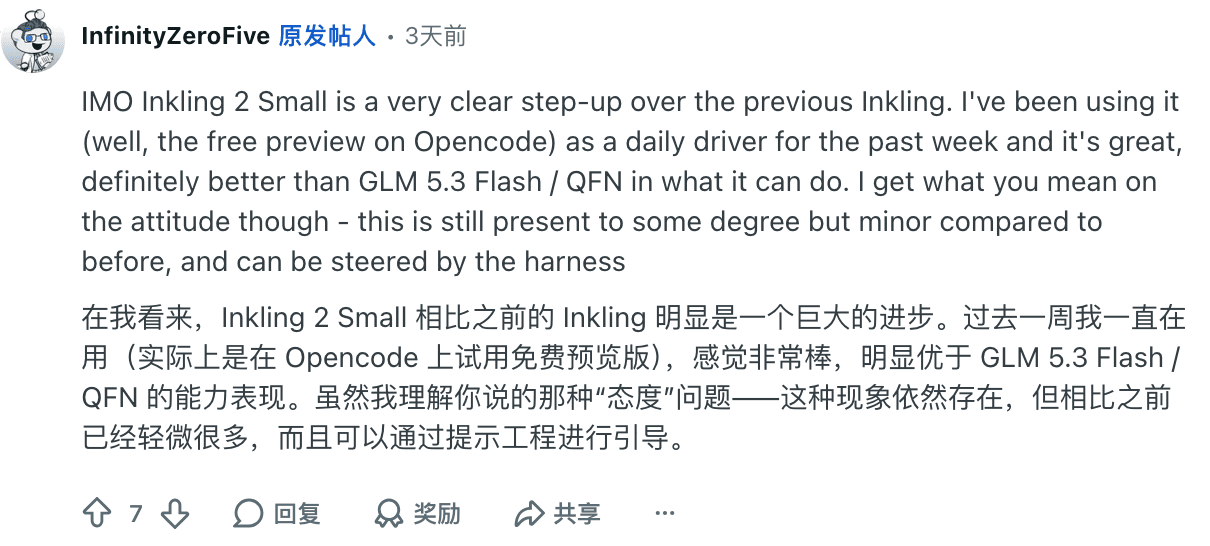
Do not assume an API is free because weights are downloadable. The model files and the service that runs them are different things. A Reddit commenter described using an OpenCode free preview as a daily model route. That is an anecdote about a hosted preview, not evidence of local inference or current route availability. Original comment
Choose a route before you download
Use this order to avoid a large download that cannot be served on your hardware:
Read the live terms. Check the Apache-2.0 license and the linked Model AUP. If your company has a model approval process, route them both through it.
Decide whether you need self-hosting. If you need to keep inference on infrastructure you control, map the official VRAM floor to the actual server GPUs and serving framework. If you do not have that capacity, compare an API provider first.
Choose a checkpoint and runtime together. The HF card lists two checkpoint formats and several frameworks. Verify the framework recipe supports the exact checkpoint before you pull it.
Price the whole deployment. For local hosting, account for GPUs, power, capacity and operations. For an API, check provider rates, quotas, region and data terms. This article does not estimate either bill.
Test with non-sensitive inputs. Start with a small task, preserve the exact model and provider identifiers, and check the result before connecting it to a production workflow.
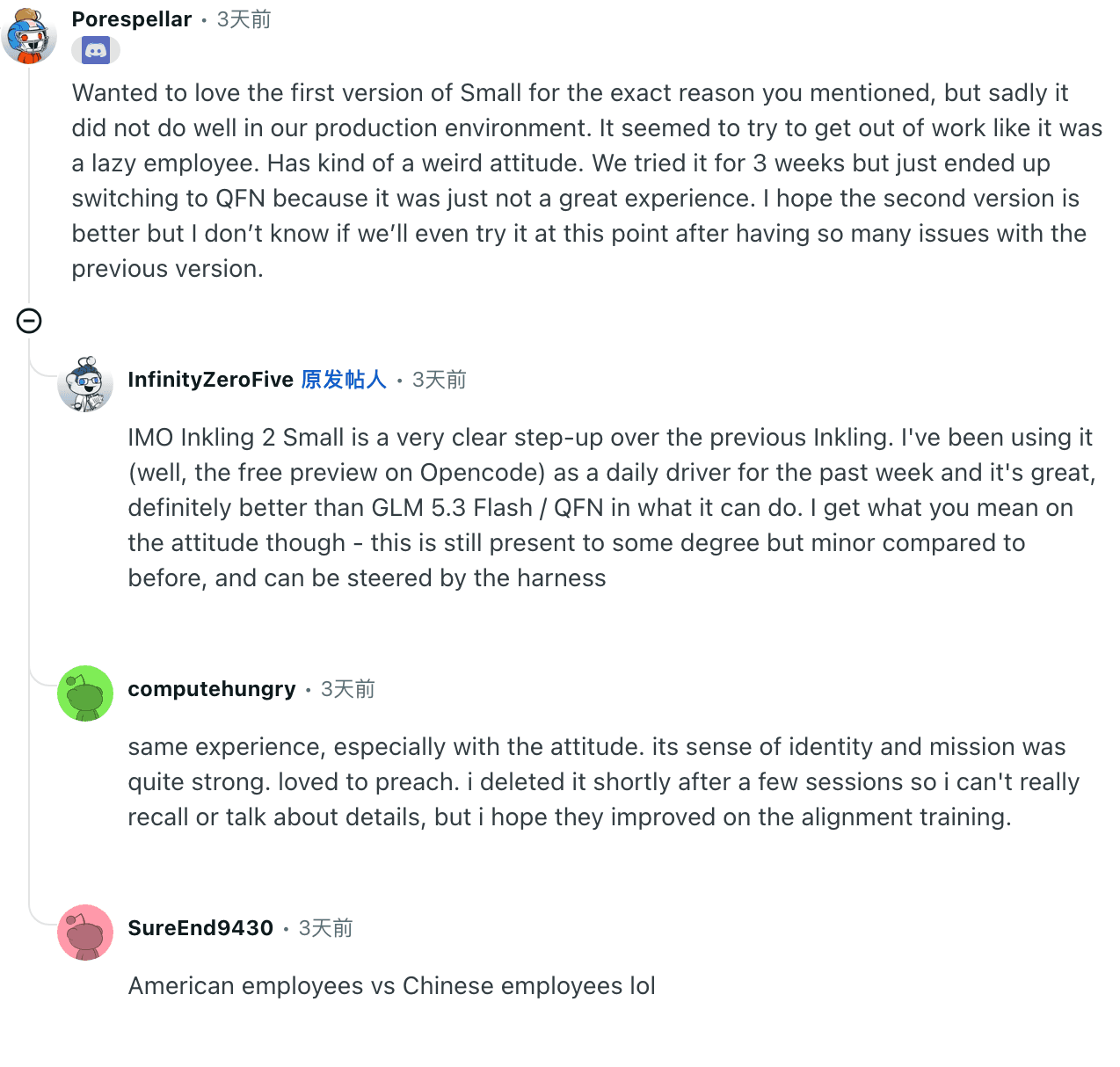
One r/LocalLLaMA participant said the first Inkling model did not work well in their production environment. Another user reported a positive week on Inkling 2 Small's free preview. Those are opposite experiences with different versions and hosted conditions. They are reasons to pilot your own task, not proof of how Inkling 2 Small will perform for you. First-generation report · Inkling 2 preview report
A browser workflow is a separate layer
Tabbit Browser can help with browser work when the agent you chose supports the Tabbit CLI or skill. It does not host Inkling, load its weights, or provide an API. Think of the model endpoint, the agent that calls it, and the browser connection as separate parts of your setup.
If the goal is to use Inkling through an agent on a signed-in website, the existing Inkling 2 Small browser-use guide covers a read-only path with a local agent and Tabbit CLI. It was written for a hosted model route and does not prove that a self-hosted Inkling endpoint plugs into that client. Start with the Tabbit CLI guide, the existing-browser connection walkthrough, and the first-task checklist. For a client choice, compare browser MCP and CLI.
Tabbit is a sensible option when the task needs the browser's visible page or a profile you have already signed into. It is the wrong layer if you need a model server or a place to download weights. The Codex setup guide and agent browser-control overview explain that boundary. If you use OpenCode, see the signed-in browser setup and session reuse guide. No Inkling-to-Tabbit model integration was tested for this article.
Verdict: accessible weights, demanding local requirements
Inkling 2 Small is open-weight under an Apache-2.0 label, and its public model card provides several routes for local inference and hosted API access. But "open" does not mean small, cheap to operate, or plug-and-play. The official card's 500 GB NVFP4 and 800 GB MXFP8 aggregate VRAM requirements should settle the first question for most teams: do you have the server, or do you need a provider to host it?
Before you download, verify the live license and AUP, choose a supported checkpoint/runtime pair, and compare the provider-specific terms if you prefer an API. If your next step is browser automation, use the browser guide separately. Tabbit can provide the browser connection; it does not run the model.

FAQ
Is Inkling 2 Small open source?
Thinking Machines calls the downloadable model open weights, and the Hugging Face model card shows an Apache-2.0 license. The model card also links a separate Acceptable Use Policy. That does not establish that training data, the full training pipeline, or every provider service is open source.
Can I run Inkling 2 Small on a regular desktop GPU?
The official model card says the NVFP4 checkpoint needs at least 500 GB of aggregate VRAM, with 2 B300 or 4 H200 GPUs as examples. It lists 800 GB for MXFP8. Check your actual GPU configuration against the current card before planning a local deployment.
Which Inkling 2 Small checkpoint should I choose?
The model card recommends NVFP4, the checkpoint format used through training. It says MXFP8 gains 1–2 percentage points on evaluations, a publisher-reported difference it considers impractical. The MXFP8 hardware requirement is higher, so compare the official requirements with your setup.
Can I use Inkling 2 Small through an API?
Yes. Thinking Machines lists NVIDIA, Fireworks, Together, Baseten, Nebius, Modal, and Cloudflare as API providers. Model IDs, pricing, availability, and data terms differ by provider, so verify the provider page before connecting an application.
Is the weight download free to run?
A public model repository and an Apache-2.0 label do not remove infrastructure costs. Local serving requires substantial GPU capacity, while hosted APIs may charge for use. Check the selected provider's current pricing and service terms.
Does Tabbit Browser host or run Inkling 2 Small?
No. Tabbit handles browser work through supported agent and CLI workflows; it does not host this model or deploy its weights. The model route, agent runtime, and browser connector are separate choices.