
GPT-6 Astra costs $10 per million input tokens and $50 per million output tokens on the standard API tier, with cached input at $1, cache writes at $12.50, and every rate checked on OpenAI's own pages on September 22, 2026. That is the rate card. The bill is a different object: on the same card, Artificial Analysis measures the cost of one benchmark task at $0.82 at low reasoning effort and $3.26 at max — a roughly 4x swing before you touch a single price line.
The gap between those two numbers is why this article exists. A Reddit developer put the sticker shock plainly when Astra launched: "GPT-5.6 Sol: $4/M input, $20/M output. GPT-6 Astra: $10/M input, $50/M output. That is literally a 2.5x price jump across both input and output." (r/codex thread, 456 upvotes). The arithmetic is correct. The conclusion — expensive or cheap — is not settled by arithmetic, because effort level, service tier, context length, and caching each move the invoice by more than the model choice itself. Later in this guide, Tabbit Browser appears as one practical place to compare model routes once the budget is clear; first, the numbers.
Key takeaways
Standard rates: $10 input, $1 cached input, $12.50 cache writes, $50 output per million tokens; prompts above 272K input switch the entire request to $20/$2/$25/$75.
The same card bills 4x apart. Batch and Flex halve every rate; Fast mode doubles them. Artificial Analysis puts one task between $0.82 (low effort) and $3.26 (max effort) on identical token prices.
The 2.5x premium is measured against a promotional baseline. Sol's $4/$20 is listed as promotional pricing "at least through November 21, 2026"; the previous GPT-5.5 input rate was $5.
Subscriptions are a separate economy. ChatGPT Plus is $20/month with limited Astra; Pro is displayed from $100/month. Community measurements put Astra's effective subscription cost near 1.9x its API price, with cache retention reported at about 30 minutes.
Budget by task shape, not by token price. Short answers are output-dominated; cached agent loops are cache-read-dominated; everything above 272K input pays the long-context premium on the full request.
GPT-6 Astra pricing at a glance
The full standard rate card, rendered from OpenAI's API pricing page on September 22, 2026. The GPT-6 Astra overview covers what the model is; this table is the money side.
| Model | Input / 1M | Cached input / 1M | Cache writes / 1M | Output / 1M |
|---|---|---|---|---|
| gpt-6-astra | $10.00 | $1.00 | $12.50 | $50.00 |
| gpt-5.6-sol | $4.00 | $0.40 | $5.00 | $20.00 |
| gpt-5.6-terra | $2.00 | $0.20 | $2.50 | $12.00 |
| gpt-5.6-luna | $0.20 | $0.02 | $0.25 | $1.20 |
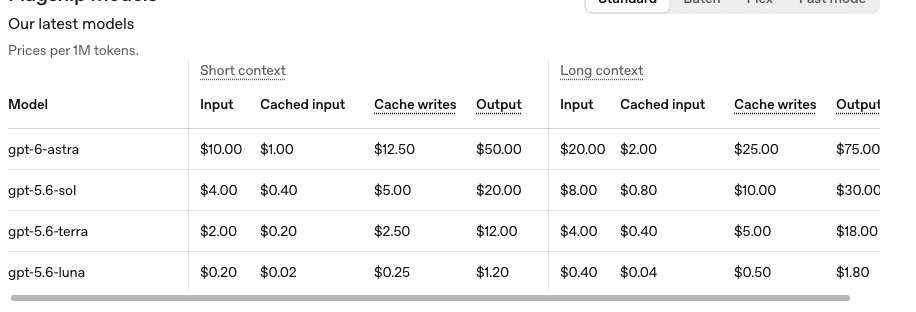
Three things in this table do the damage, and none is the headline $10:
Output is 5x input. Astra is a reasoning model; it thinks in billable output tokens. A modest prompt with a long chain of thought is an output bill wearing an input costume.
Cache writes cost more than input. $12.50 is 1.25x the uncached rate — the pricing page states the 1.25x rule explicitly. Caching pays off only when the prefix is actually reused.
The 272K cliff applies to the whole request. Cross 272,000 input tokens and the full request — not just the excess — bills at $20 input, $2 cached, $25 writes, $75 output. A 1.05M-token context window is not a 1.05M-token budget at standard rates.
The one number: the same card bills $0.82 to $3.26 per task
If you remember one number from this article, make it the swing, not the rate. Artificial Analysis tracks GPT-6 Astra as five separate entries — one per reasoning effort — and their measured cost per Intelligence Index task, snapshotted September 22, 2026, looks like this:
| Reasoning effort | Intelligence Index | Cost per task | Output speed |
|---|---|---|---|
| low | 46 | $0.82 | 55 t/s |
| medium | 50 | $1.54 | 52 t/s |
| high | 51 | $1.73 | 59 t/s |
| xhigh | 52 | $2.31 | 55 t/s |
| max | 53 | $3.26 | 67 t/s |
Read the two outer columns together: max effort costs 3.98x what low effort costs per task, for 7 index points of measured intelligence. Low effort also posts the lowest time to first token (2.46s in the same snapshot). The expensive setting is not automatically the careful one; it is the one that thinks longest in billable tokens.
This matters double for agentic work. Astra's strongest public result — roughly 40 minutes per OSWorld 2.0 task in OpenAI's simulation, versus 75 for Sol — describes exactly the workload where effort and retries compound: every loop re-reads context, every step emits reasoning tokens, and a model that "runs forever" also bills forever. A Hacker News user reported burning through a five-hour ChatGPT window in 15 messages (HN discussion); the same shape on API billing is why the agentic reasoning guide insists on acceptance criteria before long loops. Set the budget per finished task, including failed attempts, not per first attempt.
Translating the 2.5x premium over GPT-5.6 Sol
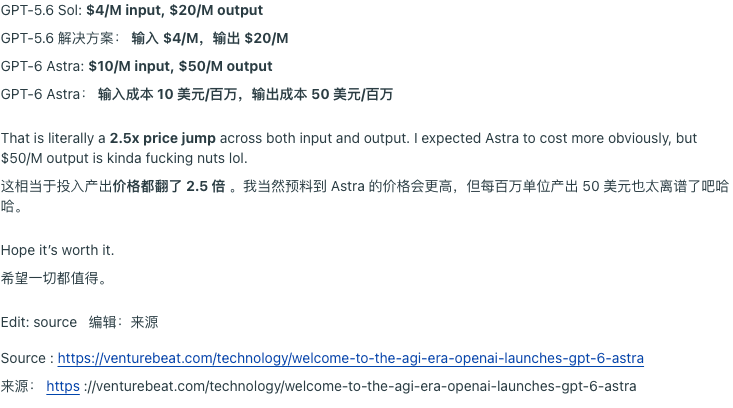
The 2.5x figure is honest arithmetic, but two caveats belong next to it before you budget.
Caveat one: the baseline is promotional. OpenAI's Sol page notes that "GPT-5.6 Sol's promotional pricing is available at least through November 21, 2026," and its quick-comparison column shows the prior GPT-5.5 input rate at $5.00. Sol got a permanent-feeling discount on July 30, 2026, when Sam Altman announced Luna down 80% (to $0.20/$1.20), Terra down 20% (to $2/$12), and Fast mode for Sol at 2x price for up to 2.5x speed (@sama). If Sol's promo lapses, the "2.5x premium" shrinks without Astra getting cheaper. The GPT-5.6 Sol context analysis tracks that family separately.
Caveat two: per-task cost can converge. The thread above is sticker shock at the rate card. But Artificial Analysis's measured $0.82 per task at low effort shows how far below the sticker the bill can land, and the direction flips entirely when capability saves retries: a job that Sol fails twice and Astra finishes once is cheaper on Astra even at 2.5x rates. Whether that describes your tasks is an empirical question — answerable with the worked budgets below, not by the rate card.
The billing lines outside the headline
Four lines decide most real invoices, and only the first appears in the launch coverage.
Batch and Flex: the 50% lever. Both are priced at half of standard rates — $5 input, $0.50 cached, $6.25 writes, $25 output. Batch is for work that can wait hours (the API exposes v1/batch, with queue limits from 1.5M tokens at Tier 1 to 15B at Tier 5); Flex is a separate lower-cost capacity mode with its own availability trade-offs. For evaluation runs, offline enrichment, and anything not user-facing, this single switch saves more than any prompt optimization. Do not stack the discounts: pick one mode.
Fast mode: the 2x accelerator. Priced at 2x the applicable rates — $20/$100 standard, and note "applicable": Fast on a Batch job doubles Batch rates, not standard ones. Priority processing was renamed Fast mode on July 30, 2026, and both service_tier: "priority" and "fast" still work, which matters if you have older code.
Regional processing: +10%. Data-residency endpoints carry a 10% uplift for models released on or after March 5, 2026 that are eligible — Astra qualifies by release date. Compliance-driven regions pay a premium on every line.
The 272K cliff and the cache clock. Above 272K input, the long-context row ($20/$2/$25/$75) applies to the full request — there is no "only the excess" accounting. And the cache that would soften repeated reads has a community-reported clock: Codex users observed retention around 30 minutes on Astra versus 24 hours on Sol and earlier models.

OpenAI does not publish a TTL table, so treat 30 minutes as a reported behavior with two independent sources (thread, comment), not a guarantee. If your loop sleeps longer than that between steps, the $1 cached read can silently become a $10 cold read plus a $12.50 write.
Tool calls sit outside all of this: OpenAI states tool-specific models bill a fee per tool call for things like web search, so an agent that searches 40 times has a second meter running.
The family ladder: which row is yours
The counterintuitive row in the ladder is Luna: 50x cheaper on input than Astra, and it exists. The official model catalog describes Luna for cost-sensitive, high-volume workloads — and OpenAI's own model-selection guidance is to default to Terra or Luna unless the work is hard enough to justify the flagship. The cheap row is not a toy; it is a routing target, and every token routed there instead of Astra saves 50x on input.
The second counterintuitive finding comes from outside the family. Astra and Anthropic's Fable 5.1 list at the identical $10/$50 — and cost opposite amounts in practice:
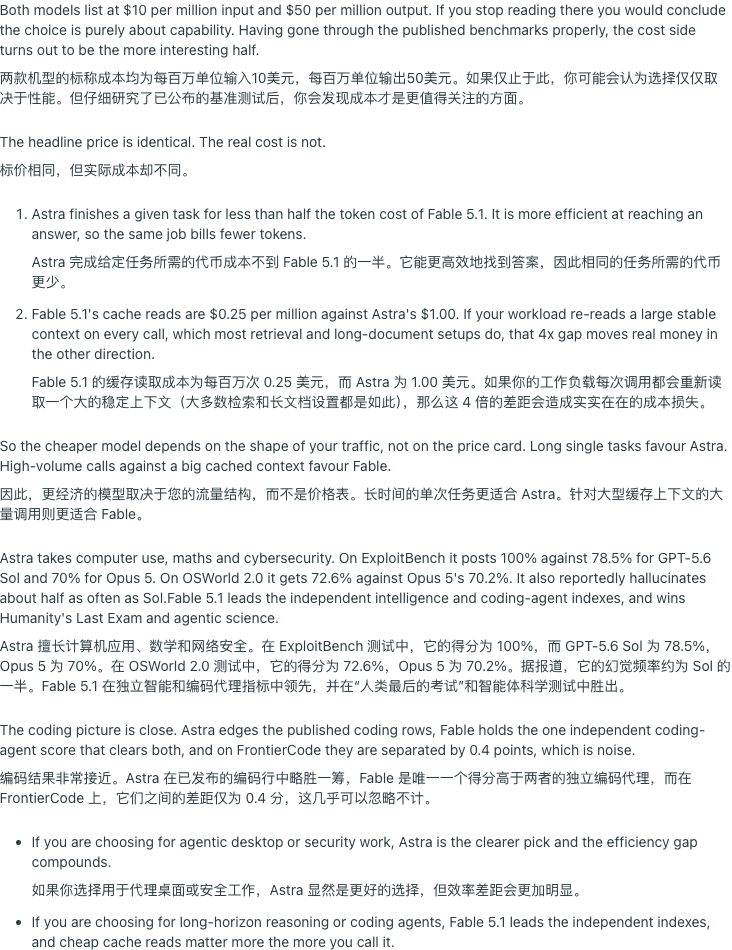
The poster's math: Astra finishes a given task in fewer tokens ("less than half the token cost of Fable 5.1" on their long single tasks), while Fable's cache reads at $0.25 per million undercut Astra's $1.00 by 4x — so high-volume traffic against a big cached context favors Fable, and long single tasks favor Astra. A commenter ran a week-long document-retrieval pipeline on both and paid roughly half on Fable at an 85% cache hit rate, "performance was basically same for that task":
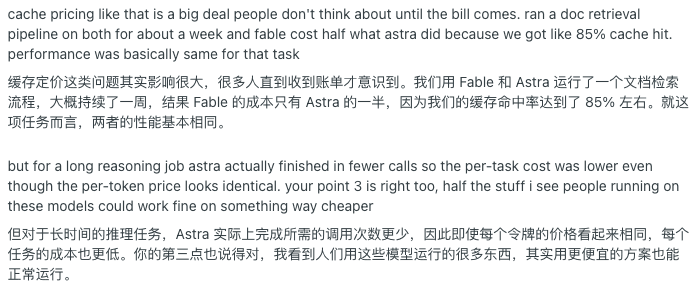
The transferable lesson does not require choosing either lab: the rate card is the smallest input to the cost function. Traffic shape — task length, cache-hit ratio, output volume — dominates. The community review collection keeps more of these reports with their conditions attached.
What the rate card does not cover
A subscription is not API credit. ChatGPT plans grant usage, priced in allowances and windows — the next section shows those allowances are their own economy. Never divide a $20 plan by token prices.
Failed attempts can still bill. In a 33-minute Codex run a developer documented in the launch-week reports, two timed-out attempts consumed budget before the successful one (r/ChatGPT). Retries are a cost line, not free.
The free API tier is closed. The rate-limit table marks Astra "Not supported" on Free; paid tiers start at Tier 1 with 500 requests per minute and 500K tokens per minute.
Taxes, tools, and provider markups are extra. OpenRouter's marketplace shows Azure and OpenAI both listing $10/$50/$1 for Astra with different latency profiles (P50 first-token 4.80s versus 6.92s in the snapshot checked today) — same rates, different routing behavior. Amazon Bedrock commercial regions are stated to match OpenAI direct pricing.
Plan availability: API tiers and ChatGPT plans
| API tier | RPM | TPM | Batch queue limit |
|---|---|---|---|
| Free | Not supported | — | — |
| Tier 1 | 500 | 500,000 | 1.5M tokens |
| Tier 2 | 5,000 | 1,000,000 | 3M tokens |
| Tier 3 | 5,000 | 2,000,000 | 100M tokens |
| Tier 4 | 10,000 | 4,000,000 | 200M tokens |
| Tier 5 | 15,000 | 40,000,000 | 15B tokens |
Source: OpenAI's gpt-6-astra model page, checked September 22, 2026. Tiers advance with spend, so the launch-week ceiling is not permanent.
On the consumer side, ChatGPT's pricing page currently displays four plans: Free at $0 (unlimited GPT-5.6 Luna text chat — no Astra), Go at $8/month, Plus at $20/month with "advanced reasoning models with GPT-6 Astra and GPT-5.6" (the comparison matrix shows Astra as limited), and Pro displayed as "from $100/month" with 5x usage and "Pro reasoning powered by GPT-6 Astra." Community discussion still references a $200 Pro tier, and YouTube breakdowns list both "$100 and $200" Pro tiers — the live page is the only arbiter, and it currently shows "from" pricing.
The subscription economics deserve their own warning label, because three separate community measurements point the same direction:
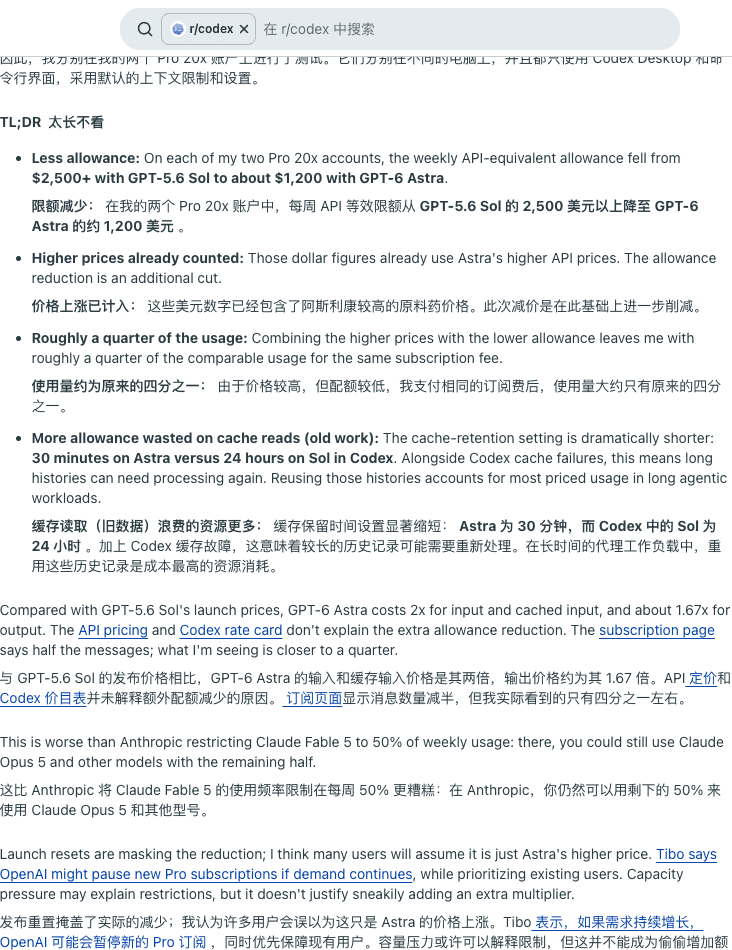
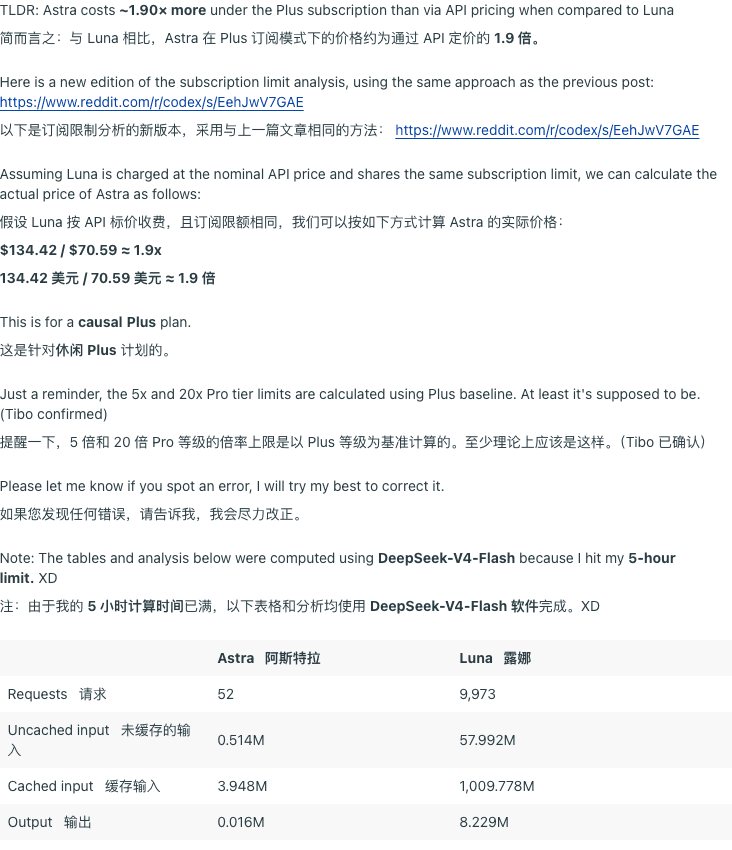
First, the quota math: across two Pro accounts, the weekly API-equivalent allowance fell from $2,500+ on Sol to about $1,200 on Astra — with higher prices already counted — leaving "roughly a quarter of the comparable usage for the same subscription fee." Second, the effective rate: a Plus subscriber reverse-engineered Astra at ~1.90x its API price when compared against Luna on the same allowance ($134.42 versus $70.59 of measured usage). Third, the burn experience:
"Astra is really good, but for any meaningful use, the $200 a month subscription simply doesn't give you enough tokens" is one game developer's summary — the capability and the frustration are the same sentence. If your Astra use is occasional and supervised, Plus may cover it; if it is the engine of a daily pipeline, the API with Batch is the predictable route, and the subscription is the premium-interaction route.
Two worked budgets, with every assumption visible
These use standard short-context rates, no retries, no tools, no taxes. Worked arithmetic, not predictions.
A short question with a long think. 10,000 input tokens, 2,000 output tokens:
(10,000 × $10 + 2,000 × $50) / 1,000,000 = $0.20A cold agent loop over a large repo. 300,000 input tokens — note, already past the cliff, so long-context rates apply to everything — with 8,000 output tokens:
(300,000 × $20 + 8,000 × $75) / 1,000,000 = $6.60The same loop under 272K (say 260,000 tokens) would cost $4.00. Crossing the threshold cost 65% more on this shape. Now the warm version: same 300,000-token context, 90% cached, cache written once per hour, 8,000 output:
(270,000 × $2 + 30,000 × $20 + 8,000 × $75) / 1,000,000 = $1.68 + writesLocal calculation
Estimate GPT-6 Astra API token cost
Uses the official USD rates checked 2026-09-22. Values stay in this browser.
Cache writes are billed at 1.25x the input rate. This estimate excludes retries, tools, taxes, the 10% regional uplift, and provider markups. Inputs above 272K switch every line to long-context rates automatically. Verify current rates
The calculator runs entirely in this page — nothing is sent anywhere. It applies the 272K long-context switch automatically, prices the selected service tier, and separates cache writes from hits. What it deliberately does not model: retries, tool-call fees, the regional 10%, and the cache TTL clock — those belong in your margin. Recheck the official rate card before committing a budget; these are the September 22, 2026 numbers.
A practical option: run the comparison in Tabbit
After the budget comes the boring part: actually running Astra-shaped work needs a place where pages, files, and model calls sit together. That is the gap Tabbit Browser occupies — an AI browser where the model picker, the live page, and the local file are in one surface, so "try Astra on medium, fall back to Luna" is a selection, not an orchestration project.
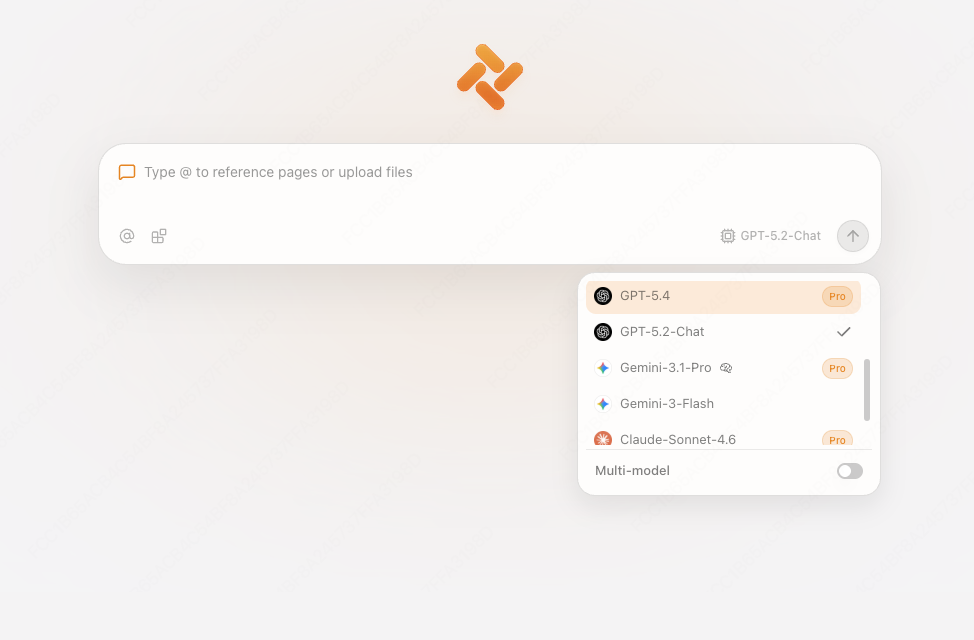
The boundaries, stated plainly: Tabbit is a client, not an OpenAI billing layer. Model availability depends on your account and edition, and nothing in the browser changes what OpenAI charges — the rate card above applies wherever Astra runs. What the browser changes is setup cost: the GPT-6 Astra resource page and its prompt collection describe repeatable tasks you can run against the picker before writing any orchestration code, which is the cheapest possible way to find out which effort tier your workload actually needs.
 Tabbit Browser
If the work is browser-level automation rather than chat, the agentic browser overview, what an agentic browser is, and the browser automation guide cover that workflow; the AI browser guide is the general starting point.
GPT-6 Astra pricing decision table
| Your workload | Cost driver | Best starting path | Watch out for |
|---|---|---|---|
| Interactive chat, short answers | Output tokens | API at low/medium effort, or Plus | $50/M output dominates; 5x the input rate |
| Overnight evaluation or enrichment | Volume | Batch at 50% | Queue limits per tier; results in hours |
| Long agent loops under 272K | Cache reads and writes | Standard with cached stable prefixes | Reported ~30-minute cache retention |
| Contexts above 272K tokens | The cliff | Restructure to stay under, or budget $20/$75 | Whole request reprices, not the excess |
| Latency-critical production | Fast mode | Fast at 2x on the cheapest sufficient effort | Effort choice moves cost more than tier |
| Daily heavy consumer use | Subscription allowance | Pro (from $100) or API+Batch | Quota burn reported ~4x faster than Sol |
Final verdict
GPT-6 Astra is priced like an ingredient for difficult work, and it bills like one. Buy it when the task is long-horizon, tool-heavy, and expensive to babysit — and then buy it carefully: Batch for everything that can wait, low effort until a failing acceptance test says otherwise, contexts engineered under 272K, and cache-friendly prefixes measured against a 30-minute clock. Keep Luna or Terra for the volume that does not need the capability; the family ladder exists precisely so the flagship is a routing decision, not a default.
If Astra is your daily engine over API, budget per finished task including retries and tool fees, and re-check the official pricing page monthly — Sol's promotional baseline has a November 21 date on it, and the whole ladder can move. The dedicated alternatives comparison is still being prepared; until it ships, the model resources, the overview, and the community records linked above are the source trail.
Sources
OpenAI API pricing and gpt-6-astra model page — rate cards, tier rules, rate limits, checked September 22, 2026
ChatGPT pricing — Free/Go/Plus/Pro displays, checked September 22, 2026
Sam Altman, July 30, 2026 — Luna/Terra price cuts and Sol Fast mode announcement
Artificial Analysis GPT-6 Astra release page — effort-tier intelligence, speed, and cost-per-task snapshot, September 22, 2026
OpenRouter GPT-6 Astra — provider rates and latency snapshot, September 22, 2026
Community records with screenshots and conditions inline: r/codex 1w6hvo9, r/codex 1wciwc1, r/codex 1w8r103, r/LLMDevs 1w9z8nb, r/ChatGPT 1w9nya5, Ask HN

FAQ
How much does GPT-6 Astra cost?
The standard API rate is $10 per million input tokens, $1 per million cached input tokens, $12.50 per million cache-write tokens, and $50 per million output tokens, checked on OpenAI's pricing pages on September 22, 2026. Prompts above 272K input tokens are billed at higher long-context rates ($20 input, $2 cached, $25 cache writes, $75 output) for the whole request. Batch and Flex run at 50% of standard rates, Fast mode at 2x, and regional data-residency endpoints add 10%.
Is GPT-6 Astra available on a free plan?
Not on the free API tier. OpenAI's rate-limit table for gpt-6-astra marks the Free tier as not supported, with access starting at Tier 1. On the consumer side, the free ChatGPT plan offers unlimited GPT-5.6 Luna text chat but no Astra; Plus includes limited Astra access, and Pro is billed as powered by GPT-6 Astra.
Why is GPT-6 Astra 2.5x the price of GPT-5.6 Sol?
OpenAI positions Astra for the hardest end-to-end work across reasoning, coding, computer use, and research, and prices it accordingly at $10/$50 versus Sol's $4/$20. Note that Sol's current rates are promotional pricing available at least through November 21, 2026, so the comparison baseline itself can move. Per-task costs can converge when Astra finishes in fewer, more reliable passes.
Is ChatGPT Pro worth it for GPT-6 Astra?
It depends on your workload shape. Pro is displayed from $100 per month with 5x usage and Astra-powered reasoning, but community reports describe the weekly API-equivalent allowance dropping from about $2,500 on Sol to about $1,200 on Astra, a roughly 30-minute cache retention, and heavy users burning through quotas quickly. If your tasks are long and agentic, budget carefully or use the API with Batch where latency allows.
What is the cheapest way to run GPT-6 Astra?
Combine the levers: route non-urgent work through Batch or Flex at 50% of standard rates, start at low or medium reasoning effort and escalate only when acceptance tests fail, keep prompts under 272K input tokens to avoid the long-context rate jump, and cache stable prefixes so reads bill at $1 instead of $10 per million tokens.
Do GPT-6 Astra API prices include tool calls?
No. The published token rates cover text input and output only. OpenAI states that tool-specific models such as web search and computer use carry a fee per tool call, billed separately from token pricing, so tool-heavy agents need a separate line in the budget.