
GPT-6 Astra is a formidable model. In OpenAI’s September 3, 2026 launch benchmarks, it cut simulated OSWorld 2.0 task execution time from 75 minutes down to 40 minutes—a 47% speedup—while boosting task completion to 72.6%. In independent developer tests, it demonstrated remarkable endurance, grinding through a 33-minute Codex Python API implementation with 13 automated repair passes without derailing, while discovering 3 to 5 times more web sources during complex exploratory research. If your primary bottleneck is human babysitting on long-running autonomous loops, Astra delivers genuine capability.
Yet the reasons to look past Astra are grounded in cold engineering arithmetic. OpenAI established Astra’s standard API rates at $10.00 per million input tokens and $50.00 per million output tokens—exactly 2.5 times the cost of GPT-5.6 Sol ($4.00/$20.00). If your request crosses 272,000 input tokens, a pricing cliff triggers premium rates across the entire call. Meanwhile, independent evaluations from Artificial Analysis reveal that Astra’s overall Intelligence Index inched up by merely 0.3 points over Sol (61.2 versus 60.9), and its 99.9% ARC-AGI-3 headline was achieved using proprietary vendor adapters that plummeted to 62.7% under standard public harnesses.
This gap frames the core switch decision: paying a 150% price multiplier for a 0.5% boost in broad reasoning is an expensive tax if your workload does not demand 40-minute stubborn resilience. For high-volume API pipelines, rapid interactive coding, multimodal document parsing, and daily human-in-the-loop workflows, alternative routes deliver equal or better outcomes at a fraction of the cost. The GPT-6 Astra overview details specifications, and the GPT-6 Astra review breaks down its benchmark harness limits; this guide provides the roadmap for choosing your alternative.
Key takeaways
GPT-5.6 Sol is the most direct same-family fallback: It offers 99.5% of Astra’s general reasoning index (60.9 vs 61.2) at a 60% discount ($4/$20 vs $10/$50 per million tokens) with significantly faster time-to-first-token.
Claude Fable 5.1 and Sonnet 5 dominate architectural code: Anthropic’s prompt caching slashes repeated input costs by 75%, providing superior stylistic taste in large codebase refactoring without Astra’s legalistic guardrail friction.
Gemini 3.8 Flash is the high-throughput multimodal champion: At $0.75 input and $3.75 output, it handles massive audio, video, and PDF ingestions at more than 85% lower cost than Astra.
DeepSeek V4.1 Flash unlocks extreme budget batching: Off-peak cache pricing drops to $0.003 input and $0.60 output per million tokens, making it the premier choice for scheduled, price-sensitive background workloads.
Tabbit Browser Agent solves the runtime layer: If your frustration stems from orchestrating headless scripts, extracting browser DOM trees, and managing API keys, running models directly in Tabbit Browser eliminates the integration overhead entirely.
How I screened these alternatives
Real cost per completed task, not token rate cards: A cheaper per-token model that rambles for 4,000 output tokens or requires three retries is more expensive than an efficient model. True cost includes thinking tokens, input cache ratios, 272K cliff surcharges, and supervisor intervention time.
Tolerable latency for human-in-the-loop: When an engineer waits for an answer, time-to-first-token (TTFT) and stream stability matter more than peak token throughput. Background batch agents can afford a 40-minute run; interactive pairing cannot.
Context, multimodal, and tool ecosystem fit: Model replacement fails if you lose native tool execution, image/PDF inspection, or 1M-token context retrieval.
Verified practitioner evidence over synthetic leaderboards: We rely on documented production experiences, developer bug reports, and reproducible harness behavior from Hacker News and Reddit rather than marketing claims.
Five candidates at a glance
| Candidate | Best for | Published route | Price checked 2026-09-22 | Context / Max Output | The main catch |
|---|---|---|---|---|---|
| GPT-5.6 Sol | Immediate same-family budget workhorse | gpt-5.6-sol | $4.00 input / $20.00 output per 1M | 1,050,000 / 128,000 | Less autonomous stamina in 10+ step desktop loops |
| Claude Fable 5.1 / Sonnet 5 | Software architecture & nuanced refactoring | claude-fable-5-1 / claude-sonnet-5 | $2.00–$3.00 input / $10.00–$15.00 output per 1M | 1,000,000 / 128,000 | Strict concurrency rate limits and expensive high thinking |
| Gemini 3.8 Flash | High-throughput multimodal parsing | gemini-3-8-flash | $0.75 input / $3.75 output per 1M | 1,048,576 / 65,536 | High TTFT under maximum thinking effort |
| DeepSeek V4.1 Flash | Scheduled off-peak batch processing | deepseek-flash | Off-peak: $0.15 input / $0.60 output per 1M | 1,000,000 / 384,000 | Peak-window surcharges and no native GUI vision agent |
| Tabbit Browser Agent | Zero-scaffolding browser workflow execution | Integrated Desktop Runtime | Built-in multi-model selector | Active Tab DOM + Local Files | Desktop workflow tool, not a headless server endpoint |
Pricing notes: Rates reflect standard API tiers checked September 22, 2026. Reasoning tokens are billed as output tokens. Prompt cache read hits reduce input rates by up to 75%–90% depending on provider.
GPT-5.6 Sol
Best for: Developers seeking the lowest-friction migration from Astra who want to preserve their existing OpenAI SDK tooling while slashing API spend by 60%.
Pros: GPT-5.6 Sol shares Astra’s exact 1,050,000-token context window, identical tool-calling schemas, and structured JSON output contracts. On Artificial Analysis’s Intelligence Index, Sol posted a 60.9 score compared to Astra’s 61.2—meaning you retain 99.5% of broad reasoning quality. In practical testing, Sol demonstrates significantly snappier TTFT, avoiding the sluggish warmup delays common to Astra’s High Effort modes. As Hacker News engineer handzhiev observed during general evaluation, Sol acts as a "true workhorse" that is "good enough for most tasks" without incurring frontier pricing premiums.
Cons: Sol lacks Astra’s specialized 47% speedup on OSWorld 2.0 tasks, clocking in at approximately 75 minutes in OpenAI’s benchmark setup. In complex agentic tasks requiring more than 10 consecutive self-correction loops, Sol is more prone to loop degradation or premature surrender. For a deeper breakdown of context management in this tier, see our analysis of GPT-5.6 Sol 1M context capabilities.
Pricing: $4.00 per million input tokens, $0.50 per million cached input tokens, and $20.00 per million output tokens. No 272K cliff penalties apply.
Verdict: Choose GPT-5.6 Sol if your current Astra pipeline is burning budget on tasks that don't involve complex desktop GUI navigation or dozen-step self-healing code runs. It is the most rational default for 80% of production workloads.
Claude Fable 5.1 & Sonnet 5
Best for: Full-stack engineering teams, systems architects, and developers who prioritize code readability, architectural elegance, and deep instruction adherence.
Pros: Anthropic’s models offer unmatched stylistic discipline and restraint. While Astra can be over-eager or verbose, Claude excels at surgical code modifications without breaking surrounding abstractions. Skiffssh noted on Hacker News that while Astra showed major leaps in 3D modeling, they "will still stick with Claude for a while" due to its dependable engineering judgment. Furthermore, Anthropic’s prompt caching delivers a massive 75% discount on repeated prompt prefixes, making complex multi-turn developer sessions surprisingly economical.
Cons: Anthropic enforces strict organizational concurrency rate limits that can choke large-scale parallel processing. High-effort adaptive reasoning can rapidly escalate output costs, and Claude’s safety boundaries, while less legalistic than Astra’s, will firmly refuse reverse-engineering or penetration-testing scaffolding.
Pricing: Standard list pricing sits at $2.00–$3.00 input and $10.00–$15.00 output per million tokens, with prompt cache reads dropping input costs to $0.20–$0.30.
Verdict: Choose Claude Fable 5.1 or Sonnet 5 if your migration away from Astra is driven by code quality, refactoring precision, or prompt caching economics rather than raw agentic computer control.
Gemini 3.8 Flash
Best for: High-throughput data extraction, massive document summarization, and multimodal pipelines that ingest hours of audio, video, or hundreds of PDF pages.
Pros: Gemini 3.8 Flash combines a 1,048,576-token context window with native multimodal understanding across text, images, video, and audio. Its standard API rate ($0.75 input / $3.75 output) is more than 85% cheaper than Astra, and its raw output generation speed easily doubles OpenAI’s frontier engine. For teams processing unstructured business documents, the Gemini 3.8 Flash pricing breakdown and our detailed Gemini 3.8 Flash review illustrate its immense operational leverage.
Cons: When configured with High Thinking effort, Gemini 3.8 Flash exhibits noticeable time-to-first-token latency. Furthermore, on deeply recursive logic tasks and complex multi-file repo synthesis, its reasoning chain can wander or produce repetitive prose if prompts lack strict schema guards.
Pricing: $0.75 per million input tokens and $3.75 per million output tokens for prompts under 128K tokens ($1.50 / $7.50 for longer prompts).
Verdict: Choose Gemini 3.8 Flash if Astra’s $10/$50 rates are choking your document ingestion, video processing, or bulk extraction pipelines. Keep Astra only for the fraction of tasks that require iterative shell execution.
DeepSeek V4.1 Flash
Best for: Cost-sensitive backend batch processing, data enrichment, and sovereign deployments that can leverage off-peak execution windows.
Pros: DeepSeek V4.1 Flash provides an aggressive pricing floor: off-peak cache hits start at just $0.003 per million tokens, with base input at $0.15 and output at $0.60. It offers 1M context with a massive 384K maximum output ceiling, supporting both thinking and non-thinking execution modes. In community evaluations, developers have praised its raw speed and transparency, making it an extraordinary engine for overnight batch transformations.
Cons: DeepSeek’s pricing varies by schedule: peak windows (01:00–04:00 and 06:00–10:00 UTC on weekdays) double the rates to $0.30 input and $1.20 output. Public endpoints can suffer network jitter and queuing delays during Asian business hours. Most importantly, it lacks native desktop computer-use vision agents, making it unsuitable for OSWorld-style desktop automation.
Pricing: Off-peak: $0.15 input / $0.60 output; Peak: $0.30 input / $1.20 output per million tokens. Cache hits drop to $0.003–$0.006.
Verdict: Choose DeepSeek V4.1 Flash when raw API cost is the single non-negotiable metric and your architecture can buffer tasks into off-peak windows. Do not choose it as a direct replacement for Astra’s GUI computer-use agents.
Tabbit Browser Agent
Best for: Practitioners, analysts, and developers who want agentic execution directly across live web apps, SaaS dashboards, and multi-tab workflows without writing API glue code.
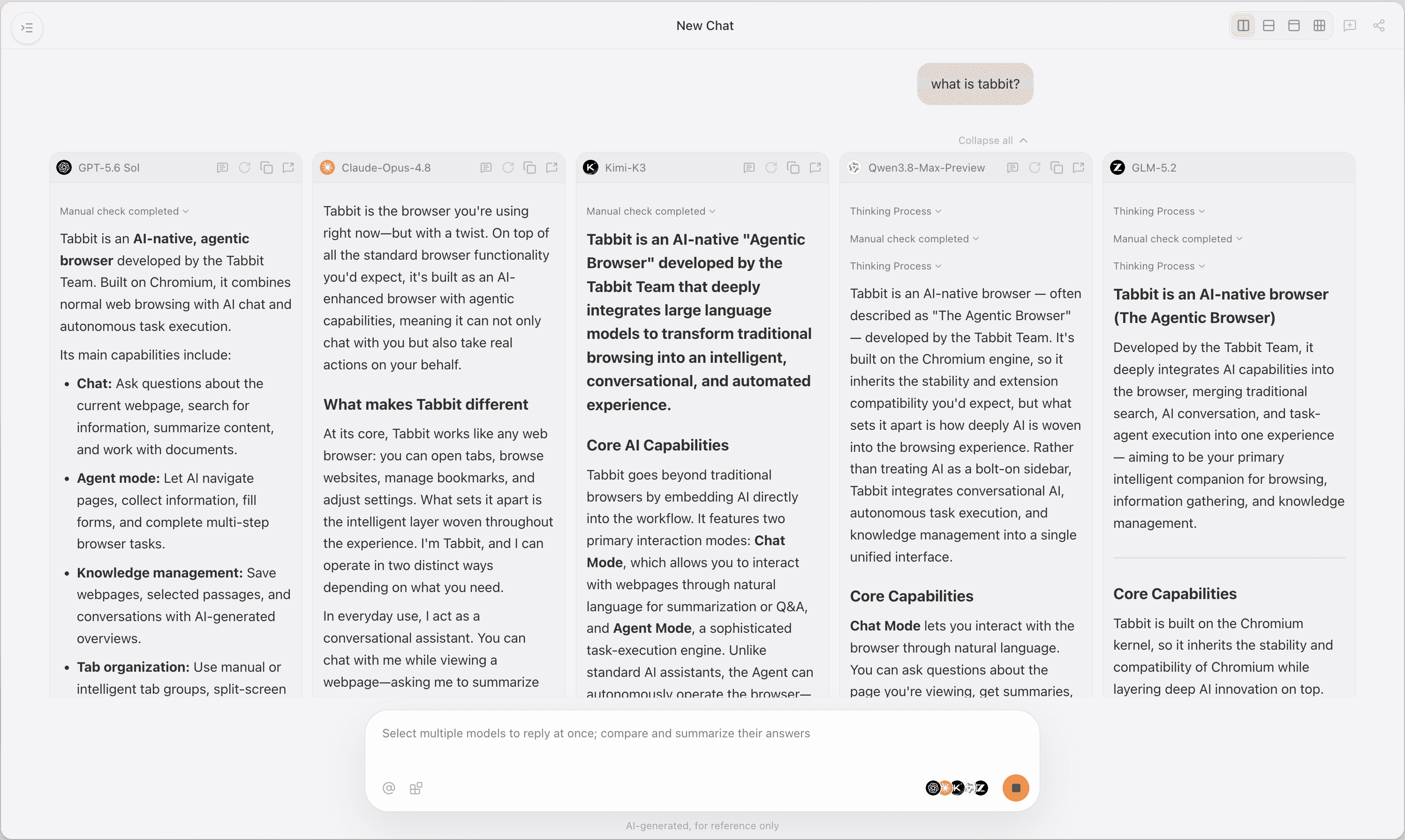
Pros: Often, the frustration attributed to GPT-6 Astra isn't about the model's weights—it's about the friction of building autonomous harnesses. Setting up Playwright scripts, passing DOM snapshots, managing tokens, and debugging API timeouts consumes days of engineering time. Tabbit Browser embeds multi-model AI agents directly into your browser workspace. You can execute deep research, scrape multi-tab datasets, and synthesize competitor intelligence using an integrated model selector that routes tasks to the best engine.
Cons: Tabbit Browser is designed for desktop productivity, interactive pairing, and workflow automation. It is not an asynchronous headless backend endpoint designed to serve millions of programmatic API requests per hour.
Pricing: Free to download and evaluate on macOS and Windows, with flexible multi-model routing options.
Verdict: Choose Tabbit Browser if you find yourself paying for Astra’s expensive API just to inspect web pages, summarize documents, or run browser workflows. Understanding what an agentic browser is and exploring agentic AI browsers shows how runtime integration frequently trumps raw model upgrades. Discover more in our Tabbit AI browser guide and browser automation directory.
 Tabbit Browser
Choose by your binding constraint
When migrating from GPT-6 Astra, avoid looking for a single "winner." Pinpoint the specific operational friction that broke your workflow, then match it to the optimal alternative:
| Main constraint | First pilot model | Success criterion | Main trade-off |
|---|---|---|---|
| API budget & same SDK | GPT-5.6 Sol | Pipeline runs with 60% lower token cost and zero schema rewrites | Slightly lower completion rate on 10+ step autonomous repair runs |
| Code elegance & refactoring | Claude Fable 5.1 / Sonnet 5 | Fewer supervisor corrections and lower multi-turn cache costs | Must handle tighter organizational concurrency rate limits |
| Multimodal & document volume | Gemini 3.8 Flash | 85%+ cost reduction on large PDF/video parsing tasks | Noticeable TTFT latency under maximum thinking settings |
| Extreme budget batching | DeepSeek V4.1 Flash | Overnight batch pipelines complete within off-peak price ceilings | Peak-hour latency variability and lack of desktop GUI tools |
| Scaffolding & setup fatigue | Tabbit Browser Agent | Tasks execute across live tabs without custom scraper code | Built for interactive human workflow, not headless backend APIs |
Run the same-task pilot
Before committing to a widespread architectural migration away from GPT-6 Astra, execute a controlled pilot:
Freeze two representative tasks: Select one bounded reasoning task (e.g., refactoring a complex API client module) and one data-processing task (e.g., parsing a 50-page financial PDF with structured tables).
Standardize the harness: Fix the prompt instructions, tool definitions, output schemas, and retry policies across all candidate models.
Measure completed-task cost: Track total expenditure including input tokens, output tokens, thinking tokens, and supervisor corrections. Do not rely on nominal rate cards.
Log latency distributions: Record time-to-first-token and total wall-clock execution time over at least five runs per model to capture variance.
Score autonomous yield: Evaluate whether the task passed without human intervention on the first attempt, or required automated repair passes.
Verdict
GPT-6 Astra is a specialized tool for narrow, high-difficulty workloads. If your project requires an agent to operate an uninstrumented desktop GUI for 40 minutes or write complex 3D spatial shaders through dozens of automated self-debugging cycles, Astra’s $10/$50 rates are defensible.
However, for the vast majority of engineering and enterprise workloads, Astra imposes an unjustified 2.5x tax. GPT-5.6 Sol provides virtually identical general intelligence at a 60% discount; Claude delivers superior architectural taste for codebase maintenance; Gemini 3.8 Flash dominates bulk multimodal pipelines; and DeepSeek unlocks unmatched batch economics. And if your ultimate goal is to automate work across the web without maintaining brittle API harnesses, running agents inside Tabbit Browser delivers the shortest path to production.

FAQ
What is the closest same-family alternative to GPT-6 Astra?
GPT-5.6 Sol is the immediate same-family fallback. It shares the identical 1,050,000-token context window, supports structured outputs and tool use, and scored 60.9 on Artificial Analysis's Intelligence Index (merely 0.3 points below Astra) while costing 60% less ($4/$20 vs $10/$50).
Why consider leaving GPT-6 Astra if it achieved a 40-minute OSWorld record?
Because Astra's 47% speedup in OSWorld 2.0 (40 min vs 75 min) reflects autonomous resilience in long-running loop simulations, not faster raw latency. For everyday question answering, code generation, and interactive chats, Astra incurs severe TTFT lag, heavy token inflation, and a 2.5x price premium that delivers little to no observable benefit.
Which alternative model has the lowest listed API pricing?
DeepSeek V4.1 Flash provides the lowest published API floor, with off-peak rates starting at $0.003 (cache hit), $0.15 (cache miss), and $0.60 (output) per million tokens. Gemini 3.8 Flash is the cheapest tier among US frontier providers at $0.75/$3.75. However, true task cost depends on verbosity, thinking tokens, and retry frequency.
How does the 272K input token threshold affect cost calculation?
In OpenAI's published pricing for Astra, requests exceeding 272K input tokens are billed at an elevated tier for the entire request, not merely the tokens beyond 272K. This creates an economic cliff where a 280K prompt costs substantially more than two 140K calls. Alternatives like Sol, Gemini, and Claude Sonnet maintain more predictable tiered or flat rates.
Can API token prices be compared directly with consumer ChatGPT or Claude Pro subscriptions?
No. API token pricing is strictly usage-based with pay-as-you-go billing, whereas consumer subscriptions charge a flat monthly fee ($20–$200) subject to dynamic message caps, rate limits, and priority queues. Workloads requiring programmatic automation, system integration, or large batch jobs must evaluate API economics rather than subscription seats.
How can I test and compare these alternative models inside Tabbit Browser?
Tabbit Browser features an integrated multi-model selector allowing users to switch between GPT-6 Astra, GPT-5.6 Sol, Claude, Gemini, and DeepSeek directly within their everyday browsing session. Instead of writing custom API scripts or web-scraping orchestrators, you can run prompts side-by-side against active tabs, local PDFs, and web applications to verify real-world task completion.