
Gemini 3.8 Flash is a stable, multimodal Flash model aimed at long-horizon coding, autonomous agents and complex enterprise workflows. Google released it on September 2, 2026, alongside the separate Gemini 3.8 Flash Cyber variant. If you need a quick answer, start with the access table below: the route you choose determines the account, billing and product conditions that apply. (Google)
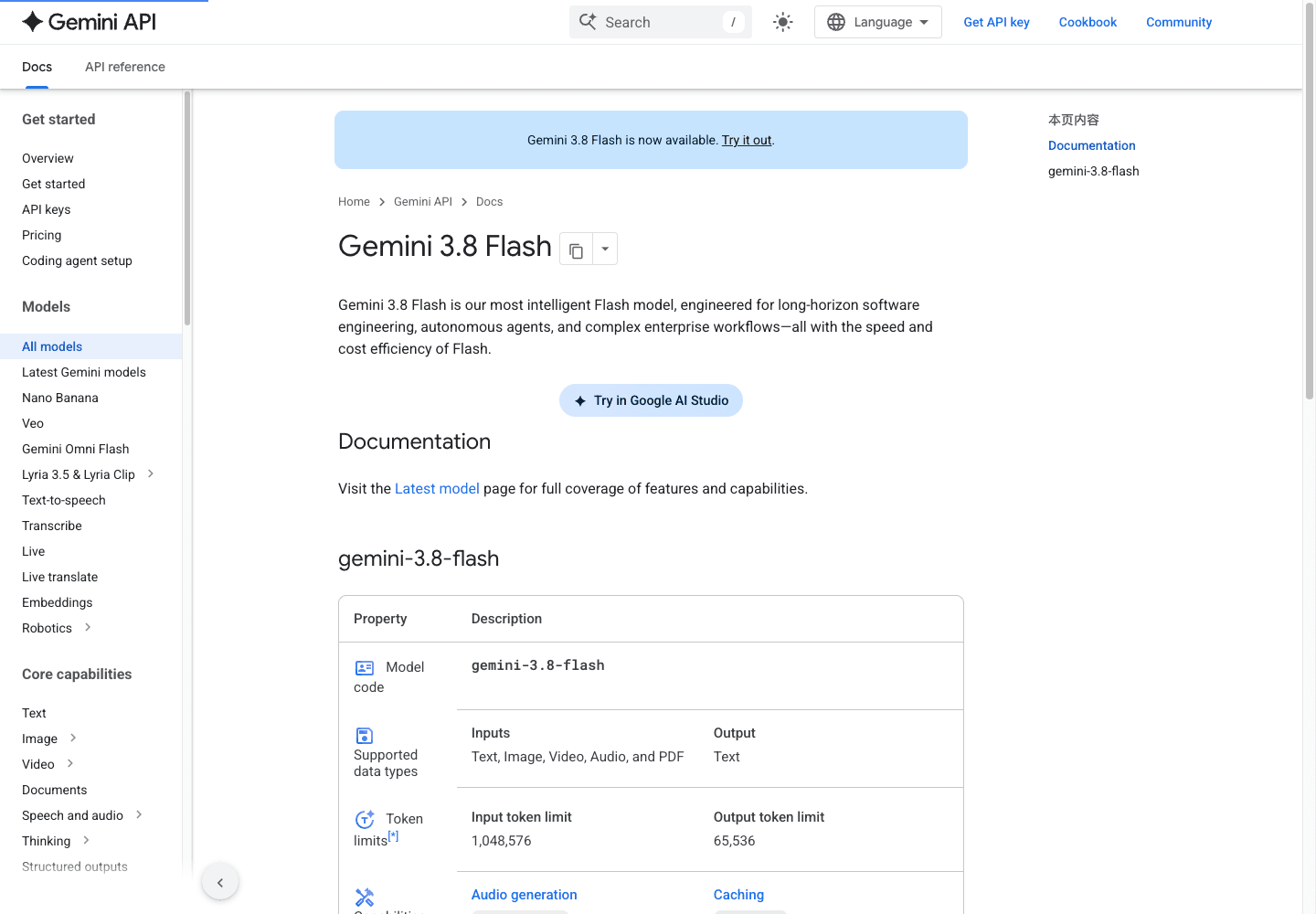
The number to read carefully: 1,048,576
Google lists 1,048,576 input tokens for the Gemini API. That number is an API ceiling, not an allowance promised by every browser, subscription or account. Access is the first decision: confirm the exact model and route, then use the review and pricing guides to decide how much work to give it. (Google)
The practical question is not simply whether 3.8 is “better.” Google says it works harder on complex tasks, with extra reasoning steps and iterative tool calls. That can improve difficult workflows while using more output tokens. Community creators are already testing coding and generation tasks, but those demonstrations are not controlled proof of general superiority. The Gemini 3.8 Flash review addresses that narrower question.
Can you actually use Gemini 3.8 Flash?
Pick the route closest to your situation. This is an access check, not a promise that your account has the model.
Check your API project, billing tier, region, and quota before building around it.
Key takeaways
Gemini 3.8 Flash is the stable
gemini-3.8-flashAPI model, with text, image, video, audio and PDF input and text output.Its listed limits are 1,048,576 input tokens and 65,536 output tokens. Thinking supports low, medium and high; minimal is unsupported.
The main change from 3.7 is a more deliberate reasoning and agent workflow. Google says 3.8 can iterate tools and spend more tokens on difficult work.
Google lists routes through AI Studio, Gemini API, Antigravity, Android Studio, Stitch, Gemini Enterprise and selected consumer subscriptions. These routes are not interchangeable.
Standard API pricing is $0.75 per million input tokens and $3.75 per million output tokens through December 31, 2026, then the listed prices rise to $1.50 and $7.50. This article does not calculate task costs; see the pricing analysis. (Google API)
Gemini 3.8 Flash at a glance
The official model specification is the right source for limits and supported capabilities. The launch article contains Google’s performance framing, while Artificial Analysis provides a dated independent snapshot. The two should not be mixed as if they were one test.
| Question | Current answer | What it means |
|---|---|---|
| Model status | Stable gemini-3.8-flash | Suitable for production planning only where your chosen route exposes the stable ID. |
| Inputs / output | Text, image, video, audio, PDF / text | Multimodal input is broad; image generation and audio generation are not listed as outputs. |
| Token limits | 1,048,576 input; 65,536 output | Large documents fit the API window, but client limits can differ. |
| Thinking | Low, medium, high | Minimal is unsupported and errors. Higher effort can increase token use. |
| Tools | Caching, code execution, computer use preview, file search, function calling, grounding, structured outputs and URL context | Support is an API specification, not proof that every client exposes every tool. |
| API price through 2026-12-31 | $0.75 input / $3.75 output per million tokens | Output includes thinking tokens; subscription and Tabbit costs are separate. |
The independent snapshot is also conditional: Artificial Analysis lists Intelligence Index 41 under v4.3.2 with high thinking, 305 output tokens per second and $1.24 per index task on the page checked September 20, 2026. TTFT was not exposed. These figures are useful for orientation, not a universal latency promise.
What changed from Gemini 3.7 Flash?
Google describes 3.8 Flash as its most intelligent Flash model and says it improves on 3.7 Flash in software engineering, agentic tasks and specialized multi-step reasoning. It also says the shared model core behind 3.8 Flash and Flash Cyber was trained with long-running agentic loops that recursively evaluate and refine the models. The implementation details needed to reproduce that claim are not public in the announcement.
The user-visible change is the workload strategy. On complex tasks, 3.8 may reason longer, call tools repeatedly and use more tokens. Google explicitly says lower effort levels can reduce token overhead, and that 3.7 remains supported for efficiency-first workloads. That makes 3.8 a conditional upgrade: it is most interesting when finishing a difficult task matters more than minimizing every token.
| Dimension | Gemini 3.7 Flash | Gemini 3.8 Flash | Decision implication |
|---|---|---|---|
| Positioning | Fast, efficient Flash for daily coding and agent tools | More intelligent Flash workhorse for long-horizon coding and autonomy | Choose 3.8 when the task needs sustained planning or iteration. |
| Reasoning behavior | Public source does not define the same 3.8 claim | More reasoning steps and iterative tool calls on difficult work | Budget for variable output and waiting time. |
| Effort levels | Check the chosen client’s controls | Low, medium and high; minimal unsupported | Do not assume a “minimal” fallback exists. |
| Price | Google launch page says 3.8 keeps the introductory 3.7 price | $0.75 input / $3.75 output through 2026-12-31 | Equal list price does not mean equal task cost if 3.8 uses more tokens. |
| Cyber variant | Not the focus of this article | Flash Cyber is a separate, restricted model for trusted defenders | Do not treat Cyber access as ordinary 3.8 access. |
Google’s own examples include long-horizon software engineering, finance and legal agent benchmarks, and generated interactive applications. Those are vendor-reported claims. The model resource page collects the underlying prompts and evaluations, while this article keeps the decision to a few release-level facts.
How to get access
Google lists several entry points:
Google AI Studio: a browser-based place to try the model and obtain API credentials where available.
Gemini API: use the stable model ID
gemini-3.8-flash, with the API limits, billing tier and regional availability that apply to your account.Developer products: Google names Android Studio, Google Antigravity and Stitch as places to build or generate with 3.8 Flash.
Enterprise: Google says Gemini Enterprise can provide access under its enterprise terms.
Consumer subscription: Google says 3.8 Flash is available to Google AI Pro and Ultra subscribers in the Gemini app, AI Mode in Search and Gemini in Sheets.
The same model name does not guarantee the same controls. A consumer subscription is not an API billing account, and API access is not proof that a browser client has exposed the model. Check the product’s live model selector, region and quota before promising a workflow to a team.
A small task in Tabbit Browser
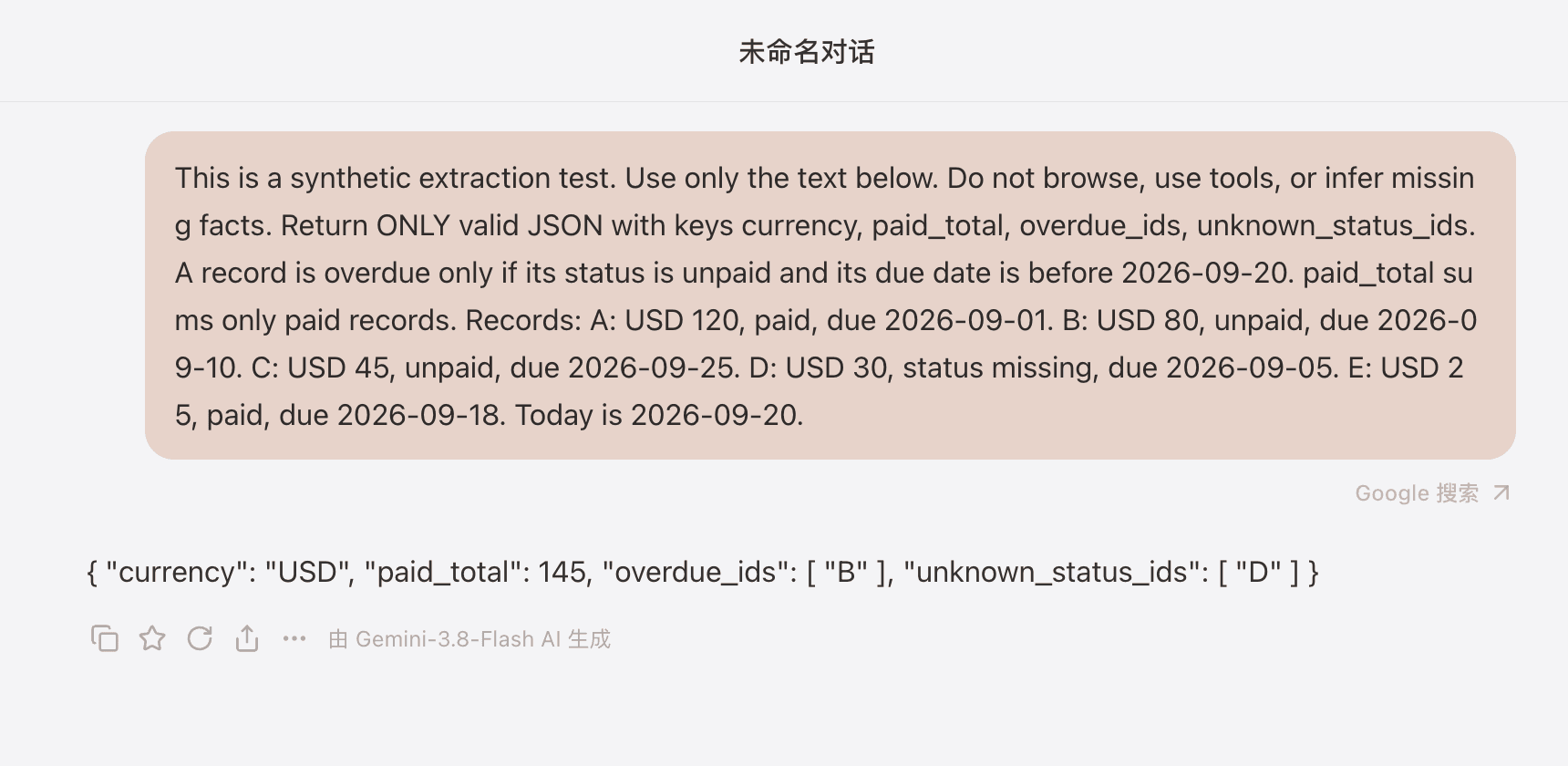
The editorial check on September 20, 2026 used an automation-assisted session in Tabbit Browser Dev, on the test site and an existing signed-in account. After selecting Gemini-3.8-Flash, it sent five synthetic payment records and asked for JSON: currency, paid total, overdue IDs and missing-status IDs. The result was USD, 145, B and D—the expected four fields. The missing status was not invented.
This was one extraction task, not a production benchmark. The UI showed a Google Search indicator despite the instruction not to use tools; tool execution was not independently verified. Thinking level, token usage, cost and timing were not measured. Use the screenshot to inspect the task and result, then try your own small task after checking the live selector.
What the community is actually saying
The useful signal is conditional, and it cuts both ways. On Hacker News, handzhiev described Gemini 3.7 as a fast workhorse and said they were “quite happy to test 3.8 now” (original comment; personal experience, Gemini 3.7, September 2, 2026). simonw reported a solid HTML rendering task with Gemini 3.8 Flash in his own coding agent (original comment; personal experience, Gemini 3.8 Flash, September 2, 2026).


The counter-signal is access and cost. robertwt7 said they were still on 3.6 Flash as a Plus user and asked whether 3.7 was available in Australia (original comment; personal experience, Gemini web access, September 3, 2026). wyrdcurt called Gemini’s HTML result a fast “cool HTML toy” and compared it with cheaper models (original comment; personal comparison, model versions listed in the comment, September 2, 2026).

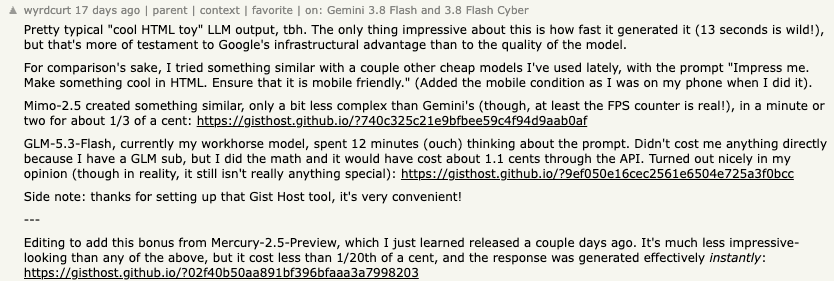
These comments establish scenarios and trade-offs, not a benchmark or a guarantee that your plan exposes 3.8. Reddit returned a human-verification challenge on September 20, 2026; the X and YouTube searches did not expose usable text in this browser session. No claim is derived from those attempts.
Who should try it?
Try Gemini 3.8 Flash when you need multimodal input, a large API context window, structured outputs or sustained agent work, and you can accept variable token use. It is a reasonable candidate for long coding loops, document-heavy analysis and tool-using workflows.
Keep 3.7 Flash or another model in the comparison when latency, predictable token budgets or a client’s exact tool support is the binding constraint. Do not infer that a strong vendor benchmark will transfer to your task. The community reports collected here show interest in coding, generation and price, but their setups are not fully reproducible.
Gemini 3.8 Flash is not the same as Flash Cyber. Cyber access is described as a Fairwind Program route for trusted government authorities, critical infrastructure operators and software maintainers. Ordinary API access to 3.8 Flash does not imply eligibility for that program.
Sources and next step
Read the official model documentation for current limits, then confirm access in the product you actually plan to use. If cost is your constraint, continue to the Gemini 3.8 Flash pricing analysis; if task quality is your constraint, use the review and alternatives guide.
Further reading: Tabbit model resources, AI browser guide, agentic browser, browser automation, AI browser comparison.
Use the task guides to reproduce a workflow, the review sources to inspect evidence, and the browser migration guide to compare the surrounding product.
 Tabbit Browser
FAQ
What is Gemini 3.8 Flash?
Gemini 3.8 Flash is a stable Google model for long-horizon software engineering, autonomous agents and complex enterprise workflows. Its API accepts text, images, video, audio and PDF, and returns text.
What changed from Gemini 3.7 Flash?
Google positions 3.8 Flash as a stronger reasoning and coding release with more deliberate tool use and agent loops. Higher effort can use more tokens, so the improvement may trade efficiency for completion quality.
What are Gemini 3.8 Flash’s context and output limits?
The model page lists a 1,048,576-token input limit and a 65,536-token output limit. These are API limits, not a promise that every client exposes the same window.
Which thinking levels does Gemini 3.8 Flash support?
The API supports low, medium and high thinking. Minimal thinking is unsupported and returns an error according to Google’s model page.
Where can I use Gemini 3.8 Flash?
Google lists Google AI Studio, the Gemini API, Android Studio, Google Antigravity, Stitch, Gemini Enterprise, and consumer access for Google AI Pro and Ultra subscribers. Availability and qualification vary by route and region.
Is Gemini 3.8 Flash available in Tabbit?
One Tabbit Browser Dev test account completed the expected JSON extraction on September 20, 2026. This single sample does not establish production account access, performance or cost; check your own selector and result.