
GPT-6.1 Terra costs $1 per million input tokens, $0.05 per million cached input tokens and $5 per million output tokens on OpenAI's Standard short-context API rate card, checked October 27, 2026. Cache writes are separate billing categories, priced at $1.25 for 30 minutes or $2.50 for 12 hours. These are API prices, not a ChatGPT or Tabbit subscription. (OpenAI pricing)
The number to watch is 95%: a cached read costs 95% less than ordinary input. That can matter more than the input-price headline when an agent keeps reading the same instructions and documents. It still does not guarantee a cheaper completed task. In a launch-day Reddit report, ayudha90 described using more subscription allowance for a result they liked less after raising Terra's effort. That is one user's experience, not an API invoice or a controlled comparison.
Below are the current rate card, the conditions behind the discounts, two reproducible budgets and a local calculator. The Tabbit Browser section checks the actual model picker before suggesting a client workflow.
GPT-6.1 Terra API pricing at a glance
Prices are USD per one million tokens, verified October 27, 2026. Both columns use Standard processing with no regional premium. The predecessor column comes from the current GPT-5.6 Terra model card and pricing table, not an assumed historical price.
| Billing category, short context | GPT-5.6 Terra | GPT-6.1 Terra | Change |
|---|---|---|---|
| Uncached input | $2.00 | $1.00 | −50% |
| Cached input read | $0.20 | $0.05 | −75% |
| Cache write, 30 minutes | $2.50 | $1.25 | −50% |
| Cache write, 12 hours | $5.00 | $2.50 | −50% |
| Output, including reasoning | $12.00 | $5.00 | about −58.3% |
This is GPT-6.1 Terra, API ID gpt-6.1-terra, a text-and-image input model with text output. OpenAI positions it for visual reasoning, computer use and writing. Its 1,050,000-token context window is a capacity specification; the cheaper pricing tier ends much earlier. The earlier Terra overview gives background on the predecessor, while the current model card controls today's specifications.
Key takeaways
A cached input read costs $0.05 per million tokens, 5% of Terra's $1 ordinary input rate. Cache writes cost more and must be budgeted separately.
Input, cached reads and cache writes are mutually exclusive token categories. Adding a write fee to ordinary input for the same tokens overstates the bill.
Above 272K input tokens, the whole request uses higher rates. More context fitting into memory does not keep the short-context price.
Batch and Flex halve the relevant Standard rates; Fast doubles them. Each has service conditions, so choose the processing mode before estimating costs.
Compare cost per accepted result at a suitable effort setting. API dollars, subscription allowance and client access answer different questions.
The 95% discount only applies to cache hits
At $0.05, Terra's cached-read rate is one twentieth of its uncached input rate. Relative to GPT-5.6 Terra's $0.20 cached-read rate, it is 75% lower. Those percentages have different denominators. Neither means your entire bill falls by 95% or 75%.
A repeated prefix can include instructions, tools and stable document context. Cache reuse requires matching prefixes and at least 1,024 tokens for these models. Changing the prefix or missing retention can turn an expected hit into a write or ordinary input. You should measure returned usage, not assume every repeated request hits. The prompt-caching guide explains the matching and retention rules.
For input tokens that are not being written, a hit fraction h gives this short-context input cost per million total input tokens:
input cost = (1 − h) × $1 + h × $0.05
h = 80% → input cost = $0.24
That $0.24 excludes output and cache writes. The first request that creates a prefix is different from a later request that reads it. This matters in agent research loops, where repeated context can dominate input volume.
Translate the savings claim into a task budget
The rate-card comparison is favorable: input halves, output falls by about 58.3%, and reads fall by 75% against the currently listed predecessor. The official tables establish those differences. They do not establish how many tokens your task needs, how often it succeeds, or whether another model solves it with fewer attempts.
In the same Reddit report, ayudha90 compared a pixel-art project-management application across models and effort settings. They reported spending 39% of a five-hour allowance in about 20 minutes across Terra high and max. Different effort settings, subjective output preferences and subscription metering prevent a clean API-cost conclusion. The practical warning remains useful: check the result you accept, not the lowest printed token rate.
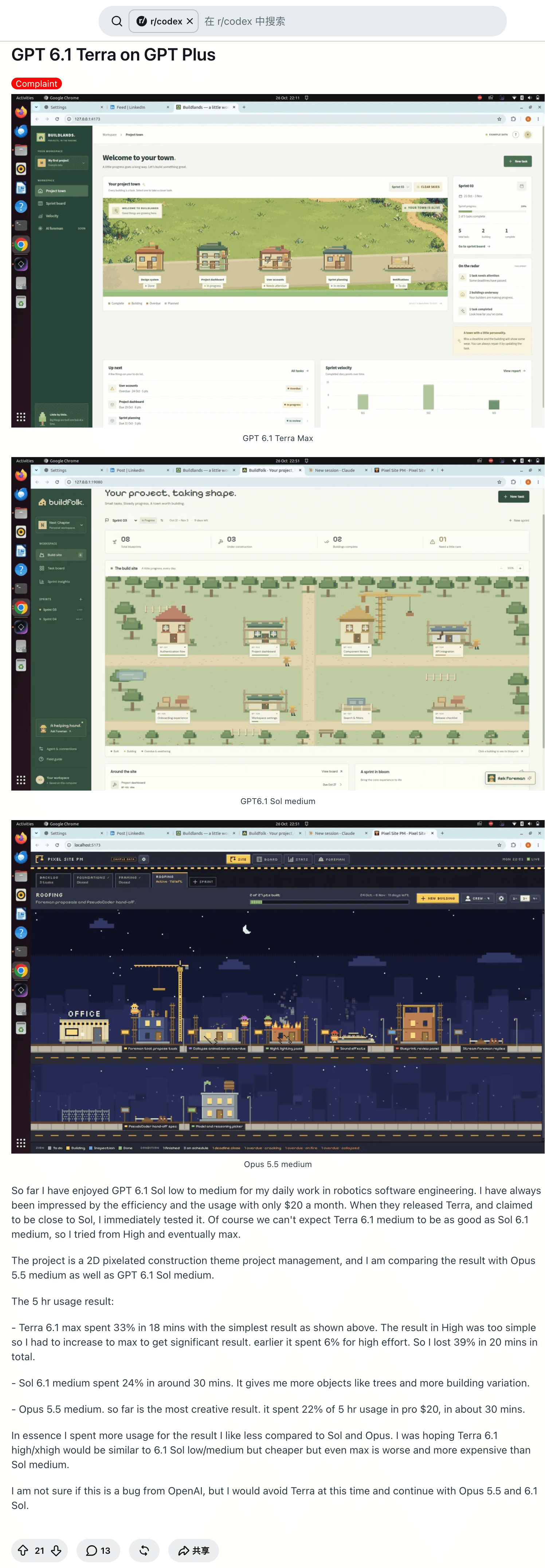
A useful purchasing metric is:
cost per accepted result = total spend across attempts / accepted resultsRun the same representative inputs, define acceptance before testing, and retain usage for failed attempts too. The AI research use-case guide helps separate a bounded extraction task from a long research assignment; they need different budgets.
Extra line items and the 272K boundary
The Terra model card prices requests with more than 272,000 input tokens at 2× input and cache rates and 1.5× output rates. This applies to the full request, including the first 272K tokens.
| Terra processing mode | Input context | Input | Cached read | 30m write | 12h write | Output |
|---|---|---|---|---|---|---|
| Standard | ≤272K | $1 | $0.05 | $1.25 | $2.50 | $5 |
| Standard | >272K | $2 | $0.10 | $2.50 | $5 | $7.50 |
| Batch / Flex | ≤272K | $0.50 | $0.025 | $0.625 | $1.25 | $2.50 |
| Batch / Flex | >272K | $1 | $0.05 | $1.25 | $2.50 | $3.75 |
| Fast | ≤272K | $2 | $0.10 | $2.50 | $5 | $10 |
| Fast | >272K | $4 | $0.20 | $5 | $10 | $15 |
At exactly 272K, use the short row. At 272,001, use the long row for everything. For example, 300K ordinary input and 10K output costs $0.6 + $0.075 = $0.675 on Standard before other charges. Charging only the extra 28K at the higher rate would be incorrect.
Batch is asynchronous, and Flex has different processing availability and latency semantics. Verify Batch or Flex fits the application before taking the discount. The API table currently does not list Terra under Ultrafast; the Sol or Astra option is not a Terra price.
Regional processing adds 10% where available. Hosted tools can add their own fees. For example, web search lists $10 per 1,000 calls plus search-content tokens at model rates. Containers and file-search storage also have separate line items. No Terra promotion expiry is specified in the cited rate card; GPT-5.6 Sol's November 21 promotional note belongs to a different model.
Which family tier fits the work?
These are current Standard short-context rates from the same official table, rather than a quality ranking.
| Model | Input | Cached read | 30m write | 12h write | Output | Starting point |
|---|---|---|---|---|---|---|
| GPT-6 Luna | $0.10 | $0.01 | $0.125 | $0.25 | $0.50 | Focused, repeatable tasks after a quality check |
| GPT-6.1 Terra | $1 | $0.05 | $1.25 | $2.50 | $5 | Visual, document and computer-use workflows |
| GPT-6.1 Sol | $2 | $0.10 | $2.50 | $5 | $10 | More demanding coding and sustained reasoning |
| GPT-6 Astra | $10 | $1 | $12.50 | $25 | $50 | Harder work where extra capability earns its cost |
Terra's input and output are ten times Luna's, but its cached reads are only five times Luna's. That makes cache mix relevant even before quality testing. The Luna pricing guide, previous Sol cost guide and Astra pricing guide cover adjacent choices; older articles retain their own verification dates, so use today's official table for current rates.
Terra supports none, low, medium, high, xhigh and max effort; medium is the default. Start there for a representative task, lower it if results remain acceptable, and increase it only when the extra work helps. Reasoning tokens are charged as output. A cheaper input rate cannot compensate indefinitely for longer reasoning or retries. (Reasoning guide)
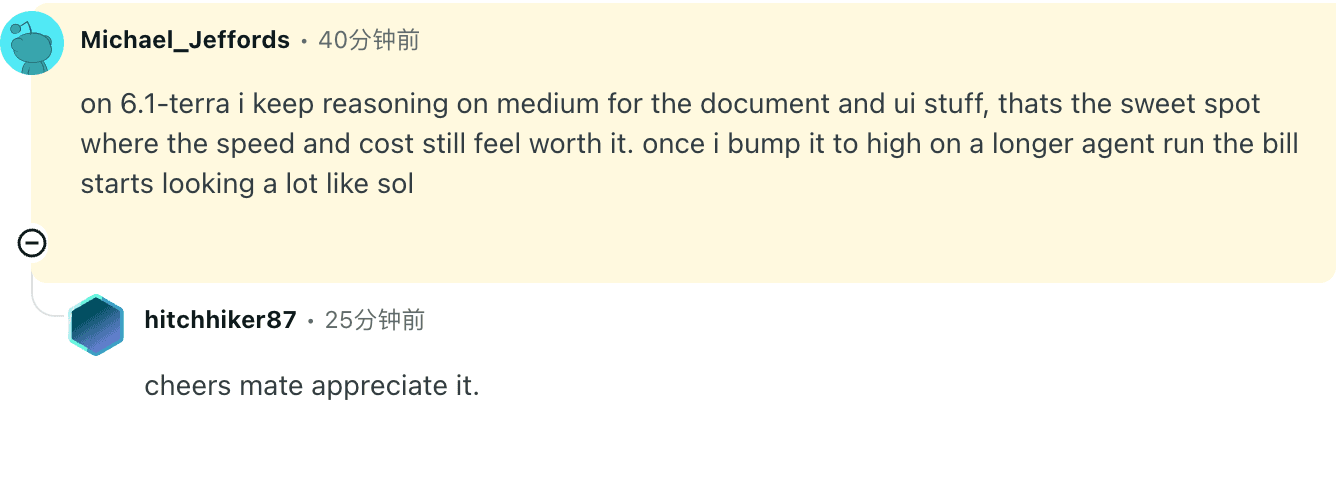
Michael_Jeffords reports keeping Terra at medium for document and UI work, while longer high-effort runs feel closer to Sol's cost. No invoice or controlled sample accompanies the comment. Treat it as a setting to test.
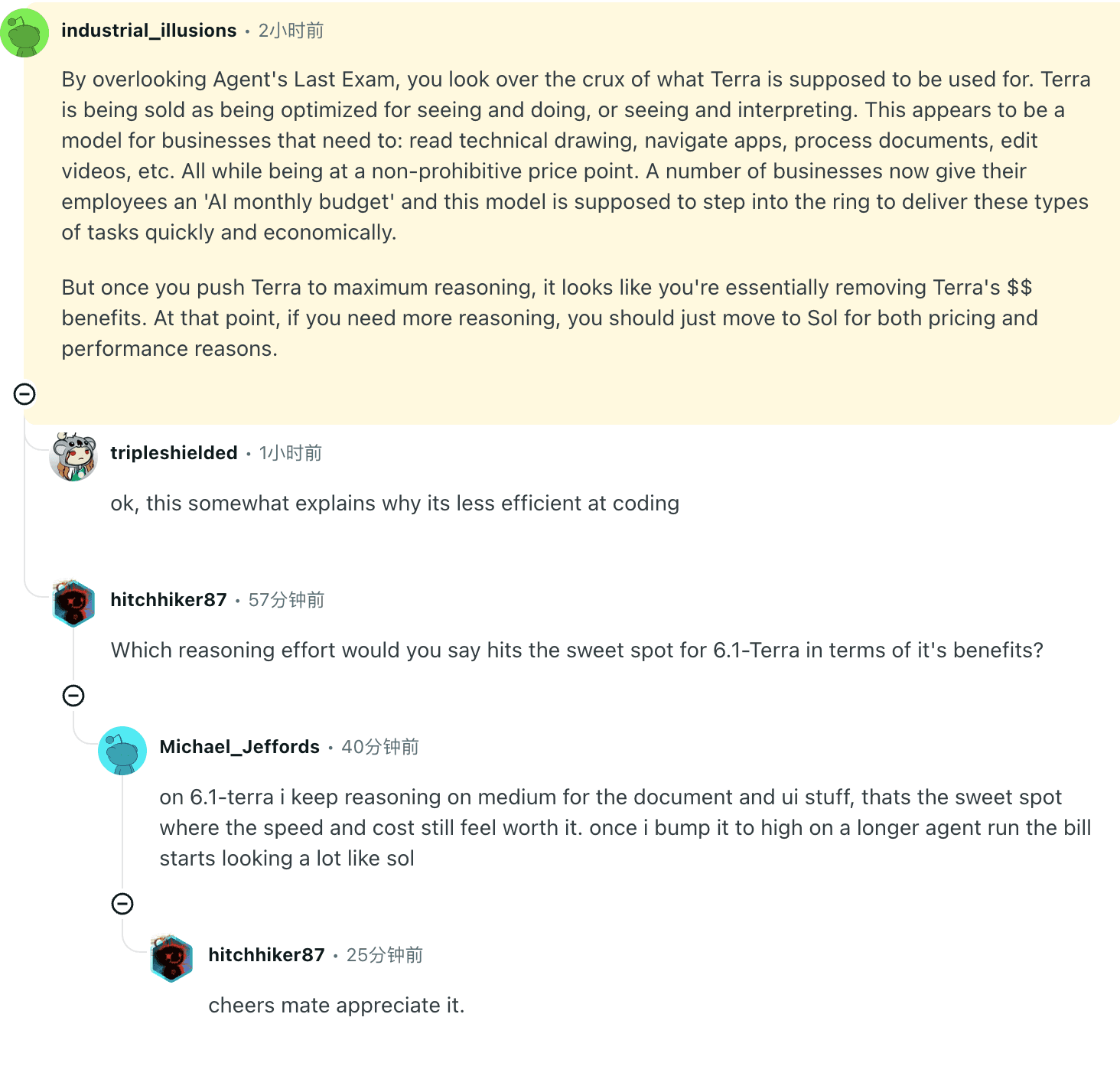
industrial_illusions makes the related case for document processing and app navigation at scale, while questioning the benefit of maximum reasoning. It is a workload argument, not independent validation of OpenAI's benchmarks.
For writing, Louis-François Bouchard's ToneBench post favors low-effort bulk first drafts while questioning gains from higher effort in that evaluation. His conclusion comes from a particular writing task and judging setup; it is not a universal quality ranking.

What has no separate fee, and what is not free
OpenAI does not add a separate Responses API or Chat Completions endpoint fee to these model-token charges. Increasing effort is not listed as a fixed surcharge either; its cost effect comes through usage. A cached read does not also incur a write charge for the same token in the same request.
That does not make failed work free. The reasoning guide says an incomplete response can consume input and reasoning tokens without producing a visible final answer. The cited pages do not promise a refusal waiver or automatic fallback credit. Check response usage and billing records rather than assuming no useful answer means no charge.
The estimates below exclude tool calls, search-content input not already counted, storage, retries, taxes, applicable regional charges and provider markups. Images use model tokenization rules; a screenshot count alone is not a token budget.
ChatGPT plans and API access are separate purchases
OpenAI lists GPT-6.1 Terra in ChatGPT Work and Codex for Plus, Pro, Business, Enterprise and Edu, subject to workspace controls. It is not listed for ordinary Chat. The API model card lists no free-tier support. (Work and Codex pricing; Terra model card)
The Work/Codex page currently lists Plus at $20 per month and Pro from $100 per month. It estimates 35–285 local Terra messages per five hours for Plus and Standard Business, explicitly not a fixed message guarantee. Model choice, context, reasoning and tools change consumption. Check current regional checkout and your usage dashboard before purchasing.
Purchased credits use their own rate card, and Codex does not apply a separate API-style cache-write charge to those credits. API key usage follows API billing. Therefore neither a Plus fee nor an included-usage percentage can be converted into a guaranteed number of API tasks.
Two budgets you can reproduce
These are arithmetic examples, not measured model runs. Both use Standard short-context prices and assume 1,000 requests with 100K total input and 2K total output each. Output already includes reasoning tokens.
| Per-request input mix | Ordinary input | Cached reads | 30m cache writes | Output | Per request | 1,000 requests |
|---|---|---|---|---|---|---|
| Cold prefix, first write | 20K | 0 | 80K | 2K | $0.130 | $130 |
| Warm prefix, later read | 20K | 80K | 0 | 2K | $0.034 | $34 |
Cold arithmetic is 0.02 × $1 + 0.08 × $1.25 + 0.002 × $5 = $0.13. Warm arithmetic is 0.02 × $1 + 0.08 × $0.05 + 0.002 × $5 = $0.034. The same 100K input appears in three exclusive categories, never as 100K ordinary input plus another 80K write.
One initial cold request followed by 999 warm requests costs $0.13 + 999 × $0.034 = $34.096. It assumes the same cacheable prefix, retained cache and no retries. Rewriting or expiring that prefix changes the mix. A cold 12-hour write instead costs $0.23; paying for longer retention only helps if later cache hits justify it.
Estimate your own token budget locally
Enter total input, the fraction read from cache, cache-write tokens, output including reasoning, and request count. The calculator subtracts reads and writes from total input, applies the context boundary to the whole request and compares Terra with Sol and Luna at the same token volumes. Identical token volume does not imply identical quality or task completion.
Local calculator
Compare Terra, Sol and Luna API costs
Official USD API rates checked 2026-10-27. Input values stay here and estimates run in this browser.
Estimates exclude tools, retries, taxes, regional processing, and provider or application fees. Reasoning tokens are included in output tokens. Subscription credits and ChatGPT usage are not estimated. View official API rates
Calculation values stay in your browser. The page records a generic calculator-change event without input values. It does not send the values to a model or pricing service. The results exclude the other charges listed above and use the October 27 rate snapshot.
Check Tabbit's picker before choosing a client
If your work involves browser pages and documents, the Tabbit Browser workflow is relevant after you decide which model you need. Model rates and a usable client are separate parts of that decision.
The actual check here used web.tabbit.ai/newtab in Tabbit on October 27, 2026. The loaded picker contained 16 options, including Kimi-K3.1-Pro and Claude-Sonnet-5.5, and did not list GPT-6.1 Terra. Sample size was one international account; no Terra inference was submitted, no tool-marked Terra response was observed, and no cost or speed was measured. The expected test was a small table-extraction task with a known answer; the missing model prevented it.
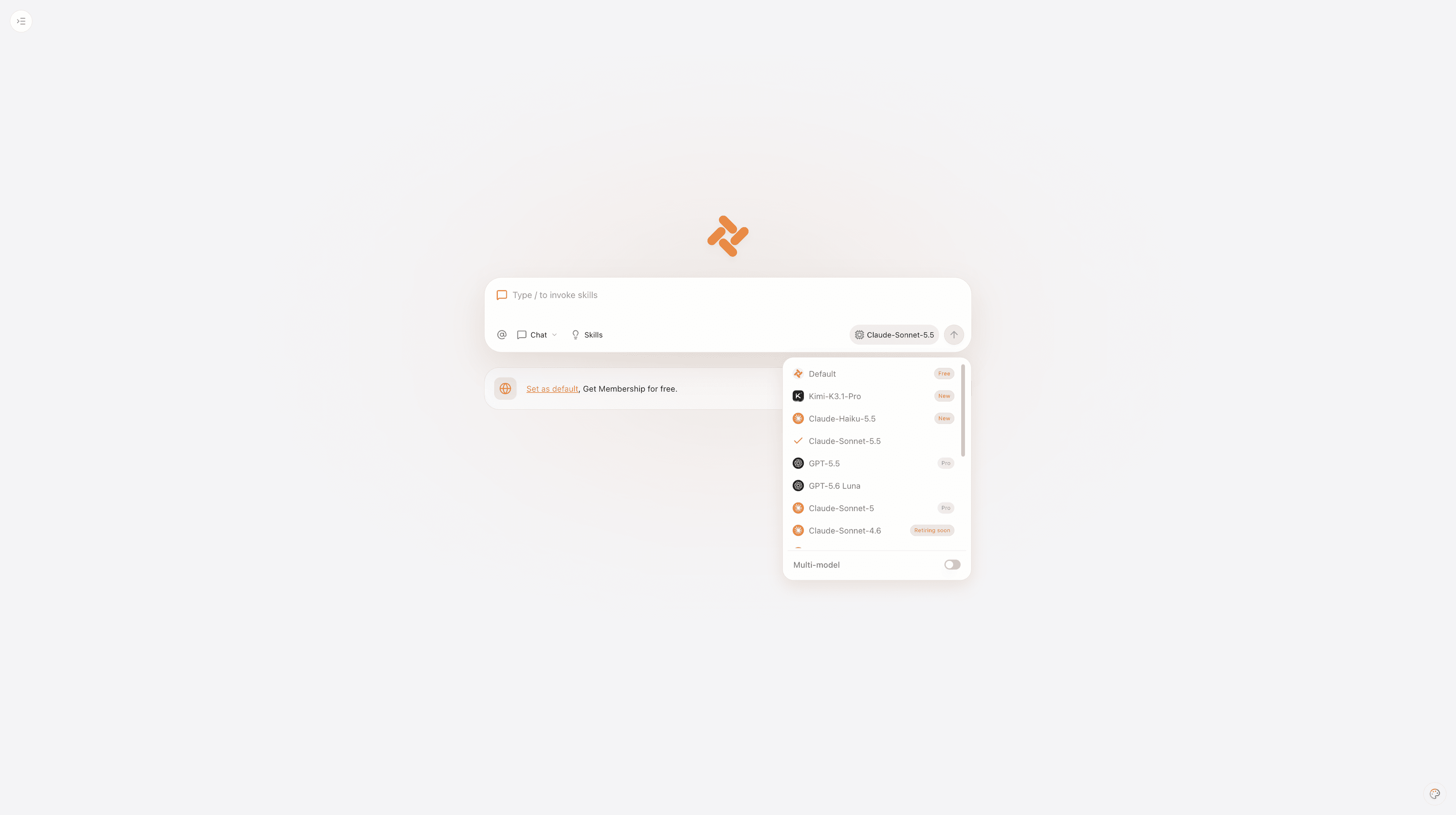
If Terra appears in your account later, use the same source table and expected answer across models, record the displayed name, tool markers and result, and check the current client plan. Until then, use a client whose Terra access is confirmed. The Tabbit practice guide and agentic browser explanation describe browser workflows without proving Terra availability.
Verdict: match the model to your workload
| Your constraint | Sensible next step | What to verify |
|---|---|---|
| Repeated document or visual tasks | Trial Terra at medium, then test lower effort | Accepted results, reasoning output and cache hits |
| Bulk drafts with human review | Compare low-effort Terra against alternatives | Voice, editing time and total task cost |
| Long reasoning or demanding coding | Compare Sol at suitable effort | Whether fewer tokens or retries offset its rates |
| Offline processing | Evaluate Batch or Flex | Service behavior and completion timing |
| Input near 272K | Shorten context or budget the long row | Full input including cached and written tokens |
| Work/Codex subscription | Compare actual allowance and credits | Account dashboard, not API price alone |
Terra's $1/$5 card is a useful starting price for visual and document work. The 95% read discount becomes valuable only when your requests actually reuse cached input; effort and successful completion determine whether the whole task is economical. Test the workload, inspect usage, then choose the plan or API service tier.
For browser work, inspect current Tabbit access before relying on a particular model. Downloading the client does not grant GPT-6.1 Terra or replace OpenAI's billing rules.
 Tabbit Browser

FAQ
How much does GPT-6.1 Terra cost per million tokens?
As checked October 27, 2026, Standard API pricing at up to 272,000 input tokens is $1 for uncached input, $0.05 for cached input and $5 for output per million tokens. Cache writes cost $1.25 for 30-minute retention or $2.50 for 12-hour retention. A token uses one input billing category, so writes are not added to ordinary input charges for the same tokens.
Is GPT-6.1 Terra cheaper than GPT-5.6 Terra?
The current Standard short-context input rate falls from $2 to $1, output from $12 to $5, and cached reads from $0.20 to $0.05 per million tokens. Those are reductions of 50%, about 58.3% and 75%. Your task cost also depends on generated reasoning, cache hits, retries and acceptable output quality.
Does GPT-6.1 Terra have a long-context surcharge?
Yes. Above 272,000 input tokens, the whole request uses long-context rates: input and cache prices double, while output costs 1.5 times as much. Exactly 272,000 input tokens remains in the short-context tier.
Are reasoning tokens and refusals free?
Reasoning tokens count toward billed output tokens, including when no final answer becomes visible. The cited official pages do not promise that refusals are free. Inspect response usage and billing rather than assuming an unsuccessful result costs nothing.
Can I use GPT-6.1 Terra with a ChatGPT subscription?
OpenAI lists Terra in ChatGPT Work and Codex for Plus, Pro, Business, Enterprise and Edu, subject to access and workspace controls. It is not listed for the ordinary Chat surface. Included usage and purchased credits are separate from API key billing.
Is GPT-6.1 Terra available in Tabbit Browser?
The international Tabbit account inspected on October 27, 2026 did not list GPT-6.1 Terra among its 16 loaded model options. This article therefore does not claim a Terra inference test in Tabbit or promise model access. Check your current picker and plan before choosing a client for this model.