
Google’s announcement lists a standard Gemini 4 Carbon API rate of $2 per million input tokens and $10 per million output tokens through November 30, 2026, with a scheduled change to $4 and $20 on December 1. Google says thinking tokens are billed as output. These are dated list rates, not a prediction of your invoice; verify the live model SKU, cached-token rules, batch pricing, region and taxes before budgeting. Google’s launch notice is the primary record.
The current Gemini API pricing card confirms that Carbon has no free tier. Standard implicit context-cache tokens cost $0.10/M through Nov 30 and $0.20/M from Dec 1; explicit caching is unsupported. The page also lists Batch and Flex at $1/$5/$0.05 per million input/output/cache tokens through Nov 30, then $2/$10/$0.10, and Priority at $3.60/$18/$0.18 then $7.20/$36/$0.36. Standard Search grounding includes 5,000 monthly requests shared across Gemini 3+ models, then $14 per 1,000, subject to a 1,500 daily request cap. The examples below use paid Standard, uncached input, and no grounding.
What users reported
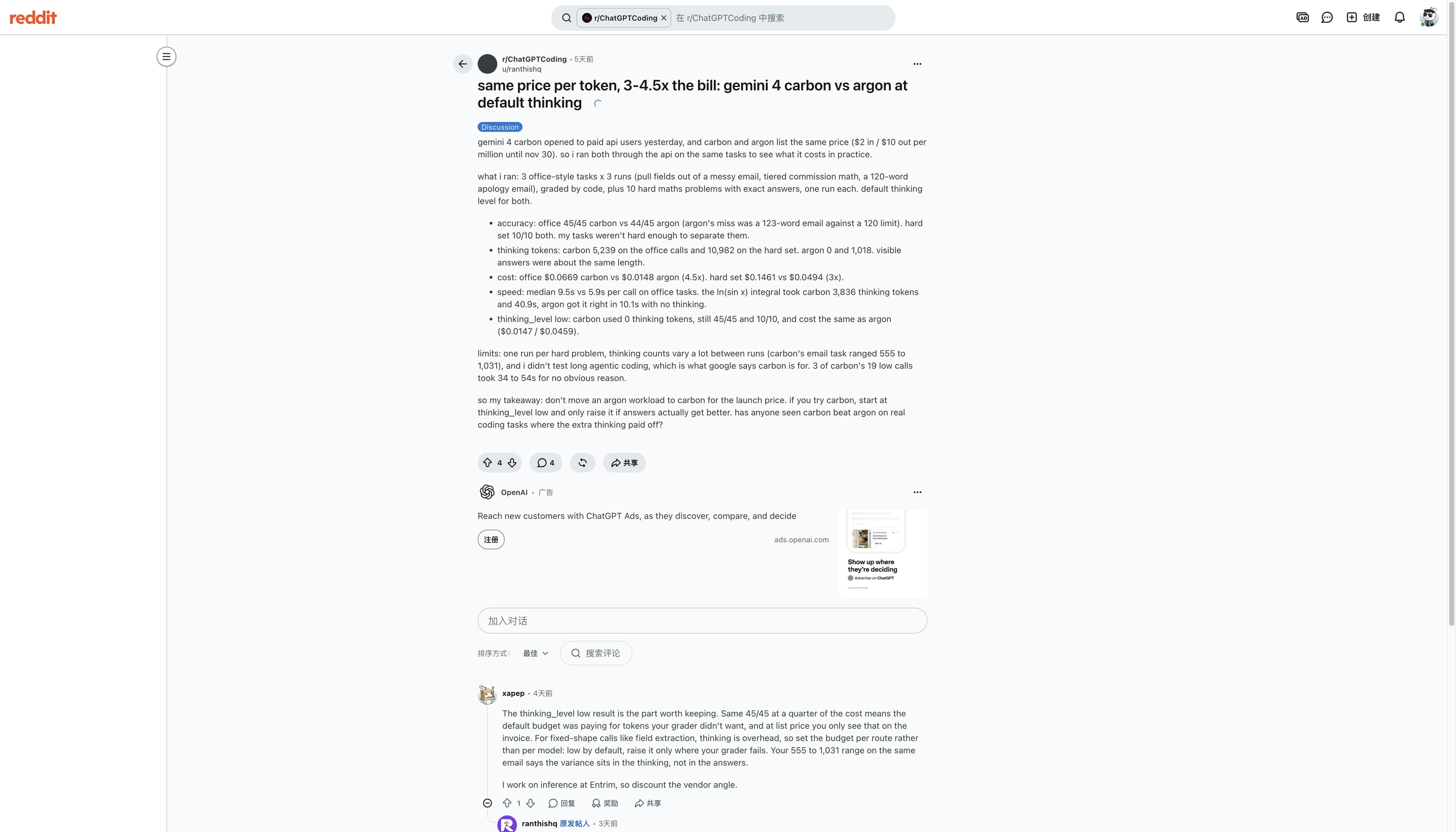
A Reddit user compared Carbon and Argon at the same listed per-token rate, then reported a higher Carbon bill on a small set of office and math prompts. The post title says “3–4.5x the bill”; the author also says the tasks may not have been difficult enough. This is one self-test, not a general multiplier. Read the original report.
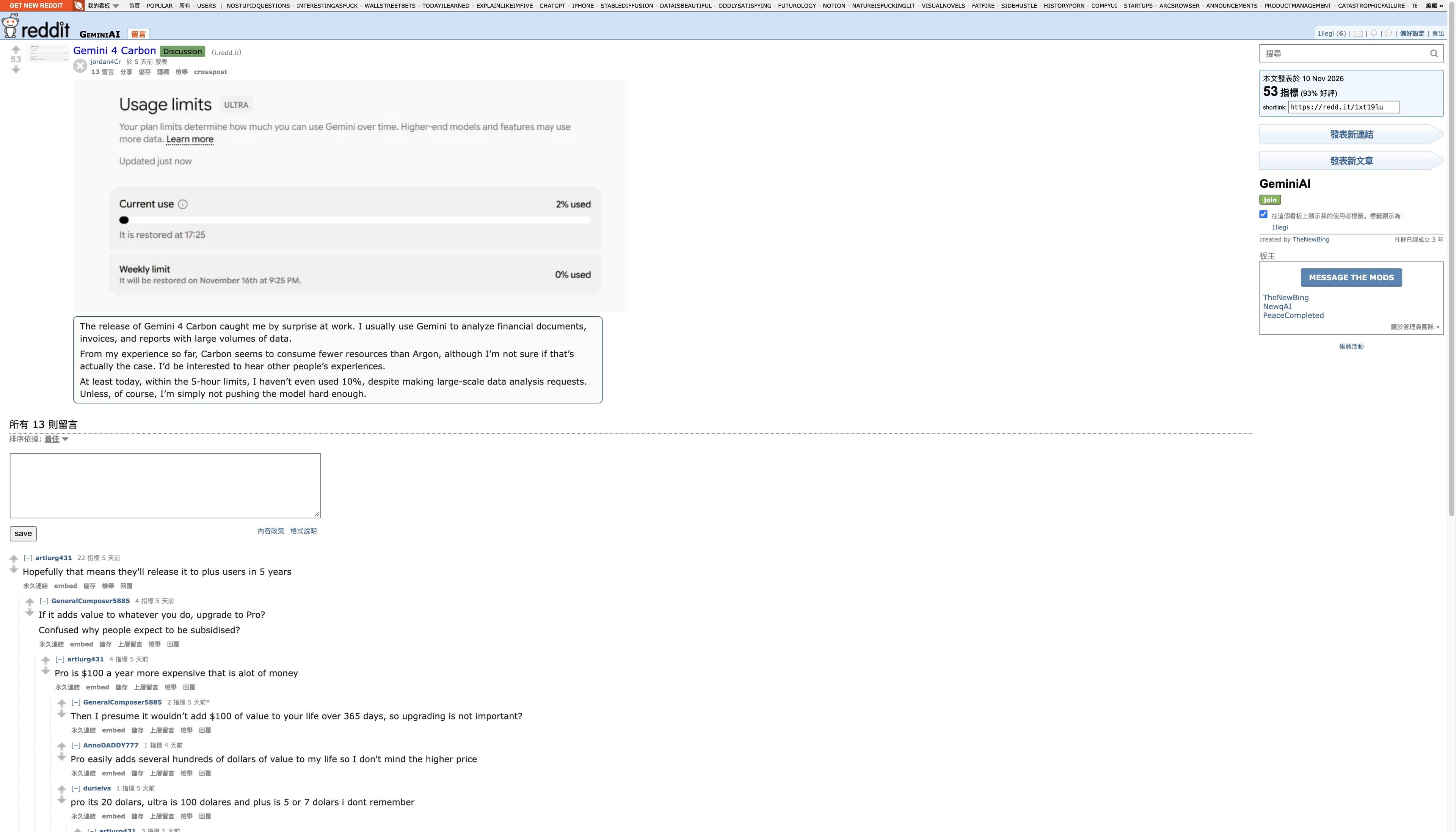
A separate user described using under 10% of a five-hour Gemini app quota after data analysis. That is a consumer quota anecdote, not a Gemini API invoice; the screenshot shows why the meters should stay separate. Read the original post.
Key takeaways
Standard paid API is $2/M input and $10/M output through Nov 30; the card schedules $4/$20 from Dec 1.
Carbon has no free API tier; Standard implicit cache is $0.10/M now and $0.20/M from Dec 1, while explicit cache is unsupported.
Thinking tokens are billed as output; include grounding requests and the chosen Standard/Batch/Flex/Priority tier in the estimate.
App or Antigravity quotas are separate from API invoices; compare cost per accepted task using billed usage.
A practical decision table
| Task | What the sources support | What remains unproven | Next check |
|---|---|---|---|
| Current Standard API rate | $2/M input, $10/M output; implicit cache $0.10/M through Nov 30, 2026 | Actual invoice and account-specific terms | Check live billing SKU |
| Announced Dec 1 rate | $4/M input, $20/M output | Whether account, region and SKU use this exact meter | Verify before rollout |
| Consumer app / Antigravity | Product-level plan or quota | API-equivalent cost | Read that product's meter |
Turn the claim into a task test
For a pilot, write down the accepted answer before running the model. Use read-only inputs and a harmless output, then repeat the task with the same context and rubric. Record correctness, omissions, time, input/output tokens, and cost. If an answer is wrong, note whether the error came from the model, the prompt, or missing source material; do not silently change the task between runs.
For a simple Standard estimate, use cost = (uncached input × input rate + cache-hit input × cache rate + billable output × output rate) / 1,000,000, then add any grounding charges. Thinking tokens are billed as output. The examples below assume zero cache-hit tokens and zero grounding requests.
| Example usage | Through Nov 30 | From Dec 1, 2026 |
|---|---|---|
| 20k input + 4k output tokens | $0.08 | $0.16 |
| 100k input + 20k output tokens | $0.40 | $0.80 |
Local calculator
Estimate Standard API costs
Use billed input and output tokens for one request. Values stay in your browser.
Through November 30, 2026
From December 1, 2026
Paid Gemini API Standard, USD. Output includes thinking tokens. Taxes, tools and subscriptions are excluded. Google API pricing
These examples multiply the announced standard rates directly. Replace them with your actual token counts, and verify the billing page after a small capped request. A single task may produce far more output or thinking tokens than expected; stop or reduce the budget when the estimate exceeds your limit.
For a fuller budget, compare cost per successful browser task and ways to reduce agent token usage. A repeatable source task benefits from multi-model research notes, source-backed browser research, and this deep-research workflow overview.
Where Tabbit fits
Tabbit Browser and its CLI can help a local agent handle browser work when the model route and browser permissions are configured separately. It does not grant access to Carbon or make app quotas equal API billing. For the workflow layer, see the Carbon browser-use guide and Tabbit CLI setup. Do not send credentials in prompts; use read-only tasks and review before any action.
For execution setup, the first browser-task checklist, existing-browser connection guide, local browser automation guide, and agentic browser explainer cover the browser layer.
Budget around accepted work
A useful budget starts with a representative task, not a token-price comparison alone. Estimate the input once, then add the output and thinking tokens the model actually billed on a capped pilot. Multiply that task cost by expected monthly volume and reserve room for retries. If Carbon produces a more complete answer that avoids a second model call or substantial human repair, record that saving separately; do not assume it in advance. Recalculate at the announced December rate boundary and whenever the provider changes a SKU. Keep app or Antigravity quotas in a different column from API dollars, because those products may meter usage differently.
Treat the published evidence as a starting point, not a promise for your workload. Verify the current model, account terms and measured result before committing sensitive data or recurring spend.

FAQ
What is the Gemini 4 Carbon API price?
Google announced $2/M input and $10/M output through Nov 30, 2026, then $4/M and $20/M from Dec 1. Confirm the live SKU and billing details before use.
Are thinking tokens billed separately?
Google says thinking tokens count as output tokens. Check the current pricing page for the endpoint and account you use.
How do I estimate one task?
Multiply input tokens by the input rate and output tokens, including billed thinking tokens, by the output rate; divide by one million and add applicable fees.
Does Gemini app usage use the API rate?
Consumer app and Antigravity usage have product-specific plans or quotas. Do not convert an app quota anecdote into an API invoice.
Do caching or batch requests change the price?
The live card lists Standard implicit cache at $0.10/M through Nov 30 and $0.20/M from Dec 1; explicit cache is unsupported. Batch/Flex and Priority have separate rates, listed above.