
If you are choosing between Gemini 4 Hydrogen and Gemini 3.8 Flash, Hydrogen is the stronger first model to try for work where reasoning quality and turnaround both matter. Google reports higher benchmark scores and shorter completion times for Hydrogen. Flash still has a practical case for short, predictable jobs and, for API calls through December 31, 2026, a lower published token rate. Those are different trade-offs, not a universal upgrade verdict.
One Reddit user comparing the two through Antigravity wrote, “Both got 24/24.” The same post says its Hydrogen batch used a larger share of that account's weekly quota, then adds an eight-run coding task with a different result. That is a useful reminder that task shape and the meter you watch can change the answer. It is one user's self-reported test, with AI-assisted wording, not a benchmark. Read the full comparison and setup.
Key takeaways
Hydrogen is Google's newer fast model. Google says it completes tasks 2.5 times faster than 3.8 Flash at the default high thinking setting, and reports stronger results on selected coding benchmarks. These are vendor claims tied to particular evaluations.
The choice depends on the task. Hydrogen is a sensible first try when a task needs several reasoning steps, tool calls, or quick iteration. Flash can remain useful for simpler jobs where speed is already adequate and API price matters.
Do not mix up API pricing with a consumer subscription's quota. Google lists Hydrogen and 3.8 Flash token rates for API use. Antigravity and Gemini app plans use separate access and usage rules.
Model availability is channel-specific. Google lists Hydrogen for Gemini API, AI Studio, business, the Gemini app, Search, and paid AI Pro/Ultra in Antigravity. A model appearing in one product does not prove it is available in another.
A fair comparison needs paired runs on your own tasks. Track completion, wall time, retries, human corrections, and the actual bill or plan quota. Do not infer a project-level cost from an intelligence score alone.
Gemini 4 Hydrogen vs 3.8 Flash at a glance
| Decision factor | Gemini 4 Hydrogen | Gemini 3.8 Flash | What the evidence means |
|---|---|---|---|
| Google’s positioning | Fast execution for coding and agentic workflows | Previous fast model; still documented as available | Vendor framing, not an independent ranking |
| Quality | Google reports 57% on Terminal-Bench 4.1 and stronger results on selected evaluations | Google reports 18.2% on the same coding benchmark | Benchmark scores apply to that benchmark and setup |
| Speed | Google says 2.5x faster at its default high setting | Reference point in Google’s comparison | Do not apply the ratio to every request |
| Thinking controls | Low, medium, high, and xhigh, according to launch materials | Available controls depend on the endpoint and product | Confirm the controls exposed in your channel |
| API price in Google’s announcement | $1.50/M input, $7.50/M output | Half those rates through Dec 31, 2026 | Check the live pricing page before budgeting |
| Context | Up to 1M combined input and output tokens in the model card | Check the current model page for the specific endpoint | A context limit is not a guarantee of equal quality across the full window |
| Access | API, AI Studio, business, app, Search, plus paid AI Pro/Ultra in Antigravity | Check channel-specific model lists | Access and quotas differ by product and plan |
| Best first trial | Multi-step tasks where quicker, stronger execution could save correction time | Short, routine tasks where existing behavior and API rate are attractive | Test on the actual workflow before migrating |
Where Hydrogen has the edge
Google presents Hydrogen as an everyday execution model that can handle more complex work than 3.8 Flash while responding faster. The company's announcement reports a 57% result for Hydrogen and 18.2% for 3.8 Flash on Terminal-Bench 4.1. Google also says Hydrogen makes fewer fabricated claims and adapts better when a tool call fails or a search returns no results. Treat each point as Google's reported evaluation, not a guarantee for your codebase or research process. Google's launch post describes the test claims; the DeepMind model card lists evaluation categories, intended use, and limitations.
That distinction matters in an agent workflow. A coding agent can spend time reading files, planning, editing, running tests, and recovering from tool errors. If a model saves a minute but needs more repair work, that minute may not matter. If it completes the task with fewer retries and a cleaner patch, it may be worth more than a token-rate comparison suggests. The useful unit is successful work delivered, not one answer in isolation.
Independent comparisons can help, but their numbers are also tied to a fixed benchmark. Artificial Analysis's release comparison can show how the models behaved under its evaluation setup. It cannot tell you exactly how a private repo, long browser session, or constrained tool environment will behave. Read the setup and metric definitions before comparing headline scores.
When 3.8 Flash still makes sense
A newer model does not make every existing workflow worth migrating. A short extraction, classification, format conversion, or straightforward response may not benefit from Hydrogen's additional capability. If 3.8 Flash already meets your quality bar, takes acceptable time, and is cheaper on the API rate in effect, keeping it is a reasonable choice.
There is also a difference between a model's per-token rate and the bill for a completed job. A model that uses fewer output tokens may still cost more if its rate is higher. A model that uses more tokens might still be cheaper if it avoids expensive retries. For API use, calculate each run as:
run cost = input tokens × input rate + output tokens × output rateThen add any tool or hosting charges outside that model bill. In a managed product such as Antigravity, compare the product's quota change, not a notional API bill. The quotas may account for model, thinking effort, tools, cached context, or system instructions differently. Do not translate a percentage of weekly plan quota into tokens unless Google documents that conversion for the plan.
Google's November announcement gives Hydrogen a $1.50/M input and $7.50/M output API rate, and says Flash is half that through Dec 31, 2026. This is a dated API rate statement. It does not describe the Gemini app's subscription, Antigravity quota, business plan, or every third-party provider. Check the current Gemini API pricing page and the current model list before making a budget or integration decision.
Availability depends on the product
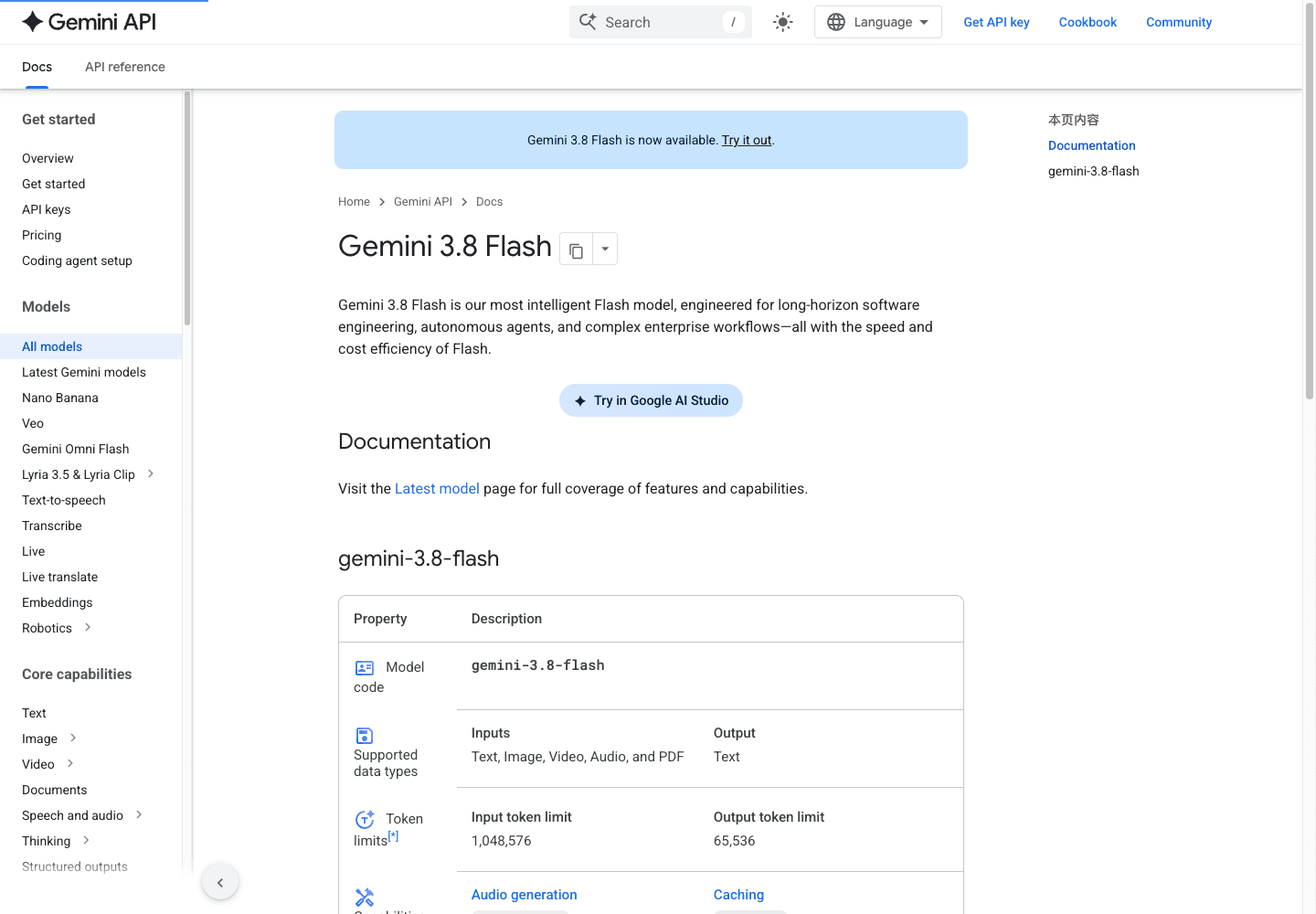
“Available in Gemini” can mean several different things. Google's launch post lists Hydrogen in the Gemini API, AI Studio, Gemini for business, Gemini app, Google Search, and in paid Google AI Pro and Ultra subscriptions for Antigravity. The model card also names those distribution channels. Yet the exact rollout, plan, region, model picker, rate limit, and usage meter can differ in each one.
For the Gemini consumer app, check the model selector and your plan's current limits. Google's API documentation is the source for model IDs, token rates, and endpoint-specific behavior. For Antigravity, check its own model picker and account quota. A Reddit user reported that Hydrogen appeared, disappeared, and reappeared during the initial rollout, which is a launch-day observation rather than a current status report. The thread captures that brief confusion.
If you are testing a workflow through a browser, the browser is part of the environment. Page state, login status, tool access, network delay, and human handoffs all affect the outcome. A fair workflow test should keep those conditions fixed. Guides to AI browsers, agentic browsers, and browser automation explain why a model comparison can change when the browser or task setup changes too.
A fair Hydrogen vs Flash test
A reliable test does not start with “which model feels smarter?” It starts with a task you actually need to finish. Use the same inputs and tool permissions for both models. Do not give one model a cleaned-up prompt after the other has already shown you what it missed.
Choose 10 or more tasks from the same workload: for example, summarize source pages, fix a small bug with a test, or extract fields from the same set of documents.
Freeze the prompt, files, tools, network access, and success criteria. If thinking level is adjustable in the product, record it and keep it consistent for the first pass.
Alternate or randomize which model runs first. Avoid scheduling one model during a quieter part of the day and the other during a busy period.
Record whether the result passes the same checks, wall-clock time, input and output tokens where available, retries, tool failures, and human corrections.
Record the actual cost meter: API charges for API calls, or plan quota change for a managed product. Keep the two channels separate.
Repeat enough paired runs to catch variability. A single successful answer is a useful anecdote, not a model verdict.
For coding, include both the final test result and the time spent fixing the patch. For research, count unsupported claims and source verification work. For browser tasks, record whether the model reached the right page and completed the intended action without a person taking over. A simple score such as “answer quality” hides the work that happened after the first response.
The Reddit comparison above is a good example of why task definition matters. The author says Hydrogen and Flash both answered 24 short questions correctly, while their account quota use differed. The post later reports a separate multi-step coding task with a different relationship between the models. The author warns that their compact tasks were unlike a long, loosely specified agent job. That is a helpful test note, but it is not enough to settle the comparison for everyone.
A browser workflow example with Tabbit
If the task involves web pages, keep the pages and handoff rules identical while you compare models. Tabbit Browser can provide a browser workspace where you keep source pages open, ask questions against page context, and inspect what the agent did. That is useful for running a repeatable browser workflow, but it does not prove that Hydrogen is available inside Tabbit, and no Hydrogen benchmark was run for this article.
A practical test could compare two models on the same public product page: ask each to extract the current plan names, quote the source lines, and identify what the page does not say. Then check the citations and the missing-information calls yourself. You can repeat the same test in a browser agent workflow or with a browser-use setup. The result you should care about is fewer corrections and a reliable answer, not whether one model sounded more confident.
Tabbit is a poor fit if the real choice is which Gemini API model ID to call from a backend service. Use Google's API docs and billing data for that decision. If you want to test broader web research or cross-tab reading, the research browser guide and deep research overview provide a browser-centered workflow context. Tabbit's Gemini model page is about a different Gemini integration; do not assume it includes Hydrogen.
Which one should you choose?
| Your situation | Start with | Why | Reconsider when |
|---|---|---|---|
| A short, well-defined API task | 3.8 Flash | Lower published API rate through Dec 31, 2026, if that rate applies to your endpoint | It fails quality checks or needs repeated retries |
| A coding task that needs several tool calls | Hydrogen | Google reports stronger results on selected coding and agentic tests | Your own paired test shows no useful quality or time gain |
| A long-running workflow with a managed quota | The model exposed in your plan, then test both where possible | API rates do not map directly to plan quota | The quota meter, access, or reset rules change |
| A latency-sensitive task with review available | Hydrogen | A faster first pass may shorten the loop | Review costs more time than the saved execution time |
| A stable production API integration | Keep the current model until tests pass | A version label alone is not a migration plan | Regression tests and costs favor switching |
| A browser research job | Compare in the same browser and page state | The environment can drive model performance | Browser permissions or source pages differ between runs |
Final verdict
Hydrogen is the stronger first candidate when a task needs reasoning, tool use, or quick iteration. Google's results make it worth testing, especially if a faster, more capable run could cut correction work. The evidence does not say every Hydrogen call is faster, cheaper, or better than 3.8 Flash.
Keep 3.8 Flash for the jobs it already handles well, especially where API price is the deciding constraint. Check access in the exact product you use. Then run paired tests and measure successful completion, time, rework, and the actual meter that bills you. If a browser workflow is part of the job, hold the browser setup steady too. The AI browser comparison and browser download guide can help you choose a working environment, but neither changes the model's access rules.

FAQ
Is Gemini 4 Hydrogen better than Gemini 3.8 Flash?
Google positions Hydrogen as the newer fast model and reports stronger results on several coding and agentic benchmarks. That does not make it the better choice for every prompt, plan, or tool workflow. Compare them on the tasks you actually run.
Is Gemini 4 Hydrogen faster than Gemini 3.8 Flash?
Google reports that Hydrogen completes tasks 2.5 times faster at its default high thinking setting. That is a vendor result under a stated test setup, not a promise that every reply or agent session will be 2.5 times faster.
Can I use Gemini 4 Hydrogen in the Gemini app?
Google lists Hydrogen for the Gemini app and Search, but product rollouts and model selection can differ by plan, region, and date. Check the model picker in your own account instead of assuming API access means app access.
Is Gemini 4 Hydrogen available through the Gemini API?
Google lists Hydrogen in the Gemini API and AI Studio. API access has its own model IDs, pricing, rate limits, and terms, separate from consumer Gemini app access and Antigravity plan quota.
Does Gemini 4 Hydrogen cost more than Gemini 3.8 Flash?
Google's November 2026 announcement lists Hydrogen at $1.50 per million input tokens and $7.50 per million output tokens. It says 3.8 Flash is half that API rate through December 31, 2026, so verify the current pricing page before estimating a project.
Should I switch an existing Gemini 3.8 Flash workflow now?
Switch only after you have checked access and compared success rate, time, correction work, and the relevant cost or quota meter. Keep 3.8 Flash where its lower API rate or current behavior still fits your task.