
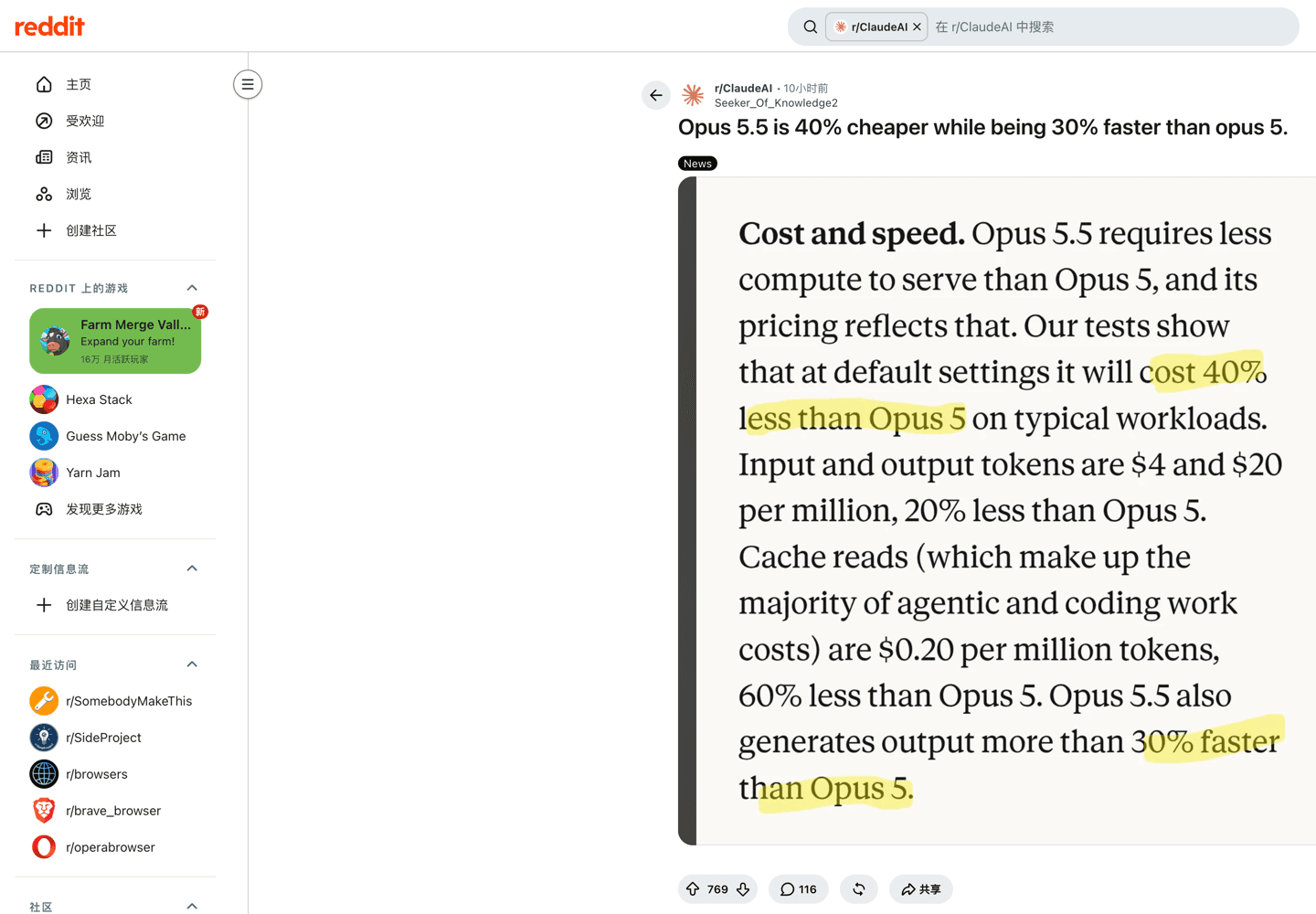
Claude Opus 5.5 costs $4 per million input tokens and $20 per million output tokens on the Anthropic API, with cache reads at $0.20 per million — every rate checked on Anthropic's own pricing docs on September 23, 2026, the day after release. This time the rate card itself is the news: all five billing lines moved down from Opus 5, the first Opus generation that undercuts its predecessor. Five generations of Opus — 4.5 through 5 — all list at $5/$25, and the newest one is suddenly the cheapest. Anthropic's estimate: "at default settings it will cost 40% less than Opus 5 on typical workloads."
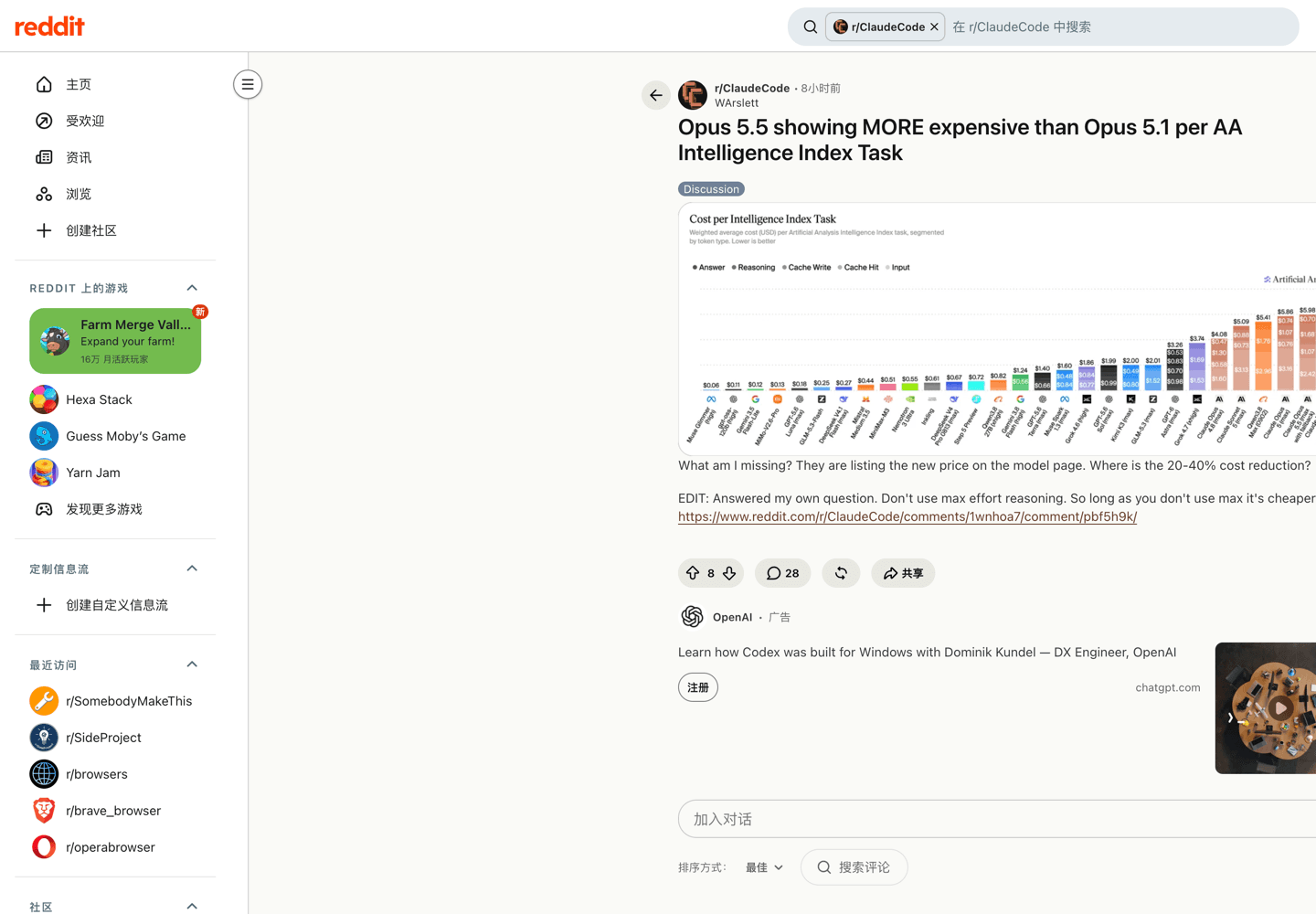
Both halves of that sentence are true, and the gap between them is why this article exists. On the official card, one line did most of the work — cache reads fell 60%, to the same $0.20 that Sonnet 5 charges. Off the card, an r/ClaudeCode developer opened Artificial Analysis on launch day and saw Opus 5.5 "showing MORE expensive than Opus 5.1 per AA Intelligence Index Task," then answered their own question: "Don't use max effort reasoning. So long as you don't use max it's cheaper" (r/ClaudeCode). This page is the money side of the Opus 5.5 story — the family overview and Opus 4.8's legacy status carry the capability background; later in the guide, Tabbit Browser appears as one practical place to run these comparisons once the budget is clear. First, the numbers.
Key takeaways
The rate card: $4 input, $0.20 cache reads (0.05x — a rate only Opus 5.5 has), $5/$8 cache writes (5m/1h), $20 output per million tokens. Batch halves everything to $2/$10; Fast mode doubles everything to $8/$40; US-only inference adds 1.1x to every line.
One number did most of the cutting. Cache reads fell 60% ($0.50 → $0.20) — the line Anthropic itself says "make[s] up the majority of agentic and coding work costs." Opus 5.5's cache read now matches Sonnet 5's, at twice the model.
Effort is the biggest controllable lever. Artificial Analysis measures $0.55 per task at low effort and $5.98 at max — an 11x swing for 16 intelligence points. Default is medium, and the model thinks more per turn than Opus 5 at the same setting.
No long-context cliff. The full 1M-token window bills at standard rates, and a Batch beta header allows 300K output tokens. But the newer tokenizer produces ~30% more tokens for the same text than pre-4.7 models.
Subscriptions got a parallel update. Opus 5.5 is standard allowance on Pro/Max (Fable burns usage credits at 50% of weekly limits), five-hour limits were raised on paid plans, and rate-limit resets can now be saved for later.
Claude Opus 5.5 pricing at a glance
The full standard rate card, rendered from Anthropic's pricing docs on September 23, 2026:
| Model | Input / 1M | 5m cache write / 1M | 1h cache write / 1M | Cache read / 1M | Output / 1M |
|---|---|---|---|---|---|
| Claude Opus 5.5 | $4.00 | $5.00 | $8.00 | $0.20 | $20.00 |
| Claude Fable 5.1 | $10.00 | $12.50 | $20.00 | $0.25 | $50.00 |
| Claude Opus 5 | $5.00 | $6.25 | $10.00 | $0.50 | $25.00 |
| Claude Sonnet 5 | $2.00 | $2.50 | $4.00 | $0.20 | $10.00 |
| Claude Haiku 4.5 | $1.00 | $1.25 | $2.00 | $0.10 | $5.00 |
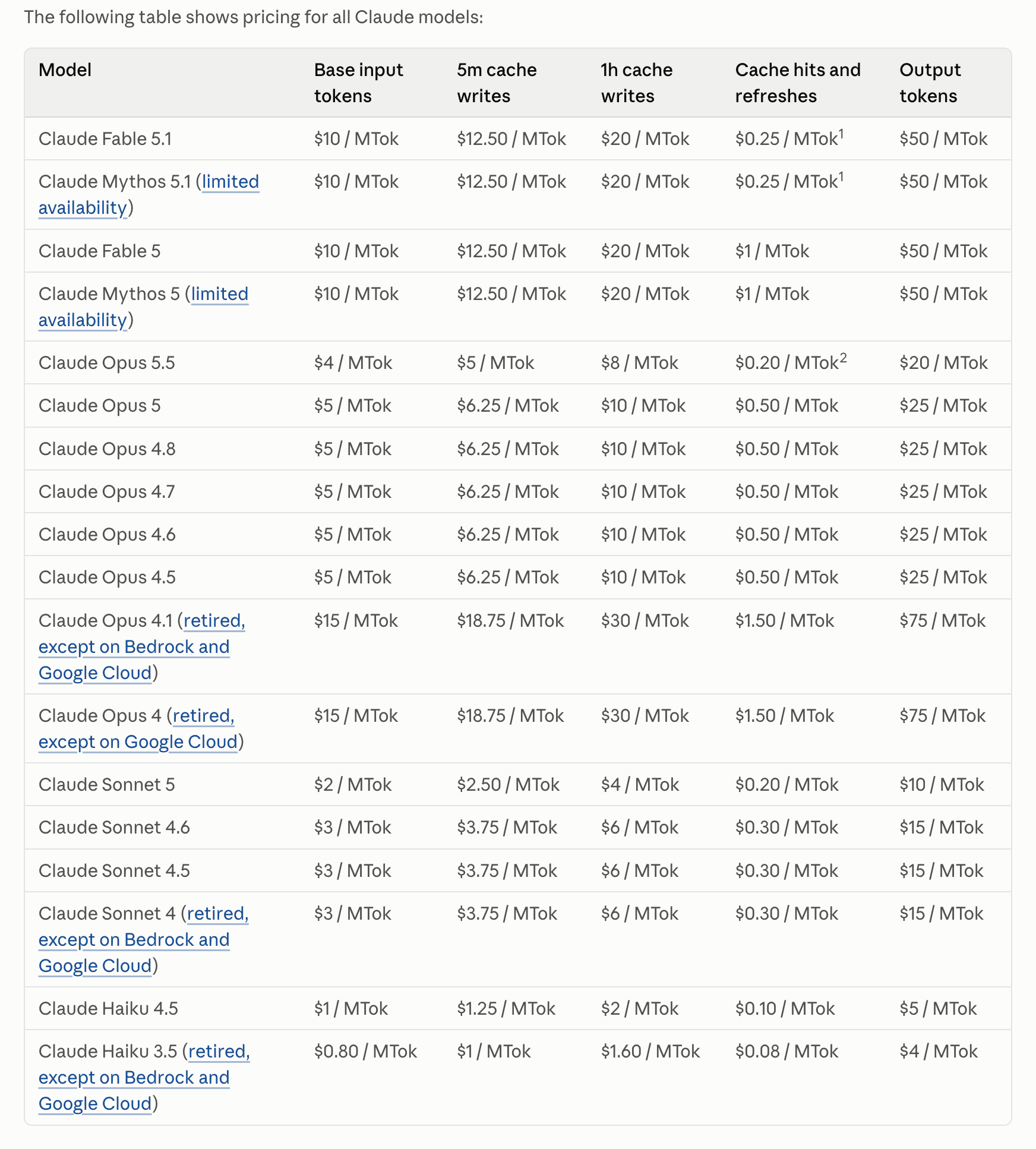
Three things in this table deserve attention, and none is the headline $4:
Cache reads have their own multiplier now. Reads on every other standard model cost 0.1x base input; Fable 5.1 and Mythos 5.1 pay 0.025x; Opus 5.5 sits between them at 0.05x, per Anthropic's footnote. The result: $0.20 — identical to Sonnet 5's cache read.
Output is still 5x input. Adaptive thinking cannot be turned off on this model, and thinking tokens are billable output. A modest prompt with a long reasoning chain is an output bill wearing an input costume.
The tokenizer changed under you two generations ago. Claude 4.7-and-later models produce approximately 30% more tokens for the same text, per Anthropic's footnote. Per-token comparisons against Opus 4.6-era rates overstate the older model's cost by a third.
Also worth pinning: the full 1M-token window bills at standard rates — no long-context tier exists. Unlike GPT-6 Astra's 272K cliff, where crossing a threshold reprices the entire request, a 900k-token request on Opus 5.5 "is billed at the same per-token rate as a 9k-token request," in Anthropic's words.
The one number that changed: cache reads fell 60%
Five billing lines moved between Opus 5 and Opus 5.5, but the cut that matters for agentic work is the read line: $0.50 → $0.20 per million, a 60% cut and a new 0.05x multiplier.
The mechanics: when a request repeats a previously processed prompt prefix — system prompt, repository context, conversation history, tool definitions — the API reads that prefix from cache instead of reprocessing it. Writes cost 1.25x base input for a 5-minute entry ($5/M here), 2x for a 1-hour entry ($8/M). Reads cost 0.05x base — $0.20/M — only on this model. Caching pays off after one 5-minute read or two 1-hour reads, the multipliers stack with Batch and data-residency pricing, and the minimum cacheable prompt is 512 tokens.
Why this dominates agent bills: an agent that makes 40 tool calls over a 200,000-token context re-reads that prefix 40 times. Under Opus 5's $0.50/M reads, those re-reads cost $4.00; under Opus 5.5's $0.20/M, they cost $1.60 — before a single new token is generated. Anthropic's own launch page points at exactly this line: cache reads "make up the majority of agentic and coding work costs," and the 60% cut is the biggest single slice of the official 40% claim.
The subscription side of the same story, from the field:
"Usage drains so slowly with opus 5.5. Have multiple threads going on xhigh and max and the usage bar is hardly budging," reads one reply; another user reports two substantial tasks without the weekly allowance moving. Those are self-reported plan experiences, not benchmarks — but they point the same direction as the API math: the read line is where agentic budgets live.
The catch, same as ever: cache savings require a stable prefix. If your context churns every turn — dynamic tool outputs, rotating documents — you pay the 1.25x–2x write penalty repeatedly instead of riding the 0.05x reads. And thinking blocks are tied to the model and the conversation on Opus 5.5; a prefix edit invalidates them, which is the next section's story in miniature.
What "40% less" actually means
Anthropic's launch claim has three precise conditions, and parsing them is the difference between a budget and a wish. "Our tests show that at default settings it will cost 40% less than Opus 5 on typical workloads."
Condition one: the baseline is Opus 5, not competitors and not Fable. The claim nets two effects — the ~20% card cut plus fewer tokens per task ("it costs less per token than Opus 5 and uses fewer tokens per task, which nets out to a 40% drop in costs"). Anthropic's own worked examples land in the same band and above: a HAProxy C-to-Rust rewrite finished in 9.5 hours versus 12 for Fable 5.1 at 51% less cost; a 200,000-line codebase audit took under 3 hours where Opus 5 took over 20 and used 2.5x the tokens. Named early testers reported 40–50% cost cuts (Spotify), half the tokens (Kiro), a third of the tokens (Box), and "first model we'd default to at medium effort" (Factory). One HN commenter put the trend line bluntly: "releasing a model that has ~3-6x the performance/cost ratio than your last release just 3 weeks ago" (Hacker News).
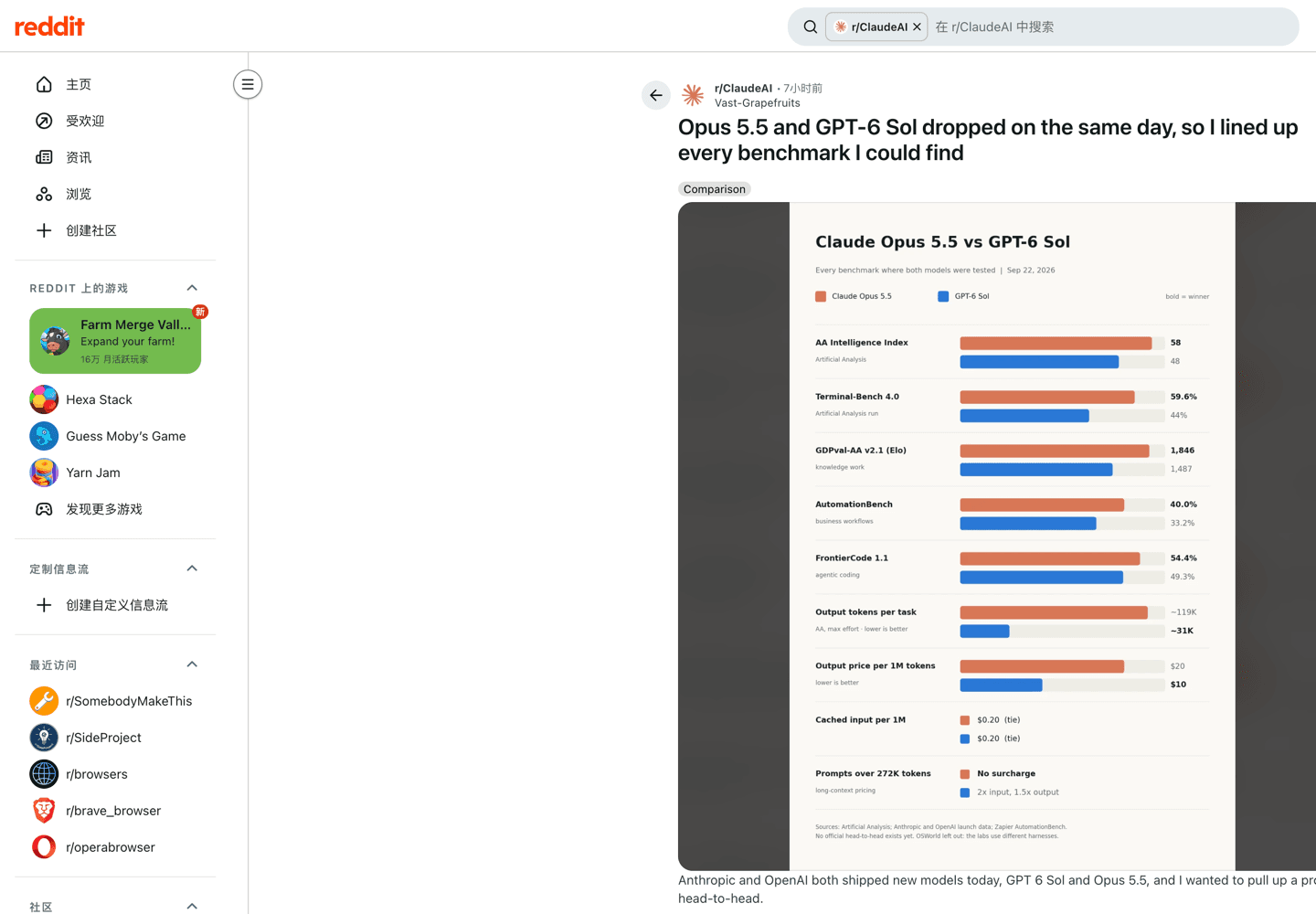
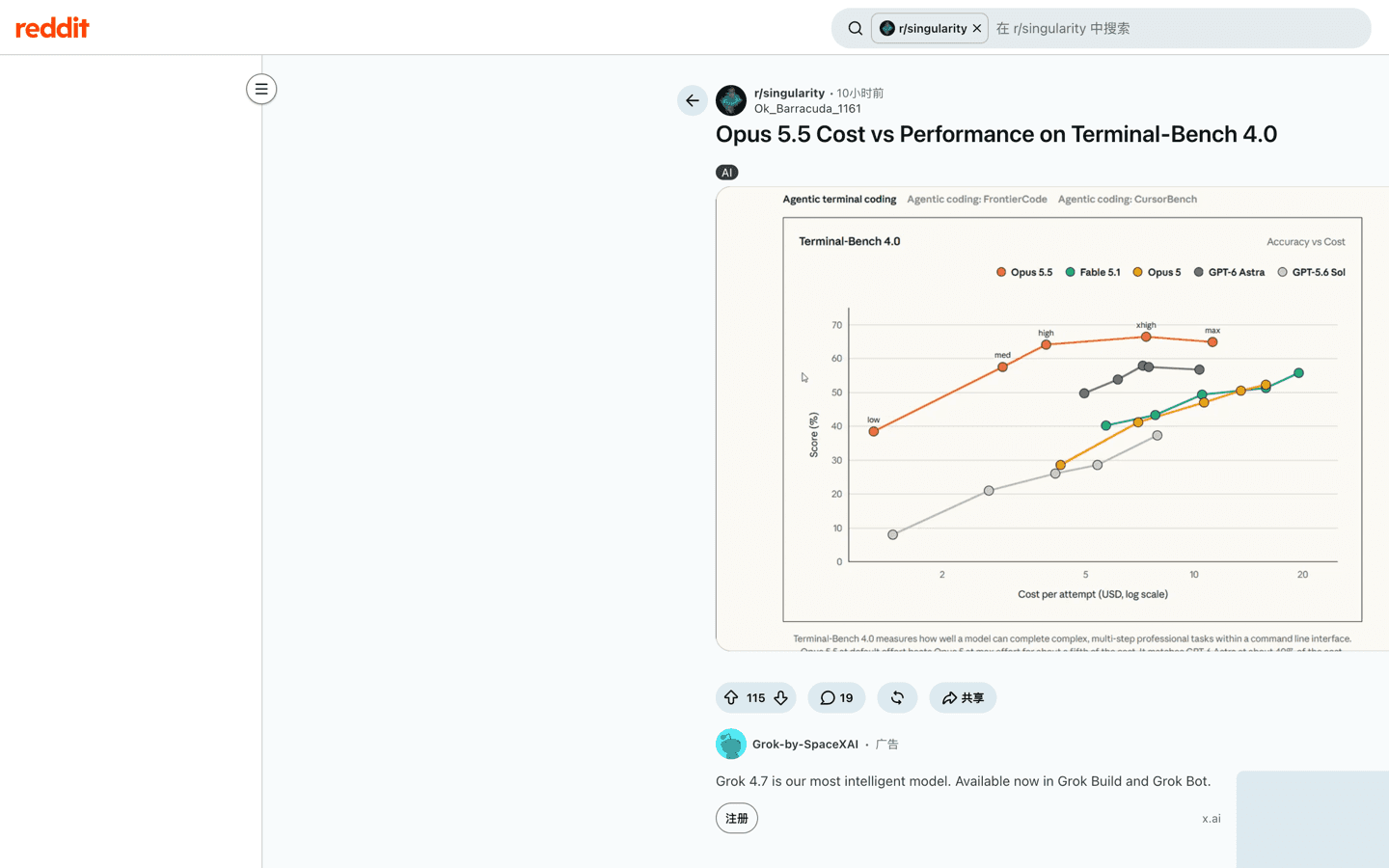
Condition two: "default settings" means medium effort. At max effort the math inverts — the model "tends to think more per turn than Claude Opus 5, most of all at xhigh and max," per the official behavior notes, and billable thinking is where budgets die. The r/ClaudeAI head-to-head thread quantified the shape of it: "At max effort, AA measured Opus 5.5 at around 119K output tokens per task, while [GPT-6] Sol used about 31K and cost $1.06 per task to run the whole index":
Condition three: "typical workloads" means yours may not be. The community carries scar tissue here, and it is priced in. The top comment (226 points) under the launch news thread:
"when they first released Opus 5, they kept claiming how cutting-edge the model was… people discovered that Opus 5 couldn't even communicate properly… wasting even more time and tokens." Skeptics on the same network read the AA charts the other way — "opus 5.5 beats astra… but used 4.5x the tokens for the same task" — while defenders read "same performance opus 5.5 med vs Astra max, 2.5x cheaper." Both are reading the same release. Which one your bill resembles depends on which token dominates it, which is what the next section measures. For the capability side of that trade, see the Fable 5.1 review and our agentic reasoning guide.
The effort lever: $0.55 to $5.98 per task
Nothing on the rate card tells you that this dial moves cost more than any price line. Artificial Analysis tracks Opus 5.5 as five separate entries; snapshotted September 23, 2026:
| Effort | Intelligence Index | Cost per II task | Output speed |
|---|---|---|---|
| low | 42 | $0.55 | 83 t/s |
| medium (default) | 51 | $1.34 | 76 t/s |
| high | 54 | $1.82 | 90 t/s |
| xhigh | 56 | $3.46 | 76 t/s |
| max | 58 | $5.98 | — |
Read the outer columns together: max effort costs 10.9x what low costs per task, for 16 points of measured intelligence. Medium — the default — delivers the same intelligence index as Opus 5 at max effort ($1.34 against Opus 5's max-tier pricing). "max is nearly double the cost of xhigh and it's an outlier from other effort levels. If you use on medium or high effort you should see some real cost savings," as the top-voted reply in the r/ClaudeCode thread put it. One developer there has already rebuilt a workflow around the ladder: "Opus 5.5 High is freaking great. Feels just like fable 5.1 medium, but way cheaper… changed up my workflow to now use Opus 5.5 high for most things."
Two caveats before you crank effort down or up. First, migration: the default moved from high (Opus 5) to medium, and at the same setting the new model thinks more per turn — Anthropic's docs tell you to re-run your effort sweep rather than carry a setting over, and to leave room in max_tokens for thinking. Second, higher effort does not reliably buy quality. CodeRabbit's launch-day evaluation found "higher reasoning effort didn't consistently deliver a better completion" rate on their code-review benchmarks — and more comments for developers to assess is itself a cost:

The launch-page customer quotes run the same direction — Rogo beat Opus 5 at high effort using Opus 5.5 "at its lowest effort setting… with about 60% fewer output tokens"; Walleye Capital "largely solved" their suite at the lowest setting. When a vendor's own evidence keeps pointing at the cheap settings, treat that as the default answer and reserve max for the tasks that demonstrably need it.
The billing lines outside the headline
Five lines decide most real invoices, and only the first appears in launch coverage.
Fast mode: 2x on every line, for up to 2.5x speed. Fast mode (research preview, Claude API only) bills $8 input / $40 output — double the standard card, cache lines included ($0.40 reads). It stacks with caching and data residency, cannot combine with Batch, and delivers "up to 2.5x" faster output; OpenRouter's provider table measures 143 tok/s on Fast versus 71–83 standard. Notably, Fast Opus 5.5 at $40/M output still undercuts Fable 5.1's standard $50.
Batch: the 50% lever. Asynchronous Batch requests bill at $2/$10 — the largest discount on the card, stacking with prompt caching across the full context window, with a beta header allowing up to 300K output tokens. Managed-agent sessions don't qualify; they're stateful and interactive.
US-only inference: 1.1x on everything. Setting inference_geo: "us" multiplies every category — input, output, cache writes, cache reads — by 1.1x. The same 10% appears as regional-endpoint pricing on partner clouds: OpenRouter lists Bedrock/Azure/Vertex regional routes at $4.40/$22.00/$0.22. Compliance-driven regions pay a quiet premium per line; global routing is the default and the cheaper path.
Tool overheads are token bills. The tool-use system prompt adds 286 tokens per request (down from Opus 4.7's 675); declaring the browser-use toolset adds about 6,600 input tokens, computer use about 4,500. Server-side web search bills $10 per 1,000 searches on top of tokens; code execution is free alongside search/fetch, with 1,550 free container-hours per month before $0.05/hour starts. An "agent" is a pricing structure, not a chat — budget the toolset line explicitly. For the budget end of that comparison, see Kimi K3's pricing breakdown.
Managed Agents runtime: $0.08 per session-hour, metered only while running, with all token lines at model rates. Batch does not apply to sessions.
The family ladder: Opus 5.5 vs Fable 5.1 vs Opus 5 vs Sonnet 5
| Line (per 1M tokens) | Opus 5.5 | Fable 5.1 | Opus 5 | Sonnet 5 |
|---|---|---|---|---|
| Input | $4.00 | $10.00 | $5.00 | $2.00 |
| Cache read | $0.20 (0.05x) | $0.25 (0.025x) | $0.50 (0.1x) | $0.20 (0.1x) |
| Output | $20.00 | $50.00 | $25.00 | $10.00 |
| Batch input / output | $2.00 / $10.00 | $5.00 / $25.00 | $2.50 / $12.50 | $1.00 / $5.00 |
| AA Intelligence Index (max effort) | 58 | 53 | 51 | 38 |
| AA cost per II task (max effort) | $5.98 | $7.63¹ | — | — |
¹ Fable 5.1 figure from AA's September 22 snapshot, via our Fable pricing breakdown; both AA pages move daily.
The counterintuitive row is the last one: on Artificial Analysis's index, the cheaper model is now the stronger model. Opus 5.5 at max effort scores 58 against Fable 5.1's 53, at $5.98 versus $7.63 per task — while Anthropic's own positioning still reserves Fable for "ambitious, long-running, asynchronous work" and now describes the Opus-to-Fable gap as "narrower than these scores suggest." Read that pairing as: the scores overstate the gap, but the price gap is real and inverted. Cached-context loops are closer still — Fable keeps the deepest read discount (0.025x), but its reads start from a $10 base: $0.25/M. Opus 5.5's $0.20 read undercuts it in absolute terms.
The two community readings of the same AA chart, side by side:
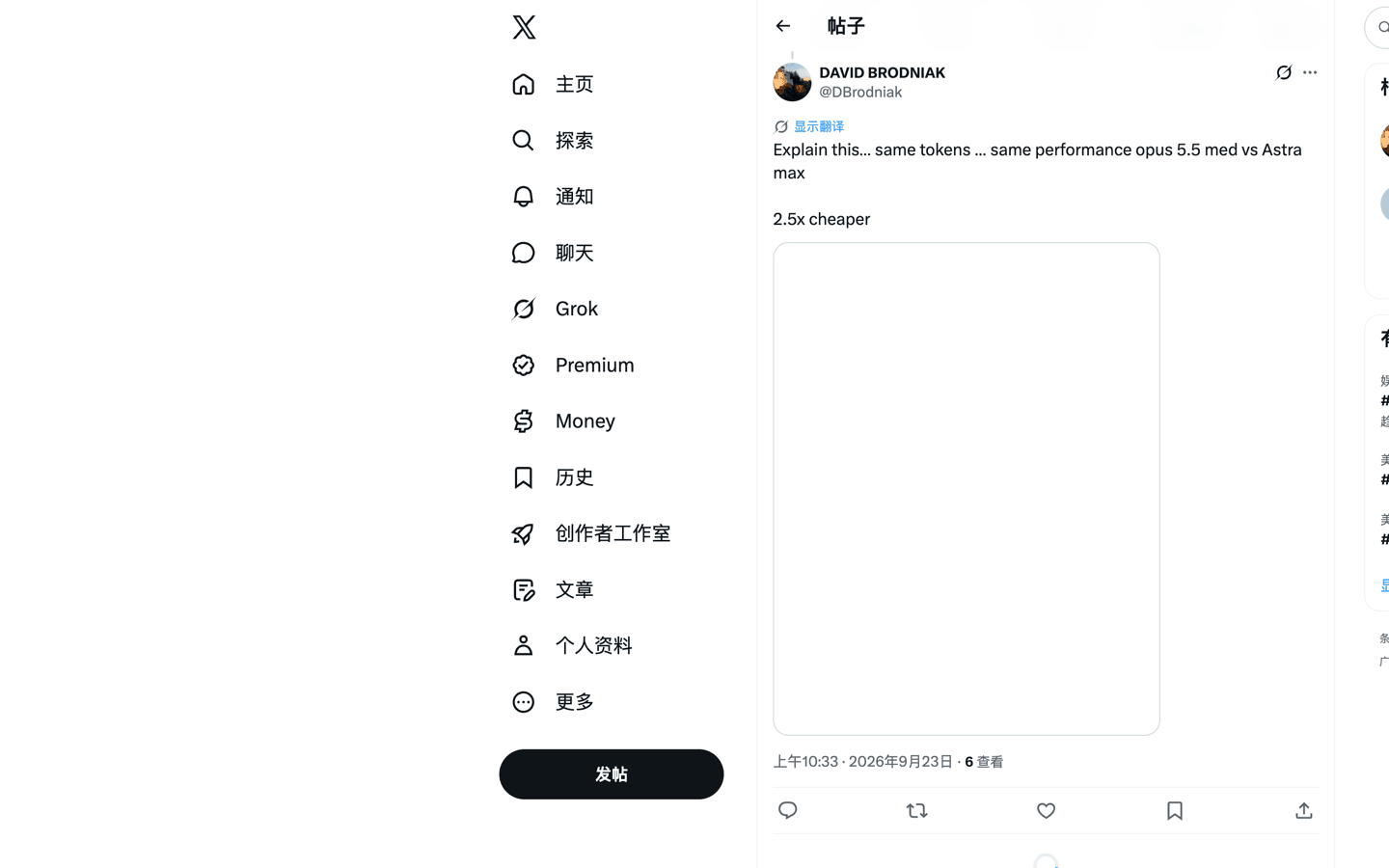
"same tokens … same performance opus 5.5 med vs Astra max — 2.5x cheaper" versus "opus 5.5 beat astra… but used 4.5x the tokens for the same task." Both describe the same shape: Opus 5.5 wins cost-per-completed-task and loses tokens-per-task. If your workloads are token-shape-sensitive — strict per-token budgets, third-party routers, throughput caps — measure before migrating; if they are task-shaped, the ladder favors Opus 5.5 at nearly every rung.
Below the flagship rungs, Sonnet 5 keeps the budget seat at $2/$10 with its $0.20 read — the same read price as Opus 5.5 now — and Haiku 4.5 holds $1/$5. The ladder's new logic: the cache-read column has compressed to the point where the smart model and the cheap model charge the same for the line agents hit hardest.
What you do not pay for
The docs draw boundaries that read like refund policy, and they matter at agentic scale:
Dropped thinking blocks are not billed. When a request carries a thinking block the model cannot read, the API drops it before inference: "the request succeeds, and dropped blocks aren't billed." On a model whose thinking blocks are tied to the conversation, that is the graceful-degradation line.
Safeguard reroutes complete on other models. Cybersecurity-flagged requests are completed by Opus 4.8, per the launch page's benchmark footnote; the handoff is transparent (refusals return
stop_reason: "refusal"with a policy area, and server-side fallback retries on a recommended model). Anthropic does not spell out the reroute billing model for Opus 5.5 the way it did for Fable — treat the completing model's rate as the safe assumption until documented.Failed web searches are not billed. Successful ones bill $10 per 1,000; errored ones don't. Web fetch adds no charge beyond the tokens the fetched content becomes.
Code execution is free alongside search or fetch, and every organization gets 1,550 free container-hours monthly before the $0.05/hour rate starts.
Plan availability: API, clouds, and consumer plans
The API rate card is one of three economies. Checked on claude.com/pricing and the platform docs on September 23, 2026:
| Surface | Price (verified display) | Opus 5.5 access |
|---|---|---|
| Anthropic API | Token rates above | Yes — claude-opus-5-5 |
| Free plan | $0 | No (Sonnet/Haiku only) |
| Pro | $17/mo annual ($200 up front) or $20 monthly | Yes — standard allowance |
| Max 5x / 20x | From $100/mo | Yes — standard allowance |
| Team | Standard seats above Pro; Premium = 5x Standard | Yes |
| Enterprise | $20/seat/mo annual + usage at API rates | Yes, with spend controls |
| Clouds | AWS Bedrock, Google Cloud, Microsoft Foundry, Claude Platform on AWS | Yes; regional endpoints +10%, Foundry meters in CCUs |
The subscription row worth underlining: on the plan comparison, Opus draws from standard usage allowances on Pro and Max — it is Fable that carries the "usage credits, 50% of weekly limits" asterisk. A Fable hour costs twice a standard-model hour against your allowance; an Opus 5.5 hour does not. Anthropic stacked two more changes on top at launch: five-hour usage limits increased on Pro, Max, Team, and seat-based Enterprise plans, and a rate-limit reset you "can now save and use whenever you choose."
The community is split on what that means in practice, both directions visible in the same launch-week threads:
"I am using Fable 5.1 rn, and this is 5x cheaper for same intelligence? I am never going to hit my weekly limits at this rate" — against — "these cuts don't necessarily translate to subscriptions… they use API costs as marketing material while they shift the scale to benefit API users." The limits increase is documented; how generous it proves is a wait-and-see that only your own five-hour windows can answer. Mechanically: usage resets on rolling five-hour session windows with weekly limits stacked on top for paid plans, web/desktop/mobile/Claude Code draw from one pool, and usage credits on paid plans let you keep working at standard API rates past the limits.
Two worked budgets, with every assumption visible
Standard rates, no retries, no tools, no taxes. Worked arithmetic, not predictions.
A short question with a long think. 10,000 input tokens, 2,000 output:
(10,000 × $4 + 2,000 × $20) / 1,000,000 = $0.08A cold agent loop over a large repo. 300,000 input tokens (standard rate — no long-context tier), 8,000 output:
(300,000 × $4 + 8,000 × $20) / 1,000,000 = $1.36The warm version of the same loop. Same 300,000-token context, 90% cached, one 1-hour write per session, 8,000 output per pass:
per pass: (270,000 × $0.20 + 30,000 × $4 + 8,000 × $20) / 1,000,000 = $0.334
one-time: 300,000 × $8 / 1,000,000 = $2.40 per session write
The warm pass drops to a quarter of the cold cost, and the $2.40 write amortizes across every pass that reuses it — a 5-minute write ($1.50) pays for itself after one re-read, an hour write after two. The same loop cold-starts at $1.36 every pass when the prefix churns. The model resource and its prompt collection track repeatable tasks you can measure your own hit rate on.
Local calculation
Estimate Claude Opus 5.5 API token cost
Uses the official USD rates checked 2026-09-23. Values stay in this browser.
Cache hits bill at $0.20 per million tokens — the 0.05x Opus 5.5 rate. This estimate excludes retries, tool overheads, safeguard reroutes, and provider markups. Fast mode doubles every line and cannot combine with Batch. Verify current rates
The calculator runs entirely in this page — nothing is sent anywhere. It prices both cache-write durations and the Standard, Batch, US-only, and Fast modes, and validates inputs locally. What it deliberately does not model: retries, sub-agent fan-out, tool overheads, and safeguard reroutes — those belong in your margin. Recheck the official rate card before committing a budget; these are the September 23, 2026 numbers.
A practical option: run the comparison in Tabbit
After the budget comes the boring part: actually running Opus-shaped work needs a place where pages, files, and model calls sit together, and where "try Opus 5.5 at medium, fall back to Sonnet" is a selection instead of an orchestration project. That is the gap Tabbit Browser occupies — an agentic AI browser whose model picker, live tabs, and local files share one surface.
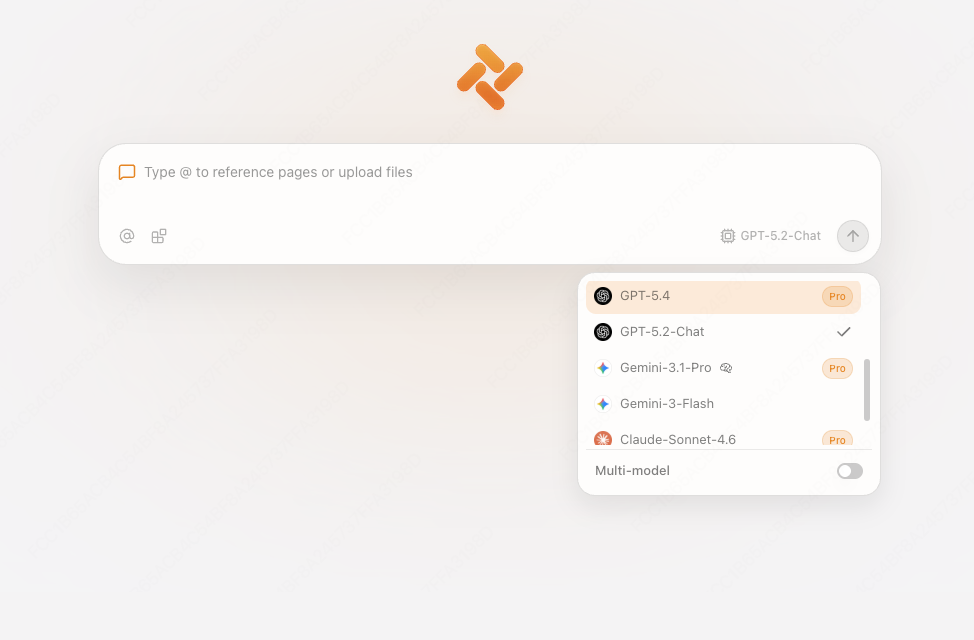
The boundaries, stated plainly: Tabbit is a client, not an Anthropic billing layer. Model availability depends on your account and edition, and nothing in the browser changes what Anthropic charges — the rate card above applies wherever Opus 5.5 runs. This article did not run an Opus 5.5 task inside Tabbit, so no availability or performance claim is made here. What the browser changes is setup cost: measuring your own cache-hit rate and effort threshold on real work — the two numbers this entire page says decide your bill — before writing any orchestration code is cheapest in a workspace built for exactly that. The Tabbit working-habits guide covers the method.
 Tabbit Browser
Claude Opus 5.5 pricing decision table
| Your workload | Cost driver | Best starting path | Watch out for |
|---|---|---|---|
| Long agent loops, stable repo/docs context | Cache reads | Standard tier, prefix-stable prompts, 1h writes | Prefix edits invalidate tied thinking blocks; churn turns reads into 1.25–2x writes |
| Short chat, quick edits | Output tokens | Lower effort — or Sonnet 5 | Thinking can't be disabled; medium is the default and usually enough |
| Overnight evaluation, batch refactors | Volume | Batch API at $2/$10, 300K-output beta | Interactive and managed-agent sessions don't qualify |
| Latency-bound interactive work | Output speed | Fast mode at 2x ($8/$40), cache it | Fast can't combine with Batch; it doubles every line |
| Compliance-required US processing | Every line | US-only at 1.1x, or regional cloud endpoints (+10%) | Premium applies to cache reads too |
| Token-shape-sensitive budgets (routers, caps) | Tokens per task | Measure before migrating | Opus 5.5 wins cost-per-task, loses tokens-per-task vs rivals |
| Subscription-based daily use | 5-hour windows | Pro/Max — Opus is standard allowance, limits raised | Fable on the same plans burns credits at 50% of weekly limits |
Final verdict
Claude Opus 5.5 is the first Opus that got cheaper than its predecessor, and the cut is real at every line — 20% on input and output, 60% on the cache reads that dominate agentic bills, now priced level with Sonnet 5. Buy it for long-horizon agentic coding and knowledge work at medium effort, with prefixes held stable and Batch carrying everything that can wait; on AA's index it now outscored Fable 5.1 while costing less per task, which reorders the family ladder. The two bills it will not fix: max-effort thinking (an 11x lever the rate card never shows) and token-shape-sensitive budgets, where it still spends more tokens per task than leaner rivals. On subscriptions it is the allowance-friendly flagship — standard usage, raised limits — but verify your own five-hour burn before committing a team. Recheck the official pricing page monthly: the Sonnet 5 standardization and this release both show the ladder moves fast. The capability story lives in the Fable 5.1 overview and review; the community records linked above carry the workload evidence; and the cross-family pricing comparison shows what the same list price costs elsewhere.
Sources
Anthropic pricing docs — rate card, 0.05x cache footnote, Fast mode, Batch, residency, tool pricing; checked September 23, 2026
Claude Opus 5.5 model page and What's new — specs, default effort, breaking changes, "thinks more per turn," billing of dropped blocks; checked September 23, 2026
Anthropic launch page — 40% claim and conditions, HAProxy example, customer cost quotes, limits increase, safeguard reroutes; checked September 23, 2026
claude.com/pricing — Free/Pro/Max plan comparison and Opus vs Fable allowance rules; checked September 23, 2026
Artificial Analysis release page — effort-tier intelligence, speed, cost-per-task snapshot; checked September 23, 2026
OpenRouter Opus 5.5 — provider rates, regional endpoints, Fast throughput; checked September 23, 2026
Community records with screenshots and conditions inline: r/ClaudeCode max-effort question, r/ClaudeAI Sol comparison, r/ClaudeAI launch thread, r/singularity subscription split, X chart readings, CodeRabbit evaluation video, HN launch thread

FAQ
How much does Claude Opus 5.5 cost?
On the Anthropic API, Claude Opus 5.5 is $4 per million input tokens and $20 per million output tokens, checked on Anthropic's pricing docs on September 23, 2026. Prompt-cache writes cost $5 per million (5-minute) or $8 per million (1-hour), and cache reads cost $0.20 per million — a 0.05x rate that applies only to this model. The Batch API halves everything to $2/$10, and Fast mode doubles everything to $8/$40.
Is Claude Opus 5.5 cheaper than Opus 5?
Every line on the card moved down: input and output are 20% less than Opus 5's $5/$25, cache writes dropped from $6.25/$10 to $5/$8, and cache reads fell 60% from $0.50 to $0.20. Anthropic estimates typical workloads at default settings cost about 40% less overall. The exception is effort: at max effort the model thinks more per turn, and independent per-task measurements range from $0.55 at low to $5.98 at max — an 11x spread that no list price shows.
Is Claude Opus 5.5 available on the Free plan?
No. Anthropic's plan comparison marks Opus as unavailable on Free, which gets Sonnet and Haiku models only. Opus 5.5 is included in Pro, Max, Team, and Enterprise allowances — notably as standard usage, not the usage-credits arrangement Fable 5.1 has on Pro and Max. Anthropic also raised five-hour usage limits on Pro, Max, Team, and seat-based Enterprise plans at launch, and added a rate-limit reset you can save for later.
What is the cheapest way to run Claude Opus 5.5?
Work the levers in order: keep prompts prefix-stable so re-reads bill at $0.20 instead of $4 per million, run at the lowest effort that passes your acceptance check (medium is the default and often enough), route non-urgent work through the Batch API at $2/$10, and skip US-only inference and Fast mode unless compliance or latency requires them. Also re-run your effort sweep when migrating: at the same effort setting, Opus 5.5 tends to think more per turn than Opus 5.
Does Claude Opus 5.5 charge extra for long context?
No. The full 1M-token context window bills at standard per-token rates with no long-context tier, and prompt caching and Batch discounts apply across the whole window. On the Batch API, a beta header raises maximum output to 300K tokens. Note that Claude 4.7-and-later models use a newer tokenizer that produces roughly 30% more tokens for the same text than pre-4.7 models.
Do safeguard reroutes or failed tool calls bill at Opus 5.5 prices?
Requests rerouted by safeguards are completed by other models — Anthropic says cybersecurity-flagged work is handled by Opus 4.8 — and the handoff is reported transparently rather than silently billed. Failed web searches are not billed at all, web fetch adds no charge beyond the tokens fetched content becomes, and thinking blocks the model cannot read are dropped before inference at no charge. Code execution is free when paired with web search or fetch, with 1,550 free container-hours per month otherwise.