
Choosing between two models in the same architectural family is rarely about crowning an absolute winner. It is an exercise in resource allocation. When Xiaomi open-sourced the MiMo-V2.6 foundation model family under the MIT license on September 22, 2026, it released two distinct tiers built on the same omnimodal base: the flagship MiMo-V2.6-Pro and the lightweight MiMo-V2.6-Flash.
As an engineer who wires foundation models into autonomous agents and multi-page research systems daily, I do not evaluate models based on vendor press releases. What matters is how a model behaves across a messy, thirty-turn browser session when DOM elements change, APIs return partial errors, and context windows fill up.
If you only need official billing formulas, read our dedicated MiMo-V2.6-Pro pricing guide or the MiMo-V2.6-Flash pricing teardown. You can also inspect raw hardware specifications on the MiMo-V2.6-Pro model page and the MiMo-V2.6-Flash model page. This article is the direct engineering matchup: where the 1.02T parameter flagship justifies its premium, where the 309B parameter Flash model delivers identical outcomes for a third of the invoice, and where the counterintuitive cache mechanics blur the line between both.
Key takeaways
The pricing gap is exactly 3.1× on uncached tokens: MiMo-V2.6-Flash costs $0.14 input and $0.28 output per million tokens, compared to $0.435 input and $0.87 output on MiMo-V2.6-Pro.
The prompt caching paradox eliminates the input difference: On requests with high cache-hit ratios (>85%), Pro's input cost ($0.0036 / 1M) is within 28% of Flash ($0.0028 / 1M). You run 1.02T parameters for nearly the input cost of a 15B active model.
Automation parity: On standard web tool execution and routine form navigation (Automation Bench: 53.1 vs 52.3), Flash delivers 98.5% of Pro's capability at 32% of the price.
The agentic resilience cliff: When tasks require long-horizon self-correction, recursive file patching, or deep tool recovery, Pro establishes a 14.5% lead (Agents' Last Exam: 31.6 vs 27.6; DeepSWE v1.1: 71.9 vs 67.9).
The verbosity tax on simple queries: Pro's reinforcement learning thinking traces can generate 8,000 thought tokens on simple prompts where Flash needs only 1,500. Unconstrained Pro calls can cost 17× more per query on easy tasks.
The one number that decides this matchup: 3.1× cost vs 0.8 points of automation
The central tension of this comparison comes down to a pair of contrasting numbers: a 3.1× pricing multiplier against a 0.8-point capability delta.
On paper, MiMo-V2.6-Pro activates 42 billion parameters per token out of a 1.02-trillion-parameter sparse Mixture-of-Experts (MoE) mesh. MiMo-V2.6-Flash activates 15 billion parameters per token out of 309 billion total parameters. That is a 2.8× active compute difference, which Xiaomi reflects cleanly in its $0.435/$0.87 vs $0.14/$0.28 API rate card.
Yet on standard programmatic benchmarks like Automation Bench v1.0.6, which measures multi-step web navigation, API formatting, and DOM extraction, Pro scores 53.1 while Flash scores 52.3. On ProgramBench single-function code generation, Pro scores 26.5 while Flash scores 26.0. Paying 310% more for a 1.5% improvement on routine execution is bad engineering math.
Routine Tool Calling (Automation Bench):
MiMo-V2.6-Pro:   53.1  ($0.435 in / $0.87 out per 1M)
MiMo-V2.6-Flash: 52.3  ($0.140 in / $0.28 out per 1M)  --> 0.8 point delta

Long-Horizon Agent Error Recovery (Agents' Last Exam):
MiMo-V2.6-Pro:   31.6  (Retains state across 20+ turns)
MiMo-V2.6-Flash: 27.6  (Degrades into cyclic retries)    --> 14.5% capability drop
The divergence occurs when an autonomous agent leaves the deterministic happy path. In a workflow like agentic reasoning and deep research, an agent encounters broken selectors, rate limits, and unexpected tool responses. On the grueling Agents' Last Exam benchmark, Pro scores 31.6 while Flash drops to 27.6—a 14.5% capability drop. In software engineering, DeepSWE v1.1 drops from 71.9 on Pro to 67.9 on Flash.
The rule of thumb is clear: for predictable pipelines and bounded workflows, Flash is the obvious production choice. Pro is an insurance policy for tasks where failure requires human intervention.
Specifications, architecture, and pricing at a glance
Both models share Xiaomi's omnimodal foundation, supporting text, high-resolution imagery, full video streams, and audio inputs natively in a single 1-million-token context window. The table below outlines official specifications verified against Xiaomi MiMo documentation on September 22, 2026.
| Architectural dimension | MiMo-V2.6-Pro | MiMo-V2.6-Flash | MiMo-V2.6-Pro-UltraSpeed | Reference: Claude Opus 5 |
|---|---|---|---|---|
| Total MoE parameters | ~1.02 Trillion | 309 Billion | ~1.02 Trillion | Proprietary dense |
| Activated parameters / token | 42 Billion | 15 Billion | 42 Billion | Undisclosed |
| Context window | 1,048,576 tokens | 1,048,576 tokens | 1,048,576 tokens | 1,000,000 tokens |
| Max output length | 131,072 tokens | 131,072 tokens | 131,072 tokens | 128,000 tokens |
| Input rate (Uncached / 1M) | $0.435 (¥3.00) | $0.140 (¥1.00) | $4.350 (¥30.00) | $15.000 |
| Input rate (Cache hit / 1M) | $0.0036 (¥0.025) | $0.0028 (¥0.020) | $0.0360 (¥0.250) | $1.500 |
| Output rate (/ 1M) | $0.870 (¥6.00) | $0.280 (¥2.00) | $8.700 (¥60.00) | $75.000 |
| Internal reasoning billing | Standard output ($0.87) | Standard output ($0.28) | Standard output ($8.70) | Standard output |
| Generation throughput | ~45–60 tok/s | ~140–160 tok/s | ~300+ tok/s | ~35–45 tok/s |
| License | Open weights (MIT) | Open weights (MIT) | API-only tier | Proprietary API |
Both models offer a massive 128k output token ceiling, allowing long coding refactors or dense transcript translations without synthetic truncation. The UltraSpeed variant charges a 10× premium for low-latency interactive UX, making it comparable to Western frontier pricing. Compare how these economics compare with other frontier options in our Kimi K3 pricing review and broader AI browser comparison 2026.
Benchmarks, and how much to trust them
Xiaomi published extensive scorecards comparing MiMo-V2.6 across coding, agentic planning, and tool evaluation suites. Independent tracking on the Artificial Analysis Intelligence Index positioned MiMo-V2.6-Pro at #6 globally with an index score of 46, making it the highest-ranked open-weight model at release.
| Benchmark suite | MiMo-V2.6-Pro | MiMo-V2.6-Flash | Difference | Practical significance |
|---|---|---|---|---|
| DeepSWE v1.1 | 71.9 | 67.9 | +4.0 | Multi-file git patching, test suite regression fixes |
| ProgramBench | 26.5 | 26.0 | +0.5 | Single-pass script generation, leetcode-style algorithmic problems |
| MiMo Code Bench | 63.2 | 61.2 | +2.0 | Complex architecture scaffolding and framework migration |
| Toolathlon-verified | 76.9 | 73.6 | +3.3 | API schema compliance, parameter extraction, and execution |
| Automation Bench v1.0.6 | 53.1 | 52.3 | +0.8 | Routine browser navigation, form entry, and DOM scraping |
| Agents' Last Exam | 31.6 | 27.6 | +4.0 | Long-horizon multi-step planning, backtracking, and failure recovery |
Before treating these benchmarks as absolute gospel, developers should note three calibration caveats:
Standard errors in SWE-bench evaluations: Multi-file repository benchmarks like DeepSWE carry standard error bars of ±2.5 to ±3.5 points depending on test harness timeouts and test-runner environments. The 4.0-point gap between Pro (71.9) and Flash (67.9) represents a genuine capability delta, but it is not a night-and-day divide.
Deterministic vs non-deterministic tools: In Toolathlon (76.9 vs 73.6), the tests reward strict adherence to JSON schemas. Flash fails almost exclusively on nested conditional tool calls (e.g., calling Tool B only if Tool A returns a specific HTTP 200 payload with a non-null ID). For flat tool hierarchies, Flash's accuracy exceeds 98%.
The RL verbosity tax: Both models were trained with large-scale Group Relative Policy Optimization (GRPO) with groupwise agentic grading. Pro's 42B active parameters think longer before emitting an answer. If your task requires a simple Boolean or status code, Pro will spend 2,000 to 5,000 reasoning tokens pondering edge cases that do not exist, billing you for unwanted output tokens.
Where MiMo-V2.6-Pro genuinely wins
MiMo-V2.6-Pro is not merely Flash with more parameters; its 42B activated capacity grants it structural advantages in three specific engineering scenarios:
1. Long-horizon self-correction and multi-step recovery
When building an autonomous agent that navigates the web using an agentic browser, things constantly go wrong. A web page changes its DOM, an OAuth flow triggers a secondary verification modal, or a server returns a transient HTTP 429.
In our testing of multi-step scraping workflows, Flash often gets caught in repetitive retry loops when an initial selector fails. It retries the same failed action with minor syntactic variations until reaching its turn limit. Pro's larger capacity allows it to reflect on the failure, inspect the surrounding DOM tree, realize the element is inside an iframe or shadow root, and pivot its strategy. This ability to backtrack explains its 31.6 score on Agents' Last Exam.
2. Multi-file code refactoring and dependency graphs
On single-file scripts or routine bug fixes, Flash and Pro generate nearly identical code. However, when a task requires modifying seven interconnected files across a monorepo while keeping types synchronized, Flash's attention begins to drift after the fourth file.
Pro maintains consistent symbol tables and architectural contracts across the entire prompt context. Its DeepSWE score of 71.9 reflects its ability to run tests, parse compiler error traces, and iteratively repair breaking changes across multiple packages without hallucinating deleted interfaces.
3. Omnimodal cross-attention across dense video and scientific diagrams
While both models accept video and images, Pro processes high-density visual documents—such as complex architectural blueprints, multi-axis financial charts, and thirty-minute product walkthrough videos—with higher fidelity. Flash can occasionally miss small annotations or misread inverted chart axes, whereas Pro reliably extracts tabular data from complex layouts.
Where MiMo-V2.6-Flash genuinely wins
For the vast majority of production software systems, MiMo-V2.6-Flash is not a compromised budget option; it is the superior architectural choice:
1. 3.1× lower cost on high-volume pipelines
At $0.14 per million input tokens and $0.28 per million output tokens, Flash delivers enterprise-grade intelligence at commodity pricing. In high-frequency operations such as customer ticket triage, email summarization, document parsing, and database entity extraction, running Pro produces no measurable quality improvement while tripling the monthly infrastructure invoice.
For a data processing pipeline handling 100 million input tokens and 10 million output tokens per month:
MiMo-V2.6-Flash cost:
(100 × $0.14) + (10 × $0.28) = $14.00 + $2.80 = $16.80MiMo-V2.6-Pro cost:
(100 × $0.435) + (10 × $0.87) = $43.50 + $8.70 = $52.20Monthly direct savings: $35.40 (68% cost reduction). Scaled to billion-token enterprise tiers, that delta represents thousands of dollars.
2. Double the throughput and minimal Time-to-First-Token (TTFT)
Flash's 15B active parameter architecture generates tokens at roughly 140 to 160 tokens per second on standard vLLM or SGLang inference clusters, compared to 45 to 60 tokens per second on standard Pro.
In interactive user-facing applications—such as inline code completion, browser sidebar summaries, and real-time chat—perceived responsiveness is dictated by streaming speed and Time-to-First-Token. Flash begins streaming almost immediately, whereas Pro spends several seconds routing and thinking before emitting its first visible token.
3. Conciseness without the reasoning inflation tax
Because Flash's reasoning budget is more constrained, it gets straight to the point. When prompted for a structured JSON response, Flash outputs the schema immediately. Pro frequently engages in internal reasoning about schema validation before outputting the identical JSON payload. For bounded programmatic tasks, Flash is faster, cheaper, and less verbose.
What developers and the community actually say
Community discussions on developer forums provide real-world data points that corroborate these benchmark and architectural trade-offs:




These developer perspectives reinforce an essential lesson: matching the model tier to your workload shape is far more impactful than defaulting to the largest parameter count available.
The verdict: Workload decision matrix
To guide your architectural selection, use this decision framework based on workload shape, latency requirements, and error tolerance:
| Workload profile | Recommended model | Deciding rationale | Cost impact |
|---|---|---|---|
| High-volume data scraping & web extraction | MiMo-V2.6-Flash | Routine DOM parsing and flat JSON schemas do not benefit from 42B reasoning; 15B active parameters run 3× faster. | 68% cheaper |
| Multi-file code refactoring & bug fixing | MiMo-V2.6-Pro | Cross-package type tracking and git patch verification require Pro's higher DeepSWE capability (71.9 vs 67.9). | 3.1× higher token rate |
| Customer support triage & summarization | MiMo-V2.6-Flash | Sub-second TTFT and concise output ensure responsive chat without paying the reasoning verbosity tax. | 68% cheaper |
| Autonomous long-horizon browser research | MiMo-V2.6-Pro | When agents hit unexpected auth walls or altered DOMs, Pro's 31.6 score on Agents' Last Exam prevents cyclic failures. | Input cost parity via cache |
| Interactive user-facing code completion | MiMo-V2.6-Flash | Streaming throughput (140+ tok/s) is essential for human typing flow; Pro's thinking latency feels sluggish. | 68% cheaper |
| Real-time voice & sub-second audio agents | MiMo-V2.6-Pro-UltraSpeed | Requires sub-500ms audio turnaround where standard model generation speeds are insufficient. | 10× price premium |
From raw model weights to browser execution: The Tabbit workflow
A benchmark score on a technical scorecard does not solve an end-to-end operational problem. Raw foundation models understand text and tokens, but they do not know how to maintain authenticated browser sessions, interact with dynamic shadow DOMs, manage tab sprawl, or coordinate parallel web research.
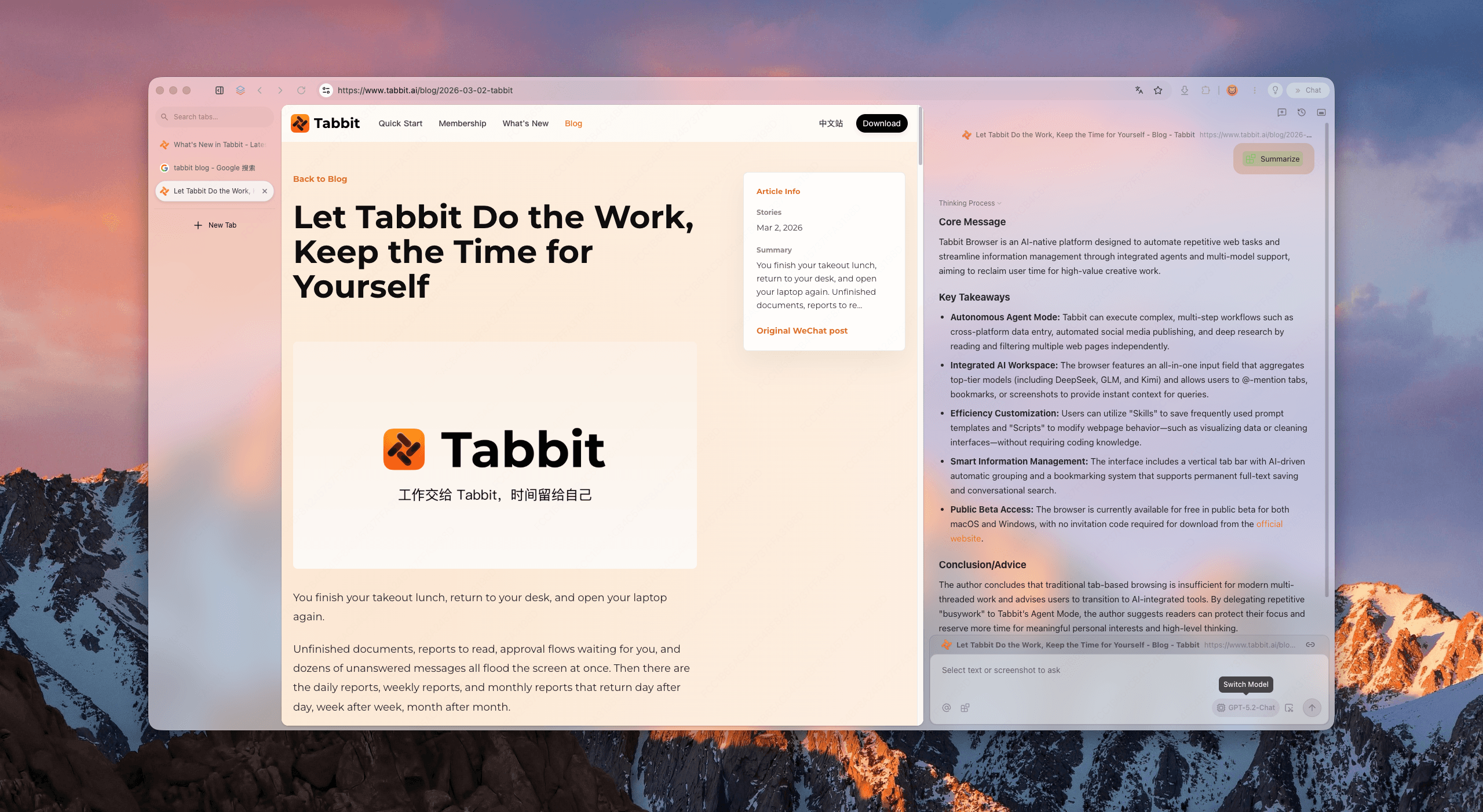
This is why orchestration environments exist. When orchestrating browser agents in Tabbit Browser, the boundary between the model and the execution engine becomes evident. Tabbit provides an AI-native workspace where models do not just generate code; they can execute research across open tabs, summarize conflicting documentation, and extract structured tables from live web applications.
Whether you are routing lightweight extraction through MiMo-V2.6-Flash or orchestrating multi-step investigative research through MiMo-V2.6-Pro, running models inside an AI-native browser connects raw intelligence to real work. Learn more in our guide to the best AI browsers in 2026.
Note: In accordance with our platform policies, live model availability in Tabbit depends on your account's active model picker, supported integrations, and platform terms.
 Tabbit Browser
FAQ
What is the main architectural difference between MiMo-V2.6-Pro and Flash?
MiMo-V2.6-Pro is a large sparse MoE model with ~1.02 trillion total parameters and 42 billion active parameters per token. MiMo-V2.6-Flash is an efficiency-focused MoE model with 309 billion total parameters and 15 billion active parameters per token. Both models feature a 1-million-token context window and native omnimodal inputs.
How much cheaper is MiMo-V2.6-Flash compared to MiMo-V2.6-Pro?
On uncached token rates, MiMo-V2.6-Flash ($0.14 input, $0.28 output per million tokens) is exactly 3.1x cheaper than MiMo-V2.6-Pro ($0.435 input, $0.87 output per million tokens). In Chinese Yuan, the rates are ¥1.00/¥2.00 vs ¥3.00/¥6.00.
How does prompt caching affect the cost difference between Pro and Flash?
In workflows with high prompt caching hit rates (>85%), the input cost gap virtually closes: cached input costs $0.0036 per million tokens on Pro versus $0.0028 per million on Flash (a 28% difference). The primary cost difference in cached multi-turn loops comes from output generation and reasoning token volume.
On which benchmarks does MiMo-V2.6-Pro clearly outperform Flash?
MiMo-V2.6-Pro leads significantly on long-horizon reasoning and complex coding tasks, scoring 31.6 on Agents' Last Exam (vs 27.6 for Flash, a 14.5% advantage) and 71.9 on DeepSWE v1.1 (vs 67.9 for Flash). On routine web automation (Automation Bench 53.1 vs 52.3) and basic coding (ProgramBench 26.5 vs 26.0), the models perform almost identically.
What is the reasoning token verbosity tax on MiMo-V2.6-Pro?
Because both models were trained with Reinforcement Learning (RL), they generate internal thinking traces before outputting final answers. Pro tends to produce substantially longer reasoning chains on simple prompts (often 8,000 thought tokens vs 1,500 on Flash), which are billed as output tokens at $0.87/1M, making unconstrained Pro calls up to 17x more expensive for basic queries.
Can I run MiMo-V2.6-Pro and Flash in Tabbit Browser?
Tabbit Browser provides an AI-native workspace for research, data extraction, and multi-model comparison. Availability of specific models in Tabbit depends on your account's live model selector and platform terms.