
Choose GLM-5.3-Flash first if downloadable weights and a self-hosting option are essential. Consider LongCat 2.5 for a trial on long-running coding or visual agent tasks, but compare it on your own work before paying more or changing providers. The public scores do not establish a controlled winner.
That distinction matters when an agent can edit a repository. One Reddit user reported repeated tool failures and unrelated edits during a large refactor with LongCat 2.5 Preview. This is one person's experience with an earlier version, not a measurement of the November release. Later in this guide, we show how Tabbit Browser can help organize a comparison without treating a browser session as an API benchmark.
Key takeaways
Z.ai publishes GLM-5.3-Flash weights under MIT. LongCat's release page marked its GitHub and Hugging Face releases as coming soon when checked on November 3, 2026.
Both publishers describe multimodal models. Check image and video support on the specific client and provider you plan to use.
LongCat's API documentation and GLM's checkpoint configuration each specify a roughly one-million-token context. An application may impose a smaller limit.
Vendor-reported coding scores use different conditions. A score difference is a reason to test, not a promise about your repository.
Token rates are only part of the cost. Cache hits, reasoning output, retries and review time change the effective cost of an accepted result.
LongCat 2.5 vs GLM-5.3-Flash at a glance
| Decision | LongCat 2.5 | GLM-5.3-Flash |
|---|---|---|
| Developer | Meituan | Z.ai |
| Published model size | 1.6 trillion total, about 48 billion active per token | 320 billion total, about 18 billion active per token |
| Weights | Release links marked coming soon on November 3 | Downloadable; MIT license |
| Context | LongCat API documents 1M tokens | Checkpoint configuration specifies 1,048,576 tokens |
| Inputs | Official launch describes native vision and language | Official model card describes a native multimodal model |
| Coding evidence | Publisher reports 88.4 on Terminal-Bench 2.1 | Model card reports 84.3 on Terminal-Bench 2.1 |
| API rate | LongCat official promotional rate: $0.30 input and $1.20 output per million tokens | Z.ai route on OpenRouter: $0.15 input and $0.50 output per million tokens |
The specifications come from Meituan's launch article, the Z.ai model card, LongCat's API guide and NVIDIA's model documentation. Rates are November 3 snapshots of LongCat’s official promotional rate card and the Z.ai OpenRouter route. They are different routes, not universal prices or Tabbit subscription rates.
LongCat 2.5 is a distinct release from LongCat 2.0. GLM-5.3-Flash is also distinct from the larger GLM-5.3. The earlier Ox Alpha reveal explains the Flash model's preview name.
Coding and agent work: compare the whole run
Meituan reports 88.4 on Terminal-Bench 2.1 for LongCat 2.5. Z.ai's model card lists 84.3 for Flash. Those numbers describe reported outcomes on a named benchmark, but they do not come from a single experiment run for this article. The publishers describe different harness versions and settings. A 4.1-point difference cannot tell you which model will fix your particular test failure, how many retries it will need, or whether it will keep unrelated files intact.
A small community screen found that both LongCat 2.5 Preview Free and GLM-5.3 Flash Free passed three checks. The author added Flash on a different day and ran each part once. The author explicitly cautioned against drawing a controlled speed comparison. The result is useful as a test design example, not as a ranking of the final LongCat release.
For a practical comparison, prepare a copy of the same repository and give each model the same issue, instructions, tools and timeout. Keep the tests outside the agent's write access or record their hashes. Review changed files, run the unchanged tests, and record tool errors and human corrections. Repeat across several tasks before using the result for a purchasing decision. The agentic reasoning guide explains why tool setup and source checking belong in that evaluation.
Context and images: the route sets the usable limit
A one-million-token window is a ceiling, not evidence that every application will accept a million-token request or retrieve the right fact from it. Count the system instructions, tool results, conversation history and generated output against the limits of the actual route. Test a realistic document with known answers at the beginning, middle and end. Also check what happens when the client summarizes or truncates older messages.
There is a specific documentation discrepancy to resolve before planning large outputs. On November 3 the live LongCat API guide displayed a 256K maximum output, while a separately retrieved version displayed 128K. Recheck the current documentation and your account limit rather than designing around either number without validation.
Both vendors describe native visual input, but model capability does not guarantee support through every SDK or serving configuration. The vLLM recipe, for example, distinguishes frontends that can and cannot accept image and video input. For a screenshot-to-code task, use the same image and acceptance criteria for both models. Compare the rendered page and accessibility, not just the model's description of its work.
Open weights and deployment costs
The GLM model card provides weights under MIT. That makes a controlled deployment possible, subject to the license and your infrastructure choices. It does not make the full model small: vLLM estimates about 306 GiB for its native FP8 weights before runtime and KV-cache overhead. Quantization, concurrency and context length change the capacity required. Get a measured deployment estimate before choosing hardware.
LongCat's launch page showed its GitHub and Hugging Face links as coming soon during this research. This is a dated observation, not a claim that weights will never be released. If self-hosting is a requirement, check the current files and license before making a commitment.
How to compare actual costs
Use the price of the route you will actually call. A simple starting estimate is:
cost = uncached input tokens / 1,000,000 × input rate
     + cached input tokens / 1,000,000 × cache-read rate
     + output tokens / 1,000,000 × output rate
     + tool or platform charges
For example, at the dated rates above, 1 million uncached input tokens plus 250,000 output tokens cost $0.60 on LongCat’s promotional rate and $0.275 on the Z.ai OpenRouter route, before other charges. This is an arithmetic example, not an invoice or a prediction of the number of tokens either model needs. Verify whether reasoning tokens are billed as output and whether the provider charges for cache writes. Calculate total cost per accepted task, including retries and human review, before selecting the cheaper route.
Provider reliability matters too. A Reddit commenter described an unreliable, slow connection while using LongCat 2.5 Preview through OpenCode. That is a report about one route at one point in time. Record the provider, errors and retries rather than attributing every timeout to the model.
A practical comparison workflow in Tabbit
When the work starts with reading several web pages, Tabbit Browser can keep the source material and model responses together. The existing Tabbit workflow guide and agentic browser explainer describe how browser context fits into research. The image below shows a general multi-model reply interface with other models. It is not a test of this pair.
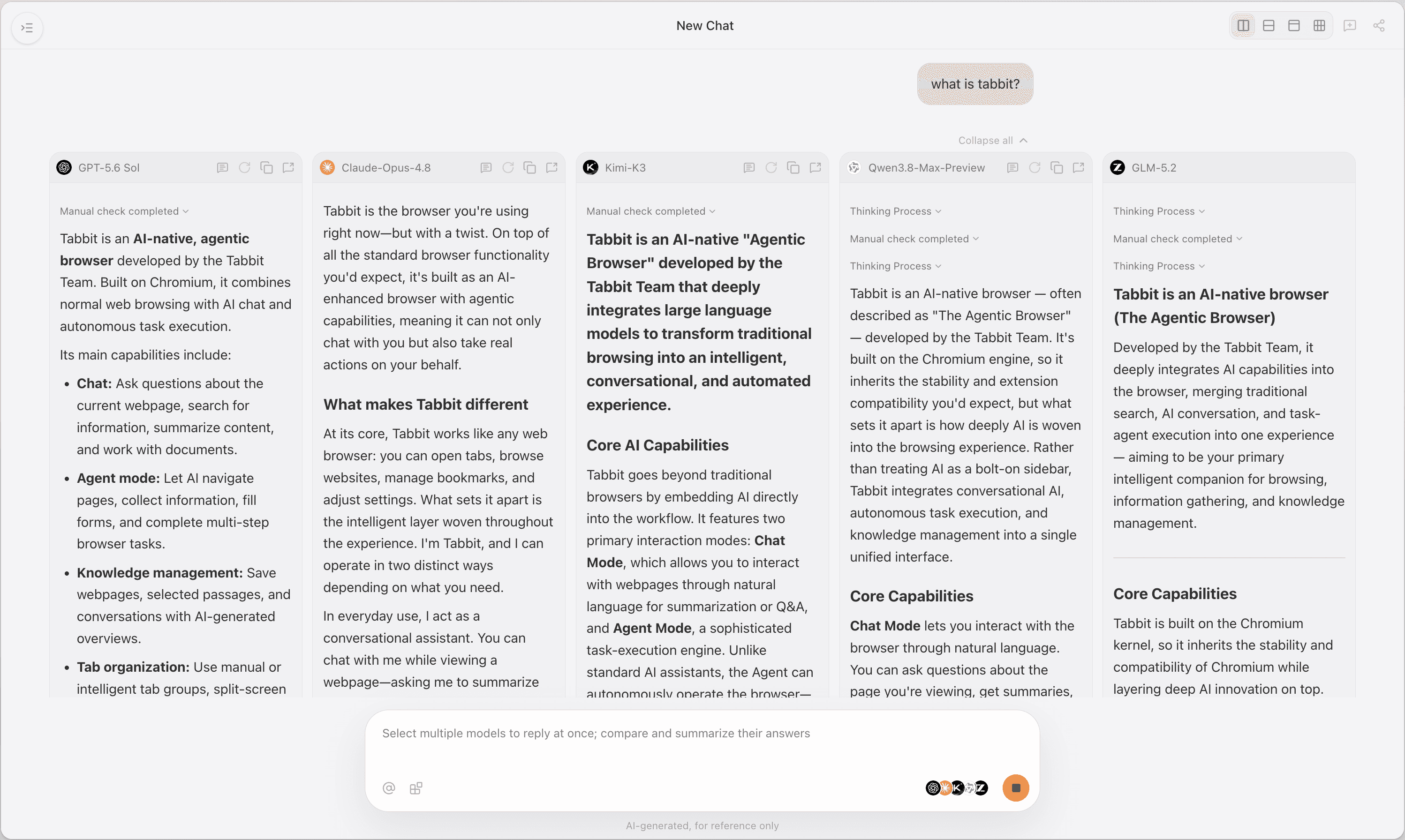
If both models appear in your account, give each the same public document and ask for a table of claims with source links. Check every citation against the original page and record missing or incorrect rows. If one model is unavailable, do not substitute a different model and call it a comparison. Account availability, quotas, tool access and pricing can change, and this article did not run an authenticated task with either model in Tabbit.
For browser actions, use a disposable or read-only task first. Decide which operations need approval and inspect the result before allowing edits. See the browser automation guide for the surrounding workflow, and the AI browser comparison for product choices. A browser workflow is not a substitute for an identical API harness when measuring model cost or latency.
Which should you choose?
| Your priority | Starting point | Check before committing |
|---|---|---|
| Control over model hosting | GLM-5.3-Flash | License, memory, serving stack and operating cost |
| Long coding or visual agent tasks | Test both; include LongCat 2.5 | Same repository, harness, images and acceptance tests |
| Lowest total API bill | Compare actual provider quotes | Cache rates, output volume, retries and service terms |
| Browser-based source research | Test the workflow in Tabbit if the models are available | Selector, quotas, citation quality and account terms |
| Sensitive code or documents | Review the deployment route first | Retention, training use, region and contractual terms |
GLM-5.3-Flash has the clearer self-hosting path today. LongCat 2.5 deserves a controlled trial for tasks matching its published agent and vision focus. Keep the first task reversible, compare accepted output and the full bill, and revisit the decision as model access and provider terms change.

FAQ
Which model is better for coding?
Neither model has been tested head to head for this article. Run the same repository tasks with the same tools, tests and time limits, then compare accepted changes, failures and total cost.
Are both models available as open weights?
Z.ai publishes GLM-5.3-Flash weights under the MIT license. On November 3, 2026, the LongCat 2.5 announcement marked GitHub and Hugging Face as coming soon, so check for a later release and its license.
Which model is cheaper?
On November 3, 2026, LongCat listed a limited-time $0.30 input and $1.20 output per million tokens, while Z.ai on OpenRouter listed $0.15 and $0.50. These are different routes; check current rates, cache terms, output volume and retries before deciding.
Do both models support long context?
LongCat's API documentation lists a one-million-token context window, and GLM-5.3-Flash's checkpoint configuration also specifies roughly one million tokens. The usable limit and output cap depend on the provider and client.
Can the models understand images?
Both model publishers describe native multimodal capabilities. Actual image and video support depends on the API route and client, so verify the accepted formats and limits before integrating them.
Can I use both models in Tabbit?
This article did not verify both models in a signed-in Tabbit account. Check your current model selector and account terms before relying on either model for a workflow.