
Ox Alpha is GLM-5.3-Flash. The name arrived on August 27, after a week in which the model had already processed real repositories, images, video, and very long agent runs under an anonymous OpenRouter route.
The preview had enough time to build a reputation before it had a maker. Under a RandomAI video, one developer wrote that Ox Alpha completed an entire version-upgrade workflow in a single session. That is a personal report, not a benchmark, but it captures why the reveal mattered: people were already using the model for work, not waiting for a model card.
GLM-5.3-Flash joins the intelligence line behind GLM-5.2 and standard GLM-5.3, then adds native multimodal input. You can now choose it in Tabbit Browser, where a model can work with the page, image, or file already in front of you.
Key takeaways
Ox Alpha appeared on OpenRouter on August 20, 2026, as a free anonymous preview with a one-million-token context window.
The preview accepted text, images, and video. It was positioned for coding and sustained agent work, not casual chat alone.
Researchers traced its tokenizer, video token budget, and server errors to the GLM family and Z.ai infrastructure before the August 27 reveal.
Early tests were good signals, not a clean leaderboard. A DeepSWE subset result and one Cline repository comparison need to stay inside their stated scope.
GLM-5.3-Flash is available in Tabbit Chat and Agent workflows. It is most useful when the task mixes reasoning with pages, screenshots, documents, or browser actions.
The Ox Alpha story at a glance
| Date | What became public | What could reasonably be concluded then |
|---|---|---|
| Aug 20 | OpenRouter listed Ox Alpha as an anonymous third-party preview | The model existed, had 1M context, and targeted coding plus long agent work. Its developer was unknown. |
| Aug 21 | OpenRouter's X post named text, image, and video input | Ox Alpha was natively multimodal at the API surface. This still said nothing about its lab. |
| Aug 21 to 25 | Tokenizer probes, video token counts, Z.ai-shaped errors, and community tests appeared | GLM became the strongest family attribution, but a family fingerprint was not yet a product name. |
| Aug 25 | Di Zhang wrote that the source was GLM-5.3-Flash from Zhipu | The exact name entered public discussion. It was still a sourced community claim at that moment. |
| Aug 27 | Ox Alpha was revealed as GLM-5.3-Flash | The codename and product identity finally met. Earlier tests could now be read as preview evidence for Flash, with their original limits intact. |
That order matters. A reveal should not rewrite the previous week into a neat launch campaign. On August 23, TechCrunch still reported competing GLM and Microsoft MAI theories. The uncertainty was real.
The stealth preview was a useful blind test
OpenRouter described Ox Alpha as a reasoning model for coding, sustained agentic work, and production workloads. The page listed 1,048,576 tokens of context and up to 131,072 output tokens. It was free during preview, with one anonymous provider behind it.
The anonymity removed the usual brand shortcut. People could not say they preferred it because it was GLM, Claude, or GPT. They had to look at whether it finished the task. That did not make every public impression scientific. It did make the week unusually revealing.
The OpenRouter page also carried a less glamorous detail: the provider retained prompts and completions, while stating they were not used for training. Anyone testing private code still needed to read the stealth terms. Free preview access was never a reason to paste secrets into an unnamed endpoint.
The page's live latency, throughput, and uptime figures changed with traffic. They describe a route at a moment in time, not the model's fixed speed. The same caution applies to preview pricing. Free was a test condition, not a lifetime promise.
How X and Google narrowed the identity
The strongest pre-reveal analysis came from measurements that a prompt could not easily imitate. Jonathan Turner's August 26 write-up assembled several independent probes:
| Signal | Reported result | What it supported | What it did not prove by itself |
|---|---|---|---|
| Tokenizer | Ox Alpha and public GLM-5.3 matched 50 of 50 tested strings | A GLM-5.x vocabulary and wrapper were likely | Exact weights or commercial SKU |
| Video token budget | Four clips matched GLM-5V-Turbo token for token | A GLM-V style visual encoder was likely | That Ox Alpha was the public GLM-5V-Turbo model |
| Serving errors | Java package paths and business codes matched Z.ai PaaS v4 / GLM-5.3 responses | The service was running on a Z.ai-shaped backend | Who owned every post-training step |
| Product card | Ox had 1M context plus vision; public 5.3 was text-only and 5V-Turbo had 200K context | Ox looked like an unreleased multimodal GLM-5.x sibling | Its final name |
Google results followed the investigation in public. The main query moved from "who made Ox Alpha" to "is Ox Alpha GLM-5.3-Flash?" Reddit titles began declaring confirmation, while X posts argued over GLM, MiMo, MAI, and other possibilities. Search captured the argument; it did not settle it.
Turner's careful line was more useful: the family looked like GLM, the kitchen looked like Z.ai, and the exact product remained unnamed. Di Zhang then supplied the exact GLM-5.3-Flash attribution. The August 27 reveal closed the last gap.
GLM-5.2 intelligence, now with native multimodality
Z.ai's GLM-5.3 technical post says standard GLM-5.3 uses the same base model as GLM-5.2. The gains came from another month of scaled post-training: more executable environments, more varied long tasks, and more compute on those trajectories.
That is what "inherits GLM-5.2 intelligence" means in practical terms. The line keeps the base reasoning stack and the long-horizon training work introduced around GLM-5.2. Standard GLM-5.3 pushed it harder on coding, tools, and agent tasks. For background on using the earlier model, see GLM-5.2 in Tabbit and the GLM-5.1 path.
GLM-5.3-Flash adds native multimodal input to that line. In the Ox Alpha preview, text, images, and video entered the same model route. That matters when a task is partly visual: read a screenshot, compare a UI to a specification, inspect a chart, then continue reasoning across code or documents.
It does not mean every standard GLM-5.3 score transfers to Flash. Z.ai reported standard-model results such as 66.9 on DeepSWE v1.1 and 28.3 on Terminal-Bench 3.0, under documented but vendor-run harnesses. Those are useful family baselines. They are not Flash results unless Flash is run under the same conditions.
What the early tests actually say
Two public tests deserve attention because they included a concrete task or number.
Wenqi/Kevin reported about 63 percent on a DeepSWE subset at roughly 47K average output tokens per task. The post called Ox Alpha Pareto-efficient among open models. It did not publish the full task list, repeated runs, or a standard leaderboard submission. Read it as an encouraging coding-agent signal.
Cline compared Ox Alpha and Fable on one real bug from the Cline repository. Both fixed it. Cline said Ox Alpha repeated less reasoning and used about three times fewer output tokens for similar work. One correct bug fix cannot rank a model family, but it does point to a useful trait: acting after a conclusion instead of restating it seven times.
The YouTube comment about finishing a version upgrade in one session adds a third kind of evidence: continuity over a real workflow. There is no repository, diff, or test log attached. It explains the appeal without proving a rate.
These signals fit the design story. A model trained on long, executable environments should be judged on whether it owns a task through completion. For the difference between a chat answer and an agent loop, see our agentic reasoning guide. For role-play behavior and presets, use the separate GLM-5.3 SillyTavern guide; that is a different workload.
Putting GLM-5.3-Flash to work in Tabbit
Tabbit is a practical home for this model because the browser already holds multimodal context. You do not have to download an image, copy a page, and rebuild the task in a separate chat.
Open Tabbit Browser and start Chat for analysis or Agent Mode for a multi-step browser task.
Choose GLM-5.3-Flash in the model picker.
Type
@to attach the current page, a tab group, a screenshot, or a local file.State the deliverable and the checks. For an agent job, include what counts as finished and what it must not change.
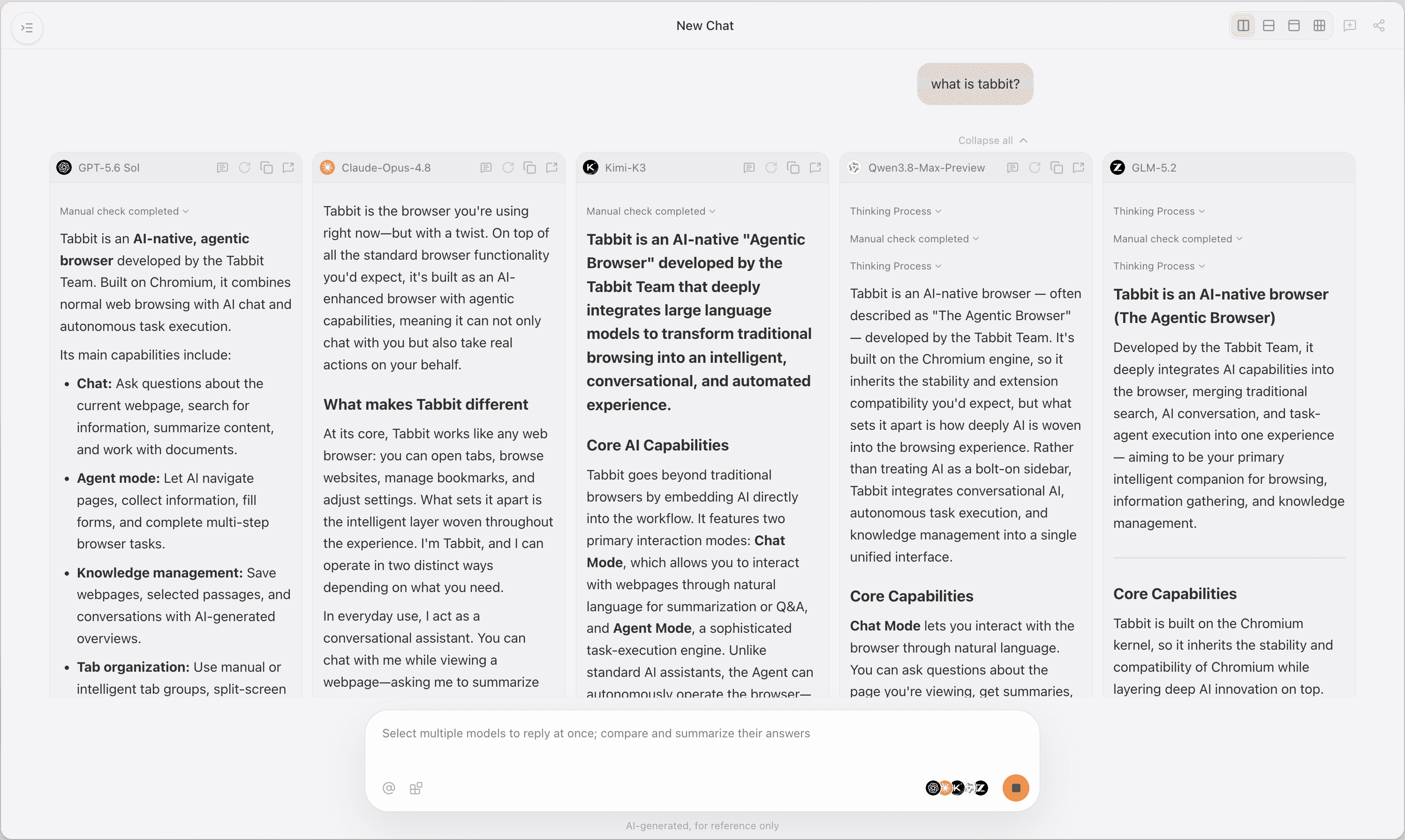
A good first task is mixed, but bounded: attach a screenshot and the relevant specification page, ask Flash to list mismatches, then have Agent Mode verify the affected pages. Researchers can use the same pattern with reports and live sources; the research browser guide covers that setup.
The boundary is simple. Tabbit is not an IDE coding harness, and selecting a model does not promise unlimited preview-era usage. Check Tabbit pricing for current limits. If the work lives entirely in a repository, a code agent may be the better runtime. If the evidence lives across pages, images, and files, the browser is where Flash's multimodal design makes more sense.
Which tasks fit GLM-5.3-Flash
| Task | Fit | How to use it | Boundary |
|---|---|---|---|
| Compare a UI screenshot with a web specification | Strong | Attach both with @, ask for a mismatch table, then verify in Agent Mode | Require source links and visual evidence |
| Long web research with charts and PDFs | Strong | Keep sources in a tab group and request a cited synthesis | Use deep research methods, not one giant unsourced answer |
| Browser workflow with visual state | Strong | Let the model read the page and act in a separate task group | Define stop conditions and review mutations |
| Large repository patch | Mixed | Use Tabbit for docs and screenshots; keep patching and tests in a code harness | The browser does not replace git or CI |
| Casual text question | Fine, often unnecessary | Use Chat without extra attachments | A smaller model may answer faster |
| Need a permanent free endpoint | Poor assumption | Check the current model picker and plan | Ox Alpha's free preview terms were temporary |
The verdict is narrower than the launch hype. GLM-5.3-Flash is compelling when GLM-style long-horizon reasoning meets visual context. The early data supports trying it on real agent work. It does not support copying every standard GLM-5.3 benchmark or declaring a universal winner.
If your task starts with a page, screenshot, PDF, or browser action, choose GLM-5.3-Flash in Tabbit and give it a finish line. If your main question is how it compares with a million-token coding model, the GPT-5.6 Sol context guide provides the other side of that decision.

FAQ
Is Ox Alpha really GLM-5.3-Flash?
Yes. The model was revealed as GLM-5.3-Flash on August 27, 2026. Before the reveal, OpenRouter listed it only as the anonymous stealth/ox-alpha preview, while independent fingerprinting had already linked its tokenizer, video token budget, and serving errors to the GLM family and Z.ai stack.
Is GLM-5.3-Flash the same model as GLM-5.3?
No. Standard GLM-5.3 was released as a text model focused on coding and long-horizon agent work. GLM-5.3-Flash carries that intelligence line into a native multimodal model that accepts text, images, and video. Scores published for standard GLM-5.3 should not be copied to Flash unless Flash is tested separately.
What does GLM-5.3-Flash inherit from GLM-5.2?
Z.ai says standard GLM-5.3 uses the same base model as GLM-5.2 and improves it through scaled post-training. That work targets coding, tool use, and long-horizon tasks. GLM-5.3-Flash combines that intelligence line with native multimodal input rather than treating vision as a separate add-on.
What inputs did Ox Alpha support during preview?
OpenRouter and its official X announcement listed a one-million-token context window with text, image, and video input. The preview returned text and was positioned for coding, sustained agent work, and production workloads. Preview limits and pricing should not be treated as permanent GLM-5.3-Flash terms.
How good were the early Ox Alpha benchmarks?
The signals were promising but incomplete. Wenqi/Kevin reported about 63 percent on a DeepSWE subset at roughly 47K average output tokens, while Cline reported one real repository bug fixed with about three times fewer output tokens than Fable. Neither result is a full independent benchmark of GLM-5.3-Flash.
How do I use GLM-5.3-Flash in Tabbit?
Open Tabbit Browser, start a Chat or Agent task, and choose GLM-5.3-Flash from the model picker. Use @ to attach the current tab, a tab group, a screenshot, or a local file when the task needs visual or page context. Availability and plan limits can change, so check the current picker and Tabbit pricing page.