
Kimi K3.1 Pro is Moonshot AI's new multimodal reasoning model, built by post-training Kimi K3 with more reinforcement-learning compute. It targets coding, 3D creation, financial research and other tasks that require repeated tool use. Hosted access is live through Kimi, Kimi Work, Kimi Code and the Kimi API. Full weights are promised by November 4, 2026, rather than established as downloadable today. This guide checks the launch and access documents as of October 24. (Moonshot launch)
The number that affects the first decision is 1,048,576 tokens. That is the API context window, not the allowance of every subscription. Kimi Code's entry eligible plan has a smaller window; higher tiers unlock 1M. Choose a route before comparing scores or buying access. (API pricing, Code model configuration)
The distinction matters in practice. HN user johnmlussier reports reaching a subscription's five-hour quota within one session; another user reports much lighter usage with a mixed-model workflow. Those are individual accounts, not a measurement of your allowance. The later Tabbit Browser section explains how to check the actual selector before treating a model resource page as proof of access. (Original quota comment)
Key takeaways
Standard Pro and Highspeed share the advertised capabilities. Moonshot's two-to-three-times speed claim is not a promise about your task's completion time.
The API uses
kimi-k3.1-pro; Kimi Code usesk3.1-pro. A correct name with the wrong endpoint can still fail.Thinking stays on. Supported effort levels are
low,highandmax, withmaxas the default.Standard international API rates are $2 input and $10 output per million tokens. Cache writes, tools, taxes and subscription allowances need separate checks.
Treat the weight release as pending and use task-level evidence when deciding whether to migrate.
Kimi K3.1 Pro at a glance
The table separates model specifications from product access. Each row links to its controlling source.
| Item | Verified information | Practical limit and source |
|---|---|---|
| Developer and family | Moonshot AI; post-trained Kimi K3 | The launch calls it 3T-class, rather than documenting a new exact parameter count. Launch |
| Hosted rollout | Kimi Code dates the release October 23, 2026 | Some regional research indexes show October 24; this is not a second model release. Changelog |
| API IDs | kimi-k3.1-pro, kimi-k3.1-pro-highspeed | Code's IDs omit kimi-. Quickstart |
| Context | 1,048,576 tokens on the API | Code's plan limits can be lower. Pricing |
| Completion setting | Default 131,072; configurable up to 1,048,576 | This is not an extra 1M output budget beyond a full context. Quickstart |
| Inputs and outputs | Text, image and video input; text output | Scripts and external tools create 3D assets; the base text API is not a native 3D-file generator. Quickstart |
| Reasoning | low, high, max; always enabled | Disabling thinking is rejected. Code configuration |
| Weights, license, cutoff | Weights promised by November 4; final license and knowledge cutoff not established here | Do not inherit a license or cutoff from K3. Launch |
What changed from Kimi K3?
The model is a post-trained successor, not evidence of a wholly new architecture. Moonshot describes scaling joint reinforcement learning across hundreds of domains and improving the training framework, long-context inference, sandboxes and rollout scheduling. The intended result is better execution over long tasks, particularly software, 3D and research work. The Kimi K3 resource page is the prior-generation reference; K2.7 Code is a separate coding branch, not another name for Pro.
The useful mechanism is a loop: read context, reason, call a tool, inspect its result and continue. A 1M window gives that loop room for more source material. It does not guarantee accurate retrieval of every detail. Moonshot's Blender and game-engine examples depend on software the agent can operate; the surrounding application determines which tools and permissions actually exist. (Launch and examples)
For integrations, preserve the complete assistant message between tool turns. The API quickstart specifies fixed sampling settings, strict JSON Schema support and base64 or uploaded-file image input rather than public image URLs. It also warns that its web-search offering is being updated and is not recommended for production workflows in the near term. These conditions matter more than a generic claim of API compatibility. (API quickstart)
Benchmark snapshot: stronger results, different test conditions
| Evaluation | Reported K3.1 Pro result | What the result establishes |
|---|---|---|
| Terminal-Bench 4.0, Moonshot report | 65.7% | Vendor evaluation using Claude Code and the published footnote conditions. Launch |
| Terminal-Bench 4.0, Artificial Analysis | 67% | A separate evaluator's result, not a correction of Moonshot's number. AA launch analysis |
| Artificial Analysis Intelligence Index | 55, versus 44 for K3 max | A launch-time aggregate score, not an 11-point increase in every workload. AA |
| PlotlyDataAnalyticsBench | 42 of 43 questions | One private exam using synthetic data, standard Pro via OpenRouter. Plotly |
Moonshot normally reports max effort, temperature 1.0 and top-p 0.95 unless otherwise noted. Tools, agent software, dataset versions and scoring rules differ across evaluators. The API quickstart still contained benchmark placeholders and a different hallucination result when checked; this article uses the launch report for vendor results and does not merge those figures. Neither source establishes an everyday error rate.
The independent cost evidence also tempers the launch story. AA reports approximately $1.98 per index task, roughly level with K3 despite lower first-party token rates. Plotly reports $13.47 for its full exam, versus $5.01 for its earlier K3 run, with a median 2.5 minutes per question. Different providers, historical rates and output volumes prevent a direct price comparison. The useful conclusion is that a cheaper token does not guarantee a cheaper completed task.
What early users found
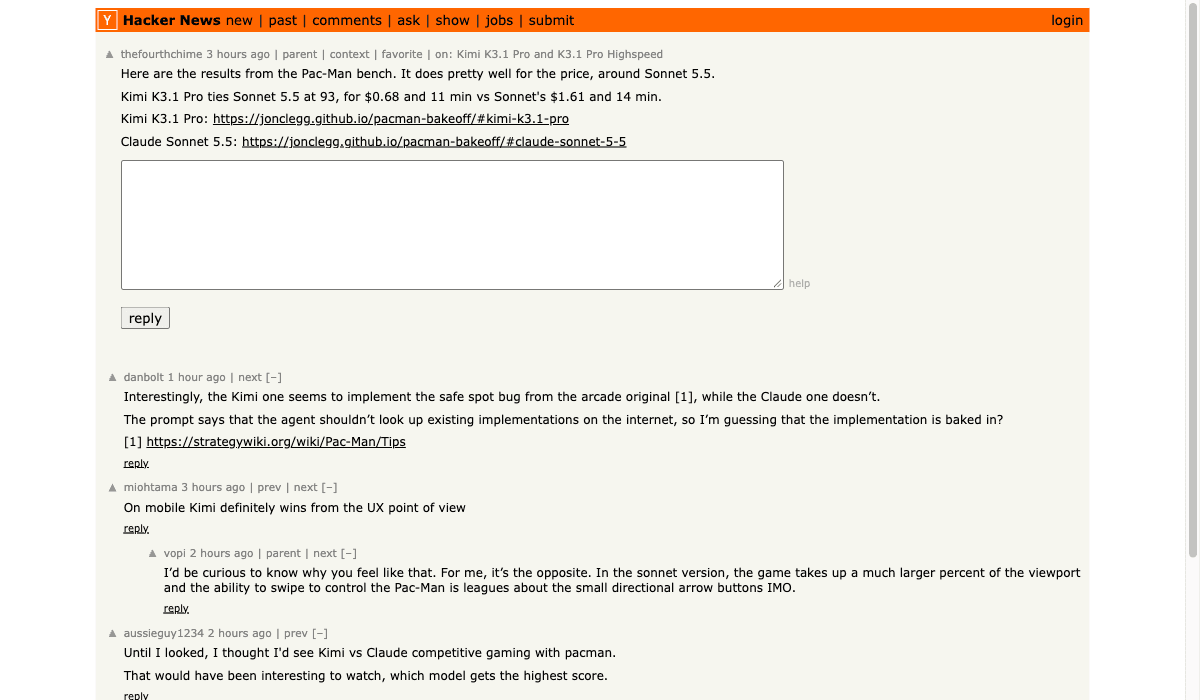
The first two reports concern concrete output. On October 23, HN user thefourthchime shared a Pac-Man comparison and called the result "pretty well for the price". The linked test has its own scoring and does not rank general coding ability. (Original comment)
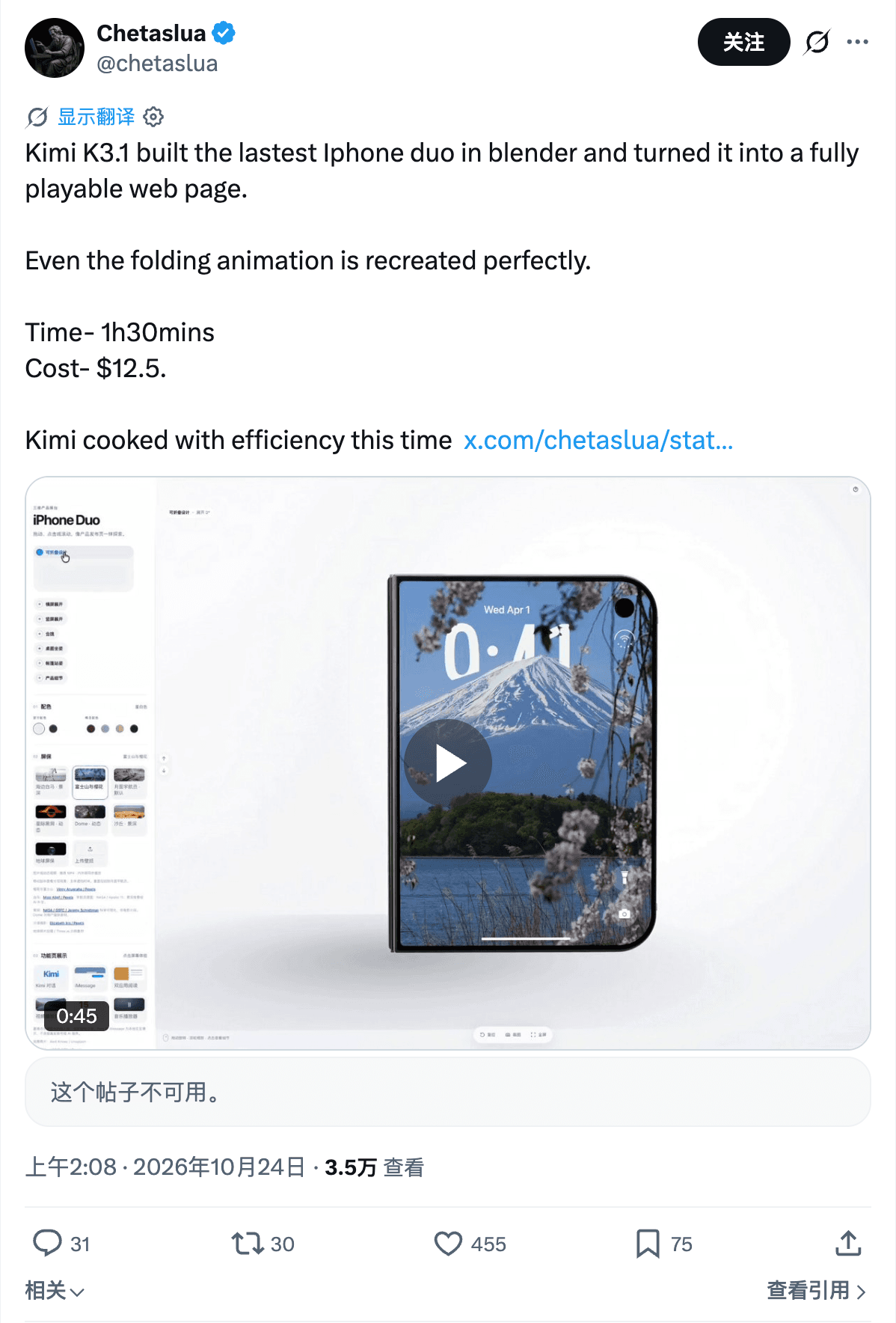
X creator @chetaslua showed a Blender-to-web folding-phone demo and reported 90 minutes and $12.50. The post calls the model K3.1; its effort, provider and billing details are not established. It is a visual workflow example, not a reproducible speed comparison. (Original post)
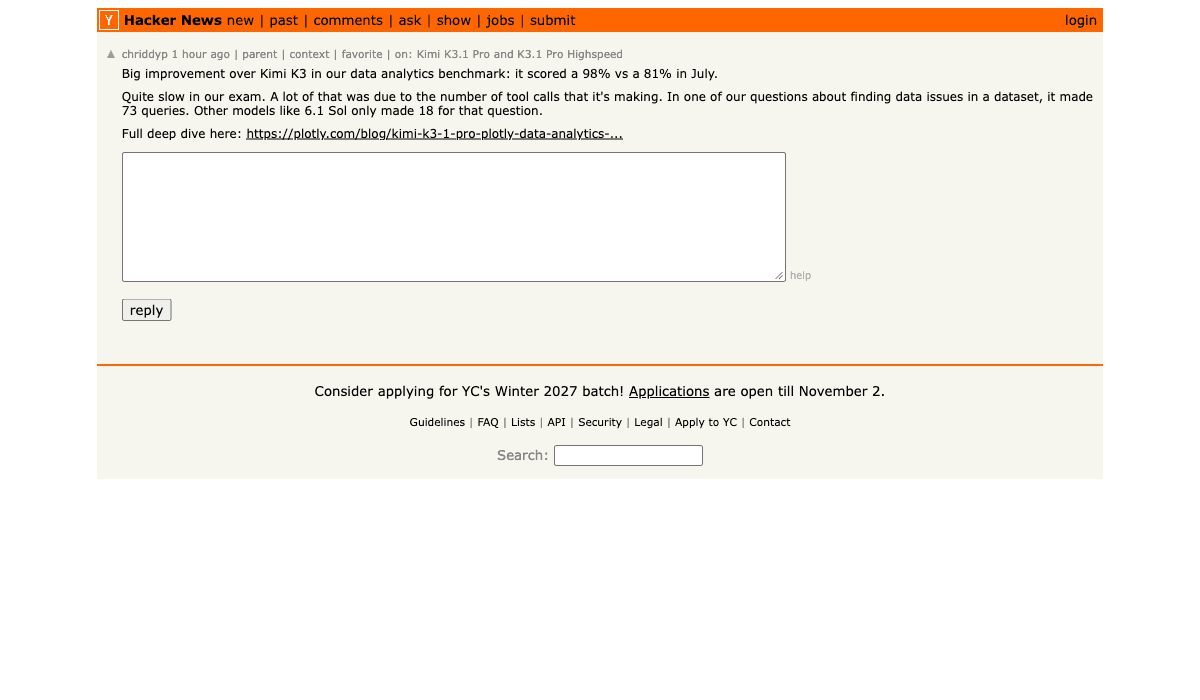
The strongest caution is about how much work the model performs. On October 24, Plotly's chriddyp described improved data analysis but said it was "Quite slow in our exam." Their linked report explains that the model made many queries and generated substantial reasoning output. (Original comment, test report)
Pricing: Pro and Highspeed are different purchases
The international first-party API lists these USD rates per million tokens, excluding tax, checked October 24. The earlier K3 pricing guide explains the previous generation; use the current official table for a new request.
| Model | Input | Output | Cached input | Cache write, 5m / 1h |
|---|---|---|---|---|
kimi-k3.1-pro | $2 | $10 | $0.20 | $2 / $4 |
kimi-k3.1-pro-highspeed | $4 | $20 | $0.20 | $4 / $8 |
kimi-k3 | $3 | $15 | $0.30 | $3 / $6 |
Source: Kimi API pricing. Cache writes are charged separately by TTL; a cache hit uses the cached-input rate without another write fee. Tool charges follow their own rules. These prices do not describe Kimi subscriptions or Tabbit fees.
Highspeed trades money or quota for advertised output speed. Kimi Code says it uses approximately twice the allowance. A faster token stream may help a long response, but network delays, tools and total reasoning still affect completion time. Compare the same task on standard Pro first.
How to get Kimi K3.1 Pro
API developer
Start at the official API quickstart. It lists a successful top-up of at least $1 to unlock this flagship model on the international platform. Use kimi-k3.1-pro and check rate limits. Access and billing on another regional platform must be verified there. The launch says Zero Data Retention is available for API customers; do not assume every account enables it by default.
Kimi Code subscriber
Plus or legacy Moderato and above can use standard Pro, with up to 256K context on that tier. Pro or legacy Allegretto and higher unlocks up to 1M and Highspeed. Use /model in the official CLI or the client selector, and start a new session. Use k3.1-pro, not the public API's prefixed ID. (Code documentation)
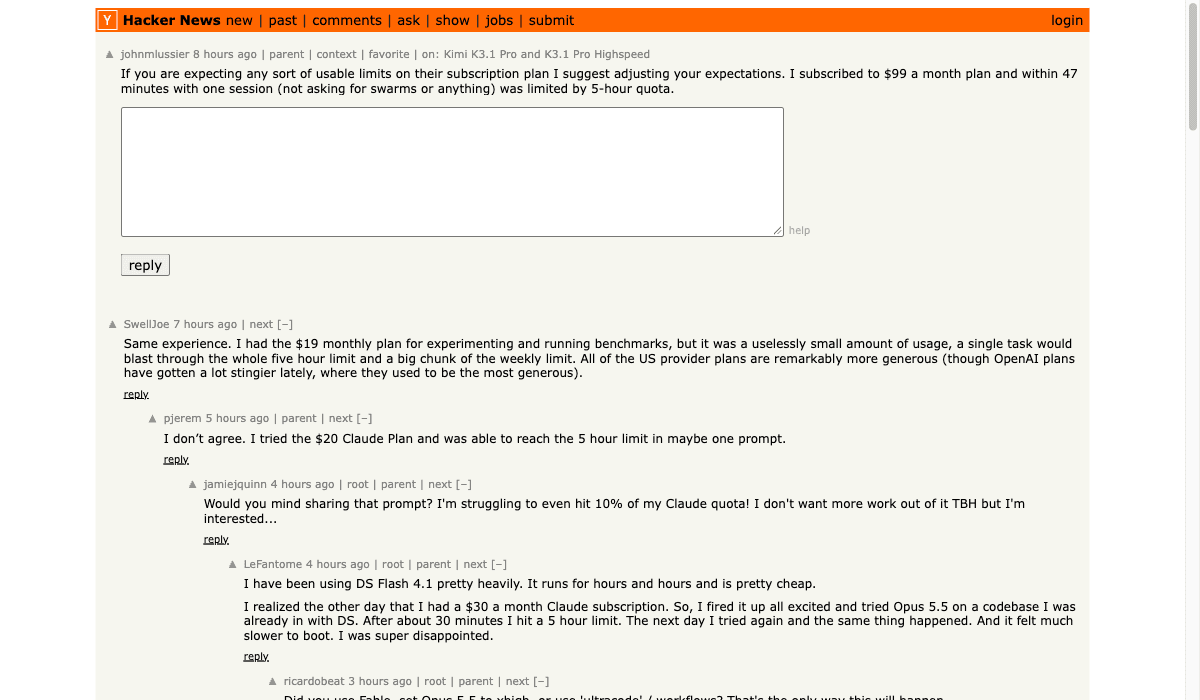
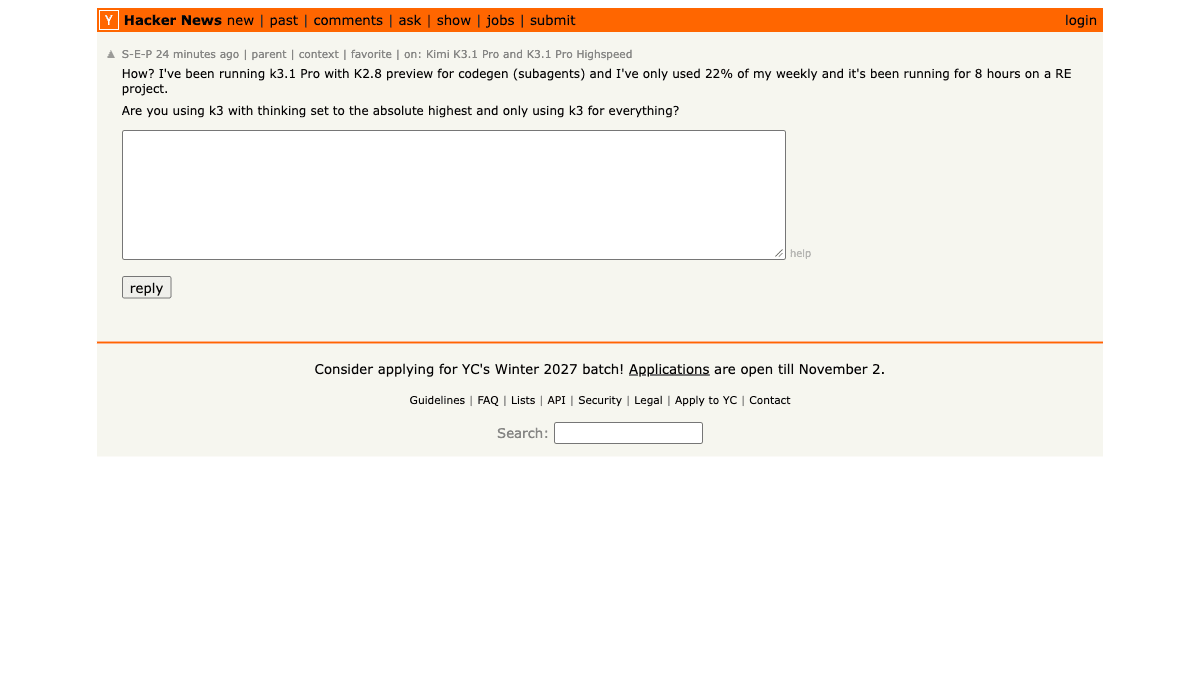
Quota reports are mixed. On October 23, johnmlussier reported exhausting a five-hour allowance in 47 minutes on a $99 plan. On October 24, S-E-P reported eight hours of work using K3.1 Pro with K2.8 Preview code-generation subagents and 22% of weekly allowance. The first report does not establish the exact version used; the second combines models. Neither predicts your allowance. (First comment, second comment)
App or enterprise user
Moonshot lists its web and mobile apps and Kimi Work. Work requires version 3.1.0 or later on Windows or Apple silicon Macs. Enterprise access is off by default at launch and requires an administrator to enable it. Check the actual account, plan and product before uploading work material. (Launch availability)
Local deployment
The next step is to wait for the checkpoint and read its final license and serving requirements. A scheduled weight release is insufficient for a local deployment plan. Do not assume ordinary laptop hardware can host a 3T-class model.
A browser workflow with Tabbit, with access checked first
An AI browser can keep source pages near the analysis, while browser automation handles permitted webpage actions. That is a practical context for this model's document and tool work. The Tabbit usage guide explains the broader workflow.
For this article, the October 24 check opened a new chat on web.tabbit.ai and inspected the model menu. K3.1 Pro was absent from that account's displayed list. No K3.1 Pro prompt was submitted, so there is no Tabbit inference result, latency or cost measurement. The K3.1 Pro resource page is a source collection, not access evidence. For a different model with a documented browser sample, see the Gemini 3.8 Flash guide.
If your own selector offers Pro, start a fresh conversation with non-sensitive documents. Ask for claims, exact supporting quotations and unresolved conflicts. Keep the sources open and check each quotation before acting. If Pro is missing, use an official supported channel; choosing another model in Tabbit does not reproduce a K3.1 Pro test.
Verdict: test the route as carefully as the model
Kimi K3.1 Pro deserves a trial for difficult coding and source-heavy agent tasks when you can inspect outputs and tolerate substantial reasoning. The 1M context ceiling is useful only when your product exposes it. Standard Pro is the sensible starting point; try Highspeed when measured waiting time justifies the extra rate or quota.
For predictable low latency, uninterrupted subscription usage or local deployment today, the evidence does not justify an unconditional switch. Keep your current workflow as a control. Record correctness, retries, tool calls and total cost on one real task before migrating. Tabbit is a browser option for that workflow when its live model menu and account permissions match what you need.
 Tabbit Browser

FAQ
What is Kimi K3.1 Pro?
Kimi K3.1 Pro is Moonshot AI's multimodal reasoning model, post-trained from Kimi K3 for coding, 3D creation and long-running agent tasks. It accepts text, images and video and returns text, code and tool calls.
Can I download Kimi K3.1 Pro weights now?
As checked on October 24, 2026, Moonshot promises full weights by November 4, 2026. Hosted availability does not establish that a downloadable checkpoint or final license is already available.
How much does the Kimi K3.1 Pro API cost?
The international first-party API lists $2 input, $10 output and $0.20 cached input per million tokens, excluding tax. Cache writes are separate, and subscriptions are a different product.
What changes with Kimi K3.1 Pro Highspeed?
Moonshot advertises the same capabilities with approximately two to three times the output speed. Input and output API rates double to $4 and $20 per million tokens; cached input remains $0.20.
Does every Kimi Code plan include the 1M window?
No. Plus or legacy Moderato unlocks standard Pro with up to 256K context; Pro or legacy Allegretto and higher unlocks up to 1M and Highspeed. Check the current plan and client rather than inferring access from the model's maximum.
Can I turn off thinking or use it in Tabbit?
K3.1 Pro requires thinking and supports low, high and max effort, defaulting to max. The checked Tabbit international account did not list K3.1 Pro on October 24, so this article does not claim a Tabbit model test or universal availability.