
Kimi K3.1 Pro costs $2 per million uncached input tokens, $10 per million output tokens and $0.20 per million cache-read tokens on the official USD rate card checked October 24, 2026. Highspeed costs $4/$20 with the same $0.20 cache-read rate. Cache writes have their own five-minute and one-hour prices.
The useful question is how much a completed task costs. Nathan Lambert welcomed the published results but noted that greater token usage could offset the lower rate. This guide calculates that break-even point and shows how to compare browser workflows in Tabbit Browser without confusing client allowances with API billing. Model identity and access sources live on the Kimi K3.1 Pro resource page.
Kimi K3.1 Pro rates at a glance
Official API prices, checked October 24, 2026. One MTok is 1,000,000 tokens. All three K3 rows list a 1,048,576-token context window. Prices exclude applicable taxes.
| Billing item, USD per 1M tokens | K3.1 Pro | Highspeed | K3 | Pro vs K3 |
|---|---|---|---|---|
| Uncached input | $2.00 | $4.00 | $3.00 | −33.3% |
| Output | $10.00 | $20.00 | $15.00 | −33.3% |
| Cache read | $0.20 | $0.20 | $0.30 | −33.3% |
| Cache write, 5 minutes | $2.00 | $4.00 | $3.00 | −33.3% |
| Cache write, 1 hour | $4.00 | $8.00 | $6.00 | −33.3% |
The change applies to every standard Pro line: each is one-third below K3. Highspeed is a separate serving option. Do not replace its cache price with twice Pro's cache-read price. The earlier K3 pricing guide provides historical context; use today's official table for a new budget.
Key takeaways
Standard Pro is one-third cheaper per token than K3 across the five listed lines. Equal token counts are an assumption, not a measured workload result.
At 1.5× the same mix of billable tokens, Pro costs as much as K3. Retries and quality can change that comparison again.
Cache reads stay at $0.20/M on Highspeed. Cached input can make its total premium much smaller than 100%.
Cache reads, writes and uncached input are separate portions of total input. Count each token once.
API balance, Kimi Code membership quota and Tabbit allowances are different purchases.
The number that changes the buying decision is 1.5×
Pro's rates are two-thirds of K3's. If the new model needs the same input/output/cache mix but 50% more tokens, the price cut disappears. That is arithmetic, not a prediction that Pro always reasons 50% longer.
Pro / K3 cost = (2 / 3) × billable-token growth
Break-even growth = 3 / 2 = 1.5
Cost per accepted result = all attempt costs / accepted results
The last line matters for agents. A lower-priced run that fails its test and needs another attempt can be more expensive than a successful first attempt. Measure accepted patches or checked reports, not only responses. Our agentic reasoning explainer covers why multi-step tasks have more than one model turn.
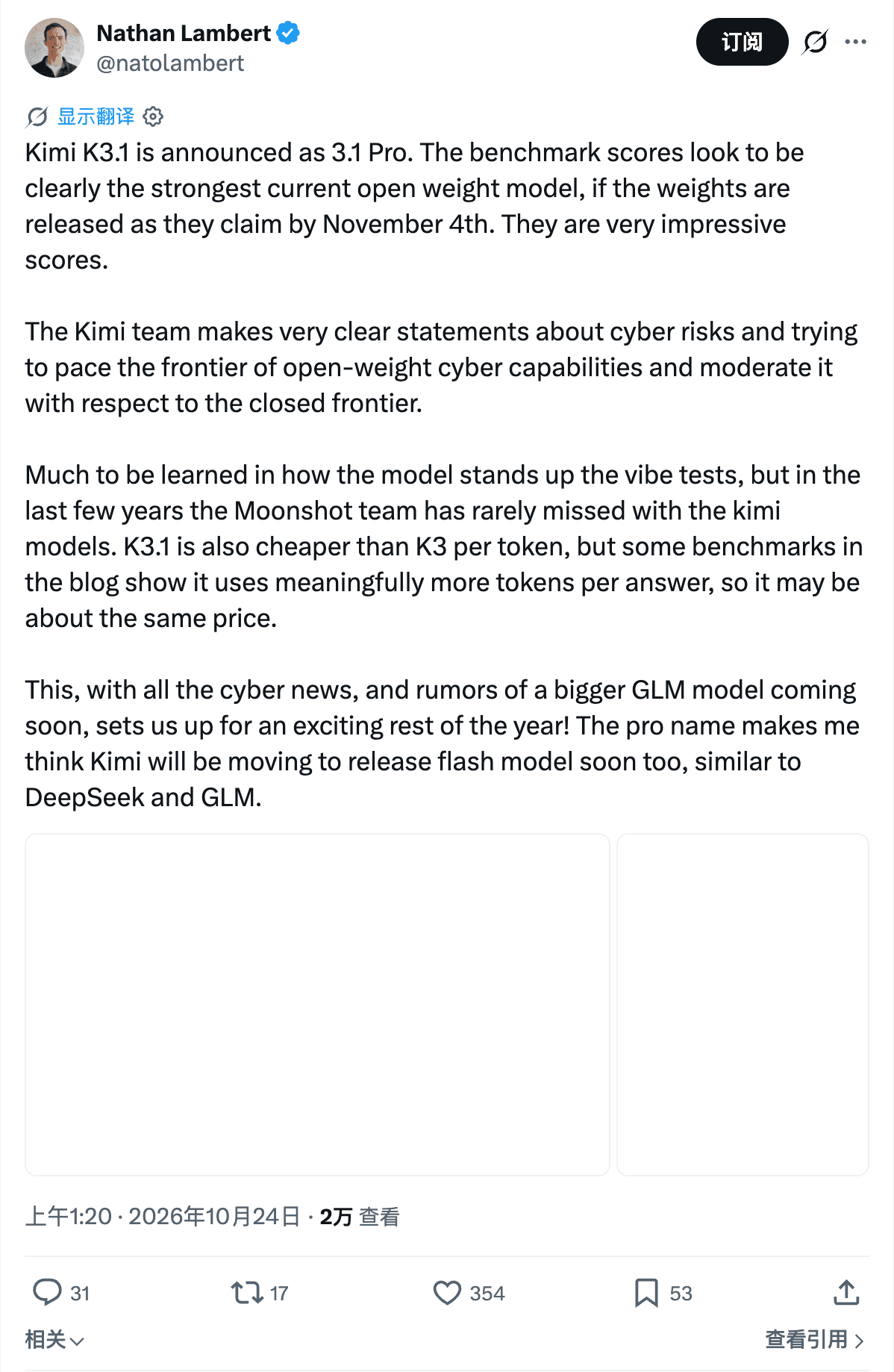
Lambert's post supports the concern about usage, not a universal savings percentage. This article has not run a controlled K3-versus-Pro API benchmark. No claim of measured savings follows from the rate card.
Cache billing without counting input twice
The current caching guide says Chat Completions and Responses divide total input into mutually exclusive cache reads, cache writes and the remaining uncached tokens. Messages exposes those parts through different fields. Reconcile your actual API's usage fields before multiplying rates.
I = total input tokens
R = cache-read input tokens
W = cache-write input tokens
U = I - R - W, with R + W <= I
O = total billable output, including billable reasoning
Pro token cost = (2U + 0.20R + write_rate × W + 10O) / 1,000,000
write_rate = 2 for 5m, or 4 for 1h
Do not add a write fee to every token already charged as normal input. On a cache hit, the read portion does not also incur a write charge. For streaming Chat Completions, the guide specifies stream_options.include_usage=true to obtain the final cache breakdown.
Put stable instructions, documents and tool definitions before changing questions or tool results. A timestamp near the front can invalidate the reusable prefix. The default TTL is five minutes; a hit renews the existing TTL without another write charge. An existing entry's TTL stays locked until it expires. One hour only helps if actual reuse justifies its higher write rate.
Two workloads, plus a cold-write check
These are calculations from the official USD table, not invoices or a claim about how many tokens your task will use. Each row has 10,000 total billable output tokens. Tool charges, taxes, retries and provider margins are excluded.
| Illustrative workload per task | Pro | Highspeed | K3 |
|---|---|---|---|
| 100k uncached input + 10k output | $0.300 | $0.600 | $0.450 |
| 100k input, 90% cache reads + 10k output | $0.138 | $0.258 | $0.207 |
| 100k input, all 1h cache writes + 10k output | $0.500 | $1.000 | $0.750 |
For a one-off 100k-input task, Pro costs (100,000 × 2 + 10,000 × 10) / 1M = $0.30. At 1,000 identical tasks per month, that is $300 before extras. K3 costs $450 at those same counts.
For a warm task with 90k cached input and 10k uncached input, Pro costs (90,000 × 0.20 + 10,000 × 2 + 10,000 × 10) / 1M = $0.138, or $138 for 1,000 tasks. Highspeed is $0.258 per task, about 87% more, because the read line stays unchanged. This warm example excludes the earlier write; include that initial request in a session budget.
The final row assigns all 100k input tokens to a one-hour cache write. Pro costs $0.50, not $0.70: that input is charged at the write rate once. If only part of a prompt is written, use the measured partition instead. For document-heavy work, compare this accounting with the tasks in our deep research use cases.
Reasoning effort is a usage setting, not a discount
The official Pro guide requires thinking. reasoning_effort accepts low, high and max, with max as the default. Turning thinking off is not a supported budget strategy.
Start with a small representative task at low effort, then increase effort if the result fails your acceptance checks. Record total billable output and retries. Do not add a separate reasoning count to an output total that already includes it. A short visible answer can still have substantial reasoning usage.
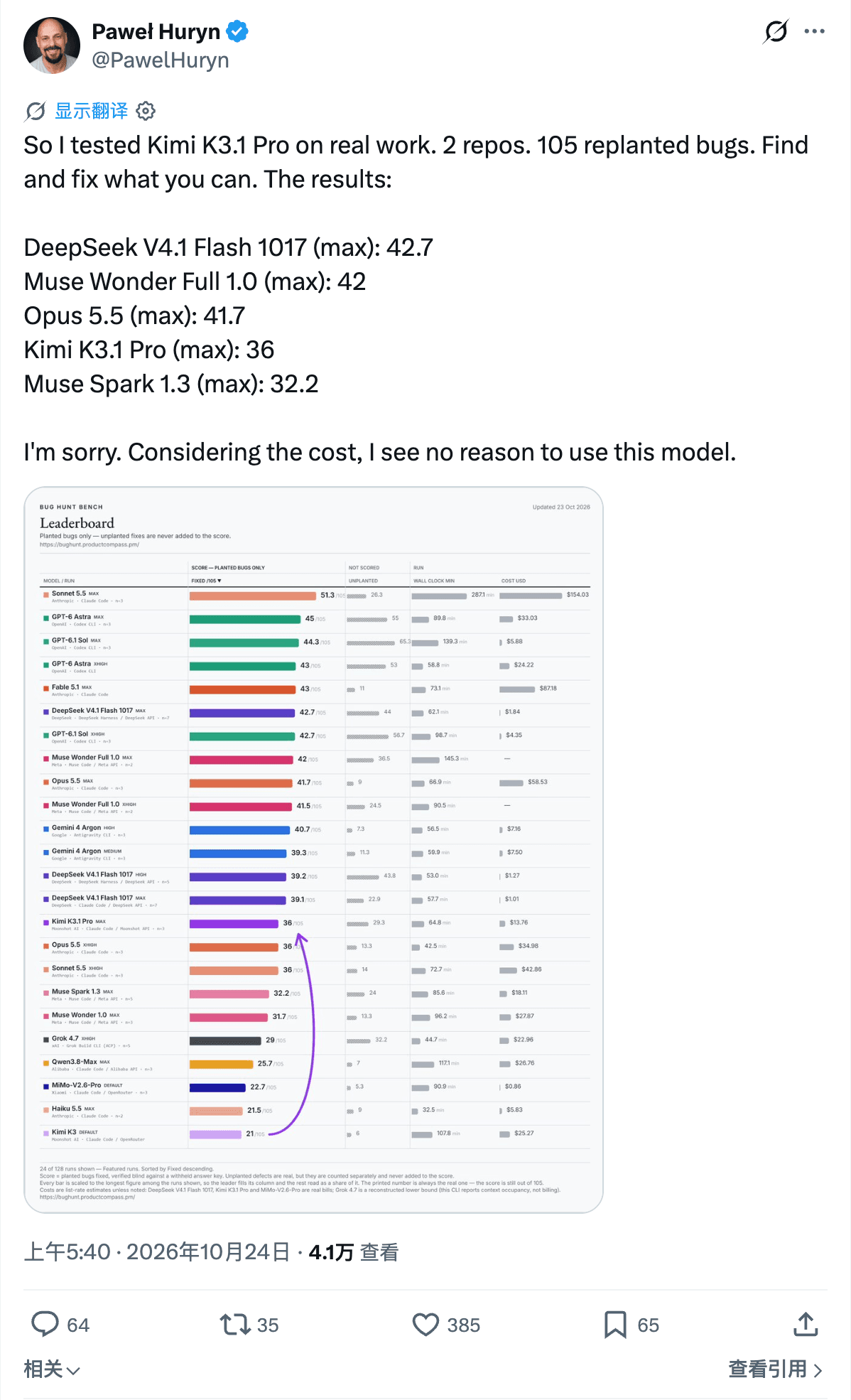
Paweł Huryn's bug-fixing test reached a less favorable value judgment than the launch narrative. It used two repositories and replanted bugs. That is a useful reason to test your own task, not evidence that every workload has the same winner. The K3 resource collection helps keep predecessor evidence separate.
Extras, discounts and what is not charged
The Batch price page lists K2.7 Code and K2.6, at 60% of standard rates. It does not list Pro. The cheaper K2.7 Code generation is also subject to the official K2 lifecycle notice: unavailable to new users from October 31, with retirement planned by the end of December 2026. Do not build a fresh long-term budget around that legacy discount.
For current standalone REST tools, Web Search Basic and URL Fetch each cost $0.002 per successful non-empty call; Web Search Pro costs $0.003. Search results passed back to the model also consume input. File extraction and storage APIs are temporarily free according to the inference page; using the extracted text as model input still costs tokens.
Failed or empty search/fetch requests do not incur those REST tool fees under the published conditions. This does not establish that all refused model replies, retries or interrupted generations are free. No general refusal credit, regional surcharge or Pro promotional expiry was verified in the inspected rate card. Treat undocumented charges as unknown, not as zero. Recheck your billing region and provider before purchasing.
Membership availability follows a different bill
The API quickstart says a successful top-up of at least $1 unlocks the flagship API. That is balance, not a monthly subscription. Kimi Code documentation separately places Pro on Plus/Moderato and above; Pro/Allegretto and above unlock 1M context and Highspeed. Highspeed uses about twice the quota according to that documentation.
The China membership page displayed these CNY prices after checking both billing toggles on October 24. Annual amounts are billed annually, not the displayed monthly equivalent. They are not USD API conversions or overseas price promises.
| China membership display | Monthly CNY | Annual CNY |
|---|---|---|
| Andante | ¥49 | ¥468 |
| Moderato | ¥99 | ¥948 |
| Allegretto | ¥199 | ¥1,908 |
| Allegro | ¥699 | ¥6,708 |
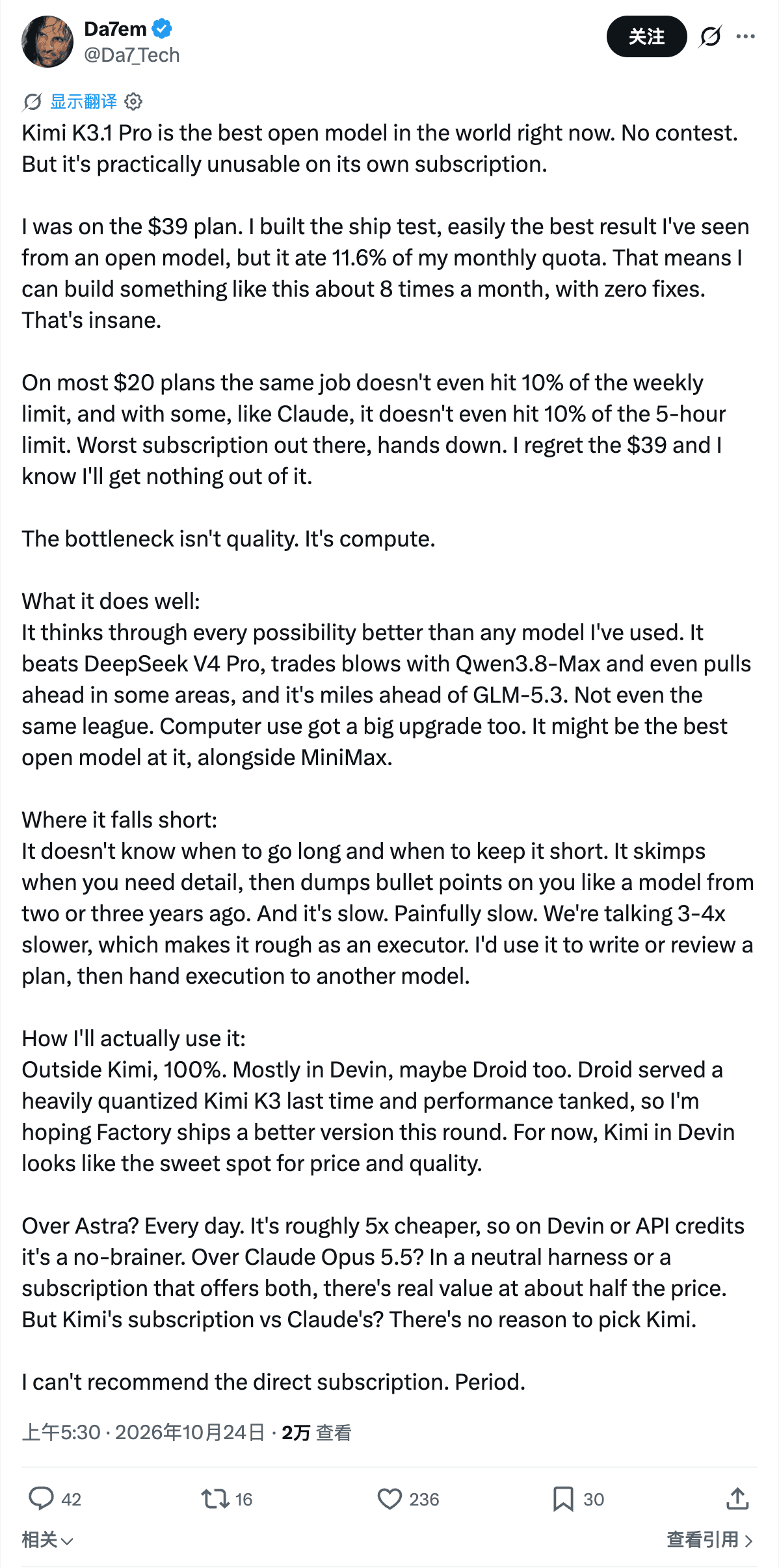
Da7em praised a ship-building result but said it consumed 11.6% of his monthly allowance. That is one user's report, not a verified quota conversion. Inspect the allowance rules in your own account rather than dividing a subscription price by a guessed token budget.
A browser workflow to check before choosing Tabbit
If your actual task is reading source pages and checking a report, Tabbit Browser can organize that work around the browser. During this article's research, Tabbit opened the official pricing, caching and membership pages, switched the membership billing toggle and captured the rate card. That verifies source inspection in the browser. It is not a K3.1 Pro inference benchmark or evidence of savings.
A practical next step is to open your source documents, choose a model currently offered to your account, and request a small table with source URL, billing unit, rate and exclusions. Check every row against the original page. The broader Tabbit workflow guide and agentic browser explanation cover the client context.
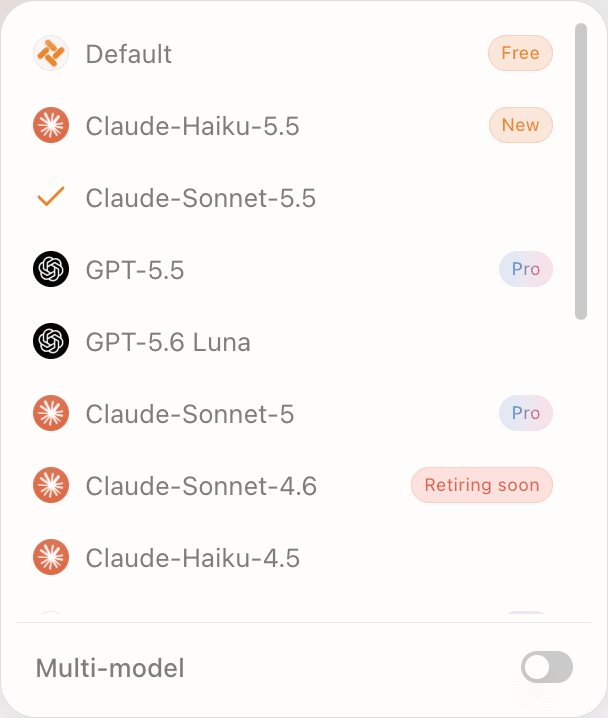
The checked international Tabbit account did not list Kimi K3.1 Pro on October 24, 2026. The screenshot shows the current picker interface; the loaded option list was also inspected. This is one account, not a claim about every edition. Exact models, permissions and allowances depend on edition and account. No Pro inference was performed. Tabbit does not turn a Kimi subscription into API credit.
Open weights do not make hosting free
MotherPotential's Reddit comment asks how very large models can run on ordinary hardware. Its hardware prices are personal estimates that this article has not verified. The parent post was removed, but the comment was accessible when captured.
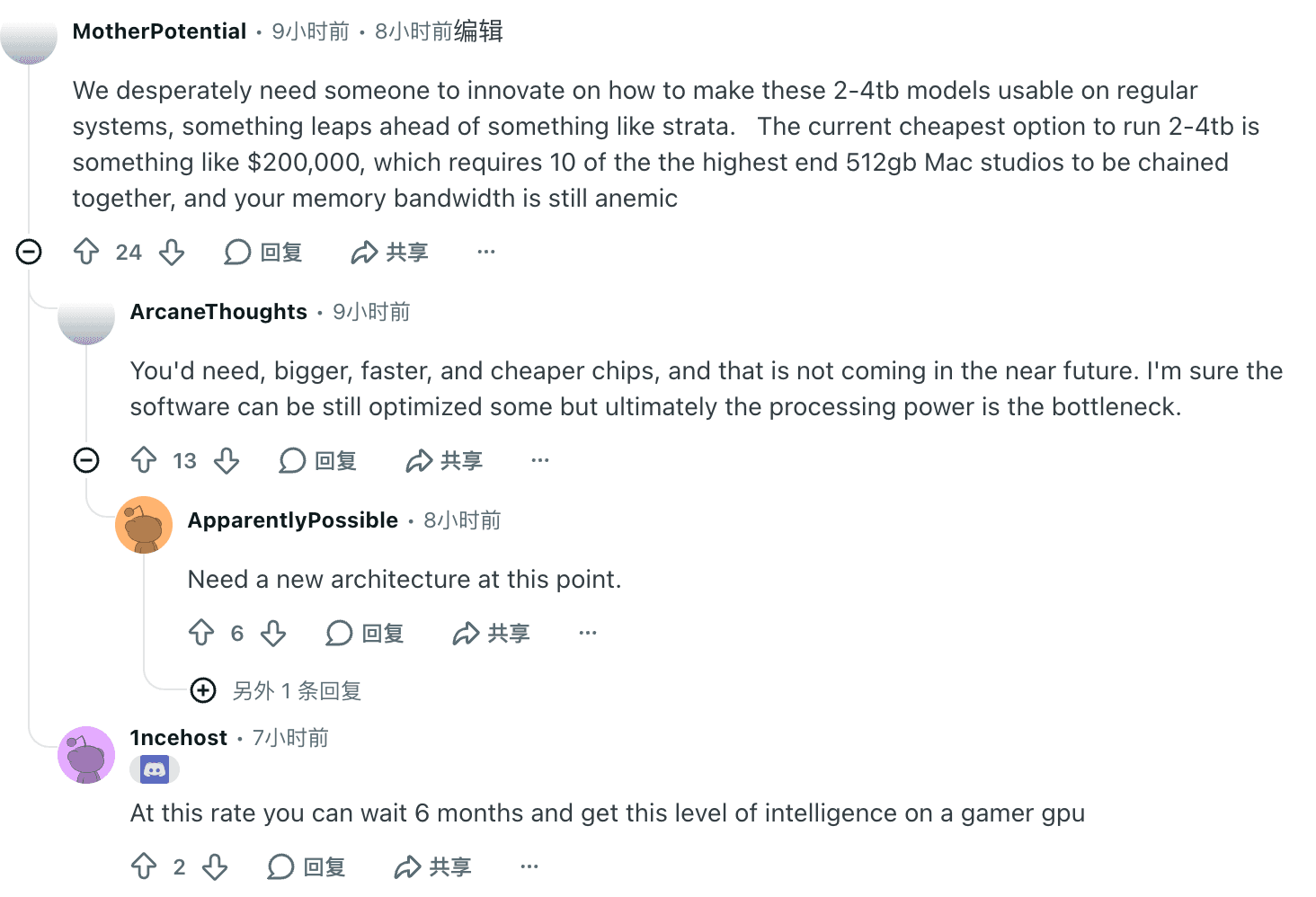
Moonshot's announcement promises full weights by November 4. As of this check, a promised release is not a usable local deployment. Even after weights arrive, hosting requires infrastructure and operations. API prices do not price that deployment.
Local calculator and buying verdict
Use the calculator for the same workload across Pro, Highspeed and K3. Total input already includes cache reads and writes. Values are calculated in this browser and are not included in analytics; a generic interaction event may be recorded. Nothing is sent to a model for this calculation.
Local calculation
Estimate Kimi K3.1 Pro API token cost
Uses the official USD rates checked 2026-10-24. Values stay in this browser.
Reads + writes cannot exceed total input. Empty, negative or non-finite values are invalid. Output includes billable reasoning; tools, taxes and retries are excluded. Verify current rates
Choose standard Pro first when measured task quality is sufficient and latency is acceptable. Choose Highspeed when the value of shorter waiting exceeds its additional cost; the advertised 2–3× speed is Moonshot's claim, not this article's measurement. Keep a working K3 integration only if your own regression checks justify it. For memberships, compare completed tasks against actual quota depletion.
Before committing, run the same task with the same pass criteria at two effort levels, log the input partition and total output, and include failed attempts. For browser research, try that workflow in Tabbit with the models available to your account. The download is a client action, not a purchase of Pro tokens.
 Tabbit Browser

FAQ
How much does the Kimi K3.1 Pro API cost?
The official USD table checked October 24, 2026 lists $2 per million uncached input tokens, $10 per million output tokens and $0.20 per million cache-read tokens. Cache writes cost $2 for a five-minute TTL or $4 for a one-hour TTL per million tokens. Taxes and metered tools are separate.
Is Highspeed exactly twice the price?
Highspeed doubles input, output and cache-write rates, but cache reads stay at $0.20 per million tokens. A cache-heavy workload can therefore cost less than twice the standard Pro total. The advertised speed gain is a vendor claim, not a measured result from this article.
Are cache writes added to all input tokens?
No. The current context-caching guide says cache reads, cache writes and remaining uncached tokens partition total input for Chat Completions and Responses. Charge each part at its own rate and do not charge cache-write tokens again as uncached input.
Can a Kimi membership pay for the Moonshot API?
Kimi membership and Kimi Code use product quotas, while the Open Platform API uses a separate pay-as-you-go balance. A Kimi Code key and endpoint follow the membership route. Do not treat the subscription as Open Platform API credit.
Can I use a Batch discount on K3.1 Pro?
The Batch pricing page checked October 24 lists K2.7 Code and K2.6 only. It does not establish a K3.1 Pro Batch tariff. Do not apply the listed 60% rate or another model’s discount to Pro.
Can I turn thinking off to reduce cost?
The official Pro guide requires thinking and offers low, high and max reasoning effort, with max as the default. Compare lower effort against your task’s acceptance test. Count billable reasoning within the reported output total rather than adding it twice.