
Muse Spark Open is Meta's first open-weight model in the Muse family: 816 billion parameters, 42 billion active, a one-million-token context window, and native text, image, audio, and video input. Meta shipped it on October 15, 2026 with weights on Hugging Face and APIs on seven hosted platforms, calling it "the most capable US open-weight model to date." The practical question most people asked first was not about benchmarks. As one Hacker News commenter put it, Meta suggests "a pair of Mac Studios w/ M5 Ultra chips and 512 GB of RAM. A single Mac Studio w/ M5 Ultra and half that RAM (256 GB) is around $11k, and the 512 GB option isn't even available yet. So.... yeah." (HN discussion)
This article runs the hardware math, reads the Muse Model License line by line, checks the day-one API pricing and independent benchmarks, and compares the model with GLM 5.3 and Kimi K3 on the same yardstick. Later on, we will also look at the third route: using a model like this through a product instead of a server room.
Key takeaways
Muse Spark Open is the open-weight release of Meta's Muse Spark: 816B total / 42B active sparse MoE, 1,048,576-token context, multimodal input, text output, built for coding and agentic work.
The one number that matters: each token touches 42B parameters, but serving loads all 816B — about 1.65 TB in BF16 or 537 GB in NVFP4, plus cache overhead.
Local means two 512 GB M5 Ultra Mac Studios on MLX, or a 4-GPU Blackwell node for NVFP4. Consumer desktops are out; even one 256 GB Mac Studio runs about $11k.
The Muse Model License allows commercial use but is not open source: a visible "Built with Muse Spark Open" label is mandatory, and Model-as-a-Service offerings above $20M in 12-month revenue need a separate Meta agreement.
Independent read (Artificial Analysis, October 19, 2026): Intelligence Index 39, 142 output tokens per second, about $0.84 per Intelligence Index task — fast and fairly concise, but expensive next to similar open-weight models, and behind GLM 5.3 (45) and Kimi K3 (44) on the Index.
Day-one hosted pricing is roughly $1.25/M input, $4.25/M output, and about $0.15/M cache reads across providers including Together AI, Fireworks, Baseten, Modal, and OpenRouter.
Muse Spark Open at a glance
| Item | Detail | Source |
|---|---|---|
| Release | October 15, 2026, Meta Superintelligence Labs | Meta research blog |
| Parameters | 816B total, 42B active per token; sparse MoE with 256 experts and 8 selected per token (model-card figures) | Meta developer docs |
| Context | 1,048,576 tokens | Meta developer docs |
| Input / output | Text, image, audio, video in; text out | Meta developer docs |
| Checkpoints | BF16 ≈ 1.65 TB (8 GPUs, e.g. 8× B300); NVFP4 ≈ 537 GB (single 4-GPU Blackwell node) | Meta developer docs |
| Local run | Two M5 Ultra Mac Studios (512 GB unified memory each) with MLX; ~2 TB VRAM budget for BF16 serving with KV cache | Meta research blog, developer docs |
| Hosted API | Baseten, Fireworks AI, Groq, Modal, Nebius, OpenRouter, Together AI | Meta research blog |
| Weight channels | Hugging Face, Amazon SageMaker AI, Google Cloud Model Garden, Microsoft Foundry Models | Meta research blog |
| License | Muse Model License (custom, commercial use with conditions) + Acceptable Use Policy | Meta developer docs |
| Positioning | Coding, long-horizon agentic tasks, multi-step reasoning; "most capable US open-weight model to date" | Meta research blog |
The one number: 42B active, 816B on the invoice
Every headline about this release leads with 816 billion parameters. The number that actually decides whether you can use it is the other one: 42 billion active. Muse Spark Open is a sparse mixture-of-experts model — each token is routed to 8 of 256 experts per layer — so the compute per token tracks the 42B active parameters. That is why the latency and per-task cost look good.
But sparsity does not shrink the model you must host. As Meta's own developer docs state plainly, "serving still loads the full 816B weights into VRAM, which sets the hardware footprint." The BF16 checkpoint is about 1.65 TB of weights, and once you add the key-value cache, activations, and runtime overhead, Meta's docs tell you to budget roughly 2 TB of VRAM — eight datacenter GPUs such as B300s. The NVFP4 checkpoint, which keeps most weights in 4-bit, drops to about 537 GB and fits a single 4-GPU NVIDIA Blackwell node.
The desktop story is the launch's centerpiece. Apple's unified memory lets an M5 Ultra Mac Studio address up to 512 GB, and two of them chained over Thunderbolt behave, in Meta's words, "like one supercomputer with a terabyte of unified memory," with 1.2 TB/s of bandwidth to feed the active slice per token. Meta demonstrated on-device agentic runs with Muse Code — shipping real changes to the open-source Ice Cubes Mastodon client and driving DaVinci Resolve frame by frame.
Two caveats keep this honest. First, the hardware is not fully shippable yet: the 512 GB M5 Ultra Mac Studio was not on sale as of October 19, 2026, and its price is unannounced; one HN commenter priced a 256 GB single unit around $11k, and TechRepublic put a four-machine 256 GB array above $38,000. Second, a commenter summarizing Apple Research's MLX post reported a cluster of four Mac Studios generating "over 36 tokens per second" — usable for agentic work, not fast by datacenter standards. (HN: hardware cost, HN: MLX throughput)
The community verdict on local runs was blunt: "I was mistaken in my thinking that open models are able to be quantized to run on average consumer hardware, I think they have outgrown that concept." (HN) If your machine has 32 or 64 GB of RAM, this model is not a download away. Hosted APIs are the realistic front door.
What it is, what it isn't
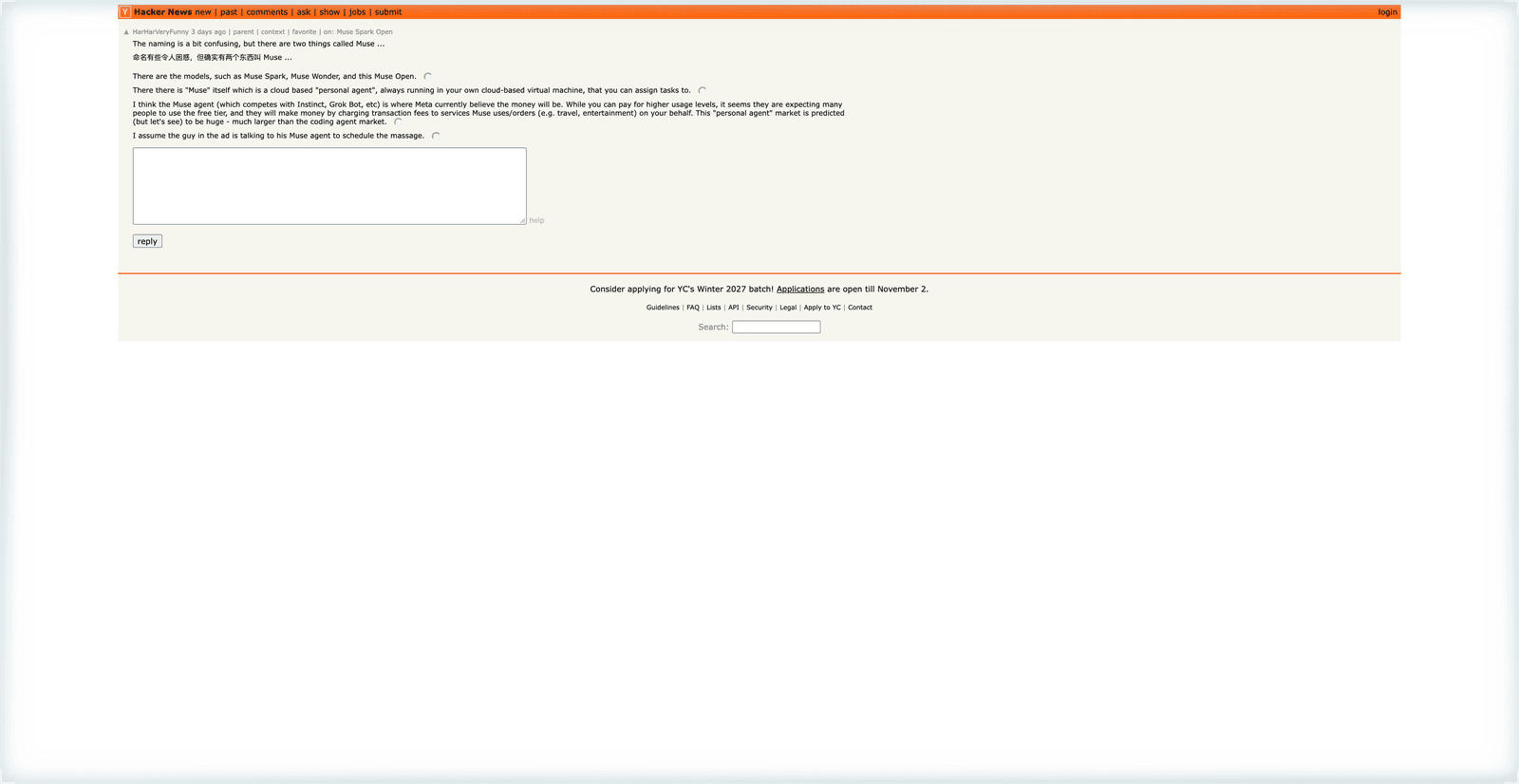
The Muse naming is genuinely confusing, and the community said so on day one: "The naming is a bit confusing, but there are two things called Muse... There are the models, such as Muse Spark, Muse Wonder, and this Muse Open. There there is 'Muse' itself which is a cloud based 'personal agent'." (HN)
The clean version:
Muse Spark is the hosted model line that debuted on April 8, 2026 — Meta's first proprietary model family after the Llama era. Versions 1.1 (July), 1.2, and 1.3 (September) stayed closed and are served through Meta's API and Muse Code at $1.25/M input and $4.25/M output.
Muse Wonder, released October 12, 2026, is the closed flagship above Spark, listed at $4/M input and $20/M output. Meta itself does not claim Spark Open beats Wonder.
Muse Spark Open is what this article covers: the downloadable sibling of the Spark line, same 1M context and multimodal input, released under a custom license.
The Muse app is a consumer agent product, unrelated to the weights.
Benchmarks: fast, concise, and pricey for open weights
Artificial Analysis's independent page for Muse Spark Open (xhigh reasoning setting), checked on October 19, 2026:
| Metric | Muse Spark Open | Reading |
|---|---|---|
| Intelligence Index | 39 (rank ~10 of 120 in its open-weight class; class median 19) | Above class median, below the leading Chinese open models |
| Output speed | 142.2 tokens/s (median across providers) | Notably fast for its class (class median ~78) |
| Time to first token | 0.81 s | Competitive |
| List price | $1.25/M in, $4.25/M out, 88% cache discount | "At the higher end" for open weights |
| Cost per Intelligence Index task | ~$0.84 | Strong, thanks to concise output |
| Verbosity | 110M output tokens across the Index | Fairly concise (class median ~130M) |
AA's own summary is worth quoting: "amongst the leading models in intelligence, but particularly expensive when comparing to other open weight models of similar size. It's also notably fast and fairly concise." Two calibration notes. First, the Index (v4.3.2) mixes ten evaluations including agentic and long-context suites, so 39 is not a single-exam score. Second, the price figures are provider medians, not Meta list price — Meta's own API does not host the Open weights variant. If you are choosing a model for agentic browsing and coding workflows, pair this with our agentic browsing guide rather than a single leaderboard number.
The license is not open source
"Open weight" is doing a lot of work in the headlines. You can download Muse Spark Open, fine-tune it, distill it, and ship it inside commercial products. But the Muse Model License is a custom license, not an OSI-approved one, and its conditions are stricter than Apache 2.0 or MIT:
Attribution, always. Every product that uses the model or a derivative must display "Built with Muse Spark Open" in the interface, documentation, website, or settings. There is no revenue floor for this clause.
Model-as-a-Service gate. If you and your affiliates exceed $20 million in aggregate gross revenue in any consecutive 12-month period and you offer the model to third parties through an API or similar interface, you must notify Meta and sign a separate written agreement first. Internal use, research, and features inside your own product are explicitly outside this clause.
Acceptable Use Policy. The license bundles an AUP that bans weapons development, malware, operating critical infrastructure, fraud, disinformation, and impersonation, and the model is not intended for users under 18.
Outputs. Meta claims no rights over what the model generates — the one clause cleaner than classic open source.
Download friction. Downloading the weights from Hugging Face requires agreeing to identity fields including legal name, date of birth, and company details — a registration gate, not a click-through.
If you want a genuinely permissive open-weight model in this class, GLM 5.3's MIT-style license is the comparison point; we cover that in the comparison section below.
How to get it
Hosted API (no hardware): Baseten, Fireworks AI, Groq, Modal, Nebius, and Together AI serve it directly; OpenRouter lists it as a gateway route. Day-one pricing across providers is about $1.25/M input, $4.25/M output, and roughly $0.15/M cache reads — the same rates as the hosted Muse Spark 1.2, which suggests Meta set the anchor and providers matched it.
Self-host on GPUs: Download BF16 (~1.65 TB) for eight-GPU nodes, or NVFP4 (~537 GB) for a single 4-GPU Blackwell node. Meta ships custom auto-tunable Helion kernels in SGLang reporting 1.03–3.95× kernel-level speedups on NVIDIA and AMD, plus a 3% end-to-end speedup on AMD MI350. vLLM, TensorRT-LLM, llama.cpp, and Unsloth are also supported day one.
Self-host on Mac: Two M5 Ultra Mac Studios with 512 GB each via MLX, pulling weights straight from Hugging Face. Apple Research separately documented a four-Mac cluster exceeding 36 tok/s.
Cloud catalogs: Amazon SageMaker AI, Google Cloud Model Garden, and Microsoft Foundry Models carry the weights for teams that want managed infrastructure.
The deployment breadth is genuinely unusual for an open-weight launch, and the community noticed: "They did the actual work of testing and documenting deployments on several platforms. It's a bit of upping the standard for open weights instead of just posting the blob and letting the community figure it out." (HN)
How it compares with GLM 5.3 and Kimi K3
The "US open-weight champion" framing only means something against the Chinese open models that have owned this leaderboard all year. Same-yardstick figures (Artificial Analysis data as compiled on October 16, 2026; verify before budgeting):
| Dimension | Muse Spark Open | GLM 5.3 | Kimi K3 |
|---|---|---|---|
| Vendor | Meta (US) | Z.ai (China) | Moonshot AI (China) |
| Parameters | 816B total / 42B active | 753B / 40B | 2.8T / 104B |
| Input | Text, image, audio, video | Text | Text, image |
| Intelligence Index | 39 | 45 | 44 |
| Output speed | 142 tok/s | 67 tok/s | 43 tok/s |
| Cost per Index task | $0.84 | $2.01 | $2.00 |
| API price ($/M in/out) | $1.25 / $4.25 | $1.40 / $4.40 | $3.00 / $15.00 |
| License | Muse Model License (label + $20M MaaS gate) | MIT-style (conditions near $10B scale) | Custom (similar $20M MaaS gate) |
| The main catch | Terabyte-class memory to self-host; mandatory label | Text-only input | Highest list price of the three |
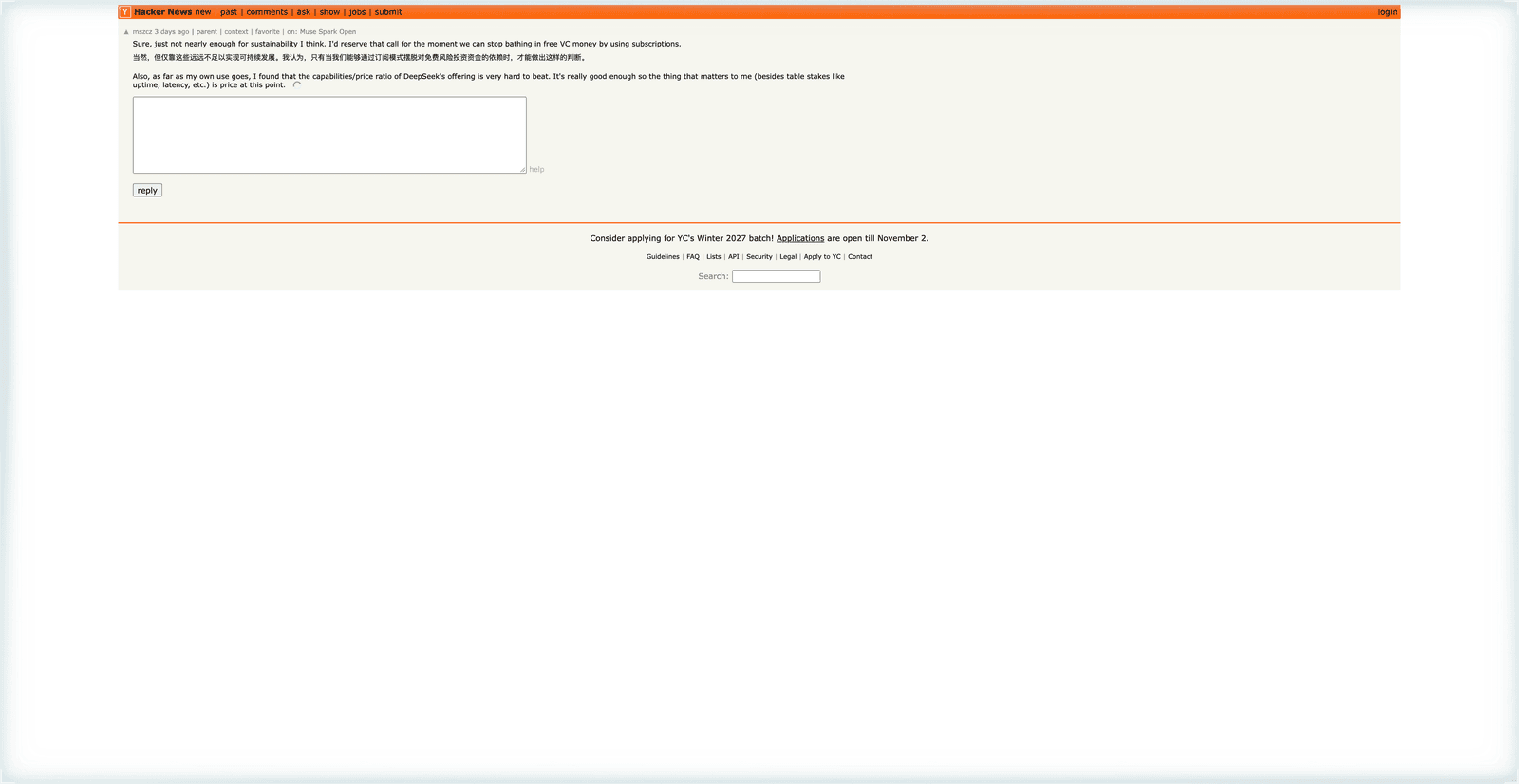
The trade-off is clear. Muse Spark Open trails both rivals on the Intelligence Index but undercuts them heavily on cost per finished task — it writes less to get the job done — and it is the only one with native audio and video input. One HN commenter's framing matches the data: "the capabilities/price ratio of DeepSeek's offering is very hard to beat... the thing that matters to me (besides table stakes like uptime, latency, etc.) is price at this point." (HN)
If raw Index rank is your criterion, this is not the leader; if cost per accepted task with multimodal input matters more, it competes.
For broader context on how model choice interacts with the tool layer, see our takes on Qwen3.8 Max, MiniMax M3, and LongCat 2.0 — each made a different bet in the same open-weight race.
What people are saying
The Hacker News launch thread (917 points, roughly 478 comments as of October 19) mixed enthusiasm with hardware skepticism:
"I love seeing major ai labs release open-weight models. really hope we'll see more of this from openai and eventually anthropic too." — shinokami
"I was mistaken in my thinking that open models are able to be quantized to run on average consumer hardware, I think they have outgrown that concept." — twitexplore
"Anyone who has tried a smaller/quantized version locally on apple silicon? Would love to know your experience, also tk/s on what hardware specs?" — nico. As of this writing, the thread still has more questions than first-hand local reports — treat any performance claim without hardware details as unverified.
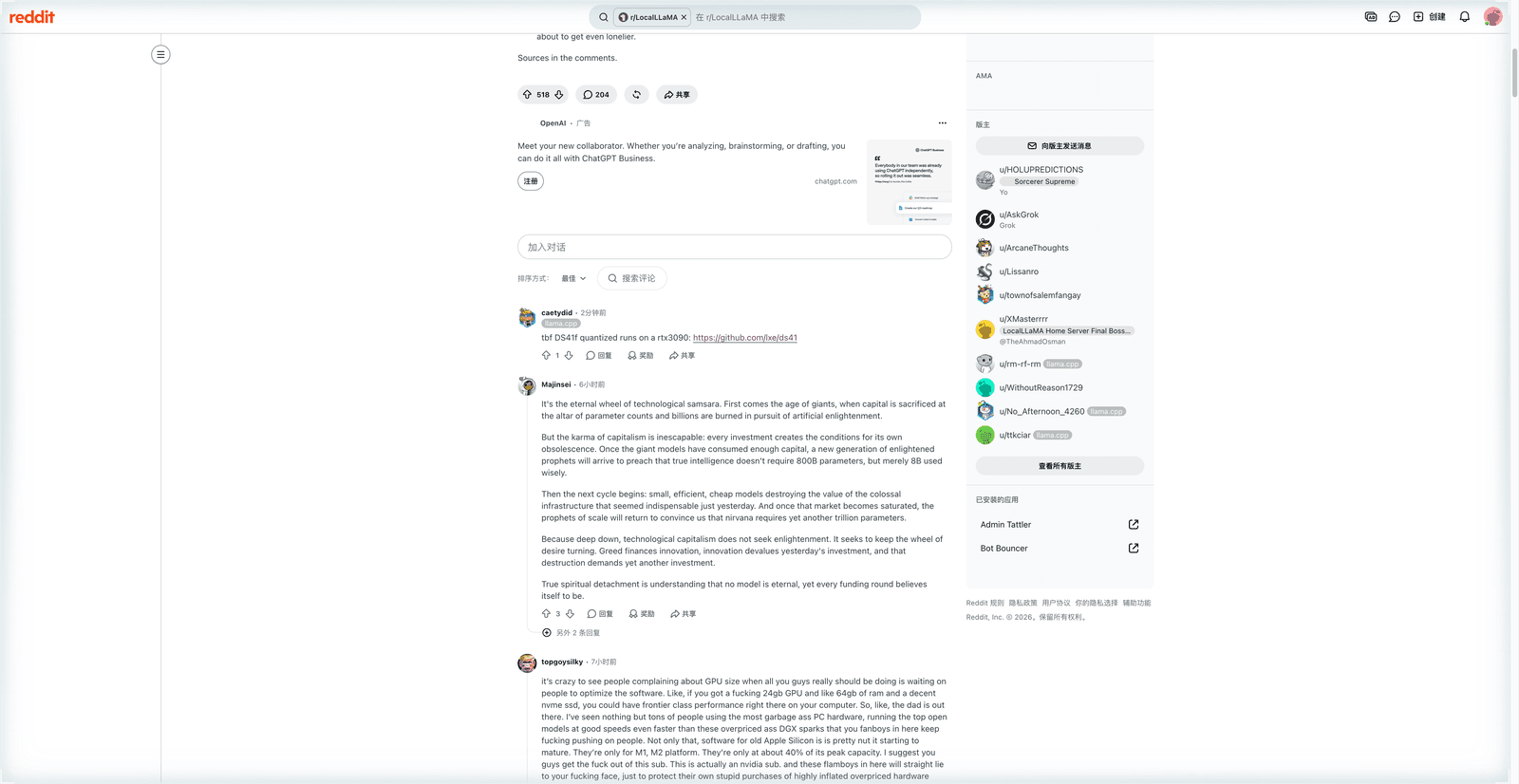
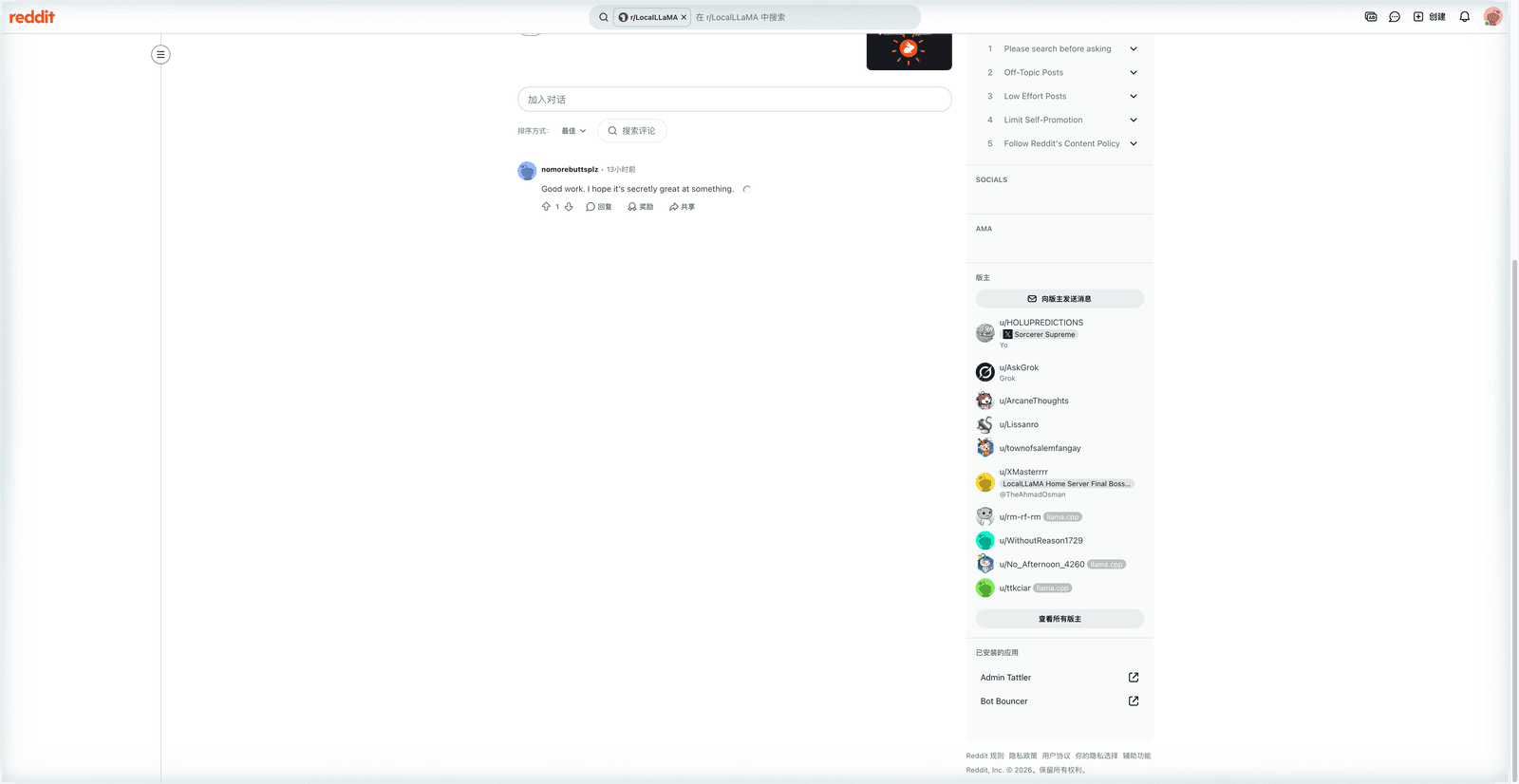
Reddit's r/LocalLLaMA began filling that gap within days. One user running the model on a single Mac Studio reported hitting 18 t/s decode — "This is text only. Output is coherent and toolcalls solid." (r/LocalLLaMA) A separate cross-model thread of the same week put the hardware reality bluntly: "'Runs locally' now officially means 'runs on a computer that costs more than a car.'" (r/LocalLLaMA)
A third route: use it through a product, not a server room
Here is the decision most readers actually face. You do not have $22k–$40k of Mac Studios on your desk, and you do not want to run eight datacenter GPUs. But your work — research, coding, browser tasks — could still use a frontier-class open model with a 1M context. That is the gap hosted APIs and AI-native clients fill.
This is where a browser like Tabbit Browser fits. The practical pattern for a model like Muse Spark Open is not self-hosting; it is picking it (or a comparable agentic model) in a client that already holds your context — the page in front of you, a tab group, a file — and putting it to work through agentic browsing or browser automation instead of rebuilding every task in a standalone chat.
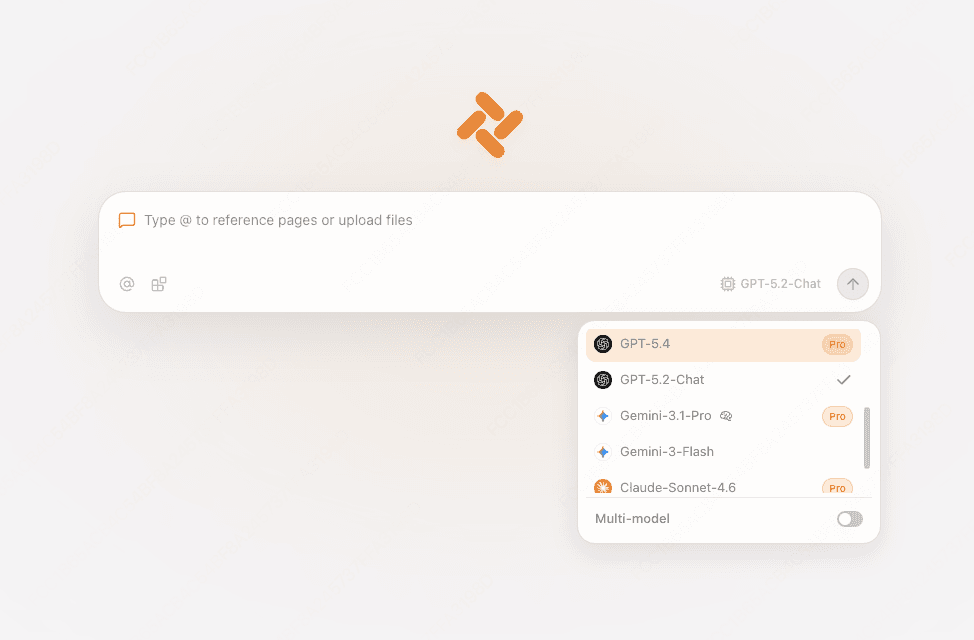
Two honest boundaries. First, we have not confirmed Muse Spark Open in Tabbit's live model picker; the model is three days old, and availability changes fast, so check the picker before planning around it. If you want a model already proven in this workflow, the GLM-5.2 route and the multimodal GLM-5.3-Flash story are working examples of the same pattern. Second, self-hosting still wins on data control and unit cost at scale — the third route trades those for zero hardware and zero ops. For a deeper look at the client landscape, see our AI browser comparison.
 Tabbit Browser
Verdict
Muse Spark Open is a credible, well-engineered open-weight release whose headline hides a binary decision. If you can afford the terabyte, you get a fast, concise, multimodal agentic model with documented runs on MLX, SGLang, and vLLM, under a license that is commercial-friendly for everyone except large-scale MaaS resellers. If you cannot — and almost no individual can yet — the honest answer is the $1.25/$4.25 hosted route, where it competes with GLM 5.3 and Kimi K3 on cost per task rather than raw Index rank.
| Your situation | First move |
|---|---|
| Individual developer, no big hardware | Try the hosted API at the $1.25/$4.25 rate on one fixed coding or research task; compare accepted output against GLM 5.3 before migrating |
| Team needing data control | Price a 4-GPU Blackwell NVFP4 node or Mac Studio pair against one year of API spend at your real volume |
| Product builder | Ship with the "Built with Muse Spark Open" label planned from day one; if you will exceed the $20M MaaS line, talk to Meta early |
| Browser/agent workflow user | Use it (or a comparable agentic model) through a client that already holds your page context — see the third route above |
| Benchmark chaser | Wait for broader independent replication; one AA snapshot and a launch-week HN thread are not a consensus |
One number to remember: 42 billion active parameters is why this model feels fast and affordable per task. 816 billion total is why it will not fit on your desk.
Sources
Meta research blog: Introducing Muse Spark Open (2026-10-15)
Meta developer docs: Muse Spark Open (checked 2026-10-19)
Artificial Analysis: Muse Spark Open (Xhigh) (checked 2026-10-19)
Hacker News launch thread and linked comment pages (checked 2026-10-19)
TechRepublic: Meta unveils Muse Spark Open (2026-10-16)
TrendingTopics: Meta's Muse Spark Open comes with strings attached (2026-10-16)
Flavio Copes: what you can run, and what it takes (2026-10-16)
Muse Spark Open vs GLM 5.3 vs Kimi K3 comparison (2026-10-16, AA data compilation)

FAQ
What is Muse Spark Open?
Muse Spark Open is the open-weight release of Meta's Muse Spark, launched on October 15, 2026 by Meta Superintelligence Labs. It is a sparse mixture-of-experts model with 816B total parameters and 42B active per token, a 1,048,576-token context window, and native text, image, audio, and video input with text output. Meta positions it for coding and agentic work and calls it the most capable US open-weight model to date.
Is Muse Spark Open open source?
No. The weights are downloadable, but they ship under Meta's custom Muse Model License, not an OSI-approved license. Commercial use, fine-tuning, and redistribution are allowed, but products must display a 'Built with Muse Spark Open' notice, and anyone offering the model as a service with more than $20 million in aggregate revenue over 12 consecutive months must notify Meta and sign a separate agreement.
What hardware do I need to run Muse Spark Open locally?
The full model needs roughly a terabyte of memory. Meta and Apple tuned it for two M5 Ultra Mac Studios with 512 GB of unified memory each running MLX; the BF16 checkpoint is about 1.65 TB and serves on eight datacenter GPUs, while the 537 GB NVFP4 checkpoint fits a single 4-GPU NVIDIA Blackwell node. Budget roughly 2 TB of VRAM for BF16 serving once the key-value cache is included.
How much does Muse Spark Open cost via API?
Day-one hosted pricing across providers such as Together AI, Fireworks, Baseten, Modal, and OpenRouter is about $1.25 per million input tokens and $4.25 per million output tokens, with roughly $0.15 per million for cache reads. Artificial Analysis measured a median of 142 output tokens per second and about $0.84 per Intelligence Index task as of October 19, 2026.
How does Muse Spark Open compare with GLM 5.3 and Kimi K3?
On Artificial Analysis data, Muse Spark Open scores 39 on the Intelligence Index versus 45 for GLM 5.3 and 44 for Kimi K3, but it generates output faster and finished the Index at about $0.84 per task versus roughly $2.00 for both rivals. Its trade-offs are a stricter license with a mandatory product label, a registration-gated download, and the largest self-hosting footprint of the three.
Is Muse Spark Open the same as Muse Wonder or the Muse app?
No. Muse Wonder is Meta's more capable closed model, released October 12, 2026, listed at $4 input and $20 output per million tokens. The Muse app is a separate cloud-based personal agent product. Muse Spark Open is the downloadable sibling of the hosted Muse Spark line that debuted in April 2026.