
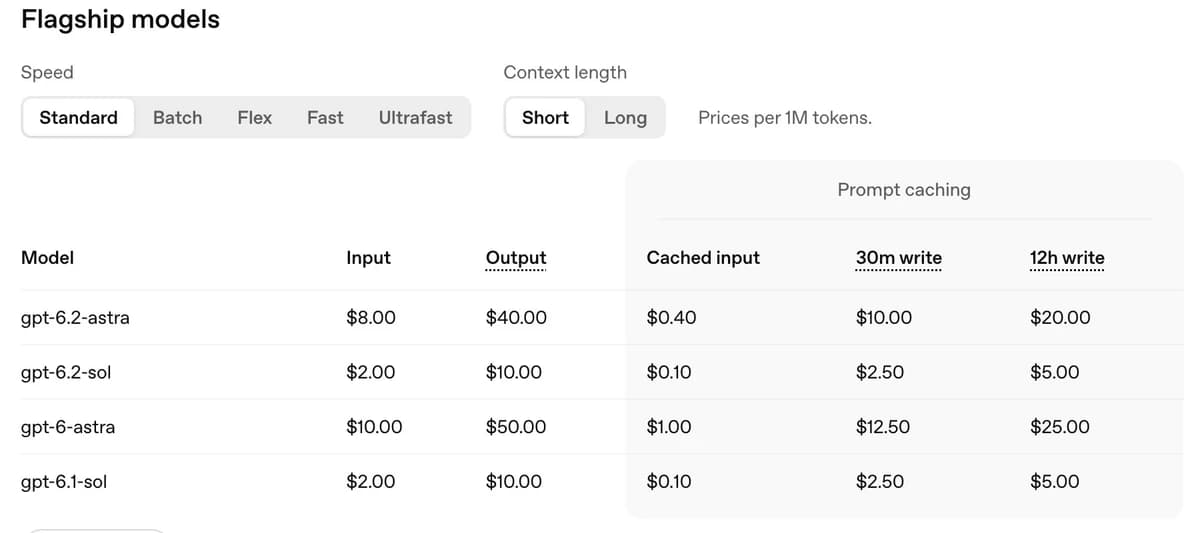
GPT-6.2 Astra costs $8 per million uncached input tokens, $0.40 per million cached input tokens and $40 per million output tokens on OpenAI’s Standard API, for requests with up to 272,000 input tokens. Cache writes cost $10 per million tokens for 30-minute retention and $20 for 12-hour retention. OpenAI released the model as gpt-6.2-astra on November 17, 2026. Rates below were checked November 19. OpenAI pricing · Launch announcement
272,000 input tokens is the number to watch. Above it, the higher rates apply to the whole request. With 3,000 billed output tokens and all input uncached, moving from 272,000 to 273,000 input tokens takes the Standard estimate from $2.296 to $4.548. Check several late turns of a long session before budgeting from its first turn. GPT-6.2 Astra model documentation
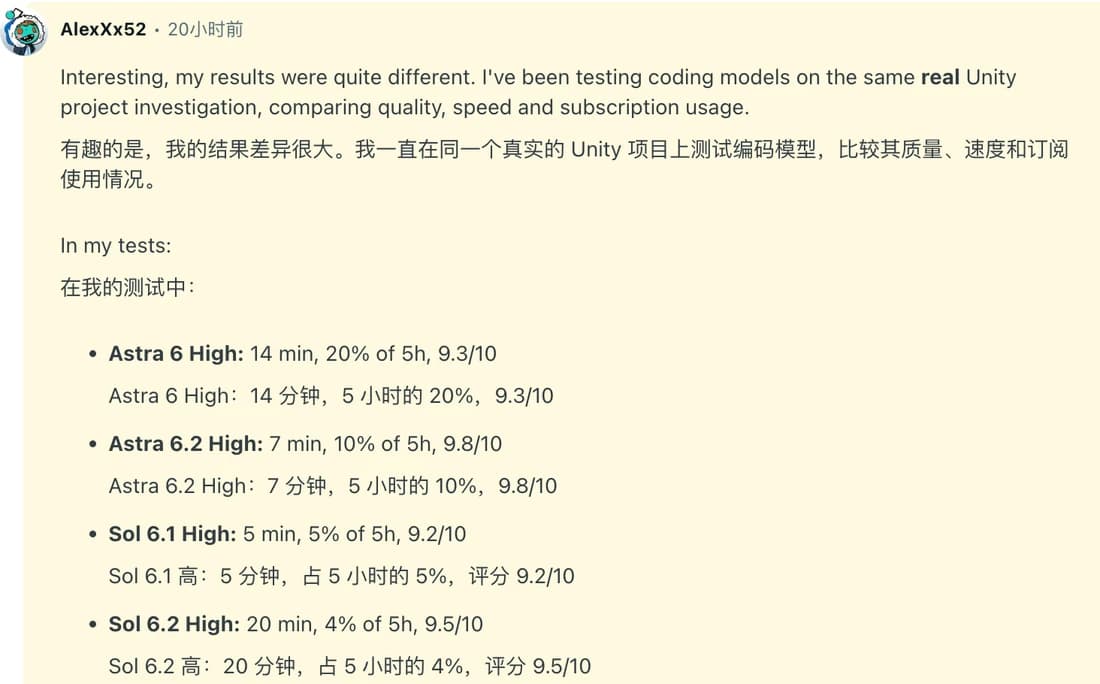
One r/codex user tracked a Pro 200 subscription and still had questions about how the product counted their allowance across Codex and ChatGPT. Keep subscription usage and API estimates in separate columns when you compare the two. r/codex discussion
Key takeaways
Short-context Standard input and output fell 20% from GPT-6 Astra. Cache reads fell 60%.
A long request can double your input and cache rates and raise the output rate by 50%. The model accepts up to 922,000 input tokens, well above the pricing threshold.
Batch lists half the Standard token rates. Fast doubles them. Ultrafast rises from 3× to 6× on March 1, 2027, Pacific time.
GPT-6.2 Sol costs one quarter as much per short-context Standard token. Use the same acceptance criteria and add the billed usage of every attempt when comparing the two.
GPT-6.2 Astra API rates at a glance
| OpenAI API rate, USD per 1M tokens | Uncached input | Cache read | 30-minute write | 12-hour write | Output |
|---|---|---|---|---|---|
| Standard, ≤272,000 input | $8 | $0.40 | $10 | $20 | $40 |
| Standard, >272,000 input | $16 | $0.80 | $20 | $40 | $60 |
| Batch, short context | $4 | $0.20 | $5 | $10 | $20 |
| Fast, short context | $16 | $0.80 | $20 | $40 | $80 |
| Ultrafast, short context through Feb 28, 2027 PT | $24 | $1.20 | $30 | $60 | $120 |
| Ultrafast, short context from Mar 1, 2027 PT | $48 | $2.40 | $60 | $120 | $240 |
For eligible Responses API background jobs, OpenAI lists rates 30% below Standard for the two-hour completion window and 40% below Standard for the eight-hour window. The pricing page lists Flex for GPT-6 Astra and omits GPT-6.2 Astra. Regional data residency and FedRAMP endpoints carry a 10% uplift under OpenAI’s published terms. Check your endpoint’s rate card before applying a discount or a premium. OpenAI API pricing
What changes above 272,000 input tokens
Use the sum of uncached input, cache reads and cache writes to choose the context band. A 300,000-token request with 250,000 cached tokens still crosses the threshold. The 1,050,000-token context window includes space for output, with an input maximum of 922,000 and an output maximum of 128,000. Those capacity limits and the price threshold govern different decisions. See the GPT-6.2 Astra model guide and official model specifications.
A conversation can cross the threshold after several turns as prior messages and tool results accumulate. Trim source material to the passages that matter. For jobs that require comparing evidence across the full source, run a small test before splitting it. A cheaper chunked run can produce a more expensive result if it needs another pass to recover context. The guide to reducing browser agent token usage explains which parts of browser workflows are worth measuring.
GPT-6.2 Astra vs GPT-6.2 Sol and GPT-6 Astra
| Standard, up to 272,000 input | Input | Read | 30-minute write | 12-hour write | Output |
|---|---|---|---|---|---|
| GPT-6.2 Astra | $8 | $0.40 | $10 | $20 | $40 |
| GPT-6.2 Sol | $2 | $0.10 | $2.50 | $5 | $10 |
| GPT-6 Astra | $10 | $1 | $12.50 | $25 | $50 |
| GPT-6.1 Sol | $2 | $0.10 | $2.50 | $5 | $10 |
OpenAI reported that Astra 6.2 scored 5.2 points higher than GPT-6 Astra at less than a third of the cost on Agents’ Last Exam. That figure describes OpenAI’s benchmark setup and estimated API costs. For your own test, log response usage, service tier and attempts across the same tasks. Calculate cost per accepted result as total spend divided by the number of tasks that pass. The GPT-6.2 Astra evaluations and the previous Astra review document other test setups. OpenAI launch evaluation
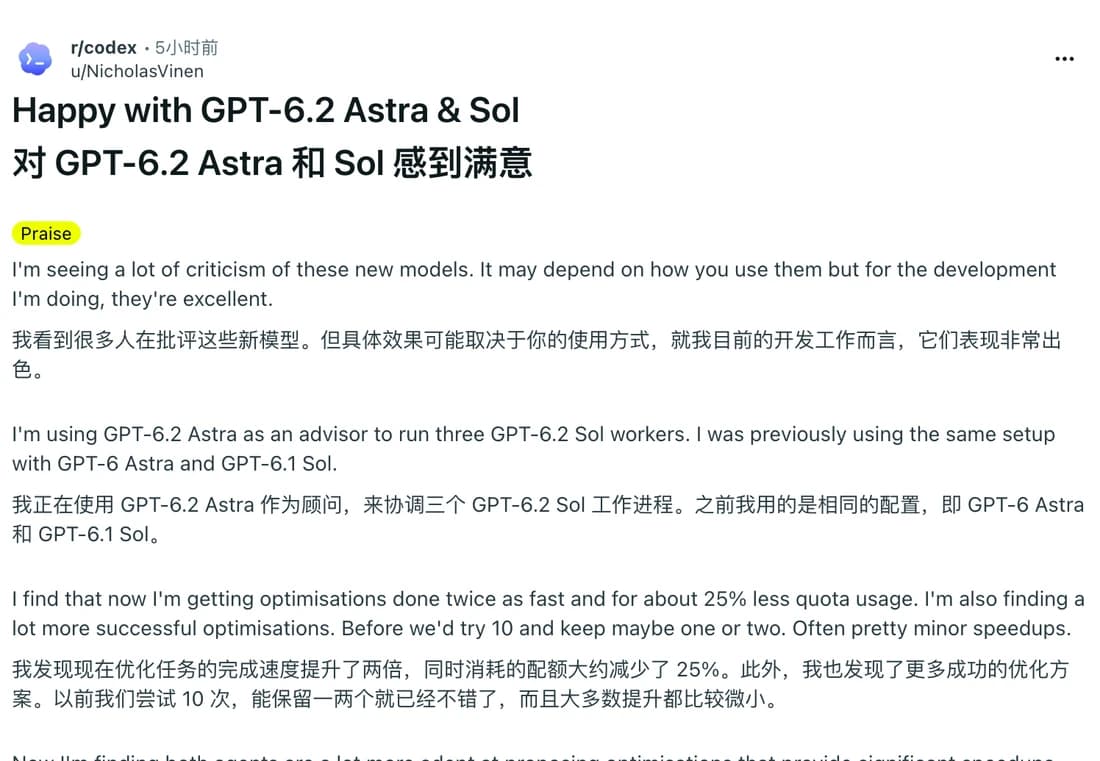
NicholasVinen described using Astra as an adviser to three Sol workers for software optimization and reported less use of their subscription quota than with the prior models. That is one developer’s workflow. An adviser that calls three workers still creates four sets of usage to count on an API deployment. r/codex post
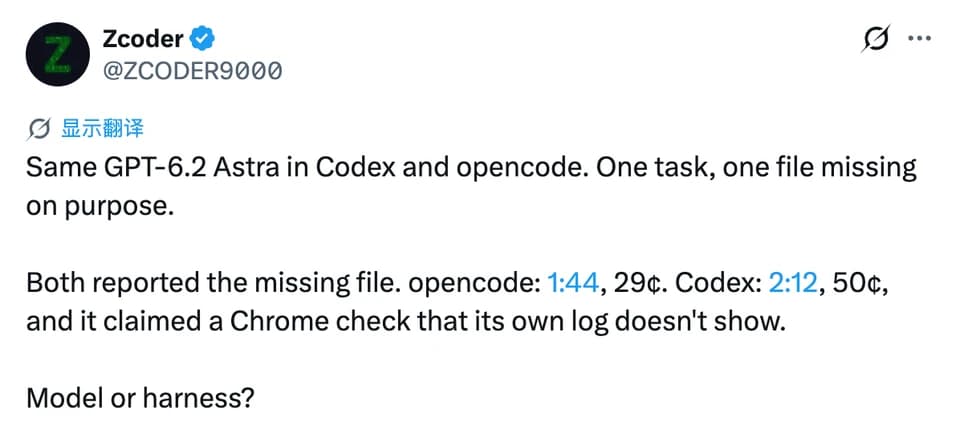
Zcoder tried the same Astra task in Codex and OpenCode with one file deliberately missing. The two clients both flagged it, and the author reported different times and costs. That single run is a reason to track the whole client workflow when comparing models. Original post on X
Estimate the bill with two worked examples
A long review near the price threshold
At 272,000 uncached input tokens and 3,000 billed output tokens, Standard costs (272,000 × 8 + 3,000 × 40) / 1,000,000 = $2.296. At 273,000 input tokens, the same output costs (273,000 × 16 + 3,000 × 60) / 1,000,000 = $4.548. At 100 identical requests, that is $229.60 versus $454.80, before tools and other charges.
Check billed output on both runs. If the response has 1,000 visible tokens and 2,000 reasoning tokens, it has 3,000 output tokens for the estimate. Astra rejects reasoning.effort: none. Start with a supported effort level that passes your checks, then raise it for tasks that need it. Each extra 1,000 billed output tokens adds $0.04 on short-context Standard or $0.06 above the threshold. Model specifications · OpenAI reasoning guide
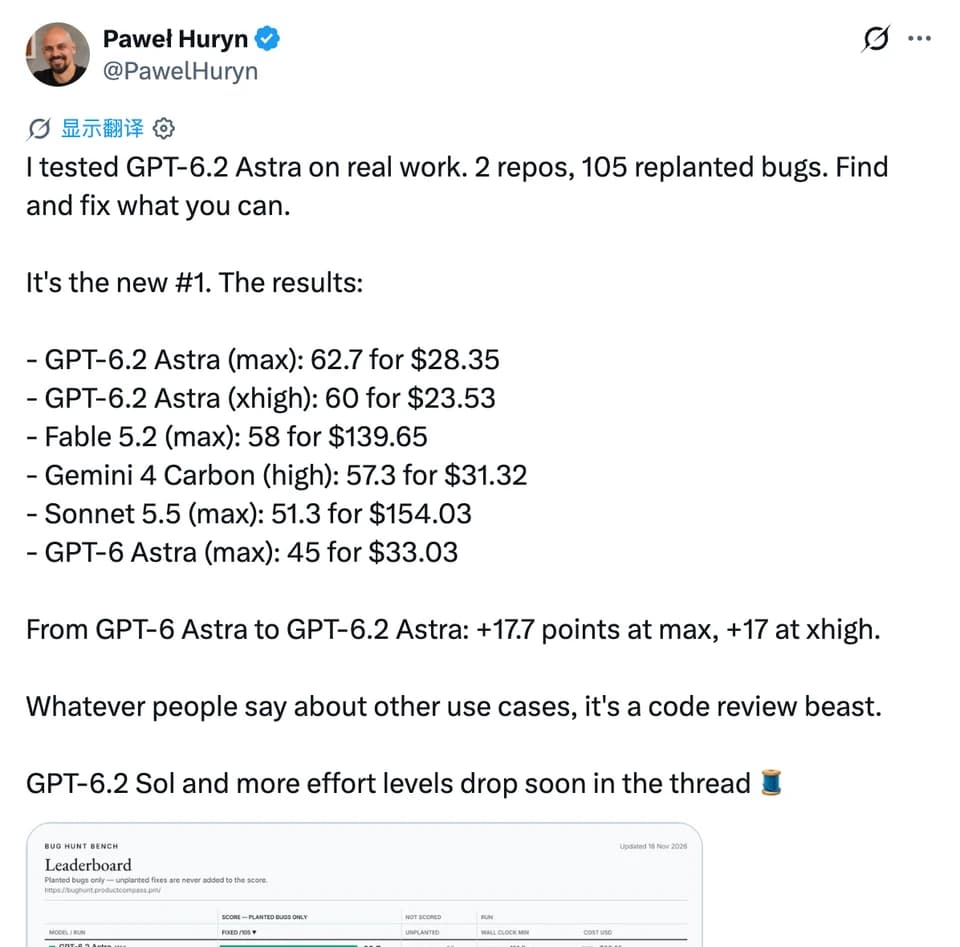
Paweł Huryn reported $28.35 at max effort and $23.53 at xhigh on his two-repository code review test, with a higher score at max. Those figures describe his setup. Use your own pass criteria to decide whether higher effort earns its cost. Original post on X
A repeated document request with cache writes
Suppose one request has 180,000 input tokens. It reads 150,000 from cache, writes 10,000 at the 30-minute rate, and processes 20,000 as ordinary uncached input. With 3,000 billed output tokens, that is $0.44 on Standard: $0.06 for reads, $0.10 for writes, $0.16 for uncached input and $0.12 for output. At 1,000 such requests, it is $440. The same token split with 12-hour writes would cost $0.54 per request.
OpenAI reports billed reads and cache-write token counts separately. Each input token goes in one bucket. Subtract billed reads and both types of writes from total input to get ordinary uncached input. When a long-lived prefix is worth keeping, copy its exact content and place request-specific material at the end. Sample the beginning of the session and calls after idle gaps to capture new writes as well as hits. The Astra prompt collection includes API setup examples. OpenAI prompt caching guide
Local calculator
Estimate GPT-6.2 Astra API costs
Standard API prices in USD. Enter per-request usage. The calculation runs in your browser.
Include reasoning in output. This estimate excludes cache writes, tools, retries, taxes and subscriptions. OpenAI API pricing
The calculator estimates Standard charges for ordinary input, cache reads and billed output. Use the write rates in the table to budget a session that writes to the cache. For a monthly estimate across changing request sizes, estimate each group of similar calls and add the subtotals. An average input length can hide calls above the price threshold.
What else shows up on the bill
A cache read bills at its read rate without a duplicate uncached input charge. A token written to the cache bills at the applicable write rate. OpenAI’s caching guide says a read can refresh 30-minute coverage without a new write charge. Upgrading matching 30-minute coverage to 12 hours can create a billable 12-hour write. OpenAI prompt caching guide
The examples cover model tokens. Hosted tools can carry separate charges and may add input tokens when results return to the model. Budget for each paid attempt in a workflow, plus any tools, service tier premiums, third-party provider charges and taxes that apply. Tool availability and billing depend on the endpoint. OpenAI API tools pricing
OpenAI announced Astra access in ChatGPT Work and Codex for Plus, Pro, Enterprise and Edu. Work and Codex share an allowance under the applicable subscription terms, with credit billing where available. OpenAI lists Astra Ultrafast for Pro 500 and eligible managed workspaces. Pro 200’s Ultrafast rollout started with Sol. For a subscription decision, check your account’s usage view and plan terms. For an API budget, start with token usage and the selected endpoint. OpenAI Work and Codex usage · Launch announcement
Use GPT-6.2 Astra in Tabbit Browser
If your task starts with several open tabs, pick one document and one question with an answer you can check. In Tabbit Browser, open the document and use Chat with Page to extract an answer and the supporting passage. Check the quote against the page before trying the same question with more sources. Use the workflow for organizing model research to keep your prompts and evidence together.
Select GPT-6.2 Astra in Tabbit. This workflow checks the answer against sources in the browser. Use the OpenAI API and its usage data when you need to measure token spend.
 Tabbit Browser
Which route should you budget for?
| Workload | Starting point | What to check |
|---|---|---|
| Repeated short transformations | GPT-6.2 Sol on Standard | Use Astra when it improves the number of accepted results enough to justify the added spend. |
| Hard reviews and coding tasks | GPT-6.2 Astra on Standard | Log retries, reasoning tokens and the largest request in the session. |
| Jobs that can wait | Batch or eligible background processing | Choose by deadline and endpoint support, then compare the effective rates. |
| Latency-sensitive interactive work | Standard first, then measure Fast or Ultrafast | Compare actual completion time against the higher rate and model availability. |
Start with Standard for the cases that need Astra and test cheaper routing on the rest. The GPT-6.1 Terra price guide gives another baseline when you are comparing tool-heavy tasks. Before signing off on a monthly estimate, run one representative task long enough to see the largest prompt. That is the request most likely to expose the 272,000-token price change.

FAQ
How much does GPT-6.2 Astra cost on the OpenAI API?
For up to 272,000 input tokens, OpenAI Standard charges $8 per million uncached input tokens, $0.40 per million cache reads and $40 per million output tokens. Cache writes cost $10 per million for 30 minutes or $20 per million for 12 hours.
What happens above 272,000 input tokens?
The entire request moves to long-context rates. On Standard, uncached input rises to $16 per million, cached input to $0.80, 30-minute writes to $20, 12-hour writes to $40 and output to $60.
Are reasoning tokens included in GPT-6.2 Astra output charges?
Yes. Include billed reasoning tokens along with visible output when estimating costs. Use the API response's total output token count if it already includes the reasoning tokens.
Is GPT-6.2 Astra available in ChatGPT Plus?
OpenAI announced Standard access in ChatGPT Work and Codex for Plus, Pro, Enterprise and Edu. Eligible workspace administrators may need to enable access. Work and Codex use the applicable shared usage allowance and credit terms.
Is GPT-6.2 Astra more expensive than GPT-6.2 Sol?
Astra costs four times as much as Sol for the same short-context Standard token mix, including cache reads and writes. Compare cost per accepted task before routing a workload, since token usage and retries can differ.
Which GPT-6.2 Astra service tier is cheapest?
Batch lists half the Standard token rates. Eligible Responses API background work lists a 30% discount with the two-hour window or 40% with the eight-hour window. Check which option supports your job and meets its deadline.