
MiniMax M3.1 Flash costs $0.15 per million new input tokens, $0.015 per million cached input tokens and $0.60 per million output tokens, according to the official rate card, checked October 21, 2026. Those rates price API usage. M Plan subscriptions, a provider's free launch offer and Tabbit Browser access are separate purchasing decisions.
The number to budget around is $0.015 for cached input. It is 90% below Flash's new-input rate and 75% below M3's standard cache-read rate. That can change the economics of an agent that repeatedly reads the same context. It does not mean every completed task costs 90% less. One developer discussion makes the practical point: cheaper cache reads can coexist with more output tokens. Later, we explain how to check access in Tabbit before treating it as an execution option.
Rate card at a glance
All values below are USD per million tokens from the same MiniMax pricing page. The M3 comparison uses its Standard tier, not Priority or a reseller's discounted route.
| Billing item | M3.1 Flash | M3 Standard, input up to 512K | Change versus that M3 row |
|---|---|---|---|
| New input | $0.15 | $0.30 | 50% lower |
| Cached input | $0.015 | $0.06 | 75% lower |
| Output | $0.60 | $1.20 | 50% lower |
| Input above 512K | Same flat Flash rates | $0.60 input / $0.12 cache / $2.40 output | Flash is 75% / 87.5% / 75% lower |
Flash's input and output rates are half M3's short-input rates. Its cached-input rate falls further. For M3, crossing 512K input tokens changes the applicable row, rather than merely billing the excess at a higher rate. Check the precise input count of each request; accumulated input across a session is not the threshold measurement.
Token counts are not character counts. MiniMax describes approximately 750 English words per 1,000 tokens as an estimate, with actual consumption varying by scenario. We found no verified tokenizer-change percentage to apply to Flash, so the examples use measured or assumed tokens explicitly, rather than inventing a text-to-token adjustment.
Key takeaways
Cache hits cost one tenth of new Flash input; a high hit rate matters most when output stays controlled.
The vendor's 70% task-cost reduction is a workload claim, distinct from the 50% reduction in input and output rates.
The direct API defaults to
maxeffort. Thinking remains enabled at lower effort settings.Server-side web search costs $0.01 per request in addition to model tokens.
OpenRouter's free launch period has an explicit end time. Plan production budgets using paid rates.
The one number that changes agent budgets: $0.015
MiniMax's caching documentation describes automatic prefix caching for requests with at least 512 input tokens. The matching order is tools, system prompts, then user messages. Put stable instructions and reusable reference content first; put changing task details later. A large context window alone does not produce cache hits.
Suppose an agent reads a 100,000-token prefix on 40 calls. If the first call is all new input and the next 39 are entirely cache hits, that input costs $0.015 + 39 × $0.0015 = $0.0735. Without cache hits, the same four million input tokens cost $0.60. This is an illustrative upper-hit scenario, not an observed cache guarantee. Growing histories and changed prefixes raise the cost.
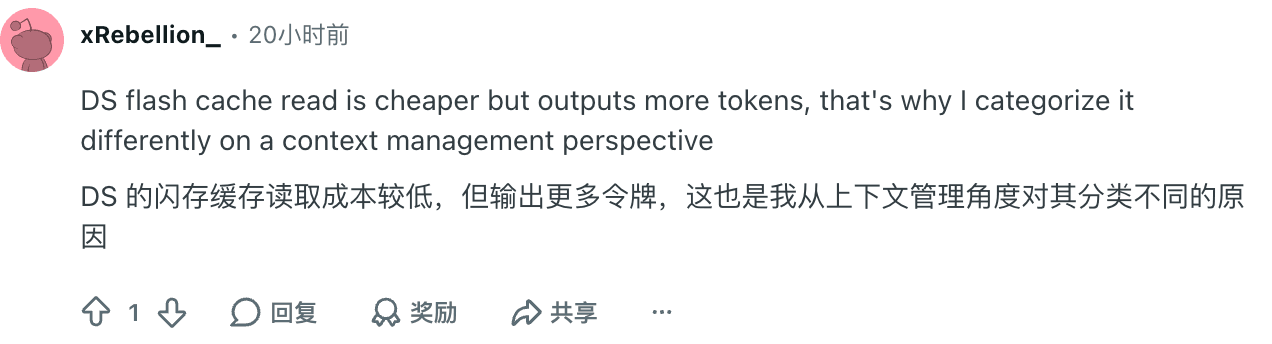
Read the original comment. Its point is useful for purchasing: compare the total generated tokens on the same task before choosing a model by cache price.
One accounting detail prevents double charging in your own spreadsheet. In the Anthropic-compatible response, usage.input_tokens means new input; add usage.cache_read_input_tokens at the cache rate. In the OpenAI-compatible response, usage.prompt_tokens already includes cached input; subtract usage.prompt_tokens_details.cached_tokens before applying the new-input rate. The official cache guide documents both conventions.
What the 70% savings claim actually tells you
The October 19 launch post says agentic-task usage costs are 70% lower than the predecessor. That is the vendor's aggregate task-cost claim. The rate card independently establishes 50% lower new-input and output rates than short-input M3, and 75% lower cache reads. These statements describe different quantities.
To reproduce 70% savings on your work, hold the task, success criteria, harness and retry policy constant. Record new input, cached input, billable output, tool requests and the number of successful completions. A task that becomes cheaper per attempt can still become more expensive per accepted result if it needs more attempts. This article has not run a seven-day production comparison and does not present the vendor percentage as a measured Tabbit saving.
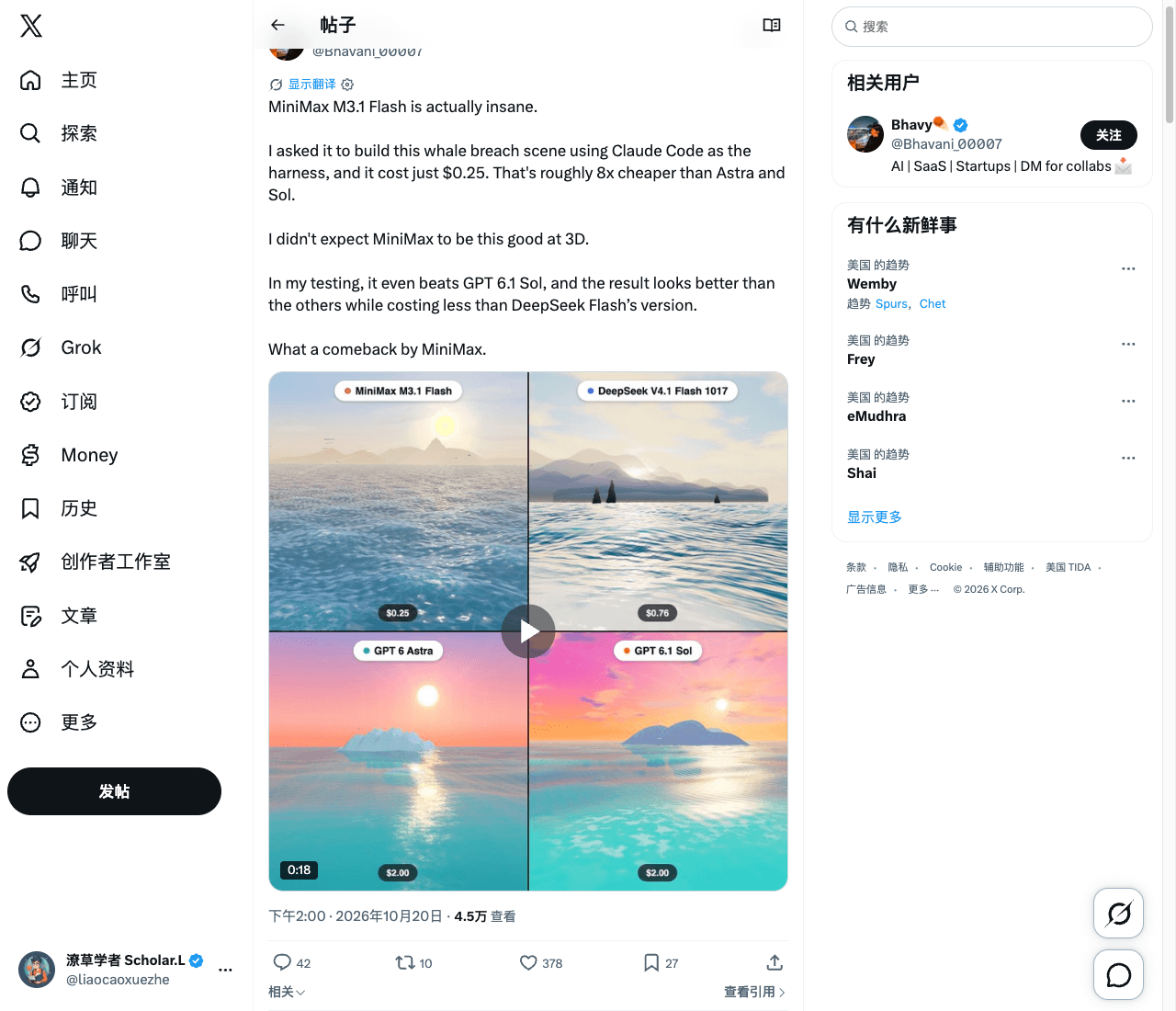
A positive example comes from Bhavy on X, who reports spending $0.25 on a whale animation built through Claude Code. That is a concrete task report, but the post does not provide a complete token invoice, fixed effort setting or repeated trials. It is evidence of an achievable user-reported result, not a forecast for your application.
Billing items outside the token table
The official pricing page lists server-side web_search at $0.01 per request. Ten thousand searches therefore add $100 before token charges. The MCP API-vlm line is also $0.01 per request. A client's own external tools may use different services and rates, so do not assign these fees to every local function call.
Flash's launch rate is described as flat. We did not verify a Flash batch discount, regional surcharge, Priority multiplier or promotional expiry on the direct API rate card. Budget with the printed rates; an absent line is not proof that every provider offers the same terms. Taxes, currency conversion, external execution and retry costs are excluded from the calculator.
Venice's own page lists $0.19 input, $0.02 cached input and $0.75 output. OpenRouter's model notice instead describes a temporary free period ending October 22, 2026 at 12:00 UTC, or 20:00 in Singapore. It says the :free variant retires afterward and instructs integrations to switch to minimax/minimax-m3.1-flash. Treat this as a dated provider notice, not a permanent free tier.
The family ladder and the effort control
| Model or billing row | New input / cached input / output per 1M | Choose it when | Main budget condition |
|---|---|---|---|
| M3.1 Flash | $0.15 / $0.015 / $0.60 | Piloting everyday coding and repeated tool loops | Control generated output and confirm cache hits |
| M3 Standard, input up to 512K | $0.30 / $0.06 / $1.20 | Keeping a tested M3 workflow during comparison | Compare accepted results before migrating |
| M3 Standard, input above 512K | $0.60 / $0.12 / $2.40 | A specific M3 request requires the longer-input row | Applies to that request's billing row |
This is a comparison of two available models and three billing configurations. The launch post says Pro will arrive later; it is not a priced third model to invent for the calculator. Our M3 overview explains the older model's access context. Its historical subscription figures should not replace today's rate card. For comparison methods, see the separate DeepSeek pricing guide and Gemini Flash pricing guide; recheck their official prices before procurement.
The unexpected constraint is that cache optimization can make output the dominant bill. At 90% cached input, Flash's effective input rate is $0.0285 per million, while output remains $0.60 per million. One output token then costs about 21 times one input token at that mixture.
MiniMax's invocation guide supports low, medium, high, xhigh and max effort, defaulting to max. It says higher effort produces more output tokens and latency, and that thinking cannot be disabled. Test lower effort on routine steps and retain harder settings where task quality requires them. Use billed output including reasoning once; do not add thinking again if the usage total already includes it.
What is free, and what has no verified waiver
Automatic caching is documented without an additional setup requirement, and the published Flash rate card lists new input, cache reads and output. We found no separate Flash cache-storage or cache-write surcharge there. This is the scope of the published table, not a contractual promise about unlisted services.
We did not verify a universal refund for refused, interrupted or unsuccessful text tasks. The pricing page's no-deduction rule for failed video jobs is about video, and cannot be transferred to this text model. A response that needs correction may still have consumed billable tokens. Thinking, cached input and agent retries should never be labeled free.
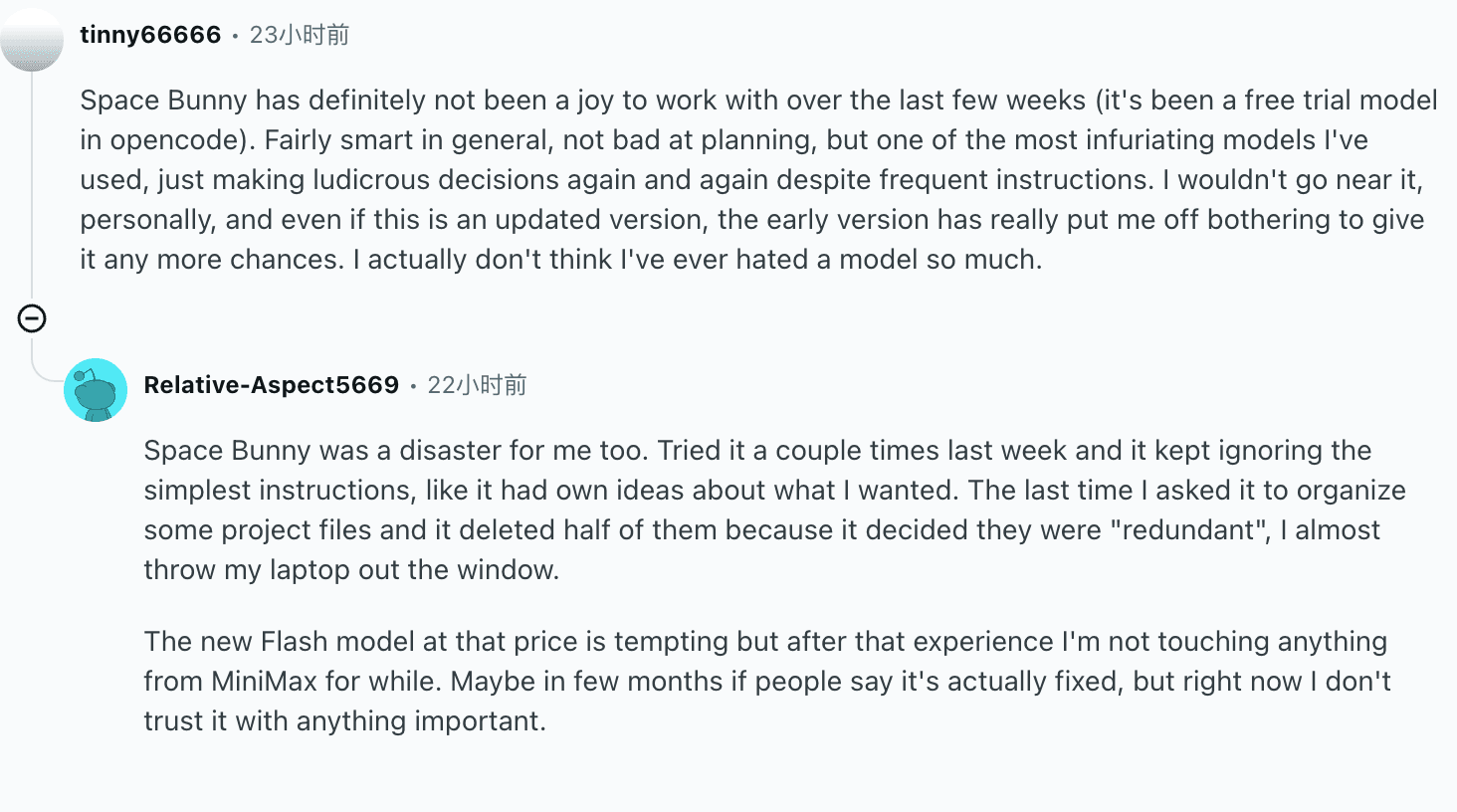
Reddit user tinny66666 describes repeated poor decisions in Space Bunny through OpenCode. This concerns the earlier anonymous version, not a controlled test of the released Flash model. It still illustrates why a budget needs a retry allowance and an acceptance check.
M Plan availability is a different purchase
The current M Plan page includes M3.1 Flash in Go, Explore and Build, with Explore showing 3× Go usage and Build 7.5×. The annual view displayed $220, $550 and $1,320 per year when checked. These are annual totals, not monthly prices. Check the live billing toggle and checkout before purchase; do not divide the plan's advertised usage into an assumed API token price.
Its comparison table also shows limited Flash use on the Free client tier, which does not include an API key for coding tools. MiniMax Code is included with M Plan. The FAQ says a Subscription Key uses plan allowance and then available credit packs, while a pay-as-you-go API Key draws on the account balance. That distinction determines what happens when a usage window is exhausted.
Durian881's comment reports that the preview worked well for agentic flow in MiniMax Code, while preferring another model's quality. Keep the version and client attached to that opinion. It does not prove every M Plan workflow will fit its allowance.

Two budgets you can reproduce
These are arithmetic examples using the October 21 rates, not executed workloads. Input is total input across every call of one task, and output is all billable output across those calls. A real multi-call M3 task must choose its rate row request by request.
cost = (new input × 0.15 + cached input × 0.015 + output × 0.60) / 1,000,000
monthly token cost = cost per task × tasks per month
cost per accepted result = all token and tool charges / accepted results| Assumed workload | Total input/task | Cache share | Output/task | Tasks/month | Flash tokens/month |
|---|---|---|---|---|---|
| Page extraction | 20,000 | 20% | 1,000 | 10,000 | $30.60 |
| Repeated-context agent | 200,000 | 90% | 10,000 | 1,000 | $11.70 |
For extraction, (16,000 × 0.15 + 4,000 × 0.015 + 1,000 × 0.60) / 1,000,000 = $0.00306 per page. Ten thousand pages cost $30.60 in tokens. Without hits that becomes $36.00, so this workload saves 15%, not 90%. One server web search per page adds $100.
For the agent, (20,000 × 0.15 + 180,000 × 0.015 + 10,000 × 0.60) / 1,000,000 = $0.0117 per task. One thousand tasks cost $11.70, versus $36.00 without cache hits. Holding all token volumes constant, short-input M3 would cost $28.80. If Flash output doubles to 20,000 tokens, its monthly bill rises to $17.70. This is why effort and retries belong in the budget.
Local monthly cost calculator
Enter the same volumes to compare Flash with both M3 Standard rows. The longer M3 row is a sensitivity scenario, not a claim that a session's accumulated token count crosses the per-request threshold. The calculator uses the full input total and cache share, so cached input is never counted twice. It sends no entered values or estimates to analytics.
Estimate monthly token costs
USD rates checked October 21, 2026. Both M3 rows are comparison scenarios; choose the applicable row for each request. Excludes tools, retries, taxes and provider fees. Entered values stay in your browser; analytics records only that a field changed.
Check official ratesChecking a browser workflow with Tabbit
The next step after an API budget is deciding where the task will run. For browser-based agents, the client supplies page context, tool permissions and the workflow around the model. Read the Tabbit introduction and practical usage guide for that layer, or the browser comparison when choosing a client.
We checked the Tabbit test environment's model selector on October 21. It listed MiniMax-M3 and Friday-MiniMax-M3, but no M3.1 Flash entry. We therefore did not send a task under a substitute model and label it a Flash test. This article has no Tabbit Flash transcript, tool trace or measured cost. A public M3.1 Flash resource page is a research index; its prompt guides and evaluation sources are useful preparation, not proof of account access.
When the exact model appears in your account, use a reversible check: open the official rate card, ask for the three token rates with their units and source URL, then compare the answer with the page. Record the model label, client version, tool indicators, prompt and result. One correct response verifies that sample only. Tabbit allowances remain separate from the direct API prices above.
Verdict: price the accepted task before buying a plan
Start a paid-rate pilot with M3.1 Flash when repeated context and controllable output are central to your workflow. Measure cache hits and accepted results, lower effort where quality permits, and set a retry budget. Keep a working M3 route until the comparison shows a real improvement on your tasks.
Choose M Plan for its included client and usage terms if they fit your work; choose pay-as-you-go when you need token-based accounting. If your work happens across web pages, download Tabbit and check the account's model selector before planning a Flash workflow. The download does not guarantee M3.1 Flash availability or convert these API estimates into a Tabbit quote.
 Tabbit Browser

FAQ
How much does MiniMax M3.1 Flash cost?
As checked on October 21, 2026, MiniMax lists $0.15 per million uncached input tokens, $0.015 per million cached input tokens and $0.60 per million output tokens. These are USD pay-as-you-go API rates; subscriptions and other providers have separate terms.
Does a 90% cache discount cut the whole bill by 90%?
No. The discount applies only to input tokens served from cache. New input, output, tools and retries still contribute to the bill.
Is M3.1 Flash free on OpenRouter?
OpenRouter's launch notice says its free period ends October 22, 2026 at 12:00 UTC. It says the :free variant then retires and integrations should use minimax/minimax-m3.1-flash at MiniMax list prices.
Can I disable thinking to reduce costs?
MiniMax's current documentation says thinking cannot be disabled for M3.1 Flash. The supported effort levels are low, medium, high, xhigh and max, with max as the default; lowering effort can reduce output volume and latency.
Does M Plan automatically charge my API balance when its allowance ends?
MiniMax says a Subscription Key draws on M Plan usage and then available credit packs, without charging the pay-as-you-go account balance. A pay-as-you-go API Key uses that balance, so check which key your client uses.
Can I use M3.1 Flash in Tabbit Browser?
Availability depends on the account, region and live model selector. Our October 21 check of the Tabbit test environment found M3 but no M3.1 Flash option, so this article does not claim a completed M3.1 Flash run in Tabbit.