
Choose LongCat 2.5 as the first pilot if your agent needs to read a screenshot or you need a lower published API price. Start with GLM-5.3 if access to model weights is a requirement. For coding quality, neither the launch table nor a price card settles the choice: run both against the same tasks and review the actual changes.
The price difference is large enough to matter. On November 3, 2026, LongCat's limited-time rate was $0.30 per million uncached input tokens and $1.20 per million output tokens. Z.ai listed GLM-5.3 at $1.40 and $4.40. Those are first-party API rates, not Tabbit subscription prices, and they do not tell you how many tokens either model needs to finish your job.
The difference between a benchmark and a real task is visible in a Reddit user's OpenCode report. They asked LongCat 2.5 Preview to analyze five C# classes and reported repeated reasoning and an unfinished request. That was one Preview session, not a test of the released model. It is a reason to include a stop condition and an acceptance test in your own pilot. Later, we outline how Tabbit Browser can help organize the comparison of public sources.
Key takeaways
LongCat 2.5 accepts visual input. Z.ai documents GLM-5.3 as text-input only.
LongCat's launch page marked its weights as coming soon when checked. GLM-5.3 has a public model repository with its own license.
Meituan's published table shows each model ahead on different coding tasks. Several GLM figures are taken from other public reports, so those rows are not a controlled head-to-head test.
LongCat's listed first-party API price is lower, but the discount is temporary and the relevant measure is cost per accepted task.
Preview feedback identifies possible failure modes. It does not measure the final release.
LongCat 2.5 vs GLM-5.3 at a glance
| Decision | LongCat 2.5 | GLM-5.3 | What to check |
|---|---|---|---|
| Input | Text and visual input | Text input | The client and endpoint must expose the input type you need. |
| Context | 1,048,576 tokens, including input and output | 1M tokens | A large context limit is not a guarantee of retrieval accuracy. |
| Reasoning | Thinking can be enabled or disabled in LongCat's parameter guide | Always enabled, with low, high, and max effort | Different effort settings change token use and results. |
| Weights | Launch page says GitHub and Hugging Face are coming soon | Public weights and serving instructions | Read the actual license and estimate hardware before planning a deployment. |
| First-party API, input/output per million | $0.30 / $1.20, limited-time discount | $1.40 / $4.40 | Compare current provider prices and cache conditions before buying. |
The LongCat launch post, model parameters, GLM-5.3 guide, and GLM model card are the primary references for this table. For a closer look at each model family, see our GLM-5.3 overview and LongCat 2.0 overview. The latter covers an earlier release, not the 2.5 specification.
Coding benchmarks: useful signals, different conditions
Meituan's launch table includes the following figures. The asterisk means the GLM score was taken from a public report or leaderboard; it was not necessarily rerun alongside LongCat under identical conditions.
| Benchmark | LongCat 2.5 | GLM-5.3 in Meituan's table | What it can help you test |
|---|---|---|---|
| Terminal-Bench 2.1 | 88.4 | 88.2* | Multi-step terminal work |
| Terminal-Bench 4.0 | 38.5 | 41.8* | Harder terminal tasks |
| DeepSWE v1.1 | 64.6 | 66.9* | Software engineering issues |
| NL2Repo | 60.5 | 58.0* | Building a repository from a description |
Source: Meituan's evaluation table, checked November 3, 2026. Meituan reports thinking enabled for LongCat and describes its Terminal-Bench 2.1 result as an average of three runs with Claude Code 2.1.280. The GLM model card reports Claude Code 2.1.207 for its Terminal-Bench 2.1 evaluation. Differences in the agent, tools, time limit, prompt, and output budget can change the result. The small numerical gap in the first row is not enough to declare a winner for your repository.
The useful next step is to turn each row into a task you can check. For an existing codebase, use a bug with a failing test, record whether the test passes, and inspect the diff for unrelated edits. For a new project, define the expected behavior before asking either model to build it. Our GLM prompt collection and review resources provide further material for designing tasks, but their examples are not a replacement for your own acceptance criteria.
API costs: compare the completed task
The LongCat price page calls its published rates a limited-time discount. Z.ai's price page lists the rates below. Both were checked on November 3, 2026. Rates are USD per million tokens, excluding separate tools and other provider charges.
| API route | Uncached input | Cached input | Output |
|---|---|---|---|
| LongCat 2.5, limited-time | $0.30 | $0.006 | $1.20 |
| Z.ai GLM-5.3 | $1.40 | $0.26 | $4.40 |
For an illustration, suppose each model consumes 1 million uncached input tokens and 200,000 output tokens, with no cache hits or tool charges. LongCat's listed price gives $0.54; GLM-5.3 gives $2.28. This is arithmetic on equal token quantities, not a claim that both models use the same number of tokens or succeed equally often.
A better production measure is:
cost per accepted task = total model and tool spend / tasks that pass your checksInclude failed attempts, retries, repeated context, cache misses, and human review if you can measure it. Z.ai separately lists a price for its built-in search tool. A Coding Plan, a third-party model provider, and a Tabbit account have their own billing and limits. Do not transfer one price card to another product.
Screenshots, context, and output limits
LongCat 2.5's launch announcement describes native visual understanding. This makes a screenshot of a broken layout a practical candidate for a pilot: give the model the image, the relevant files, and a concrete visual acceptance criterion. Its final output still needs review in a browser. Visual input does not mean the generated UI is correct or accessible.
Z.ai's model guide describes GLM-5.3 as text-input only. If the task begins with an image, supply a separately verified text description or use another vision-capable component. The distinction is about the documented model input, not a judgment that all interfaces built around GLM lack visual features.
Both vendors describe roughly 1M tokens of context. LongCat explicitly defines the limit as input plus output. Its parameter reference lists a maximum max_tokens of 262,144, while its quick start says maximum output is 128K. Until those pages agree, confirm the limit on the exact endpoint rather than promising either number. Z.ai documents 128K maximum output for GLM-5.3. A client may impose a smaller cap on either model.
Weights and deployment
On the research date, LongCat's 2.5 launch page labeled both GitHub and Hugging Face links as coming soon. That does not establish a future release date or license. If self-hosting is a requirement today, verify the official repository and terms again before planning around LongCat 2.5. The published MIT license for LongCat 2.0 cannot be assumed to apply to its successor.
GLM-5.3 has a public Hugging Face model card, which lists serving options including vLLM and SGLang. Its license label is glm-5.3, so read the terms for your intended use. Downloadable weights do not eliminate hardware, operations, security, or support costs. The model card reports 753B parameters; evaluate the memory and serving configuration for your actual quantization and context rather than treating active parameter count as a hardware quote.
What the Preview feedback can and cannot tell you
In the C# report, the author describes repetition and failure to finish. That is specific enough to suggest a useful check: log tool calls and stop a run that repeatedly makes no progress. It does not establish that the final release has the same behavior.
Another Reddit user tested the Preview on Terminal-Bench 2.1, with three runs per task, and reported fewer exceptions and timeouts than the other models in that particular comparison. The same author noted a local device failed consistently on one task. GLM-5.3 was not one of the models in that test. These two accounts describe different settings and cannot be combined into a ranking of the released models.
Run a fair pilot
Select five representative, reversible tasks. Include an ordinary bug, a long multi-file change, and a failure-recovery case if those match your work.
Fix the repository revision, tool permissions, time budget, and acceptance tests. Keep secrets and production credentials out of the fixture.
Record the exact model version, provider, agent version, reasoning setting, prompt, context, token counts, tool errors, duration, and final diff for each run.
Check functional tests and unrelated changes before reading the model's self-assessment. For visual work, compare screenshots and inspect the interface.
Repeat enough times to understand variability. Compare accepted outputs and total cost, including unsuccessful attempts.
A single pass is an example, not a measured success rate. Our guide to agentic browsers explains why tool access and the surrounding application also affect a multi-step task.
Organize the comparison in Tabbit Browser
If your immediate task is research rather than running a coding agent, Tabbit Browser can keep the vendor documentation and a comparison conversation in the same browsing workflow. Open the two official model pages and pricing pages, then ask for a table that includes the source URL, date, model version, and unresolved questions. Check each value against the original page, especially the temporary discount and output-limit conflict.
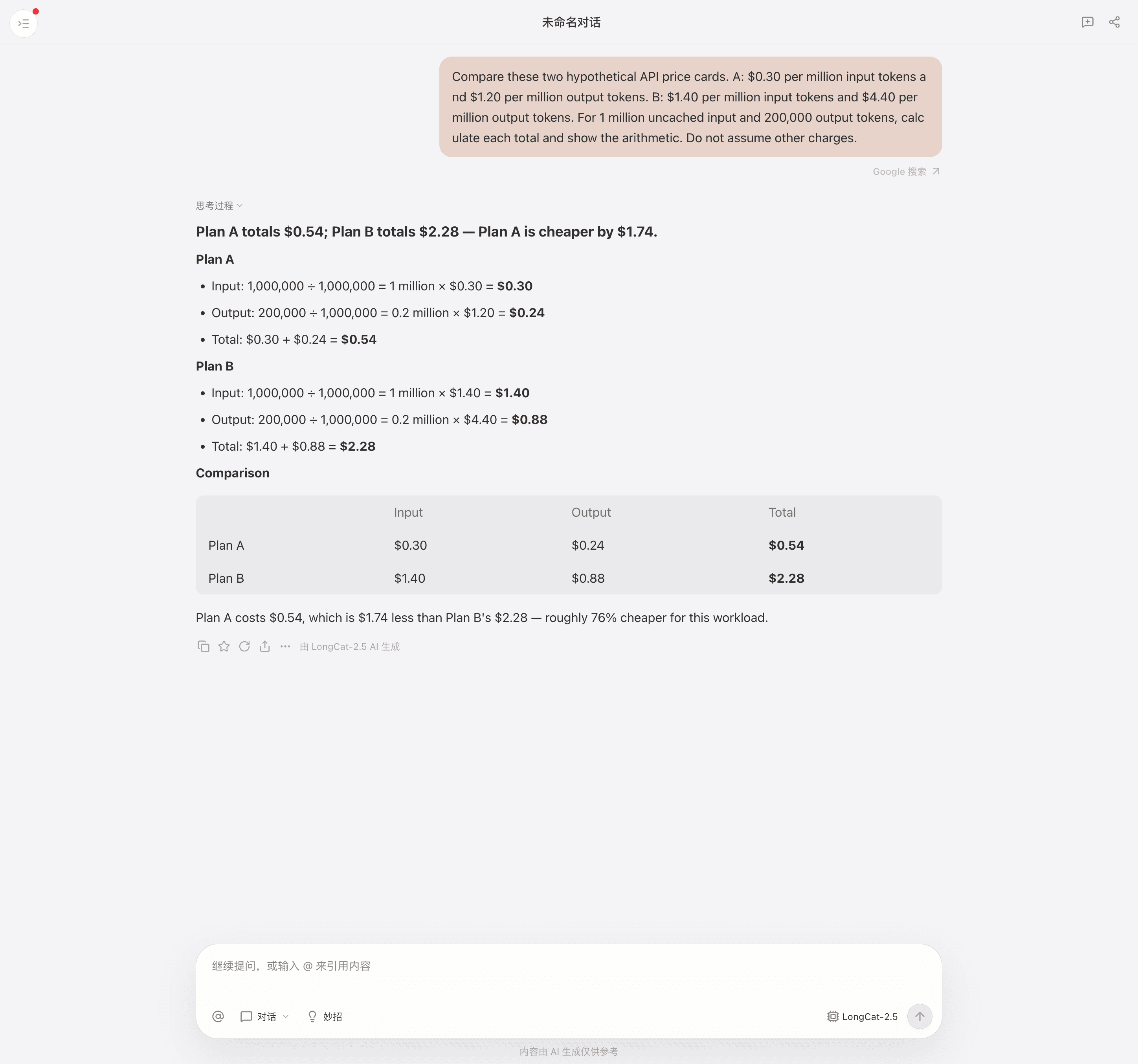
On November 3, we ran one small calculation in a Tabbit test environment with LongCat-2.5 selected. We supplied the two price cards in the prompt and asked for the cost of 1 million uncached input tokens and 200,000 output tokens. The response gave $0.54 and $2.28, matching the arithmetic above. It did not independently verify the price cards; we supplied them. One correct answer says nothing about general reliability or coding performance.
The same test account listed LongCat-2.5 but did not list the full GLM-5.3 model in its picker. GLM-5.3-FlashX is a different model, so we did not substitute it. Availability can differ by account and edition. The screenshot is from the test environment, not proof of availability in a production account.
For the surrounding workflow, see Tabbit Browser best practices and the AI browser comparison. A browser assistant does not replace a repository test harness, and account availability, quotas, and data terms need their own check.
Which model should you choose?
| Your requirement | First option to investigate | Why |
|---|---|---|
| Screenshot-based UI work | LongCat 2.5 | Its vendor documents visual input; validate the actual endpoint and generated interface. |
| Self-hosted weights today | GLM-5.3 | Its model card publishes weights and serving paths; review license and hardware. |
| Lower published first-party API rates | LongCat 2.5 | Its current discount is lower on the listed token rates; calculate accepted-task cost. |
| Existing long-running coding agent | Test both | The reported benchmark rows do not control all conditions. |
| A client that requires thinking disabled | Check LongCat's endpoint | Z.ai says GLM-5.3 requires thinking enabled; test client compatibility. |
Start with the requirement you cannot compromise, then run a small evaluation. If the result is close, retain a fallback model and repeat the test when the provider, agent, or model version changes.

FAQ
Which is better for coding, LongCat 2.5 or GLM-5.3?
Both are candidates for coding agents, but the available benchmark figures mix different test configurations. Run the same repository tasks, tools, and acceptance tests before choosing either for production.
Is LongCat 2.5 cheaper than GLM-5.3?
On November 3, 2026, LongCat listed a limited-time price of $0.30 per million uncached input tokens and $1.20 per million output tokens. Z.ai listed $1.40 and $4.40 respectively for GLM-5.3; actual task cost depends on tokens, cache hits, tools, and provider terms.
Can both models read screenshots?
LongCat describes 2.5 as a native multimodal model that accepts visual input. Z.ai describes GLM-5.3 as text-input only, so a screenshot requires a separate visual component or a different model.
Can I run either model on my own hardware?
Z.ai publishes GLM-5.3 weights and serving instructions, subject to its GLM-5.3 license and substantial hardware requirements. At the research date, LongCat's 2.5 launch page marked its GitHub and Hugging Face links as coming soon.
How large are their context windows?
Both vendors describe approximately one million tokens of context, but input and output share a request budget and individual clients may impose lower limits. LongCat's own pages disagree on its maximum output length, so confirm the endpoint before relying on a particular limit.
Is the LongCat 2.5 Preview the same as the released model?
The preview preceded the November 2026 LongCat 2.5 release. Feedback about the preview is useful for identifying tests, but it does not establish the released model's behavior.