
Start with GLM-5.3-Flash if you need a metered API, downloadable weights or a model for routine coding on limited credits. Try GLM-5.4 through the GLM Coding Plan when a difficult change keeps coming back for another round of fixes. Use the same task and tests before moving the rest of your work.
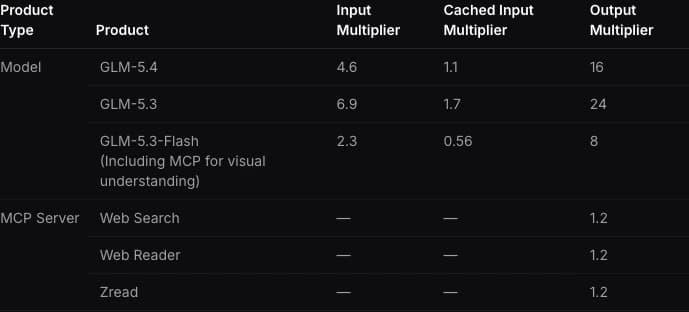
The decision starts with a number from Z.ai's November 24, 2026 Coding Plan credit schedule. An uncached input or output token uses twice as many credits on GLM-5.4 as on Flash, under the same plan rules and at the same time of day. Compare the credits needed to get an acceptable patch. A model that finishes in one pass can beat a lower rate that takes three tries.
Start with Flash for jobs you run repeatedly. One developer on YouTube switched their everyday coding agent from GLM-5.2 to Flash. It was a personal change of default, with a different comparison model. If your test starts on a staging page, Tabbit Browser can help prepare the same QA brief for both models.
Key takeaways
GLM-5.4 is available through the Coding Plan. Z.ai's developer guide says the general Model API is pending a security assessment.
GLM-5.3-Flash has a public Z.ai API rate of $0.15 per million uncached input tokens, $0.03 per million cached input tokens and $0.50 per million output tokens.
Both model guides list image input, a 1M-token context window and a 128K output cap. Check what your client and endpoint accept.
Flash's 84.3 on Terminal-Bench 2.1 comes from Z.ai's model card. The GLM-5.4 launch evidence supplies no matched Flash result.
Choose Flash for self-hosting today. Scope a GLM-5.4 pilot to the tasks where the potential savings in retries and review could cover its higher credit rate.
GLM-5.4 vs GLM-5.3-Flash at a glance
| Decision factor | GLM-5.4 | GLM-5.3-Flash |
|---|---|---|
| Z.ai release | November 23, 2026 | August 26, 2026 |
| Model design | Loop Transformer reuses 28 layers across two passes | 320B total, 18B active. Hybrid sparse and linear attention |
| Input and output | Text, images, video or files in. Text out | Text, images, video or files in. Text out |
| Documented limits | 1M context, 128K maximum output | 1M context, 128K maximum output |
| Coding Plan multipliers, input / cached / output | 4.6 / 1.1 / 16 | 2.3 / 0.56 / 8 |
| Public Z.ai API, USD per million tokens in the same order | Pending, no published rate | $0.15 / $0.03 / $0.50 |
| Downloadable weights | Pending at time of check | Available under MIT |
| Coding benchmark evidence | Launch demonstrations and a separate architecture experiment | Z.ai reports 84.3 on Terminal-Bench 2.1 |
The model limits come from Z.ai's GLM-5.4 guide and GLM-5.3-Flash guide. See the GLM-5.4 launch, the Flash release, the Flash model card and the Z.ai API price list. All access and price statements refer to the November 24 check.
The names matter when reading a chart. GLM-5.3 is Z.ai's earlier flagship. GLM-5.3-Flash is the separate multimodal release previously previewed as Ox Alpha. The 1.5× weekly allowance in the GLM-5.4 announcement compares it with regular GLM-5.3. FlashX is also a separate API model with its own pricing.
Coding benchmarks and what to test
Z.ai built GLM-5.4 from its GLM-5 base and passes the representation through part of the network twice. Reusing the layers gives the network more computation per token without adding a second set of weights for those layers. It also means model size alone tells you little about latency. Z.ai pairs the loop with cache and attention changes for long inputs. Its examples include generating video with code and building a 3D scene. These are published demonstrations of what GLM-5.4 can attempt. Z.ai's launch article
Flash has a more concrete coding baseline. Z.ai reports 84.3 on Terminal-Bench 2.1 and specifies Claude Code 2.1.207, a generation cap of 65,536 tokens and a six-hour timeout. That figure belongs to a model plus a particular agent setup. The controlled architecture study in the launch article uses a 30B model. A result from that study leaves the GLM-5.4 vs Flash question open. Even a long benchmark timeout can hide a latency issue that matters when you're waiting for a small edit. Flash model card and evaluation notes
A useful pilot has one small task you already expect Flash to handle, then at least one task where a stronger run would save time. Give both models a clean checkout of the same repo, the same issue text and the same tool permissions. For example, ask them to fix a regression in a settings panel, with a known reproduction and an unchanged test suite. Score the rendered behavior as well as the patch. A model can pass a unit test while moving a layout problem to a different screen.
Keep the client, reasoning level and timeout in the run log. Run the first comparison at the same setting and time of day, then try the effort level you'd actually use for each model. Record accepted patches, wall-clock time, credit consumption, retries and minutes of manual review. Count failed attempts even when they produce no usable diff. See the cost per successful task guide for a way to combine those costs.
In an early test posted to Hacker News, Simon Willison switched to the Coding Plan to run GLM-5.4 at three effort levels on a small SVG drawing. His sketch comparison used standard GLM-5.3. The thread helps identify which route to try and which setting to record.

Coding Plan credits and API prices
For a plan that uses the published credit schedule, total usage starts with this calculation. Input here refers to uncached input, counted separately from cache hits.
model credits = (uncached input × input multiplier
               + cached input × cache multiplier
               + output × output multiplier) ÷ 10,000
Take a run with 100,000 uncached input tokens, 400,000 cached input tokens and 25,000 output tokens. At the standard rate, this is 130 credits for GLM-5.4 and 65.4 for Flash. The model portion comes to 65 and 32.7 credits off-peak under the documented 50% rate. These are calculations for the same assumed token counts. A real run can generate a different volume of output, hit the cache at a different rate or take another attempt. The plan tracks its five-hour and weekly limits separately and shows charge details for tools. Coding Plan allowance and calculation
That example gives you a concrete threshold. One Flash attempt costs 65.4 credits and two cost 130.8. If GLM-5.4 finishes in one 130-credit run and Flash needs two comparable runs, the charge is almost the same. If both succeed on the first try, Flash uses about half the credits. The closer call is usually how much review you have to do after each attempt.
A regular API integration pays in dollars. The same assumed Flash token counts at Z.ai's public rate would cost $0.0395 in model tokens. Check any additional charges for tools or cache storage. A calling application should log provider usage and count retries before using this example as a budget. Z.ai hasn't posted a standard API price for GLM-5.4, so the example yields one dollar estimate and two plan-credit estimates. Z.ai API pricing
Vision, context and self-hosting
Both model guides list image and video inputs. Verify the path the input takes. One coding client may send a screenshot directly to the selected model. Another may call a separate vision tool and add its description to the model's context. Z.ai's plan schedule lists the visual-understanding MCP under Flash, so a screenshot tool call can involve Flash even when the main session is using GLM-5.4. To test direct image input, send the same screenshot and look for a result you can check, such as whether the reported labels and button states match the image. Model and tool charges
The 1M-token specification gives you room to attach more material. Your client may compact the conversation earlier and the generation cap still applies. Put a known requirement in the middle of a long brief and check whether the patch follows it. Record any compaction before you interpret a miss. The Flash browser-use guide also covers how to check that an agent reached the intended page when the work involves a browser.
For self-hosting, Flash is the available option in this pair. The MIT model card provides the checkpoint and serving guidance. Its 18B active parameters describe computation per token. Your memory budget has to account for the 320B-parameter checkpoint, the runtime, the context cache and concurrency. Validate capacity on a small batch before buying a machine or committing to a target context length. The LongCat 2.5 vs GLM-5.3-Flash comparison covers another open-weight decision with different hosting conditions.
A Flash user on YouTube said they settled on high effort after seeing little benefit from max for their work. They preferred another model for vision. Keep coding and vision checks separate when deciding where Flash is sufficient.

Use Tabbit to prepare a browser QA task
If a coding change starts with a bug report and a staging page, use Tabbit Browser to collect the evidence for both model runs. Open the public issue and the approved preview side by side. Use the page context to capture the heading, the precise state that fails and the action that reproduces it. Keep the URL alongside each observation. The Tabbit workflow guide shows how to reference open pages, and the research citation guide gives a way to check evidence against the source.
Use that same brief in the two coding sessions. For a read-only browser check, start with the first-task checklist. Ask for the exact page title and visible status, then verify them in the preview. That check tells you whether the input to the coding task is sound. The model availability, credit measurements and patch tests still belong to the routes where you run each version.
 Tabbit Browser
Which GLM model should you choose?
| If you need… | Start with… | What would change the decision |
|---|---|---|
| A metered API for an app | GLM-5.3-Flash | Z.ai publishes a GLM-5.4 API rate and your application passes a migration test |
| Downloadable weights | GLM-5.3-Flash | GLM-5.4 weights and license become available and fit your infrastructure |
| Routine edits, triage and reviews | GLM-5.3-Flash | Repeated failures make a GLM-5.4 retry cheaper per accepted patch |
| A long, difficult coding task | Trial GLM-5.4 on the Coding Plan | Flash reaches the same acceptance bar with lower credits or review time |
| Code changes driven by a screenshot | The model and route that accept the original image | A client sends only a tool summary or changes the observable bill |
Keep Flash as the baseline for work it already completes. Move individual tasks to GLM-5.4 when the same acceptance tests show a better result for the credits and review time you spend. If the comparison starts with a staging page, Tabbit can help you prepare a single source-backed brief that both runs can use.

FAQ
Which model should I start with for everyday coding?
Start with GLM-5.3-Flash for small, well-defined edits and reviews on a limited budget. Trial GLM-5.4 through the Coding Plan if those runs repeatedly fail on a harder task, and compare accepted patches, total credits and review time.
Can I call GLM-5.4 through Z.ai's pay-as-you-go API?
As of November 24, 2026, Z.ai documents GLM-5.4 access through the GLM Coding Plan. Its standard Model API is pending a security assessment and its public price list has no GLM-5.4 rate.
Does the 1.5× quota give GLM-5.4 more usage than Flash?
The 1.5× announcement compares GLM-5.4 with the regular GLM-5.3 on weekly-quota plans. For equal uncached input and output token counts, GLM-5.4 uses twice the credits of GLM-5.3-Flash at the same time of day.
Can I self-host both models?
Z.ai publishes GLM-5.3-Flash weights under the MIT license. GLM-5.4 weights were still pending at the November 24 check. Estimate memory for the Flash checkpoint and runtime before choosing a deployment.
Do GLM-5.4 and GLM-5.3-Flash both take screenshots?
Z.ai lists image input for both. Check that your client sends images to the chosen model and see whether it uses a separate vision tool. These routes can behave and bill differently.
Is there a head-to-head benchmark for the two models?
The official sources checked on November 24, 2026 did not establish a matched result for GLM-5.4 versus GLM-5.3-Flash. Flash's published 84.3 on Terminal-Bench 2.1 is useful evidence about Flash under one setup.