
Choose Gemini 4 Argon for the majority of coding and knowledge work; choose Gemini 4 Carbon when the task is unusually difficult, long-horizon and benefits from deeper reasoning and extended verification. That is Google’s own product distinction. In Artificial Analysis Index v5.0.1, Carbon High scores 60 against Argon High at 50, while its measured cost per task is also higher ($5.48 vs $4.97) and task time is longer (32.1 vs 29.3 minutes). These are benchmark aggregates, not a guarantee about your job. The one-number anchor is the 10-point Index gap at High: Carbon’s extra effort can help on hard tasks, but it costs time and money in this measured suite.
Key takeaways
Google describes Argon as the fit for most software engineering and knowledge work; Carbon is for tasks that test model limits and uses more thinking tokens.
Artificial Analysis Index v5.0.1 High: Carbon 60, Argon 50. Per-task cost: Carbon $5.48, Argon $4.97; mean task time: 32.1 and 29.3 minutes respectively.
The independent table measures a weighted benchmark suite, not equal quality on every task. Carbon and Argon both have a 1M combined input-output context on their model cards.
Google announces the same introductory API rate for both models, but task cost differs with token use; check the current model price and access for the actual product.
Reddit users are confused by the model names and report inconsistent quota experiences. Those posts cannot establish capability or current access rules.
Argon vs Carbon at a glance
| Decision factor | Gemini 4 Argon | Gemini 4 Carbon | What it means |
|---|---|---|---|
| Google’s intended role | Most software engineering and knowledge work | Hard, long-horizon coding, debugging and open-ended research | Start with Argon unless the task demands a deeper pass |
| Artificial Analysis Index v5.0.1, High | 50 | 60 | Carbon leads this aggregate by 10 points |
| Cost per Index task (High) | $4.97 | $5.48 | Carbon costs more in this suite, despite equal listed output price |
| Mean time per Index task (High) | 29.3 min | 32.1 min | Carbon takes longer in this suite |
| API launch price | $2/M input, $10/M output through Nov. 30 | Same introductory rate announced | Recheck after the date boundary and by API surface |
| Context window | 1M input + output combined | 1M input + output combined | Not 1M input plus a separate 1M output |
Sources: Google’s Carbon release and Artificial Analysis release comparison, checked November 16, 2026. Artificial Analysis updates evaluations regularly; the comparison page reports Index v5.0.1 and different model settings. See its methodology before using the cost or time figures in a procurement model.
How to choose by workload
| If your work looks like… | Start with | Why | Check before scaling |
|---|---|---|---|
| Routine code changes, repository questions or business analysis | Argon | Google says it is intended for the majority of coding and knowledge work | Review correctness and track usage on a representative task |
| A difficult bug with many interacting components | Carbon | Google positions it for complex debugging and extended verification loops | More thinking tokens can raise cost and latency |
| Open-ended research or difficult scientific reasoning | Carbon trial | The product is designed for deeper hypothesis exploration | Verify citations and intermediate assumptions |
| A task with a strict latency or API budget | Argon or a lighter model | Carbon’s measured high-setting task time and task cost are higher in this suite | Confirm prices, thinking mode and current access |
The benchmark is not a blanket winner table. Artificial Analysis Index v5.0.1 currently gives Carbon High 60 and Argon High 50, but its mean task time and cost are also higher for Carbon. It measures a particular nine-evaluation suite and uses model-specific configurations. A separate medium-setting comparison shows Carbon at 58 and $4.68/task versus Argon at 48 and $4.31/task. Do not compare the “High” and “Medium” rows as if they were identical settings, or interpret task cost as the API rate card.
Google’s model cards provide another useful boundary: Carbon is based on Argon, but Google says it uses more thinking tokens and longer verification loops. This is an implementation relationship, not evidence that Carbon is always a better checkpoint. Carbon’s card also lists occasional slowness/timeouts and higher token use at higher reasoning levels. Both model cards list a combined input-output context of up to 1M tokens; the exact API or product surface may still have its own rules.
What users say, and what they cannot prove
In an r/GeminiAI discussion about the lineup, commenter JeffConvertorBot wrote that Argon vs Carbon “does not make sense” as a name distinction, while another user said the model tiers were unclear. That confusion is real in the thread, but it is not evidence about architecture. Google’s official docs are clearer: Carbon is based on Argon and is designed for longer, harder work.
A separate thread includes a user who described Argon as effective on complex Antigravity coding while saying it consumed many tokens in Gemini app. Another Reddit post reports a three-task reverse-engineering run across several coding harnesses. The author explicitly used different tools for different models, so it is not a controlled comparison. These reports are useful for identifying questions to test—follow-through, quota and interface—but do not supersede official access docs or a benchmark protocol.
Verdict: route work by difficulty, then measure
Use Argon as the first trial for ordinary coding and knowledge work. Move to Carbon when the task has a meaningful long horizon, complex debugging or open-ended reasoning that can justify extra time and tokens. If the task is routine, short or tightly budgeted, the public evidence does not show that the Carbon premium is automatically worthwhile. Compare both on the same inputs, tools, reasoning setting, plan and success criteria before adopting either.
For a separate browser workflow that uses Carbon, see the Gemini 4 Carbon browser guide; for Gemini CLI research, see the browser MCP guide.
In the lineup thread, JeffConvertorBot wrote, “Argon vs carbon does not make sense.” That captures naming confusion; Google’s current model card, not this commenter’s guess, establishes that Carbon is based on Argon.
Related reading
Reddit evidence snapshots
Browser captures of the original discussions. Posts reflect individual experiences, not product guarantees.
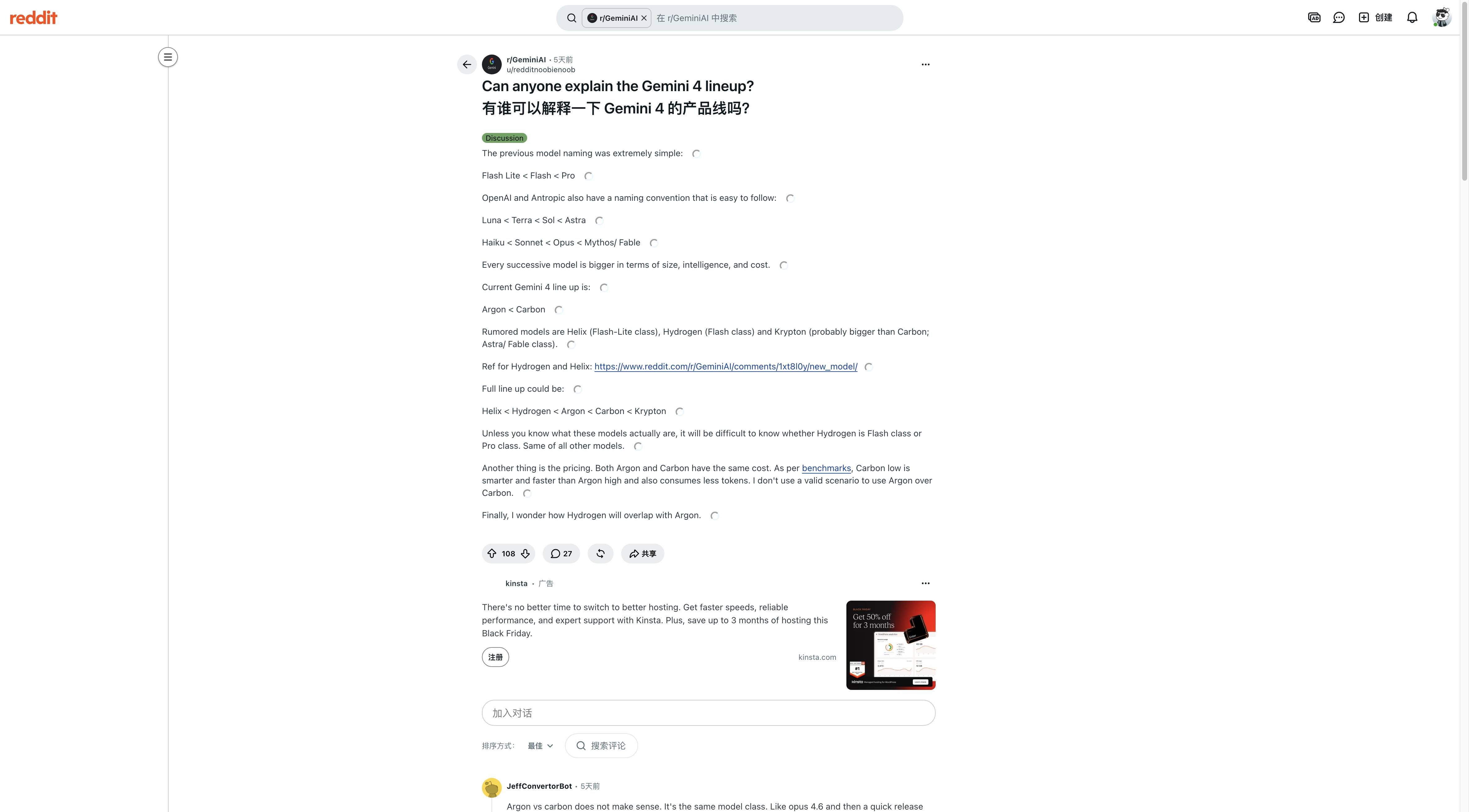
A Gemini lineup discussion where commenters question what Argon and Carbon names mean. Original Reddit discussion
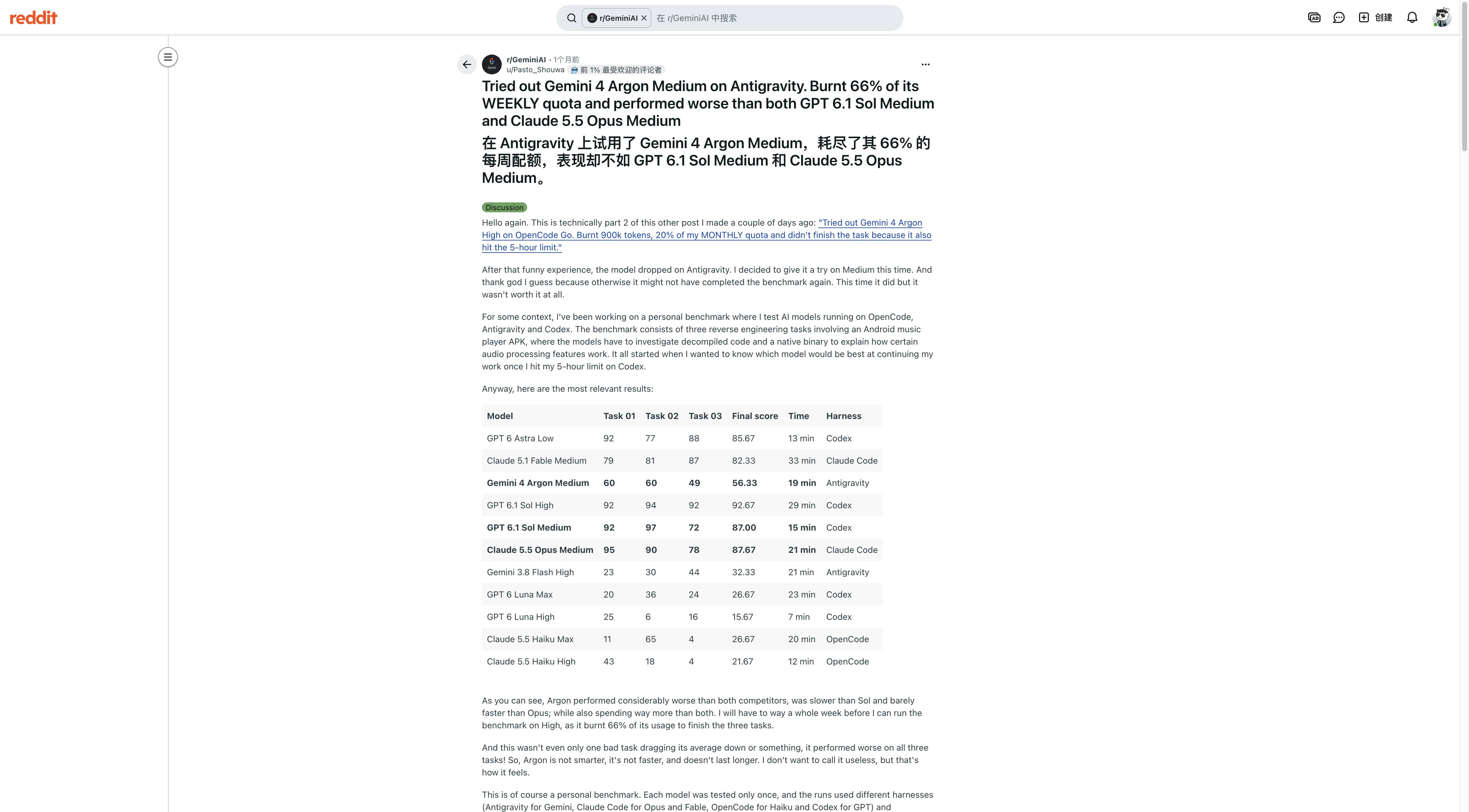
Pasto_Shouwa reports a three-task personal benchmark and names the different harnesses. Original Reddit discussion
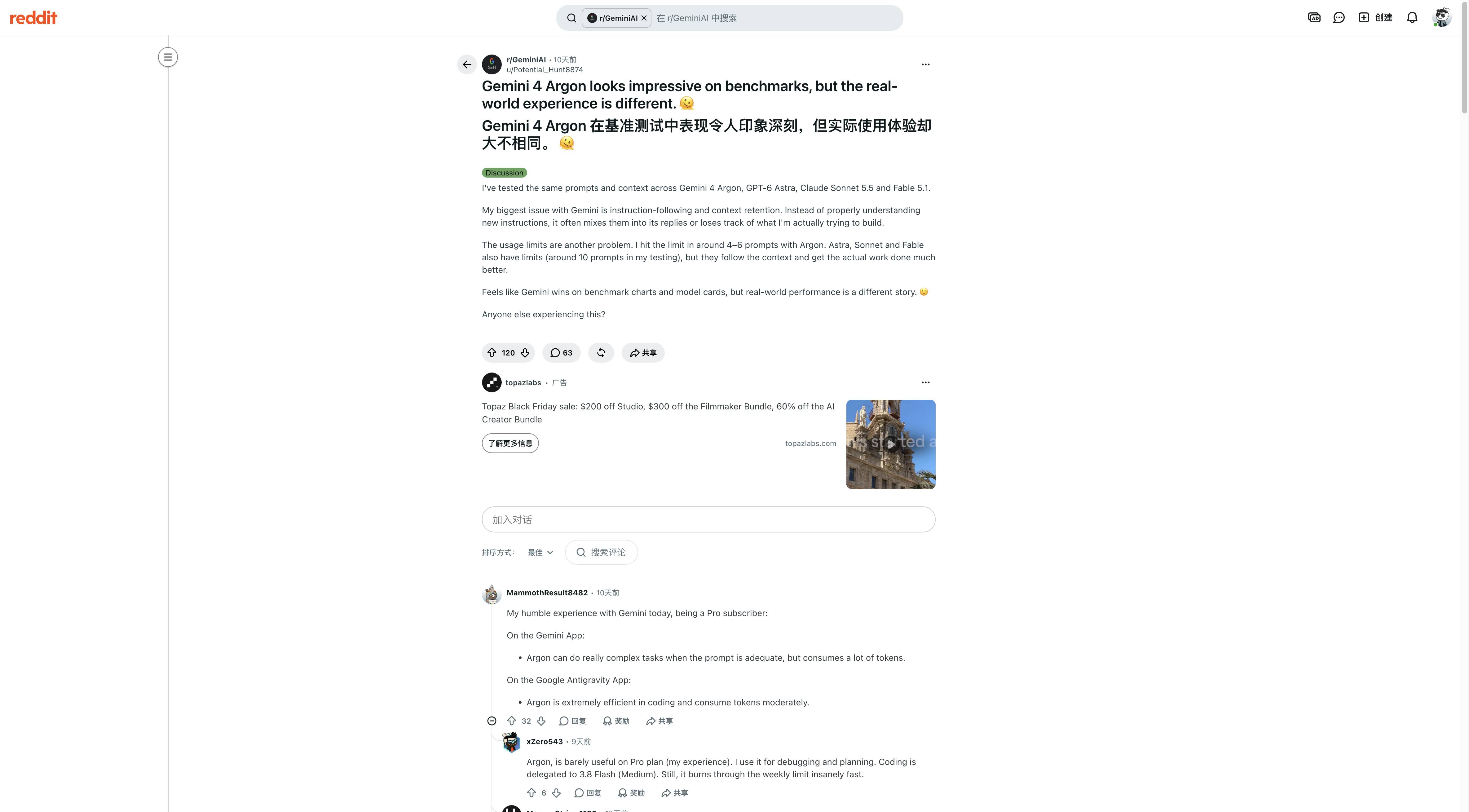
MammothResult8482 compares Gemini app and Antigravity usage; posted about 10 days before collection. Original Reddit discussion
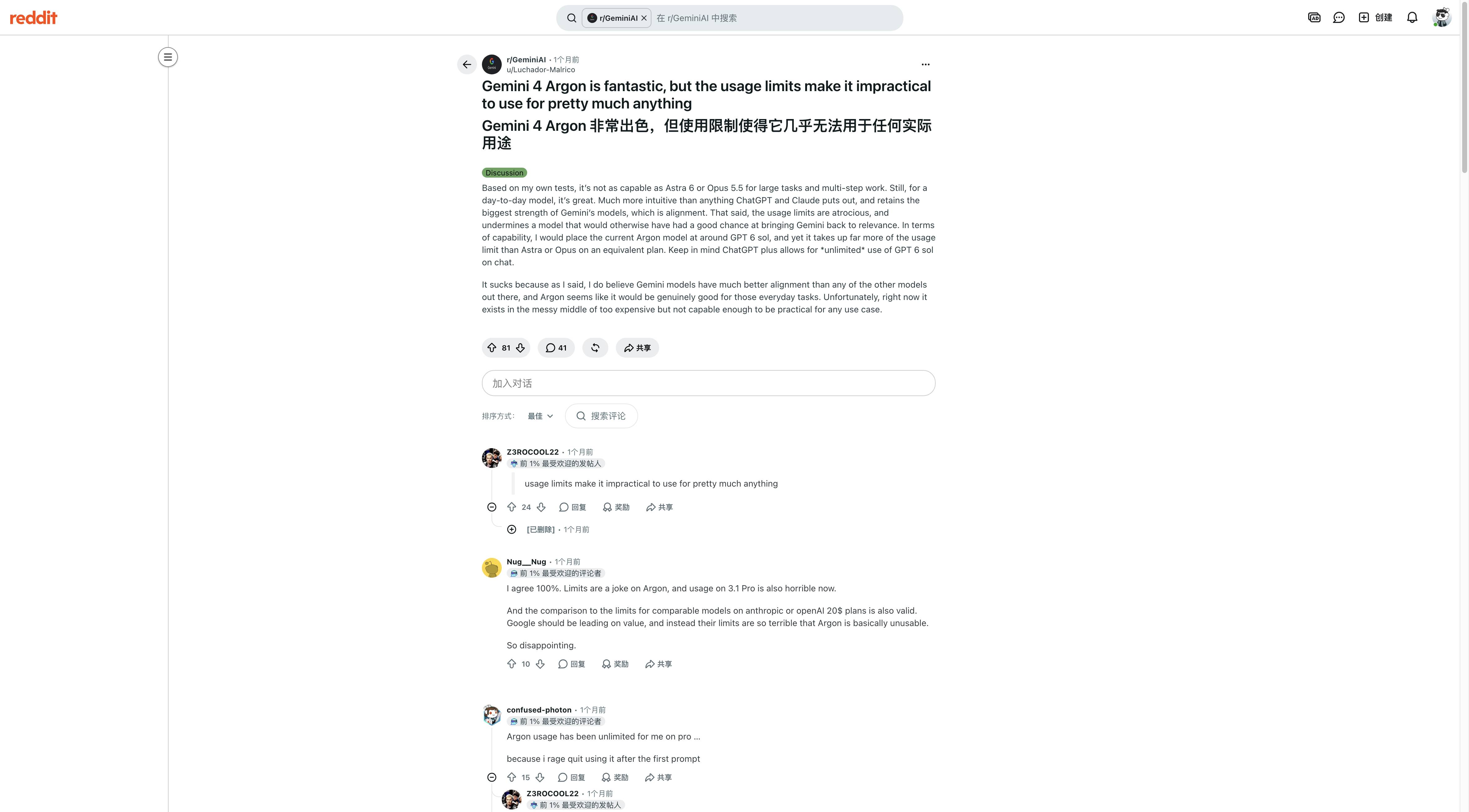
A Reddit discussion where subscribers describe different Argon usage limits; anecdotal and plan-specific. Original Reddit discussion

FAQ
What is the main difference between Gemini 4 Argon and Carbon?
Google positions Argon for most software engineering and knowledge work, while Carbon targets harder, longer tasks and uses more thinking tokens.
Is Gemini 4 Carbon more capable than Argon?
Artificial Analysis Index v5.0.1 High scores Carbon 60 and Argon 50. This is an aggregate benchmark result, not a guarantee for every task.
Is Carbon more expensive than Argon?
Google announced the same introductory API rates for both. Artificial Analysis measures a higher average task cost for Carbon in its benchmark suite because token usage differs.
Which model is faster?
In Artificial Analysis Index v5.0.1 at High, mean task time is 29.3 minutes for Argon and 32.1 for Carbon. This is benchmark-specific.
Do Argon and Carbon have the same context window?
Both model cards state up to 1 million tokens combined across input and output for the described API context.
How can I compare Argon and Carbon fairly?
Keep the prompt, tools and success criteria constant, then compare completion, retries, time and token cost. Benchmark rankings do not predict every task.