
Choose Qwen4-Max if you need a documented pay-as-you-go API today. Try GLM-5.4 first if you already use GLM Coding Plan and want to see how it handles a difficult change in your own repository. The public results reviewed here do not establish a coding winner across both setups. Launch access matters in practice. One developer reported hitting a capacity message when they tried GLM-5.4, a reminder to track whether a task can start alongside how well it finishes. Reddit launch discussion
The most useful difference is how you can run each model. Alibaba Cloud documents an API with regional prices, input limits and reasoning controls for qwen4-max. Z.ai lists GLM Coding Plan, ZCode and Z.ai Chat for GLM-5.4 and marks its general model API as forthcoming. That makes Qwen4-Max easier to budget for a service and GLM-5.4 straightforward to try in an existing Coding Plan workflow. Alibaba Cloud Model Studio · Z.ai release
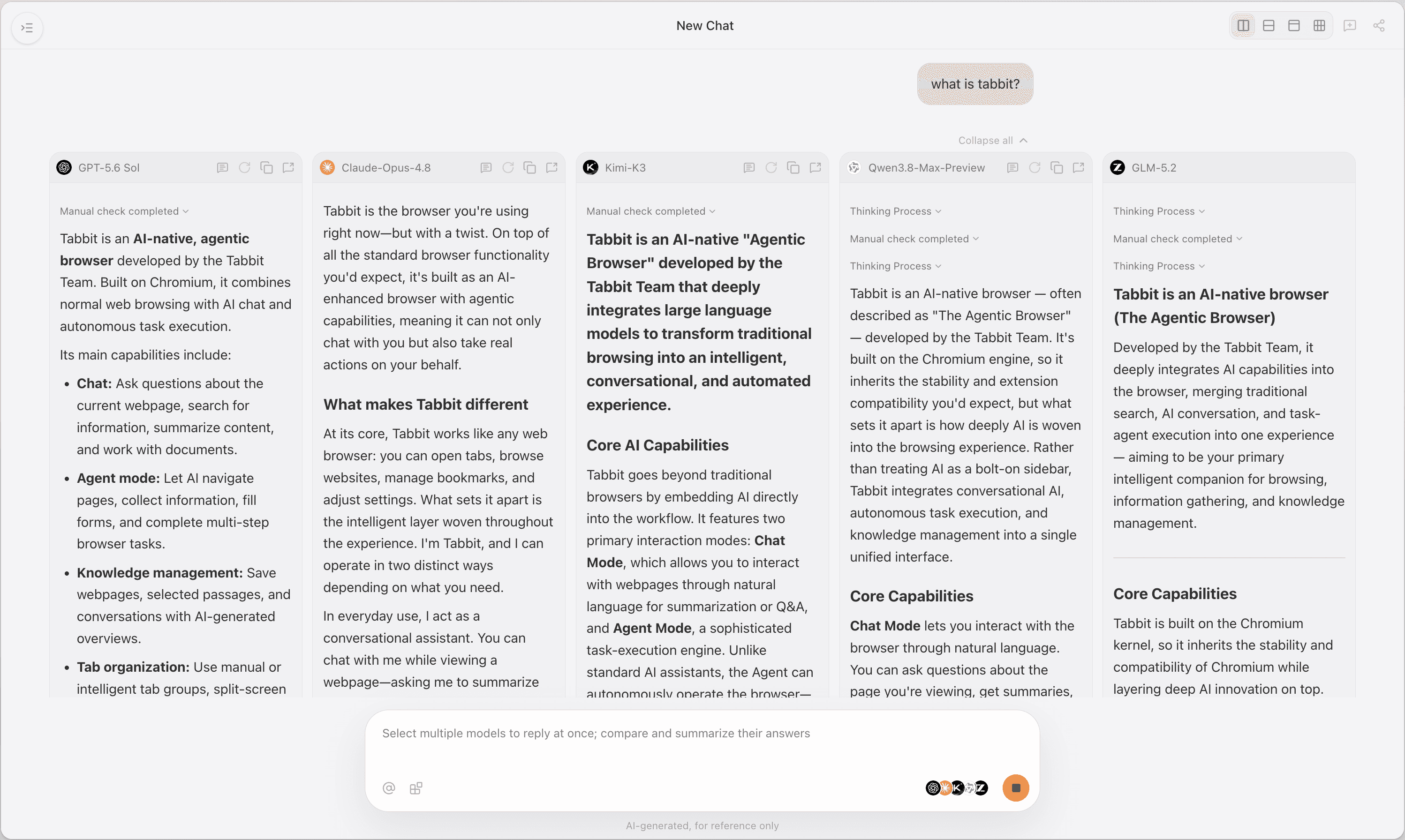
Tabbit Browser can help with a smaller comparison before you set up either integration. Give the available models the same public pages and see whether their answers point you to the right evidence.
Key takeaways
Start with Qwen4-Max for a new metered integration. The Singapore International deployment lists $1.50 per million uncached input tokens and $4.50 per million output tokens, including billed reasoning.
Start with GLM-5.4 for an interactive trial if you already have GLM Coding Plan. Count completed and accepted changes within your plan quota.
Both providers describe a one-million-token context window. Input ceilings, output headroom and context compaction depend on the endpoint and client.
Qwen4-Max has public frontend results under a named reasoning setting. Z.ai's launch material shows GLM-5.4 demos and architecture experiments. Use each result for the task and setup it actually covers.
For self-hosting, wait for downloadable weights and usable license terms for the exact model you intend to deploy.
GLM-5.4 vs Qwen4-Max at a glance
| Decision factor | GLM-5.4 | Qwen4-Max |
|---|---|---|
| Release | Z.ai, November 23, 2026 | Alibaba, November 16, 2026. The November 11 preview is a separate release stage. |
| First-party access | GLM Coding Plan, ZCode and Z.ai Chat. General Model API listed as forthcoming. | Model Studio via qwen4-max, plus QwenCloud Token Plan and Alibaba apps. |
| Metered API price | First-party general API rate unverified. Coding Plan uses plan quota. | Singapore International, $1.50 input and $4.50 output per million tokens before discounts. |
| Long context | ZCode documents 1M and compaction near 966K. Claude Code uses glm-5.4[1m] per ZCode. | 1M total context. Thinking-mode maximum input is 983,616 tokens in Model Studio. |
| Visual inputs | Z.ai documents native vision. Verify attachments in the client you plan to use. | Model Studio documents image and video understanding with text output. |
| Published weights | Z.ai states an intent to release the weights after safety work. | Alibaba's release describes hosted access. Downloadable Qwen4-Max weights remain unverified. |
Checked November 24, 2026. Z.ai release · ZCode FAQ · Alibaba launch · Model Studio model card
The GLM-5.4 workflow hub and Qwen4-Max workflow hub collect material for each model. For earlier results, see the GLM-5.3 comparison and the Qwen4-Max versus Qwen3.8-Max comparison. Keep results for those versions attached to the versions that produced them.
Which model should you try for coding?
For work in a local repository, start with the tool that can see the project, run its tests and show a diff you can review. GLM-5.4 fits this trial if your existing editor or CLI supports GLM Coding Plan. ZCode lists GLM-5.4 on Lite, Pro, Max and Team and documents how to select it in other compatible tools. Qwen4-Max is a practical starting point if the coding step sits inside a service you maintain and you need to record token usage and errors per request. ZCode FAQ · Alibaba Cloud Model Studio
Z.ai describes GLM-5.4 as a Loop Transformer. It reuses a block of 28 layers across two passes, giving the model more computation inside its network. The launch post shows what the team built with it, including a 3D scene and a CAD project. Those examples help you pick tasks for a trial. They do not tell you how often a generated change will pass your tests. The same post reports that GLM-5.4 can spend a long time reasoning, a behavior worth measuring on simple edits and hard changes separately. Z.ai technical release
Qwen4-Max has a different kind of public reference. Alibaba reported sixth place on Code Arena at launch, and the public WebDev board identifies the entry as Qwen4-Max at xHigh effort. Treat that as evidence for frontend generation at a named setting. The Qwen4-Max review has more on its reported results. For a database migration or a backend regression, use a benchmark that contains that kind of work or run the change locally. Alibaba launch · Code Arena WebDev
A Reddit user trying Qwen4-Max Preview reported that the chat began to generate code and then cleared the answer when an error appeared. That report applies to one preview session. It suggests a concrete test for either model in an editor: can you recover the patch, test output and any partial work after an interruption? Qwen preview discussion
A GLM-5.4 user reported finding edge cases on High while also having to resume the run after repeated reconnects. Keep two columns in your test notes for useful findings and manual interventions. One run can show both. GLM-5.4 user report
Run a comparison on work you can check
Pick a small change you can verify, such as fixing keyboard focus when a dialog closes. Give each model the same clean checkout, failing test, acceptance criteria and time limit. Record the exact model name, client, reasoning setting and tool permissions. If you test a visual bug, add the same before screenshot and ask for the same after screenshot at the end. A coding agent with access to a live browser has a different job from a model working from screenshots alone.
Ask the agent to reproduce the failure, make the smallest change it can explain and run the original test suite. Inspect the diff for unrelated edits. A run passes when the specified behavior works and the existing tests still pass. Record whether you had to restart the session, relay a tool result or repair the patch yourself. One pass can expose a failure worth investigating. Repeat across several changes before you commit to a workflow.
Track time to an accepted result. A model that sends its first tokens quickly may still spend several minutes on tool calls. If the environment and permissions differ between providers, record the comparison as a test of two products as configured. Keep the same starting commit and acceptance test so the result still answers a question you can act on.
API price, quotas and cost per completed task
The Qwen4-Max API is easier to price before a pilot because Model Studio publishes rates for each deployment. Use the rate for the endpoint your application will call. On Singapore International, an uncached request with 100,000 input tokens and 20,000 billed output tokens costs $0.24 at list price. That is $0.15 for input plus $0.09 for output. At the same rates, repeating the entire request after a failure would bring the total to $0.48. These examples exclude caching, batch discounts and separate tool charges. The Qwen4-Max pricing guide explains the other billing cases. Model Studio pricing
Alibaba counts reasoning and the final response toward billed output. If a short answer followed extensive reasoning, use the API's reported usage to calculate the bill. Log the effort setting beside it so you can compare the same task at two settings later. Model Studio defaults to high reasoning effort for Qwen4-Max when the request omits the relevant controls. An evaluation carried out at xHigh can have a different token bill even when the visible answer is the same length. Model Studio model card
ZCode says the current GLM Coding Plan and Team plans can use 1.5 times as many tokens with GLM-5.4 as with GLM-5.3 on the same plan quota. The documentation excludes legacy V1 plans from that change and says that ZCode's separate extra quota promotion ended. These are subscription terms. For your estimate, check which plan you have and how much quota the client reports after a representative task. ZCode also describes a Max default in its own client, which makes matching settings important. ZCode FAQ
For a paid pilot, use cost per accepted task = total cost of all attempts ÷ accepted tasks. Include retries and record developer review time separately. If you use a subscription, report the time window, the plan fee and how much of the plan's quota the pilot used. If the only GLM-5.4 access you can verify is the Coding Plan, keep the two measurements in those units. A low list price per token can coexist with a high bill for tasks that routinely need a second attempt. See the guide to measuring browser agent cost per success for a worked approach to counting outcomes.
How far do the context windows and visual inputs go?
Both providers advertise a one-million-token context window. Each client leaves a different amount of room for the prompt. Model Studio lists 983,616 maximum input tokens with thinking enabled and 991,808 without it. ZCode documents compaction near 966K and gives a separate Claude Code setting for the 1M context option. Your application also needs room for the model's reasoning, generated output and any tool results added while it works. Check the history actually sent or summarized when your real document set gets close to the limit. Model Studio model card · ZCode FAQ
Vision is relevant when your evidence starts as a screenshot, chart or clip. For a visual API integration, Alibaba's documentation is the better place to start because it specifies the request interface for Qwen4-Max. With GLM-5.4, check whether the Coding Plan client you use accepts the attachment type and passes it through. For either model, ask it to point to the exact visual detail behind its answer. A usable explanation of a broken layout identifies the overlapping elements and viewport. Test generated code in the actual browser and inspect the new layout there. Alibaba visual model documentation · Z.ai release
Z.ai's model card lists video, images, text and files as GLM-5.4 inputs, with text output. Check the file types and size limits in your client before designing a video workflow. GLM-5.4 model card
Compare answers from the same pages in Tabbit Browser
If your work starts in browser tabs, use a smaller test before setting up both environments. Open the ZCode FAQ and Alibaba Cloud model card. In Tabbit Chat, check the model picker for the exact names and give the available models the same pages and prompt. The Tabbit Browser workflow guide explains how browser context reaches Chat.
Use only the two documentation pages attached to this chat.
For each model, give its largest documented context window,
one client or API input limit, and its official access route.
Quote the line that supports each answer and link to its page.
Write "unverified" if the pages do not establish a fact.
Check the context window, the actual usable input and the access route against the pages yourself. If one answer presents GLM Coding Plan as a general-purpose API or treats Qwen's Singapore price as a global price, mark that row wrong. The guide to browser research with sources shows the same source-checking pattern on a broader research task. Keep billing, tool behavior and repository edits for trials in the environments where you intend to run them.
Which model fits your workload?
| Your workload | Start here | What to verify before committing |
|---|---|---|
| A service calling a metered model API | Qwen4-Max | Endpoint region, per-task token bill, rate limits and behavior after a failed request |
| Interactive repo work with an existing GLM Coding Plan | GLM-5.4 | Client configuration, accepted diffs, test passes and quota consumed during retries |
| Coding from a screenshot | Test both on the same issue | Image support in the client, accuracy of the diagnosis and the rendered result |
| Reading a large set of documents | Pick the deployment you can test end to end | Effective input after compaction and whether the answer cites details near the start and end of the material |
| A deployment that requires local model weights | Wait for verified weights and license terms | The exact version, allowed use, memory needs and operating cost |
Choose Qwen4-Max for a new pay-as-you-go integration. Choose GLM-5.4 for a repository trial on a Coding Plan you already use. If the buying decision depends on quality, run a task you can inspect in both environments. The Qwen4-Max versus Kimi K3.1 Pro comparison gives additional context if a second hosted API is on your shortlist. For a decision that starts with public documentation, try the page-based prompt in Tabbit and check every cited line before you copy the comparison into your notes.
 Tabbit Browser

FAQ
Is GLM-5.4 or Qwen4-Max better for coding?
Try GLM-5.4 first if you already use GLM Coding Plan for interactive repository work. Start with Qwen4-Max if your coding workflow requires a documented pay-as-you-go API. The evidence reviewed here does not establish an overall coding winner.
How much does the Qwen4-Max API cost compared with GLM-5.4?
Alibaba Cloud lists $1.50 per million uncached input tokens and $4.50 per million output tokens on the Singapore International deployment. Z.ai's GLM-5.4 launch material lists the general API as forthcoming. The Coding Plan subscription has its own quota and cannot be converted to a universal token price.
Do GLM-5.4 and Qwen4-Max both have a one-million-token context window?
Both providers document a one-million-token context window in supported setups. ZCode describes compaction near 966K, while Model Studio lists 983,616 maximum input tokens for Qwen4-Max with thinking enabled.
Can GLM-5.4 and Qwen4-Max read screenshots or video?
Both vendors document image understanding. Alibaba Cloud documents video input for the Qwen4-Max API, while Z.ai lists video among GLM-5.4's supported inputs. Check what your chosen client can attach and what it sends to the model.
Can I self-host GLM-5.4 or Qwen4-Max?
Z.ai says it plans to release GLM-5.4 weights after safety work. Alibaba describes Qwen4-Max as a hosted model. No downloadable weights for either exact version were verified in the materials checked on November 24.
Can I compare these models in Tabbit Browser?
Check the model picker in Chat for the two exact names. If both are available to your account, use the same public sources and prompt, and check the citations in the answers before relying on them.