
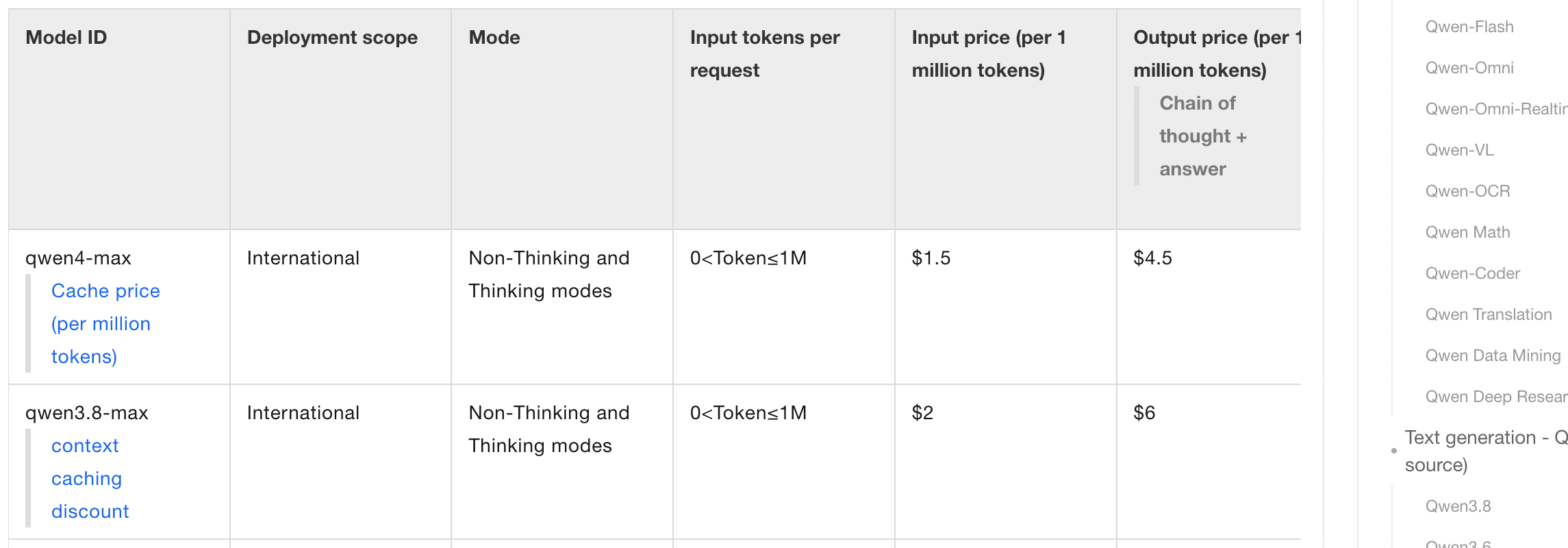
According to Alibaba Cloud’s Model Studio rate card, Qwen4 Max’s Singapore API rates are $1.50 per million input tokens and $4.50 per million output tokens (checked November 17, 2026). For the same uncached input and output token counts, that is 25% below Qwen3.8 Max; conversely, Qwen3.8 Max is 33⅓% higher than Qwen4 Max. It is a rate comparison, not a promise that a completed task will cost 25% less. The separate Token Plan uses subscription quotas and credits, so keep those figures out of an API estimate.
For preview history, see the Qwen4 Max preview guide. This page covers the generally available model and current published rates; the official update lists Qwen4 Max as available from November 16.
Key takeaways
Singapore list rates are $1.50/M input and $4.50/M output for Qwen4 Max; Qwen3.8 Max is $2/M and $6/M on the same official page.
The equal-token rate reduction is 25%. Quality, retries and token use determine actual cost per accepted result.
Cached input has its own listed rate. Cache creation, model tools, taxes and other charges need separate billing rules.
Token Plan and API pay-as-you-go billing are different products.
Recheck the official price page before committing to a budget.
Current API rates at a glance
Official Alibaba Cloud Model Studio rates, Singapore region, checked November 17, 2026. USD per one million tokens. Context limits are not the same as a usable input budget; thinking-mode requests have a documented 983,616-token input cap. Check the current endpoint and mode limits before sizing a request.
| Model | Uncached input | Cache read | Output | Same-volume comparison |
|---|---|---|---|---|
| Qwen4 Max | $1.50 | $0.075 | $4.50 | Reference |
| Qwen3.8 Max | $2.00 | See official regional cache table | $6.00 | 33⅓% higher on input/output |
The official Singapore table lists Qwen4 Max cache writes at $1.875/M for five minutes and $3.00/M for one hour, with cache reads at $0.075/M. Qwen3.8 Max uses its own region-specific cache rate; check the official context-cache pricing and Model Studio table. A cache write is not the same billing event as a cache read. This calculator estimates recurring cached-input reads and output; it does not estimate initial cache creation, tools, taxes, or plan credits.
Local calculator
Estimate Qwen4-Max API costs
Enter billed tokens per request. Values stay in your browser.
Singapore
Beijing, Hong Kong, Frankfurt, Virginia and Tokyo
Model Studio list prices in USD. Include thinking tokens in output. Cache writes, free quota, tools, taxes and subscriptions are excluded. Alibaba Cloud model pricing
Two example budgets
These examples use the Singapore uncached input/output rates only. They exclude cache, retries, tools, taxes and hosting. They are arithmetic examples, not measured Qwen4 Max tasks.
| Hypothetical task | Qwen4 Max | Qwen3.8 Max | Monthly total at 1,000 tasks |
|---|---|---|---|
| 100k input + 10k output | $0.195 | $0.260 | $195 vs $260 |
| 800k input + 100k output | $1.65 | $2.20 | $1,650 vs $2,200 |
Use your request logs to replace the assumed token counts. For agent workflows, divide total spend—including failed runs and retries—by accepted tasks. A token-rate discount does not guarantee an equal reduction in completed-work cost. The agentic reasoning guide explains why tool loops add token and review costs.
Token Plan is a separate bill
The Token Plan personal overview lists subscription tiers, quotas and credits. The API pricing page lists pay-as-you-go model rates. A monthly plan price does not tell you how much API usage a given task consumes, and API rates do not describe a Token Plan quota. Check your edition, region, quota and account eligibility before comparing.
Alibaba’s November 16 release note confirms API and Token Plan availability. The earlier preview notice says the preview ran November 11–25 with temporary credit discounts. Do not apply preview benefits to standard API list prices.
What the numbers do not tell you
A rate card prices tokens, not successful work. In the GA discussion, u/maqifrnswa said increased efficiency “is an excellent goal”; another commenter questioned the Artificial Analysis index. Neither comment is pricing evidence, but they underline why list rates and one benchmark should not stand in for your own bill (thread). For your own workflow, record input, cache hits, output, tool charges, retries, completion criteria and human edits. A coding patch, a research brief and a long agent session can have very different token shapes. Compare cost per accepted result only after running the same task and pass criteria.
To inspect the rate page, compare provider terms and organize source material in a browser workspace, try Tabbit Browser. More practical browser workflows are in the Tabbit guide and AI browser explanation.
Verdict: budget from usage logs, not the headline rate
Qwen4 Max has a lower Singapore per-token list price than Qwen3.8 Max. For a new integration, estimate the bill with actual token logs and separate cache writes, plan subscriptions and API charges. For a migration, compare both models on the same task set before treating a cheaper rate as a cheaper workflow. The Qwen3.8 Max review and browser-use notes provide predecessor context.
For a model-specific overview, see the Qwen4 Max model page, the Qwen4 Max review, and the Qwen4 Max vs Qwen3.8 Max comparison.
Tabbit Browser offers Qwen4-Max. Download Tabbit, then select Qwen4-Max from the model list in Chat to start using it.
 Tabbit Browser

FAQ
What is the Qwen4 Max API price?
Alibaba Cloud’s Singapore Model Studio table lists $1.50 per million input tokens and $4.50 per million output tokens for Qwen4 Max, checked November 17, 2026. Other regions can have different list prices.
Is Qwen4 Max cheaper than Qwen3.8 Max?
At the listed Singapore rates, the same uncached input and output token counts cost 25% less with Qwen4 Max. That does not prove each task will cost 25% less.
Are Token Plan credits the same as API tokens?
No. Token Plan is a subscription service with plan quotas and credits; the Model Studio API table is pay-as-you-go. Do not convert one into the other without current provider rules.
How do I estimate a Qwen4 Max API request?
Multiply uncached input, cache reads, and output by their separate per-million-token rates, then divide by one million. Include cache creation, tools, retries, taxes, and hosting only when the official billing rules say they apply.
Does the preview discount still apply?
The official update lists the preview period as November 11 through November 25, 2026. The standard Qwen4 Max listing is separate; verify the current account and promotion page before budgeting.