
As of November 16, 2026, Google lists Gemini 4 Argon at $2 per 1 million input tokens and $10 per 1 million output tokens during its introductory period, which ends November 30. Google says standard public-access pricing of $4 input / $20 output per million tokens applies after that. Cached input is 95% cheaper than uncached input: $0.10/M until November 30 and $0.20/M from December 1. Always confirm the live API pricing page before deployment.
The date is the pricing story: the listed input and output rates double on December 1. These are Gemini API prices; a consumer subscription, Antigravity usage meter, Gemini for business contract or separate Cloud rate card is not the same bill. Google says output pricing includes reasoning tokens, so long answers and internal reasoning both affect the bill.
Key takeaways
Introductory Gemini API rate through Nov. 30, 2026: $2/M input, $10/M output; cached input is $0.10/M at a 95% discount.
Google’s public-access rates from Dec. 1: $4/M input and $20/M output; Google lists the cache rate at $0.20/M.
Estimate cost as uncached input tokens × input rate + cached tokens × cache rate + output/reasoning tokens × output rate, divided by 1,000,000.
API pricing does not calculate Gemini app, Antigravity, Workspace or Tabbit charges.
A static example is not a live quote; recheck price, region, model ID and other billable features before launch.
Gemini 4 Argon API pricing at a glance
| Gemini API text usage | Through Nov. 30, 2026 | From Dec. 1, 2026 | Notes |
|---|---|---|---|
| Uncached input / 1M tokens | $2.00 | $4.00 | Standard public-access rate |
| Cached input / 1M tokens | $0.10 | $0.20 | 95% below uncached input |
| Output, including reasoning / 1M tokens | $10.00 | $20.00 | Reasoning tokens are billed as output |
Google lists both cache rates for implicit cache reads only. Sources: Google’s Argon announcement and Gemini API pricing, checked November 16, 2026.
The date matters more than the headline
At launch, Google stated the introductory $2/$10 rate ends November 30 and standard prices become $4/$20. This doubles both uncached input and output rates. The 95% cache discount is a relative discount: it makes cache reads one twentieth of the uncached input rate, not free. It also does not mean every repeated prompt is cached; the API’s caching behavior and eligibility rules determine the billed token categories.
The announcement’s input/output figures should not be mixed with Google Cloud’s model-garden or business-platform rate cards. Geography, product, service tier and committed throughput can change the rate. The calculation below applies only to a simple Gemini API text request with the listed global rates and no other billed feature.
Cost formula and examples
For a text-only request:
request cost = (uncached input × input rate
              + cached input × cache-read rate
              + output and reasoning × output rate) ÷ 1,000,000
monthly estimate = request cost × monthly request count
This separates cached tokens from uncached tokens. Do not count the same input token in both categories. Google’s API documentation should govern any other billable modality, grounding call, storage or service-specific charge.
| Example request | Through Nov. 30 | From Dec. 1 | Arithmetic |
|---|---|---|---|
| 100,000 uncached input + 20,000 output tokens | $0.40 | $0.80 | 100k × input rate + 20k × output rate |
| 500,000 cached input + 50,000 output tokens | $0.55 | $1.10 | 500k × cache rate + 50k × output rate |
These examples cover paid Standard token charges. At 500 requests/month, the first example is $200 at introductory pricing and $400 after the change, before other charges.
Local calculator
Estimate Standard API costs
Use billed input and output tokens for one request. Values stay in your browser.
Through November 30, 2026
From December 1, 2026
Paid Gemini API Standard, USD. Output includes thinking tokens. Taxes, tools and subscriptions are excluded. Google API pricing
Subscription limits are a different question
A Reddit thread about Argon usage limits contains subscribers describing different numbers of prompts before waiting for a reset. The reports vary by plan and task and cannot establish a universal cap. A separate Antigravity thread asserts a billing mismatch based on user telemetry; we did not independently reproduce that calculation, so it is not treated here as an official rate. Check the usage meter and billing surface associated with your own account.
For model selection, see the Argon review and Argon vs Carbon comparison. For the older generation’s distinct bill, see Gemini 3.8 Flash pricing.
Verdict: budget by surface and date
Use the API formula only when you can see token counts and the applicable rate card. Put the November 30 boundary into any estimate made before December, and recalculate with the new rate for work that continues afterward. If your work uses cached context, model its uncached and cached portions separately. If you use the Gemini app or Antigravity, use that product’s own limits and usage display instead of converting a subscription allowance into API tokens.
Tabbit is a browser workspace, not an API rate card. The estimate above applies to Google Gemini API text-token charges; use Google’s current API pricing page for billing decisions.
In the usage-limit thread, Hot_Cheesecake_905 wrote, “I did 4 - 5 prompts … and I ran out of quota.” bigeddthemonk separately reported, “I hit the 5 hour cap with 2 queries.” They describe subscription experiences, not API rates or universal plan limits.
Related reading
Reddit evidence snapshots
Browser captures of the original discussions. Posts reflect individual experiences, not product guarantees.
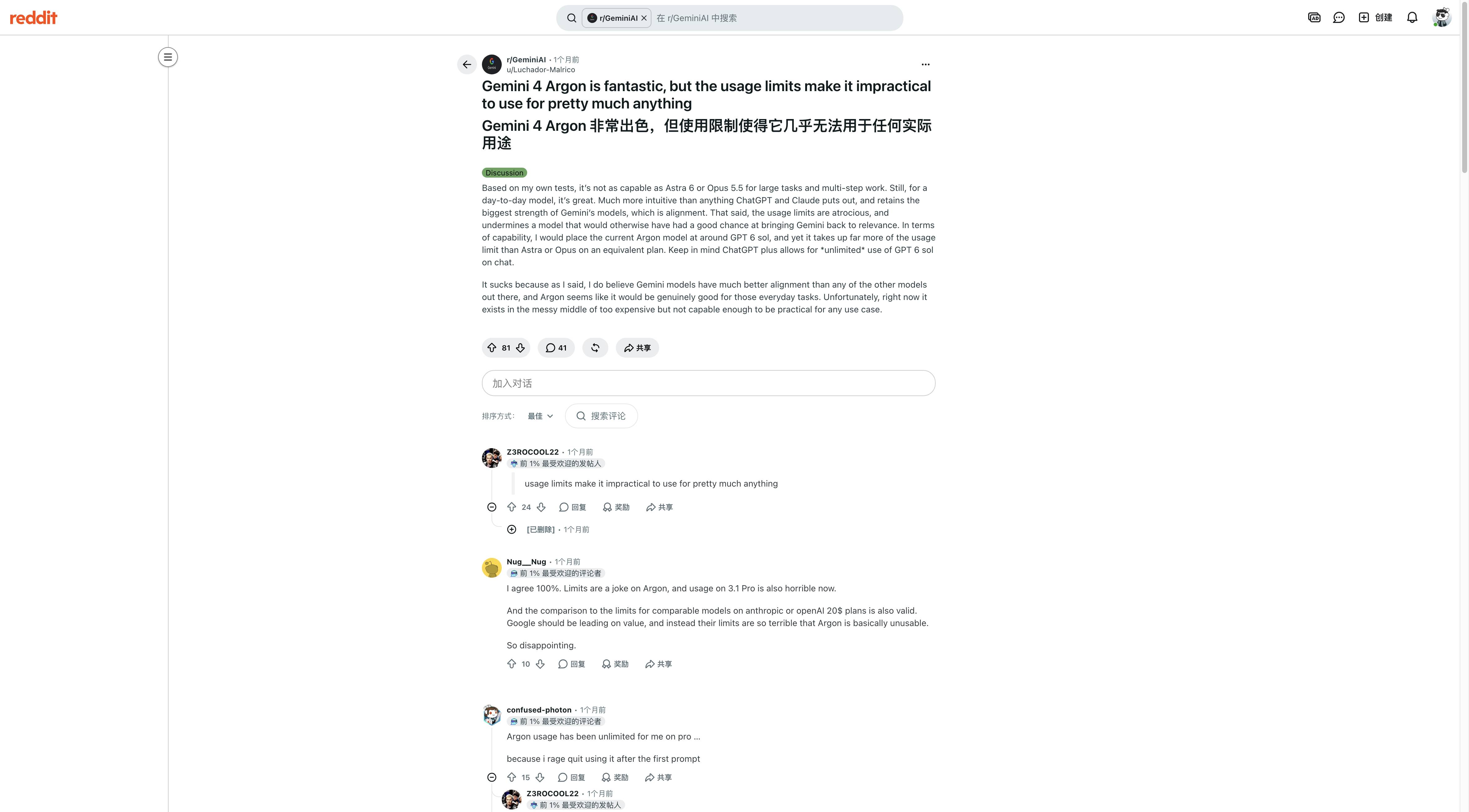
A Reddit discussion where subscribers describe different Argon usage limits; anecdotal and plan-specific. Original Reddit discussion
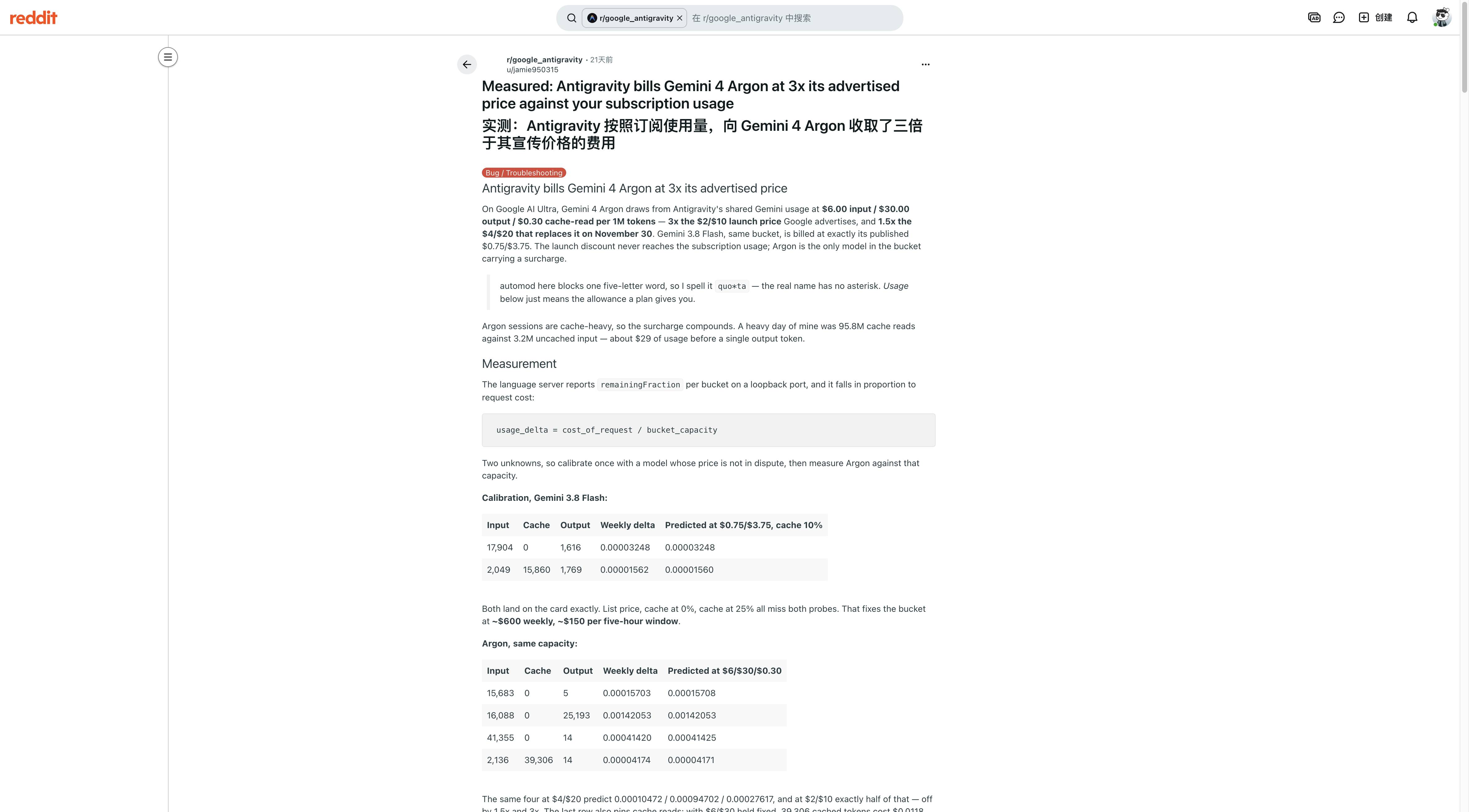
A Reddit author alleges an Antigravity metering discrepancy; the claim was not independently reproduced. Original Reddit discussion
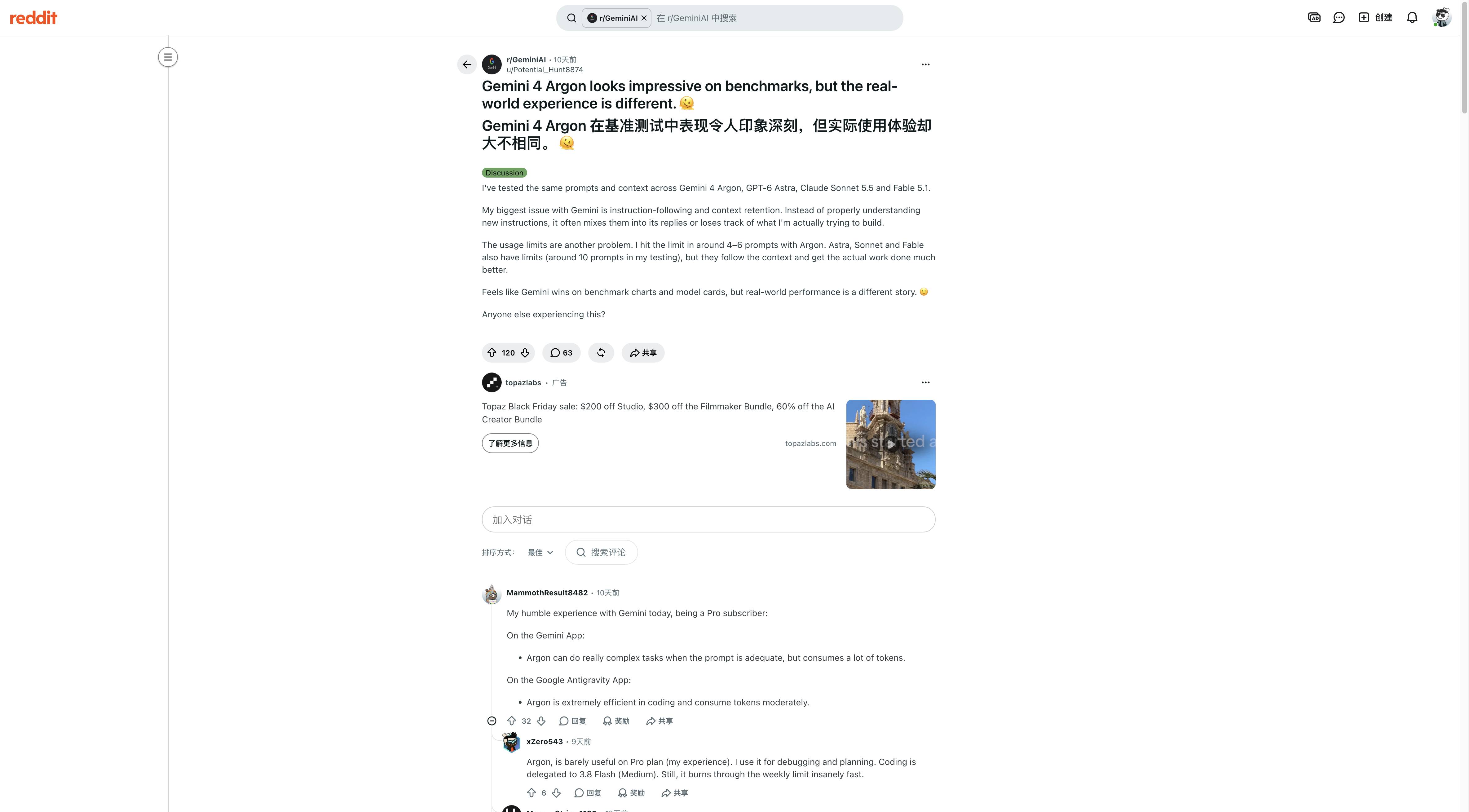
MammothResult8482 compares Gemini app and Antigravity usage; posted about 10 days before collection. Original Reddit discussion
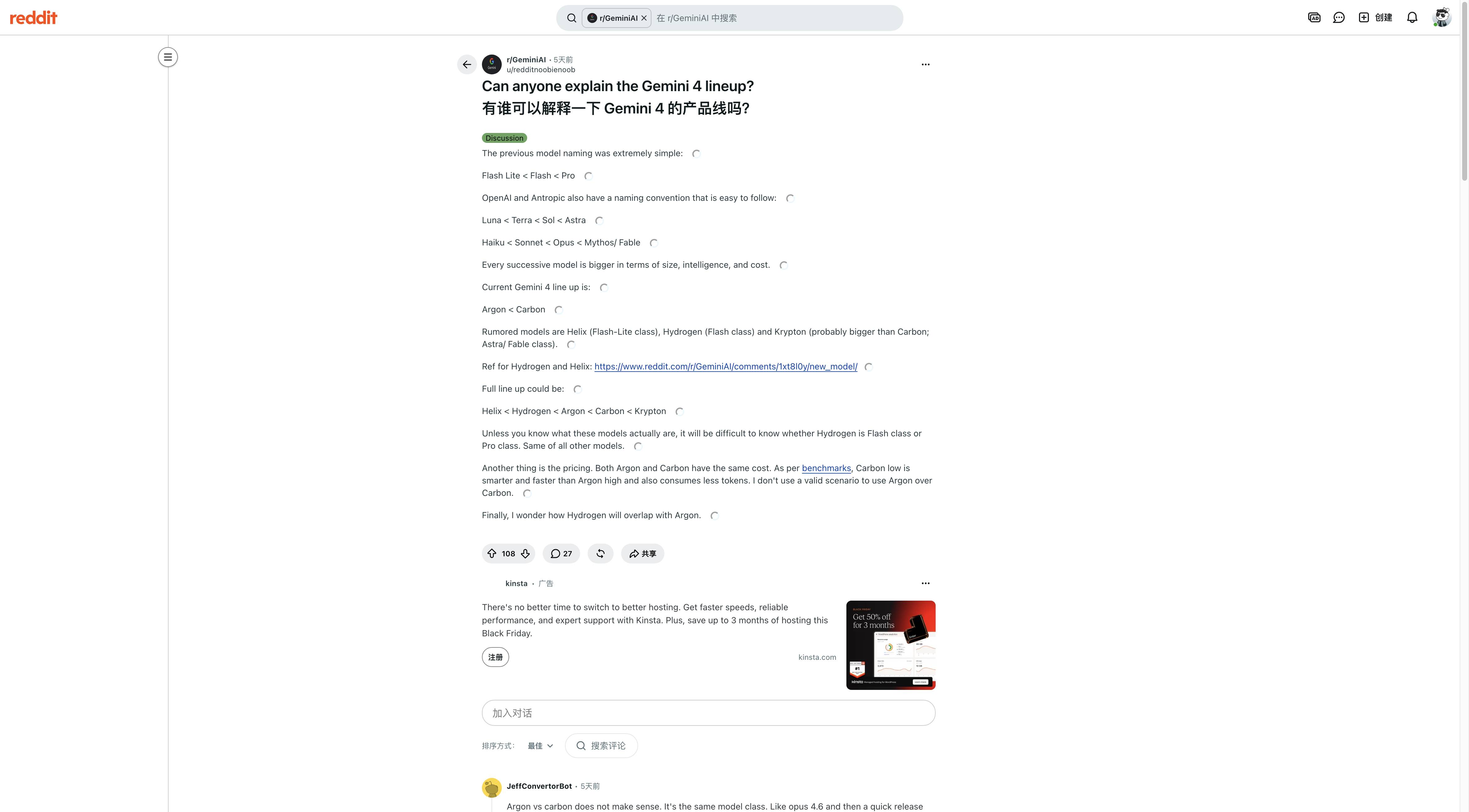
A Gemini lineup discussion where commenters question what Argon and Carbon names mean. Original Reddit discussion

FAQ
What is the Gemini 4 Argon API price?
Through November 30, 2026, Google lists $2/M input and $10/M output. From December 1, public-access rates become $4/M and $20/M. Verify the current pricing page before use.
How much is cached Gemini 4 Argon input?
Google lists $0.10/M through November 30, 2026 and $0.20/M from December 1 for implicit cache reads.
Are reasoning tokens billed?
Google’s Gemini API pricing documentation includes reasoning tokens in output billing.
Does the API rate include Gemini app or Antigravity?
No. Consumer plans, Antigravity usage and API calls use separate billing or quota systems.
How do I estimate an Argon request?
Multiply each uncached input, cached input and output/reasoning token count by its applicable per-million rate, add the results, and divide by one million.
How can I estimate monthly Argon API spend?
Multiply the per-request estimate by expected monthly requests, then add any separately billed features. Use your own token counts and the current rate card.