Official identity
MiMo-V2.5-Pro is Xiaomi MiMo’s open-source Pro model. Xiaomi lists April 27, 2026, 1.02T total parameters, 42B active parameters, and a 1M-token context window.
ROLEPLAY FIELD NOTES
The useful question is not whether MiMo-V2.5-Pro sounds impressive. It is whether a fixed character card, a live scene, and a provider route stay stable for several turns. This guide gives you a small setup you can repeat.
Xiaomi publishes a 1M-token context and the API tag `mimo-v2.5-pro`. Current Tabbit model lists checked for this page do not include MiMo-V2.5-Pro.
WHAT THE EVIDENCE SAYS
Xiaomi describes agentic work, software engineering, and long-horizon coherence. Search snippets and community posts add questions about prose, initiative, consistency, and cost. None of those posts is a controlled roleplay benchmark.
MiMo-V2.5-Pro is Xiaomi MiMo’s open-source Pro model. Xiaomi lists April 27, 2026, 1.02T total parameters, 42B active parameters, and a 1M-token context window.
SillyTavern discussions mention prose quality, character consistency, model comparisons, and whether Pro feels different from standard V2.5. Treat these as reported experiences, not universal results.
A provider can change the model ID, context cap, reasoning field, prompt format, or sampling defaults. A good RP preset on one route can fail on another.
| Layer | Known here | Do not infer |
|---|---|---|
| Model | `mimo-v2.5-pro` | A Flash alias is not the Pro model. |
| Context | 1M on Xiaomi’s Pro page | Your API route may expose less. |
| Thinking | Serving layer decides fields | No universal SillyTavern toggle is guaranteed. |
| RP quality | Needs your own fixed-turn test | Coding benchmarks do not measure character voice. |
THE RP CONTROL PANEL
When a character drifts, changing everything at once hides the cause. Keep the card and opening scene fixed, then inspect one lever at a time.
Give the card a short voice block, specific prohibitions, and two concrete memories. Refer back to the current scene instead of repeating the whole biography.
Ask for one bounded action and a visible consequence. State what the character may decide and what must remain with the user. This reduces both passivity and unwanted control.
Watch sentence openings, stock gestures, repeated metaphors, and the same emotional beat. Compare several replies before raising repetition penalties.
Count card, examples, lorebook entries, author note, history, reasoning, and reply budget together. A 1M headline is not the request limit of every provider.
If a route exposes reasoning, run paired turns with it on and off. More internal tokens can help planning, but they can also alter latency, visible format, and reply length.
A SMALL TEMPLATE
Use this as a test scaffold. Replace the brackets, keep the first scene identical across providers, and avoid copying community prompts that make safety claims you cannot verify.
[Role]
Name: {{character_name}}
Voice: {{three concrete voice traits}}
Boundaries: The user controls {{user_character}}. Never decide their private thoughts or actions.

[World]
Place: {{location}}
Known facts: {{two facts that matter now}}

[Current scene]
Time: {{time}}
Immediate tension: {{open question}}

[Turn contract]
Write one scene beat. Let {{character_name}} take one plausible action, then leave a clear opening for the user. Keep details consistent with the card. Do not repeat the same gesture or sentence shape.
The template is a test instrument, not an official Xiaomi prompt. Keep the instruction visible in your own notes so you can compare edits.
PROVIDER LAB
Record the connection details with every sample. SillyTavern supports custom OpenAI-compatible endpoints, manual IDs when `/v1/models` is missing, Test Message, and prompt post-processing modes. For troubleshooting, check the key and base URL on 401 or 403, the exact model ID on 404, context size on request errors, and post-processing on format errors.
| Check | Record | Why it matters |
|---|---|---|
| ID | `mimo-v2.5-pro` or provider namespace | Copy the exact current ID. A 404 means route discovery first. |
| Context | Provider request limit | Log the cap, not only Xiaomi’s 1M specification. |
| Reasoning | Enabled field, effort, or none | Save whether reasoning was returned as a separate field. |
| Formatting | None, merge, semi-strict, strict | A route may require one system message or alternating roles. |
| Sampling | temperature, top_p, repetition controls | Keep defaults in the record before changing one value. |
| Latency | Time to first token and total time | Thinking and provider load can change perceived RP pacing. |
REPRODUCIBLE RP TEST
Community impressions help you choose what to inspect. A fixed script tells you whether a change actually helped your character.
Save the character card, template, first user message, provider, model ID, context cap, sampler, and thinking state.
Send five turns: a greeting, a remembered fact, a new constraint, a chance for initiative, and a correction. Do not edit mid-run.
Use 0 to 2 for voice, fact recall, user agency, forward motion, style variety, and format compliance. Write one quote or turn number for each score.
Test a second run with only one difference. Compare the same rubric and note latency, truncation, refusal, or repetition.
Classify the failure as card, prompt, provider, context, sampler, or safety behavior. This prevents a provider error from becoming a folklore preset.
TABBIT AS THE SOURCE DESK
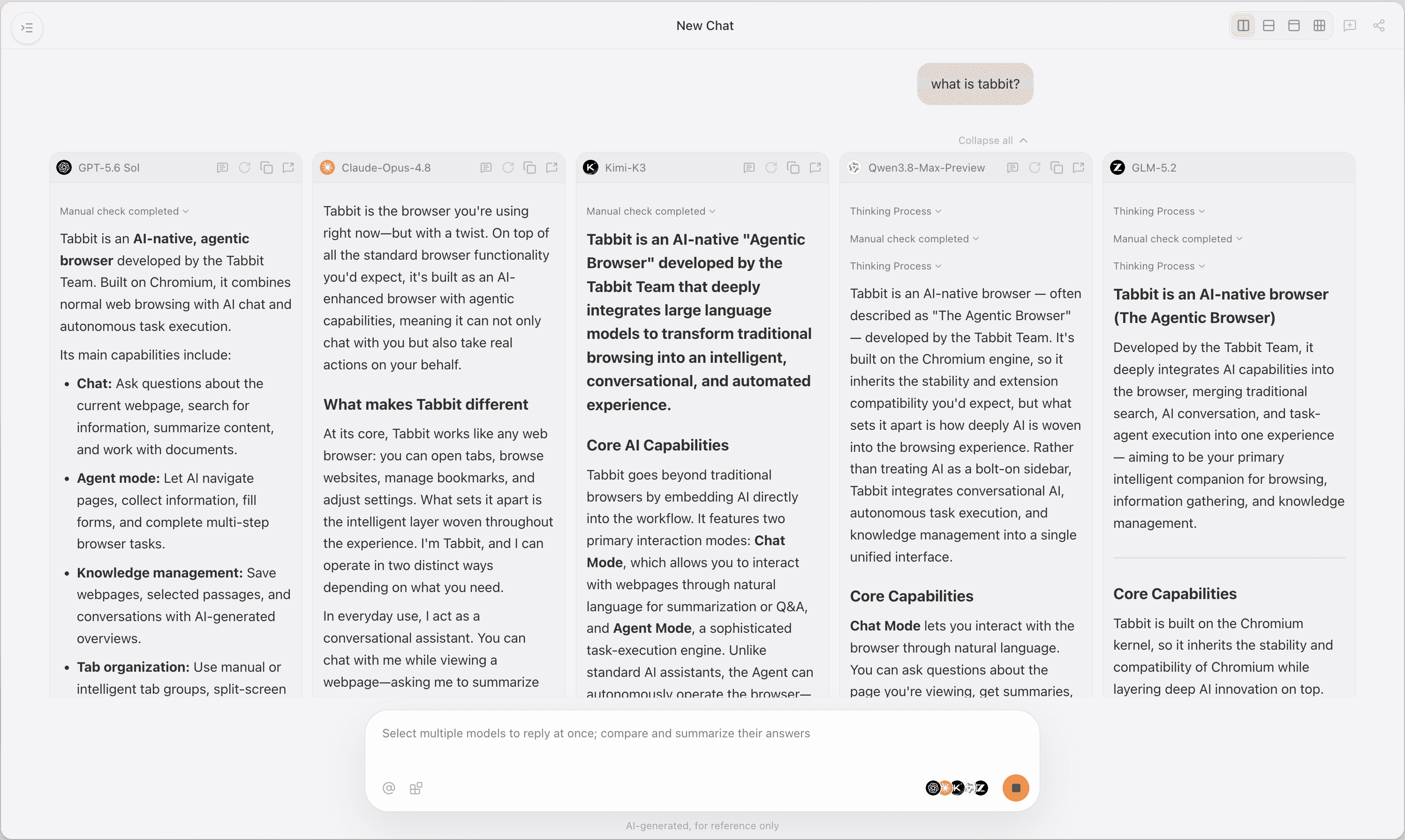
Tabbit is not a native MiMo-V2.5-Pro client according to the current visible model lists checked for this page. Its useful role is adjacent: collect source material, inspect a provider page, and compare supported models without losing the page you were reading.
Keep a character wiki, setting note, provider document, or screenshot in a Tabbit tab.
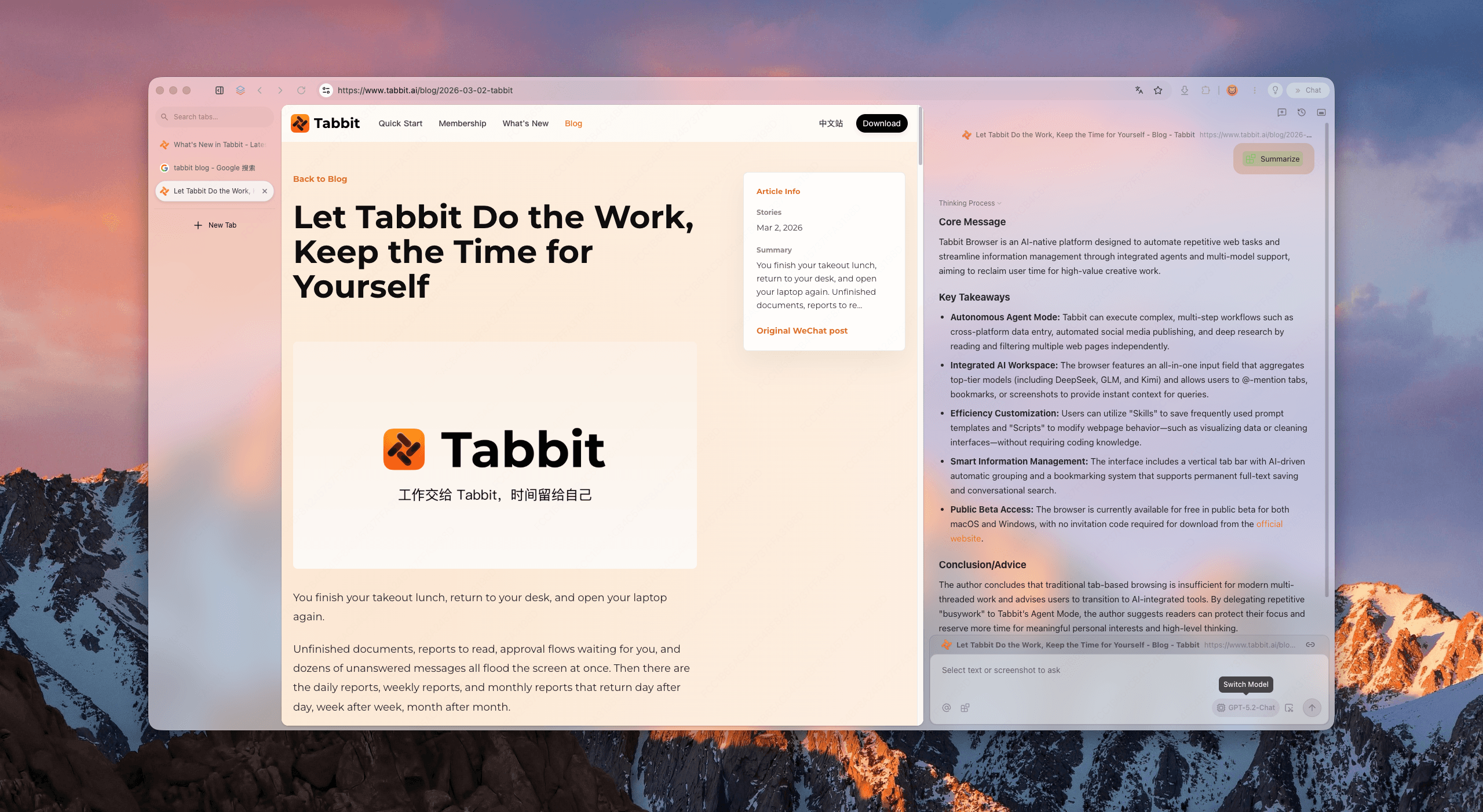
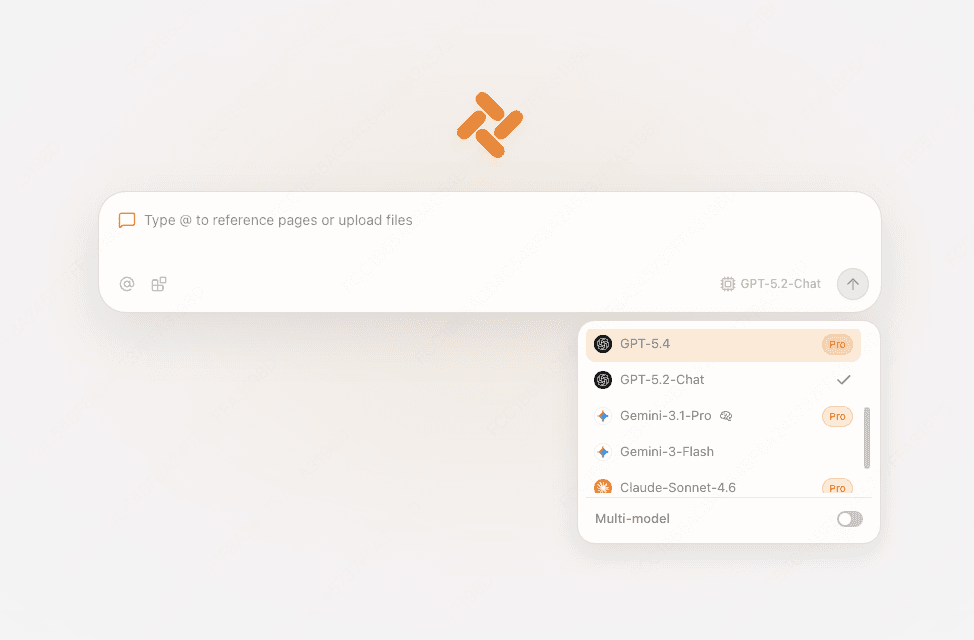
Choose a model the current picker actually shows. Availability can change with product updates.
Type `@` to bring an open page or file into the conversation. Use the result as a research note, then run RP in your specialised client.
FAQ
Xiaomi publishes MiMo-V2.5-Pro and says to use the API tag `mimo-v2.5-pro`. A provider can add a namespace, so copy its current model list when configuring a client.
No. It is the official Pro context specification. Your provider may cap requests, and the card, lorebook, history, reasoning, and reply all share the request budget.
Only when the provider documents the field for this route. Compare matched turns with thinking on and off because it can change latency, format, and response length.
First freeze the card and inspect repeated instructions, examples, and history. Then change one sampler or post-processing value and compare several turns. A single reply is weak evidence.
Give the character one bounded decision and state that the user owns their private actions. Score whether the reply creates a next move without deciding for the user.
No universal preset is established by the sources checked here. Provider defaults, prompt format, reasoning fields, and context caps differ.
The current visible Tabbit model lists checked for this page do not include MiMo-V2.5-Pro. This page does not promise a native endpoint. Tabbit can still hold reference pages beside a model it currently lists.
No. It focuses on reproducible writing tests, provider behavior, user agency, and ordinary safety boundaries. User reports that mention uncensored or jailbreak variants are not treated as instructions or quality evidence.
Fix the card, scene, provider details, and rubric before you tune. Keep research pages close in Tabbit, then choose the model route that your client actually exposes.
Available for macOS and Windows. Model availability and provider settings can change.