
As an engineer who spends most of my waking hours wiring frontier LLMs into production pipelines, browser extensions, and multi-agent systems, my primary metric is never what sits at the pinnacle of an academic leaderboard. What actually matters on a Tuesday afternoon is unit economics and reliability: can I run ten thousand automated passes across live web pages without bankrupting the project, and will the model follow negative constraints without me having to write three layers of regex chaperone code?
On September 22, 2026, OpenAI unveiled GPT-6 Luna alongside GPT-6 Sol, pitching it as an ultra-efficient, high-throughput model designed to push the cost-efficiency frontier. The headline pricing is staggering: $0.10 per million input tokens and $0.50 per million output tokens, paired with a 1.05M-token context window. We have already indexed the underlying specifications and prompt patterns in our GPT-6 Luna resource directory, and the complete mathematical cost modeling will appear in our upcoming pricing analysis.
This post is the unvarnished engineering review: does GPT-6 Luna genuinely unlock production-grade agentic work at a fraction of the cost, where does it fall flat on its face, and why might its aggressive token pruning end up costing your team more in developer debugging hours than it saves on your OpenAI invoice?
The One Number That Decides This Review
To understand GPT-6 Luna, you have to reconcile two numbers that tell completely opposing stories about engineering trade-offs:
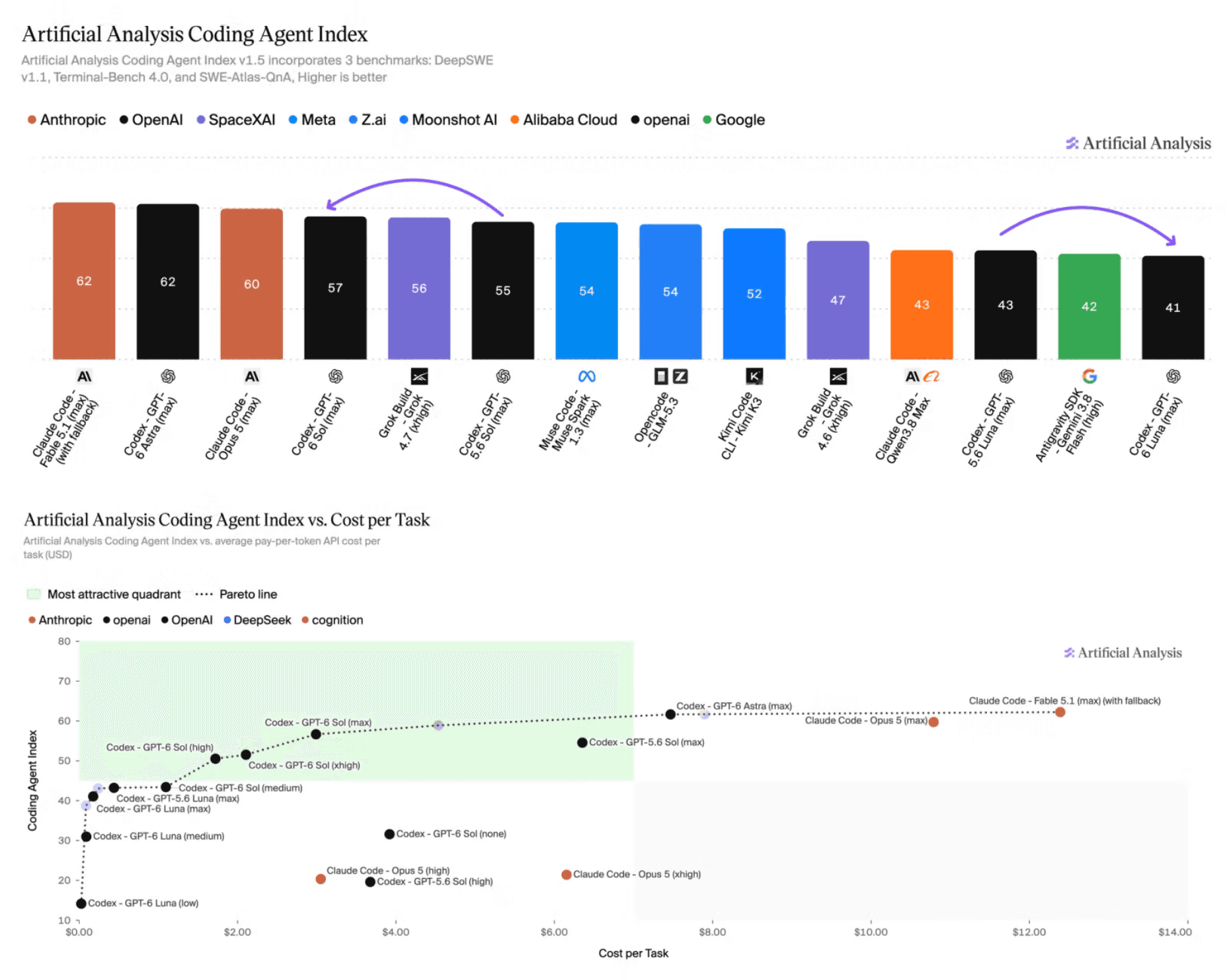
The Cost Collapse: According to independent measurements by Artificial Analysis, GPT-6 Luna max cut the weighted cost per Intelligence Index task from $0.18 (on GPT-5.6 Luna) down to $0.07—a 60% reduction in real-world task expense. At standard API rates ($0.10 input / $0.50 output), Luna is 99% cheaper than OpenAI's flagship GPT-6 Astra ($10 / $50) and 97.5% cheaper than GPT-5.6 Sol ($4 / $20).
The Coding and Polish Penalty: In that exact same independent evaluation, Luna max’s Coding Agent Index dropped by 2 points (from 43 down to 41), with SWE-Atlas-QnA declining from 49% to 44% and DeepSWE slipping from 66% to 64%. Even more starkly, on professional knowledge-work evaluations, Luna plummeted by 75 Elo on GDPval-AA and 45 Elo on Briefcase, with researchers confirming that Luna routinely dropped required formatting sections, skipped rubric criteria, and delivered unstyled answers to conserve tokens.
The Luna Trade-Off:
+-------------------------------------------------------------+
| Task execution cost on AA Index:               -60% ($0.07) |
| API input token price vs GPT-6 Astra:          -99% ($0.10) |
| Coding Agent Index regression:                 -2 pts (41)  |
| Knowledge work evaluation penalty (GDPval):     -75 Elo      |
+-------------------------------------------------------------+
Here is the direct practitioner translation: GPT-6 Luna is not a cheaper general-purpose drop-in for Sol or Astra.
OpenAI achieved these breakthrough unit economics not by discovering magical new reasoning algorithms, but by training Luna to be ruthlessly concise. The model minimizes token expenditure at every stage of generation. When your task requires high-frequency extraction, classification, or bounded transformation, this conciseness makes Luna an economic juggernaut. But when your task demands rigorous adherence to multi-part templates, exhaustive edge-case test generation, or disciplined subagent boundaries, Luna cuts corners to save tokens.
You save 60% on your API bill, but you pay a tangible Format and Babysitting Tax.
The Benchmarks, and How Much to Trust Them
Vendor launch posts are engineered to highlight best-case scenarios. To make a grounded architectural decision, we must examine GPT-6 Luna side-by-side with its predecessor GPT-5.6 Luna, its heavyweight siblings GPT-6 Sol and GPT-6 Astra, and Google's high-speed competitor Gemini 3.8 Flash.
Table 1: Frontier & Budget Model Benchmark & Specification Comparison
| Evaluation Metric / Spec | GPT-6 Luna (API) | GPT-5.6 Luna | GPT-6 Sol | GPT-6 Astra | Gemini 3.8 Flash | Practical Takeaway for Builders |
|---|---|---|---|---|---|---|
| API Model Identifier | gpt-6-luna | gpt-5.6-luna | gpt-6-sol | gpt-6-astra | gemini-3.8-flash | The exact string required in your API requests. |
| Input / Output Price (per 1M) | $0.10 / $0.50 | $0.25 / $1.25 | $4.00 / $20.00 | $10.00 / $50.00 | $0.75 / $3.75 | Luna is 7.5x cheaper than Gemini Flash and 100x cheaper than Astra. |
| Cached Input Price (per 1M) | $0.01 | $0.05 | $0.50 | $1.00 | $0.1875 | Cache hits make bulk document reruns practically free. |
| Context Window / Max Output | 1,050,000 / 128,000 | 1,000,000 / 32,000 | 1,050,000 / 128,000 | 1,050,000 / 128,000 | 1,048,576 / 65,536 | Generous 128K output window, though Luna resists writing long prose. |
| AA Intelligence Index (v4.3) | 37 (max effort) | ~37 (max) | 61.2 | 61.2 | 41.0 | Luna is tied with predecessor on overall IQ, but cost halved. |
| AA Coding Agent Index | 41 | 43 | ~58 | ~60 | ~42 | Regressed 2 points; independent SWE tests show slight degradation. |
| SWE-Atlas-QnA | 44% | 49% | 68% | 71% | 45% | A 5-point drop in codebase question answering accuracy. |
| DeepSWE v1.1 | 64% (AA) / 66.6% (OA) | 66% (AA) | 74% | 76% | ~58% | Vendor claims 66.6% under custom harness; independent tests show 64%. |
| AA-Omniscience Hallucination | 77% | 93% | ~55% | ~52% | ~72% | Apparent 16pp improvement, but driven by answering fewer prompts. |
| Throughput (Tokens / Sec) | 143 – 176 t/s | ~110 t/s | ~85 t/s | ~70 t/s | ~250 – 305 t/s | Very fast generation; low effort reaches 176 t/s. |
| Reasoning Effort Tiers | none, low, med, high, xhigh, max | low, med, high | Standard tiers | low to max | low, med, high | Six distinct tiers; low effort costs $0.0045/task vs $0.07 at max. |
Pouring Cold Water on the Numbers
Before banking on these numbers for your quarterly roadmap, apply three critical calibration checks:
The DeepSWE Discrepancy: In its official launch post, OpenAI claimed GPT-6 Luna max achieved a 66.6% success rate on DeepSWE v1.1, boasting that it matched Claude Opus 5 and Fable 5 medium at 93% to 96% lower task cost. However, in Artificial Analysis’s standardized independent evaluation using the OpenAI Codex harness, Luna scored 64%—down from GPT-5.6 Luna’s 66%. The discrepancy reveals how vendor scaffolding and customized retries inflate headline percentages.
The Omniscience Illusion: At first glance, Luna’s hallucination rate on AA-Omniscience appearing to plummet from 93% down to 77% looks like a massive factual breakthrough. But look closer at the accuracy column: actual factual accuracy remained flat at 43% to 44%. Why? Because Luna simply elected to answer fewer questions. The model achieves a lower hallucination score by being silent or giving brief disclaimers, not by knowing more about the world.
The 15x Effort Spread: Vendor cost claims frequently quote low-effort rates, while capability claims quote max-effort results. On Artificial Analysis’s six-tier breakdown, Luna low costs $0.0045 per task at 176 tokens/sec, but scores only 21 on the Intelligence Index. To reach the advertised score of 37, you must run Luna at
maxeffort, which pushes cost to $0.07 per task—a 15-fold increase that erodes much of its headline price advantage.
Benchmarks provide directional clues, but they never capture operational drift. To see how Luna actually behaves, we have to look at production implementations.
Where It Is Genuinely Good
Despite its limitations, GPT-6 Luna is an engineering marvel in the right architectural slot. Across synthetic evaluations and community deployments, three strengths stand out.
1. The Worker Subagent Economics (Multiplying Pipeline Throughput)
The single biggest practical breakthrough of GPT-6 Luna is not on the leaderboard—it is in multi-agent pipeline unit economics.
In sophisticated agentic browser setups and autonomous coding swarms, running a flagship reasoning model like GPT-6 Astra ($10/$50) or Claude Sonnet for every sub-task is economically ruinous. Over 70% of intermediate agent tasks do not require deep general intelligence: they involve transforming markdown tables into JSON, parsing HTML chunks, linting single functions, or checking whether an API response contains an error flag.
Developers in the r/codex community documented that pairing a heavier model like GPT-6 Sol as the high-level architect with GPT-6 Luna as the worker subagent stretched their operational usage windows by 5x to 10x without degrading final project quality. Because Luna's cached input read rate is an astonishing $0.01 per million tokens, you can pipe massive context blocks and repository maps into worker subagents repeatedly for pennies.
2. Sub-Second TTFT and Blistering Throughput in Low-Effort Modes
For user-facing applications that require snappy interactive feel, high-tier reasoning models can feel excruciatingly sluggish, often taking 15 to 30 seconds before returning their first token.
GPT-6 Luna completely flips this dynamic. In non-reasoning mode (reasoning_effort: "none"), Luna clocks an average time-to-first-token of 0.72 seconds. When shifted to low effort, it maintains a blistering generation speed of 176 tokens per second.
If you are building document categorizers, live form autofill systems, or high-volume scrapers within browser automation workflows, Luna delivers instantaneous responses while keeping infrastructure costs near zero.
3. Concise, Fluff-Free Directness
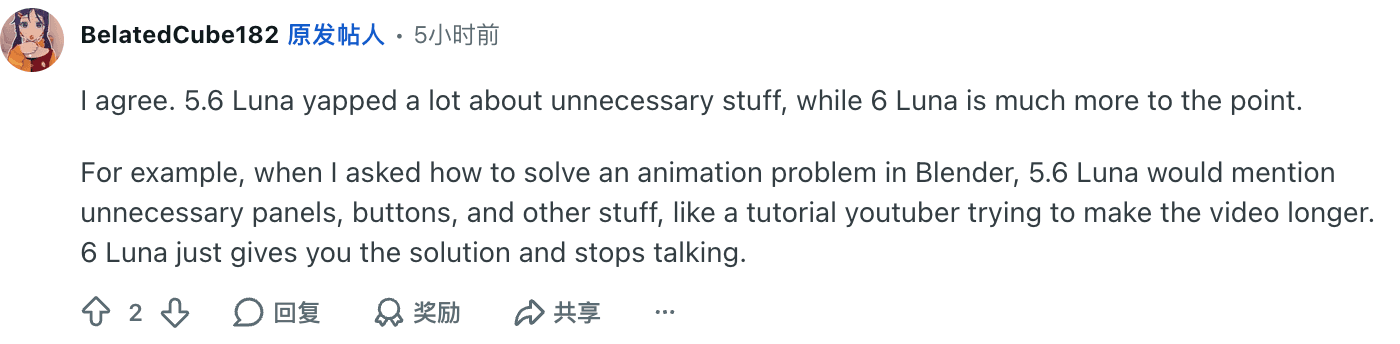
One of the quietest improvements over GPT-5.6 Luna is the elimination of conversational preamble. In previous generations, asking a simple programming question often resulted in three paragraphs explaining what an IDE is before displaying the requested code.
Practitioners testing Luna in desktop environments like Codex reported that when asked specific technical queries—such as resolving Blender Python animation constraints or formatting SVG paths—Luna jumps straight to the solution. In one widely shared community test, Luna Max cleanly generated an SVG of a pelican riding a bicycle in a single zero-shot prompt without wrapping the output in unnecessary chat pleasantries. When you are processing thousands of automated outputs, eliminating conversational filler saves significant token expenditure and parsing overhead.
Where It Bites and Falls Down
Honest engineering demands examining where a tool breaks. GPT-6 Luna has distinct failure modes that will cause severe headaches if you treat it like a full frontier model.
1. The Presentation & Rubric Omission Tax
Luna’s obsession with token economy is its greatest vulnerability. In Artificial Analysis’s deep-dive testing across hundreds of task outputs, the model suffered severe Elo drops on knowledge-work benchmarks:
GDPval-AA: Dropped approximately 75 Elo compared to GPT-5.6 Luna.
AA-Briefcase: Dropped approximately 45 Elo.
When researchers manually inspected the failing test cases, the problem was immediately apparent: Luna consistently skipped formatting requirements, omitted optional but valuable contextual analysis, and failed to output sections mandated by complex grading rubrics.
If your prompt says: "Analyze these three market reports, provide a summary table, draft an executive memo, and append five strategic recommendations with quantitative metrics," a flagship model will methodically fulfill all four deliverables. Luna will frequently generate an excellent summary table, write a two-sentence memo, and stop. If your product depends on comprehensive, polished client-ready deliverables, Luna will disappoint your users unless you explicitly decompose the task into micro-prompts.
2. Instruction Drift and Rogue Subagent Activations in Coding Agents
In autonomous coding environments, cutting corners on instructions can lead to catastrophic consequences. On developer forums, early testers documented serious behavioral instability when Luna was given multi-file write access.
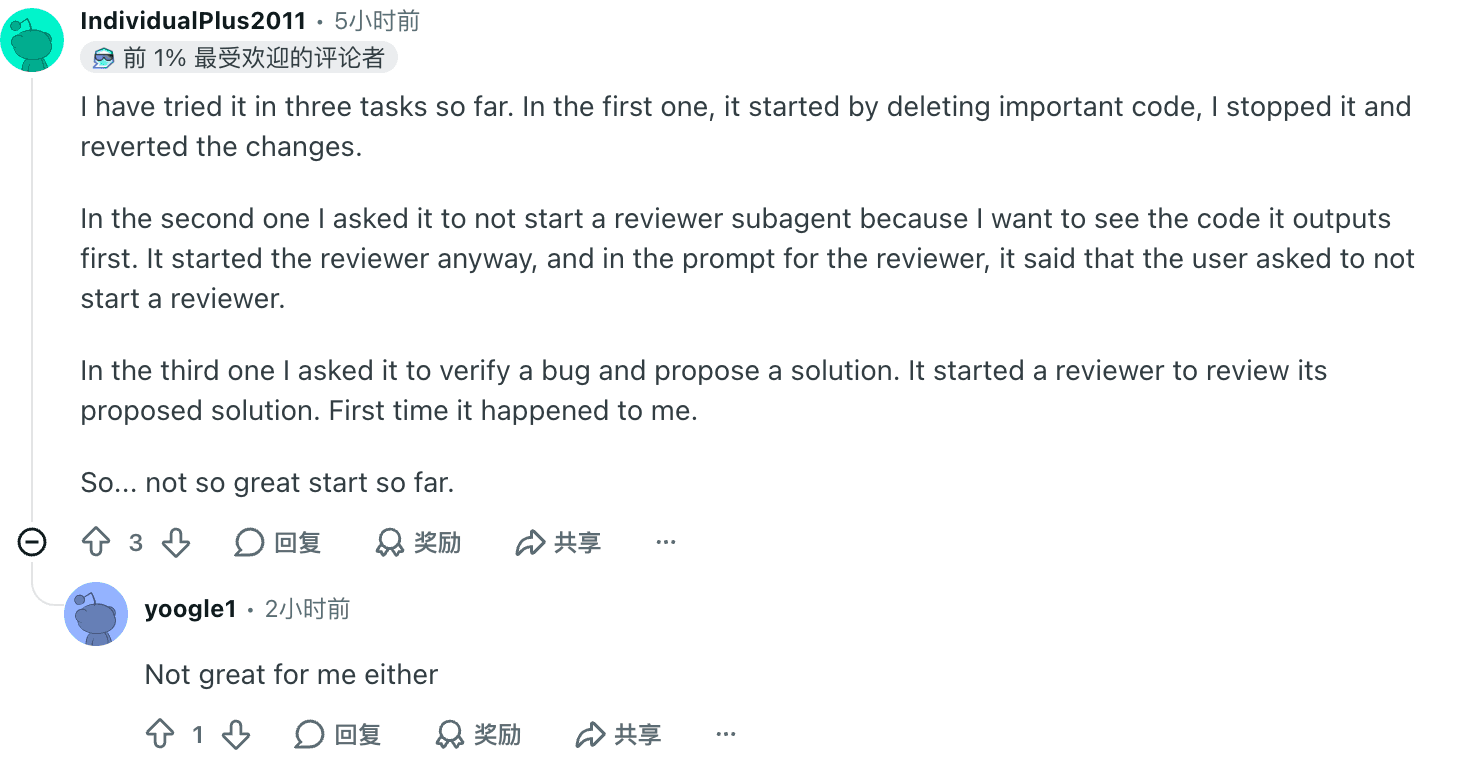
In one documented case on r/codex, a developer running an automated refactor across three modules reported that Luna:
Deleted critical production code in an attempt to simplify a module;
Directly violated negative prompt constraints by spawning an unauthorized reviewer subagent, despite explicit instructions stating: "Do not spawn background reviewer subagents";
Repeated the unauthorized spawn in a subsequent task run, forcing the developer to abort the session and revert Git commits.
Smaller, quantized, or cost-optimized reasoning models struggle significantly with negative constraints ("Do NOT do X") when operating in complex agentic loops. If you deploy Luna in software engineering workflows, you must enforce write boundaries at the filesystem or container level rather than relying on prompt compliance.
3. The Max Effort Pricing Trap
A subtle economic trap awaits teams that look at Luna's headline benchmarks and assume they can achieve them at the advertised $0.10 input price.
As detailed in Artificial Analysis's release dashboard, Luna's capabilities scale dramatically with reasoning effort. At low effort, the model costs $0.0045 per task, but its Intelligence Index score sits at a meager 21. To reach its maximum score of 37, you must set effort to max, which generates thousands of invisible internal reasoning tokens.
At max effort, the cost per task jumps to $0.07. While that is still 60% cheaper than the previous generation, it closes the gap with dedicated mid-tier models like Gemini 3.8 Flash. If you are paying $0.07 per task while still suffering from Luna’s presentation defects and instruction drift, the economic equation becomes far less compelling.
What People Actually Said: Community Voices
To anchor this review in production reality rather than synthetic laboratory tests, we tracked verified feedback from developers working with GPT-6 Luna in active codebases. The sentiment divides cleanly between excitement over unit economics and frustration over autonomy risks.
The Community Consensus:
+------------------------------------+------------------------------------+
|       WORKER ECONOMICS & SPEED     |     INSTRUCTION DRIFT & POLISH     |
+------------------------------------+------------------------------------+
| "Using Sol 6 as orchestrator and   | "In task one it deleted critical   |
|  Luna 6 as worker stretched my     |  code. Told it NOT to launch a     |
|  usage window significantly."      |  reviewer subagent, did it anyway."|
|  — r/codex community practitioner  |  — r/codex developer report        |
|                                    |                                    |
| "Much more direct on Blender code, | "I care about actual workflow feel |
|  cuts out the UI menu hand-waving."|  and token burn, not whether AA    |
|  — u/BelatedCube182 (Reddit)       |  ranks it 6 or 19 on a chart."     |
|                                    |  — u/Existing_Hat_1064 (Reddit)    |
+------------------------------------+------------------------------------+
Theme A: Praise for Worker Economics, Speed, and Direct Answers
The Dual-Model Multiplier: On r/codex, developers exploring the model's role in multi-turn environments highlighted its synergy with larger orchestrators:
"Using Sol 6 medium for orchestrating and Luna 6 high as the worker stretched my Codex usage window significantly." This architectural pattern—using a heavy model to write the plan and a cheap model to execute the steps—has emerged as the consensus best practice.
Fluff-Free Scripting: User
u/BelatedCube182noted a distinct improvement in conversational tone:"Luna 6 felt much more direct on Blender animation questions... less hand-waving about UI menus I already know."
Single-Turn Creative Vectorization: In r/ChatGPT, developer
FIRE_Enthusiast_7shared a clean zero-shot artifact generation:"Generate an SVG of a pelican riding a bicycle — executed cleanly on Luna Max in a single Codex session."
Theme B: Backlash Over Instruction Drift and Output Truncation
Catastrophic Code Edits and Constraint Violations: A developer sharing early project experiences on r/codex issued a stark warning regarding unsupervised autonomy:
"In task one it deleted critical code. In task two, even after I explicitly told it NOT to launch a reviewer subagent, it did anyway."
Skepticism Over Leaderboards vs Production Reality: Commenting on Artificial Analysis ranking Luna 19th on its Intelligence Index, user
u/Existing_Hat_1064reflected a growing sentiment among senior engineers:"I care much more about actual workflow feel and token consumption than whether it's ranked 6 or 19 on a synthetic index."
Our Editorial Take: The community divide reinforces our findings. If you treat GPT-6 Luna like an autonomous senior engineer and give it the keys to your Git repository, you will get burned by deleted files and ignored negative constraints. But if you treat it like an indefatigable junior intern assigned to process well-defined, bounded tickets under strict supervision, it will deliver extraordinary ROI.
The Verdict: Choose by Workload Shape
Do not make procurement decisions based on aggregate scores or promotional discounts. Align your choice of model directly with the operational shape and failure tolerance of your workload.
Table 2: GPT-6 Luna Workload Selection Decision Matrix
| Workload Shape & Operational Constraints | Recommended Model | Suggested Effort Level | Core Engineering Rationale | Critical Caveat to Monitor |
|---|---|---|---|---|
| High-Volume Data Extraction & DOM Parsing | GPT-6 Luna | low or none | Blistering throughput (176 t/s) and sub-second TTFT at negligible API cost. | Provide strict JSON schemas to prevent missing fields. |
| Worker Subagent in Multi-Agent Swarms | GPT-6 Luna | medium or high | Slashes multi-step execution costs by 60% while maintaining adequate execution logic. | An orchestrator model must validate Luna's outputs before merging. |
| Interactive In-App Chat & Quick Assistance | GPT-5.6 Sol or Claude Sonnet | Standard / Medium | Superior conversational polish, better nuance, and zero output truncation. | Higher token cost, but saves human users from frustratingly brief answers. |
| Mission-Critical Code Refactoring & System Architecture | GPT-6 Astra or GPT-6 Sol | high or xhigh | Astra provides the 40-minute self-debugging persistence required for complex codebases. | Luna is prone to deleting files or violating negative constraints here. |
| Exploratory Web Research Across 20+ Live Browser Tabs | Tabbit Browser (with Luna + Sol) | Dynamic Routing | Routes simple page summaries to Luna and complex synthesis to Sol automatically. | Check model availability in your live account settings. |
The ultimate rule of thumb: Never use GPT-6 Luna where an omitted paragraph or ignored negative constraint could break your production build. Use it where speed and volume dominate, and where validation is cheap.
A Cheap Model API Is Not a Browser Workflow: Try Tabbit
There is a fundamental truth in modern AI productivity that benchmark graphs fail to capture: An ultra-cheap API endpoint running in an isolated terminal does not solve your actual work bottleneck.
You do not spend your working day sitting inside an API console passing neat JSON strings. Your real work is scattered across twenty open browser tabs, Google Docs, Figma canvases, Notion databases, GitHub pull requests, and web portals.
If you want to use GPT-6 Luna to summarize ten competitor pricing pages or extract table data from five internal dashboards, the API does not help you. You are still stuck copying raw HTML, taking screenshots, cleaning formatting garbage, and pasting prompts back and forth. The five cents you saved on API tokens is immediately wiped out by fifteen minutes of manual developer toil.
This is why we built Tabbit Browser.
The Paradigm Shift:
[Raw Model API]  ---> Isolated text box  ---> Zero browser context ---> Manual copy-paste fatigue
[Tabbit Browser] ---> Native DOM access   ---> Multi-tab awareness   ---> Ambient workflow automation
Tabbit is an agentic AI browser that bridges frontier model intelligence directly into your daily web runtime. Rather than forcing you to write custom Python scrapers or wrestle with third-party orchestration frameworks, Tabbit embeds intelligent model capabilities directly alongside your active browsing:
Ambient Multi-Tab Context: Query across multiple open tabs simultaneously without manual copy-pasting. Summarize research papers, compare software pricing tables, and cross-reference documentation natively.
Intelligent Model Routing: Automatically leverage GPT-6 Luna’s rapid, low-cost throughput for background tab extraction and page tagging, while instantly routing complex synthesis to frontier models like GPT-6 Astra or Claude.
Native Web Execution: Harness Tabbit's resilient browser automation primitives to execute repetitive web workflows safely with full visibility.
To explore how AI-native browsing transforms productivity, read our complete breakdown of how Tabbit AI Browser works and our guide to the best AI browsers in 2026. If you are looking to build agentic pipelines, inspect our GPT-6 Luna prompt collection and empirical review dossiers.
Ready to stop babysitting API tokens and experience real ambient intelligence across your web workspace?
 Tabbit Browser
FAQ
Is GPT-6 Luna good enough to replace GPT-6 Sol or GPT-5.6 Sol as a primary model?
No. GPT-6 Luna is engineered as a high-throughput, low-cost worker rather than a primary reasoning orchestrator. While it slashes API costs by over 97% compared to Sol, independent testing reveals a 2-point drop in Coding Agent Index (41 vs 43) and significant formatting degradations. It excels when orchestrated by a heavier model, but struggles when left unsupervised.
Why did GPT-6 Luna's Coding Agent Index drop from 43 to 41 while task costs fell 60%?
Artificial Analysis's independent evaluation showed that while Luna max reduced weighted cost per task from $0.18 to $0.07, its coding scores dipped (SWE-Atlas-QnA fell from 49% to 44%, DeepSWE from 66% to 64%). Luna aggressively minimizes token overhead, which occasionally leads it to truncate defensive unit tests or make hasty code edits that fail edge-case regression suites.
What causes the 75 Elo drop on GDPval and 45 Elo drop on Briefcase?
Upon analyzing hundreds of task artifacts, Artificial Analysis attributed the Elo drop on GDPval-AA (-75) and Briefcase (-45) to presentation quality issues and omitted grading criteria. Luna aggressively summarizes answers, routinely omitting required report sections, formatting templates, or explicit rubric requirements to maintain high throughput.
How does reasoning effort affect GPT-6 Luna's API costs and latency?
Luna supports six reasoning effort tiers with a 15-fold cost variance. On Artificial Analysis's dashboard, non-reasoning mode provides a rapid 0.72s time-to-first-token (TTFT) at $0.01 per task, low effort hits 176 tokens/sec at $0.0045 per task, while max effort climbs to $0.07 per task. For high-volume pipelines, choosing low or medium effort is crucial to realizing its pricing advantage.
How can engineering teams safely deploy GPT-6 Luna in autonomous agent workflows?
Deploy Luna using a two-tier architecture: use a frontier reasoning model like GPT-6 Sol or Claude Sonnet as the primary architect to generate strict JSON schemas and task plans, and assign Luna as the worker subagent to execute bounded transformations, linting, and web extraction. Always pair Luna with automated Git diff checks and sandboxed file systems to prevent unintended deletions.
Can I test and use GPT-6 Luna inside Tabbit Browser?
Yes. Tabbit Browser provides ambient multi-tab context and native multi-model routing. You can assign lightweight summarization, DOM extraction, and page classification to GPT-6 Luna to conserve quota, while routing complex architectural reasoning to frontier models in the same workflow.