
Ox Alpha is probably a GLM-5.x multimodal model served on Z.ai infrastructure. That is the strongest reading of the public clues. The more specific name, GLM-5.3 Flash, is still a community attribution. Neither OpenRouter nor Z.ai has confirmed it.
The name may be unsettled, but people are already testing the model itself. In one Reddit SVG test, a commenter noticed that Ox put a leg behind the bicycle frame, kept the bike on a road, and included a chain. It is a tiny test, but a wonderfully concrete one. The more interesting question is no longer just who built Ox Alpha. It is whether the model can see relationships and make useful things.
This article follows the story from the anonymous preview to the GLM fingerprints, then separates official GLM-5.3 numbers from Ox Alpha anecdotes. If you would rather test the working theory than debate the codename, Tabbit's GLM-5.3 Flash page gives the model a direct place to run text, image, and Agent tasks.
Key takeaways
OpenRouter confirms an anonymous third-party model with a 1,048,576-token context window and text, image, and video input. It does not name Z.ai or GLM.
Token counting, video-token behavior, and backend errors point toward the GLM-5.x family and a Z.ai serving stack. They do not identify an exact checkpoint.
Z.ai says the public GLM-5.3 uses the same base model as GLM-5.2, with gains coming from more post-training. That makes the "GLM-5.2 intelligence plus native multimodality" story plausible if the Flash attribution is correct.
The encouraging Ox Alpha numbers come from personal tests and single tasks. They are useful leads, not a benchmark suite.
Tabbit currently lists GLM-5.3 Flash as a model you can use. The product label is practical routing, not a substitute for a first-party identity announcement.
Ox Alpha evidence at a glance
| Claim | Current evidence | Confidence | What it does not prove |
|---|---|---|---|
| Ox Alpha is a real anonymous preview model | OpenRouter model record | Confirmed | Who developed or operates the underlying checkpoint |
| It has 1M context and multimodal input | OpenRouter's announcement says text, image, and video input | Confirmed | Visual accuracy, a stable video limit, or long-term availability |
| It belongs to the GLM-5.x family | Tokenizer, video-token, and error fingerprints collected in a technical community review | Strong inference | A weight match or public SKU match |
| It is GLM-5.3 Flash | Direct community claims, including Di Zhang's post | Unconfirmed | An official model name, API ID, or Z.ai announcement |
| It inherits GLM-5.2's base intelligence | Z.ai says public GLM-5.3 and GLM-5.2 share a base model | Conditional | That Ox Alpha uses the same checkpoint or all standard 5.3 training |
Current verdict: GLM family, likely. Z.ai hosting, likely. Exact GLM-5.3 Flash identity, not proven.
How the mystery unfolded
August 14: Z.ai releases standard GLM-5.3
Z.ai's GLM-5.3 technical post starts with an unusually useful sentence: "Scaling post-training is all we did for GLM-5.3." The company says GLM-5.3 uses the same base model as GLM-5.2. Its gains come from more environments, more varied tasks, and more post-training compute.
That gives the later rumor a believable technical shape. A faster or multimodal sibling would not need to throw away the GLM-5.2 base. It could keep that language and reasoning lineage, then add a different serving profile and native visual inputs. The existing GLM-5.2 path in Tabbit also gives users a useful baseline for comparing style and instruction following.
Still, this is a statement about public GLM-5.3. Z.ai did not mention Ox Alpha or GLM-5.3 Flash in the release.
August 21: Ox Alpha appears without a maker
OpenRouter released stealth/ox-alpha as a free preview. Its model page calls it a reasoning model for coding, sustained agent work, and production workloads. The context window is 1,048,576 tokens, with up to 131,072 output tokens.
The official X post adds the feature that changed the investigation: Ox accepts text, images, and video. Public GLM-5.3 has the long context and coding emphasis people expected, while GLM-5V-Turbo supplies the obvious vision lineage. Ox looked like those two branches had met somewhere behind a private model card.
OpenRouter also states that the model is developed and operated by an anonymous third party. Prompts and completions are retained by the provider, though not used for training, under the Stealth Model Terms. A free route is convenient. It is not a privacy guarantee.
August 23 to 25: the internet starts fingerprinting it
TechCrunch's early report captured how unstable the first guesses were. GLM was a leading theory, then some observers considered Microsoft MAI, and Reddit split in several directions.
The stronger case arrived through technical fingerprints. Jonathan Turner's August 25 review reports that Ox Alpha matched public GLM-5.3 token counts on 50 of 50 test strings. Four video samples used the same token budgets as GLM-5V-Turbo. Some Java/Spring error responses and business codes reportedly matched a public GLM-5.3 backend byte for byte.
Those clues reinforce each other, but they are not equal to a weight hash. Turner says the measurements came from other investigators and were not rerun for the article. A tokenizer can be shared. A video encoder can be reused. A Z.ai server can host a model Z.ai did not develop. That is why the responsible endpoint is "GLM-family multimodal sibling," not "case closed."
What "GLM-5.2 intelligence plus native multimodality" means
The phrase combines two observations that can be checked separately.
First, the official standard model has continuity. Z.ai says GLM-5.3 keeps the GLM-5.2 base and improves it through post-training for long coding and tool-heavy work. This is the same class of plan, act, observe loop described in our agentic reasoning guide.
Second, Ox Alpha accepts visual inputs from the start. OpenRouter does not describe a text-only model wrapped around a separate OCR tool. It lists text, image, and video as inputs to the route. "Native multimodal" is fair for the product interface, although the public material does not explain the architecture underneath it.
Together, they make the Flash theory plausible: a GLM-5.2/5.3 reasoning lineage tuned for efficient long tasks, with visual context added to the same model experience. The word Flash could suggest a faster serving tier, but that is an interpretation of the name, not evidence.
Public model cards expose one more reason to stay cautious. Standard GLM-5.3 is a 1M text model. GLM-5V-Turbo is a vision model with a smaller published window. Ox Alpha is a 1M multimodal route. It resembles both, yet it is not identical to either public product.
The good numbers, with their labels left on
Z.ai publishes impressive gains for standard GLM-5.3. These vendor-reported figures explain why people take a possible 5.3 sibling seriously. They must not be relabeled as Ox Alpha results.
| Official benchmark | GLM-5.3 | GLM-5.2 | Scope |
|---|---|---|---|
| Terminal Bench 3.0 | 28.3 | 4.6 | Standard public GLM models |
| DeepSWE v1.1 | 66.9 | 46.2 | Standard public GLM models |
| CyberGym | 84.5 | 77.2 | Standard public GLM models |
| AutomationBench | 48.2 | 26.2 | Standard public GLM models |
Ox Alpha has a different evidence pile:
| Test or report | Reported result | Useful conclusion | Limit |
|---|---|---|---|
| Wenqi/Kevin DeepSWE subset | About 63% at 47K average output tokens | Competitive long-task signal | Personal subset; no complete prompt set, task count, harness, or code |
| Cline real repository bug | Ox and Fable both fixed it; Ox used about 3x fewer output tokens | One example of concise, correct agent output | One undisclosed bug; no raw token ledger or repeat runs |
| Reddit bicycle SVG | Commenters liked the leg, road, bike, and chain relationships | A handy visual smoke test | One image, not blind, parameters unknown |
| Reddit custom-language game | A 10-level game worked and the model added modulo; level design was weak | Evidence that it could read novel docs and sustain an implementation | No repository, commit, full prompt, or test log |
The reports were not all positive. OpenCode users encountered overload, slow starts, and upstream endpoint errors during the free rush. Those problems say more about preview capacity than model intelligence, but they still decide whether a long Agent run finishes.
If you want a comparison with another million-token model, the GPT-5.6 Sol context guide shows the same basic lesson: context capacity, product defaults, cost, and successful work are four different measurements.
Put the theory to work in Tabbit
Tabbit Browser currently exposes a GLM-5.3 Flash model page. It is a practical answer to the awkward part of a stealth preview: you can keep the source pages, prompts, screenshots, and result comparison in one browser rather than moving between model directories and coding clients.
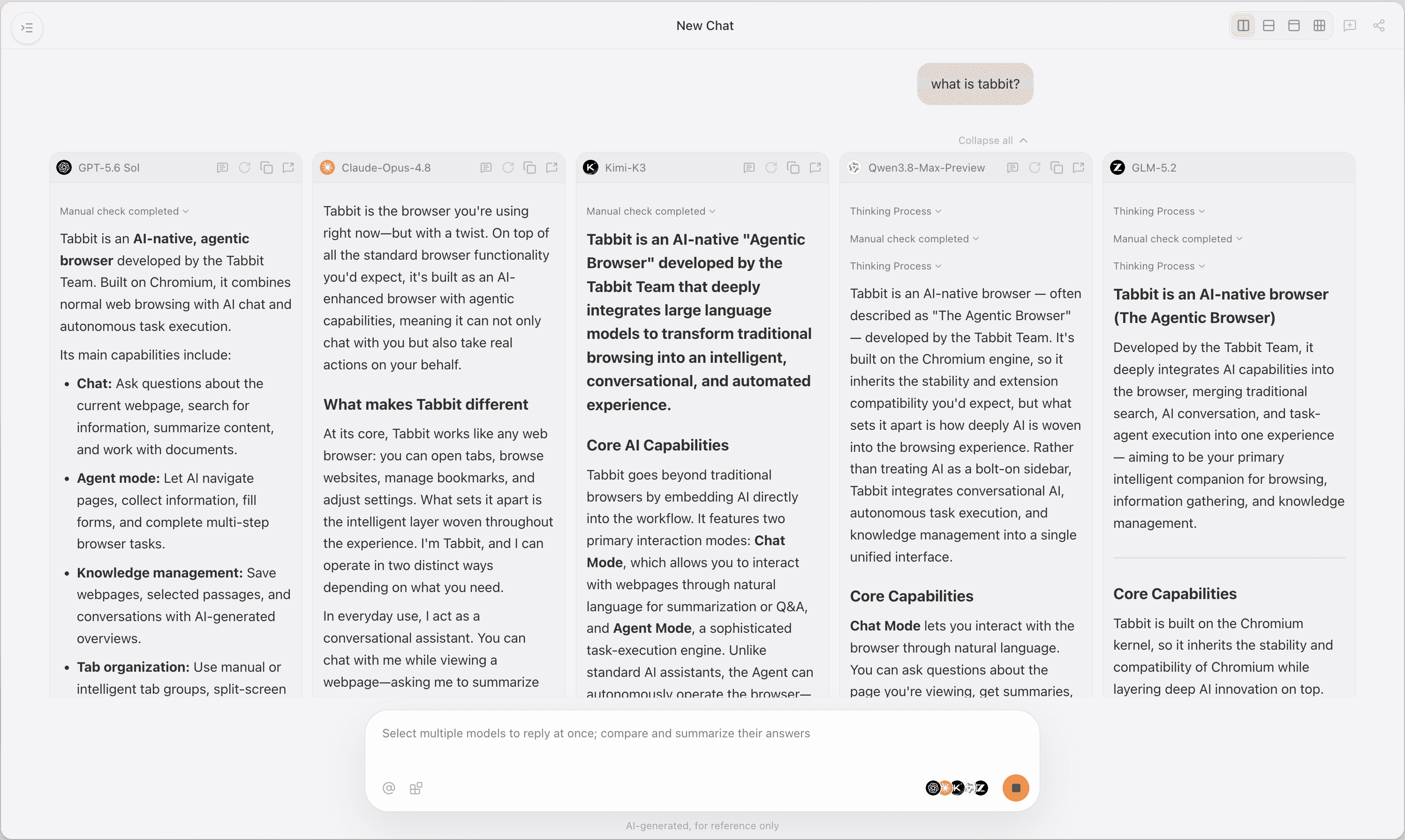
A clean test takes four passes:
Open the GLM-5.3 Flash model page and give it one task with a clear success condition. Save the prompt and output.
Repeat the task with GLM-5.2 or another model in the same browser. Change only the model.
Add an image or screenshot. Check whether the answer uses visible details rather than merely restating the prompt.
For a multi-step web task, use Agent Mode on public, reversible work. Record tool calls, retries, elapsed time, and the final artifact.
The same discipline applies if you connect a coding harness. Our DeepSeek Harness browser guide treats browser control and model quality as separate layers. Ox Alpha deserves the same treatment. A good model can still fail behind an overloaded route, and a resilient client can retry a bad answer.
For research, attach the source tabs and ask the model to build an evidence table before it writes a conclusion. The research-browser workflow is a better match than dumping a pile of URLs into an untracked chat. If this is your first time with the product, the Tabbit overview explains @ references, multi-model chat, and Agent Mode.
Tabbit makes the model easier to reach and compare. It cannot turn a community attribution into an official model card. Treat GLM-5.3-Flash as the current product route and Ox Alpha = GLM-5.3-Flash as the hypothesis under test.
What should you believe today?
| If you need to decide... | Best current answer | Why |
|---|---|---|
| Is Ox Alpha a serious coding and Agent model? | Worth testing on controlled tasks | Several concrete reports are positive, though the sample sizes are small |
| Is it connected to GLM? | Probably | Multiple independent fingerprints point in the same direction |
| Is it definitely GLM-5.3 Flash? | No | No first-party announcement, public model ID, or weight match exists |
| Should you trust the 63% number as a leaderboard score? | No | It is a DeepSWE subset with incomplete methodology |
| Should you use it for sensitive production data? | Not while the route remains anonymous | Retention terms and operator identity are not a full compliance story |
| Is Tabbit a reasonable place to try it? | Yes, for reversible text, image, and browser tasks | The model entry, context, and comparison workflow are in one browser |
The mystery is now narrow enough to be useful. Ox Alpha behaves like a GLM-family model, appears to touch the Z.ai stack, and combines a million-token window with multimodal input. GLM-5.3 Flash is the neatest name for that package. It is still a guess.
Use the model if the task fits. Save the evidence. When Z.ai or OpenRouter finally names the checkpoint, the conclusion should be easy to update because the facts and inferences were never mixed in the first place.

FAQ
What is Ox Alpha?
Ox Alpha is an anonymous preview model released through OpenRouter on August 21, 2026. OpenRouter lists a 1,048,576-token context window, up to 131,072 output tokens, and a focus on coding, sustained agent work, and production workloads. The developer and exact checkpoint have not been disclosed.
Is Ox Alpha officially GLM-5.3 Flash?
No official OpenRouter or Z.ai source currently says that Ox Alpha is GLM-5.3 Flash. Community fingerprints point strongly toward the GLM-5.x family and a Z.ai serving stack, while the exact Flash name remains an attribution rather than a confirmed product identity.
Why do people think Ox Alpha belongs to the GLM family?
Community investigators report matching GLM-5.3 token counts across 50 strings, similar video-token budgets to GLM-5V-Turbo, and server errors associated with Z.ai's GLM backend. These clues support a family relationship, but tokenizer and hosting matches do not prove that two checkpoints are identical.
Is Ox Alpha multimodal?
Yes. OpenRouter's official announcement says Ox Alpha accepts text, image, and video input, with text output. That confirms multimodal input, but it does not provide a visual benchmark, video-length limit, or proof of the model's developer.
Does Ox Alpha inherit GLM-5.2 intelligence?
Z.ai says the public GLM-5.3 uses the same base model as GLM-5.2 and gains capability through additional post-training. If Ox Alpha is the unreleased GLM-5.3 Flash variant the community suspects, the phrase describes a plausible lineage. It is not yet an official architecture statement about Ox Alpha.
How can I use GLM-5.3 Flash in Tabbit?
Open the GLM-5.3 Flash model page in Tabbit, enter a text, image, or agent task, and choose Use in Tabbit. Keep the identity claim separate from your test result, save prompts and outputs, and avoid sending sensitive code or credentials to an anonymous preview route.