
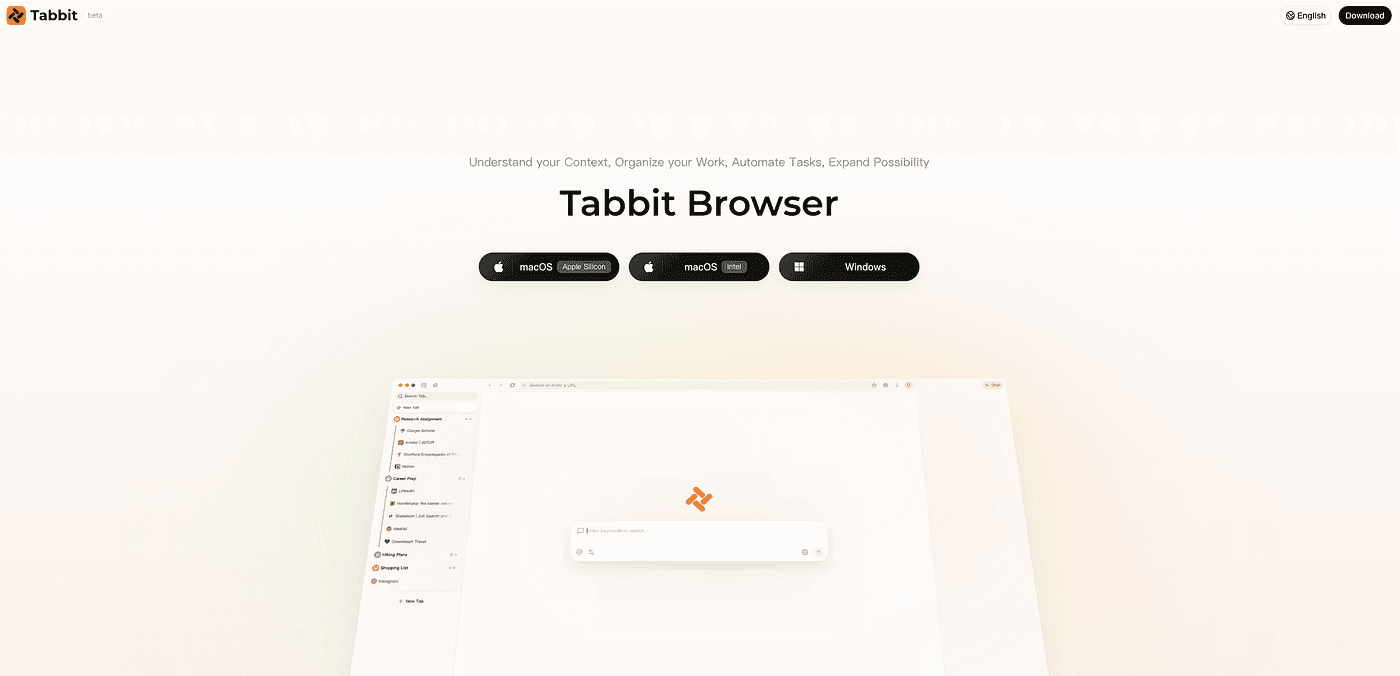
The best alternative to Atlas in 2026 is Tabbit Browser. OpenAI has scheduled Atlas to stop working on August 9, 2026, so this is no longer a theoretical comparison. Tabbit preserves the two workflows Atlas users are most likely to miss—page-aware AI and browser control—then adds multi-model agents, reusable Skills, dedicated agent tab groups, and native macOS and Windows support.
That is the short answer for Atlas users who do not want a partial substitute. The rest of this guide shows the comparison matrix, where competitors still fit, and how to switch in minutes.

Key takeaways
Best overall Atlas alternative: Tabbit — dual platform, multi-model Agent Mode, and direct browser control.
Migration deadline: Atlas is scheduled to stop working on August 9, 2026, so export important bookmarks before then.
Atlas parity you keep: chat with page, multi-step browser agents, AI inside a real Chromium browser.
What you gain: Windows support, model choice (GPT / Claude / Gemini / DeepSeek / Kimi / Qwen…), reusable Skills, vertical tabs, and parallel agent workspaces.
When to pick something else: Comet for answer-engine research, Dia for polished Mac-only context, Edge if you refuse to leave Microsoft defaults.
Atlas alternatives at a glance
| Browser | Best for | Page / tab context | Browser agents | Platforms | Main trade-off |
|---|---|---|---|---|---|
| Tabbit | Best overall Atlas replacement | Yes (multi-model) | Yes (free in public beta) | macOS, Windows | Desktop-first product focus |
| Perplexity Comet | Research synthesis | Yes | Yes (often deeper on paid) | Mac, Win, mobile | Less multi-model workspace flexibility |
| Dia | Polished Mac context | Yes | Partial / skills-style | macOS | Same Mac wall as Atlas |
| Microsoft Edge + Copilot | Stay in M365 | Yes | Limited / rolling out | Cross-platform | AI layered on Edge, not agent-first |
| Brave Leo | Privacy-first Q&A | Current-tab strength | No full agent GA | Cross-platform | Lighter on autonomous tasks |
Feature availability can change by plan, region, and rollout. Treat pricing bands as directional.
What ChatGPT Atlas users actually need
ChatGPT Atlas made three promises people remember:
Page-aware assistant — ask about the page you are looking at without copy-paste.
Browser context — optional memory / history-aware help.
Agent Mode — click, type, navigate, and finish multi-step web tasks.
OpenAI is now moving browser-based agentic work into ChatGPT and Codex, and says Atlas will stop working on August 9, 2026. That makes the migration question concrete: export your bookmarks, identify the workflows you rely on, and choose a browser that can perform them.
Most “alternatives” lists only match one of those jobs. Atlas users bounce when:
they hit a Mac-first wall;
Agent Mode sits behind ChatGPT Plus or higher;
they want Claude / Gemini / other models for specific work.
If that list sounds familiar, you are not looking for “any AI browser.” You are looking for a super-set.
1. Tabbit — best overall alternative of Atlas
Best for: Atlas users who want page AI + agents without platform or model lock-in.
Tabbit is the strongest overall ChatGPT Atlas alternative because it maps cleanly onto Atlas workflows and removes the three walls above.
Atlas parity (what you keep)
| Atlas habit | Tabbit equivalent |
|---|---|
| Sidebar chat about the current page | Chat with page / selection / screenshot AI |
| Agent Mode multi-step tasks | Agent Mode across sites (free in public beta) |
| Context from recent browsing | Omnibox @ mentions for tabs, bookmarks, files, workspaces |
| Daily Chromium browsing | Full browser + import for bookmarks/passwords |
Beyond Atlas (why switch is a step up)
macOS and Windows from day one—no “Windows coming later” gap for mixed teams.
Multi-model routing: GPT, Claude, Gemini, DeepSeek, Kimi, Qwen and more.
Skills Plaza: save reusable automations instead of retyping the same Atlas prompt every morning.
Vertical tabs + smart workspaces for research chaos, not only a chat panel.
Free public beta, including Agent Mode—no Plus tax just to unlock the headline feature.
Best fit: people who used Atlas as a daily driver and now need a reliable dual-platform agentic browser.
But… if you only want Perplexity-style answers and already live in Comet’s ecosystem, Comet may feel more familiar for pure research. If you refuse to leave Edge + Microsoft 365, Edge Copilot is the path of least resistance—not the deepest agent experience.
Browser control: Tabbit can operate the page, not just explain it
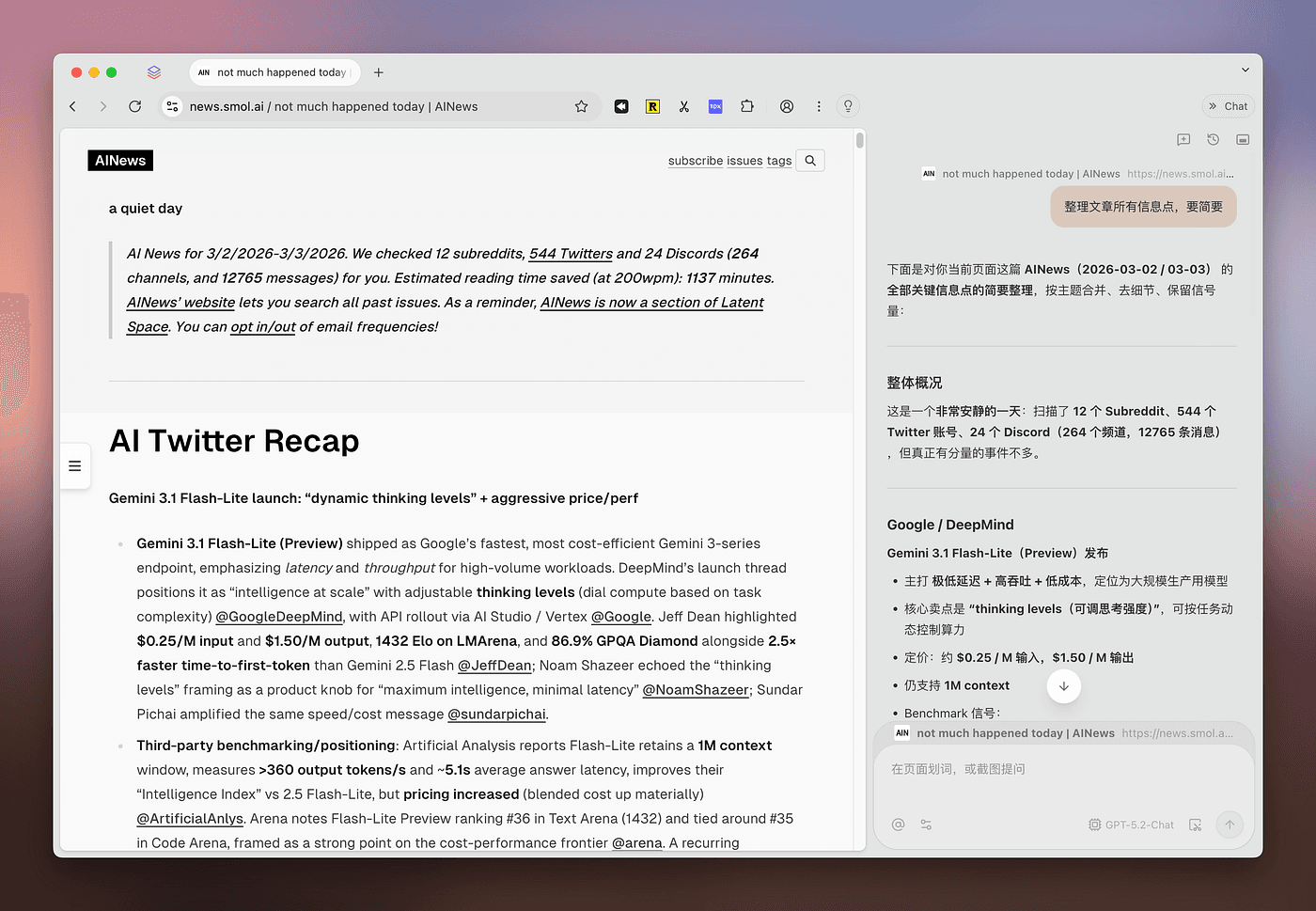
The key difference between a chat sidebar and a browser agent is action. According to Tabbit’s official browser-agent documentation, Agent Mode can read the current page, click, scroll, type, fill forms, and move between sites. You describe the outcome in natural language; Tabbit creates an execution plan and shows the steps while it works.
The spreadsheet example below makes that distinction concrete. The prompt asks Tabbit to enter employee names, ages, and departments into Google Sheets, format the header, and center the numeric values. Agent Mode operates the live sheet while its execution trail remains visible in the sidebar.
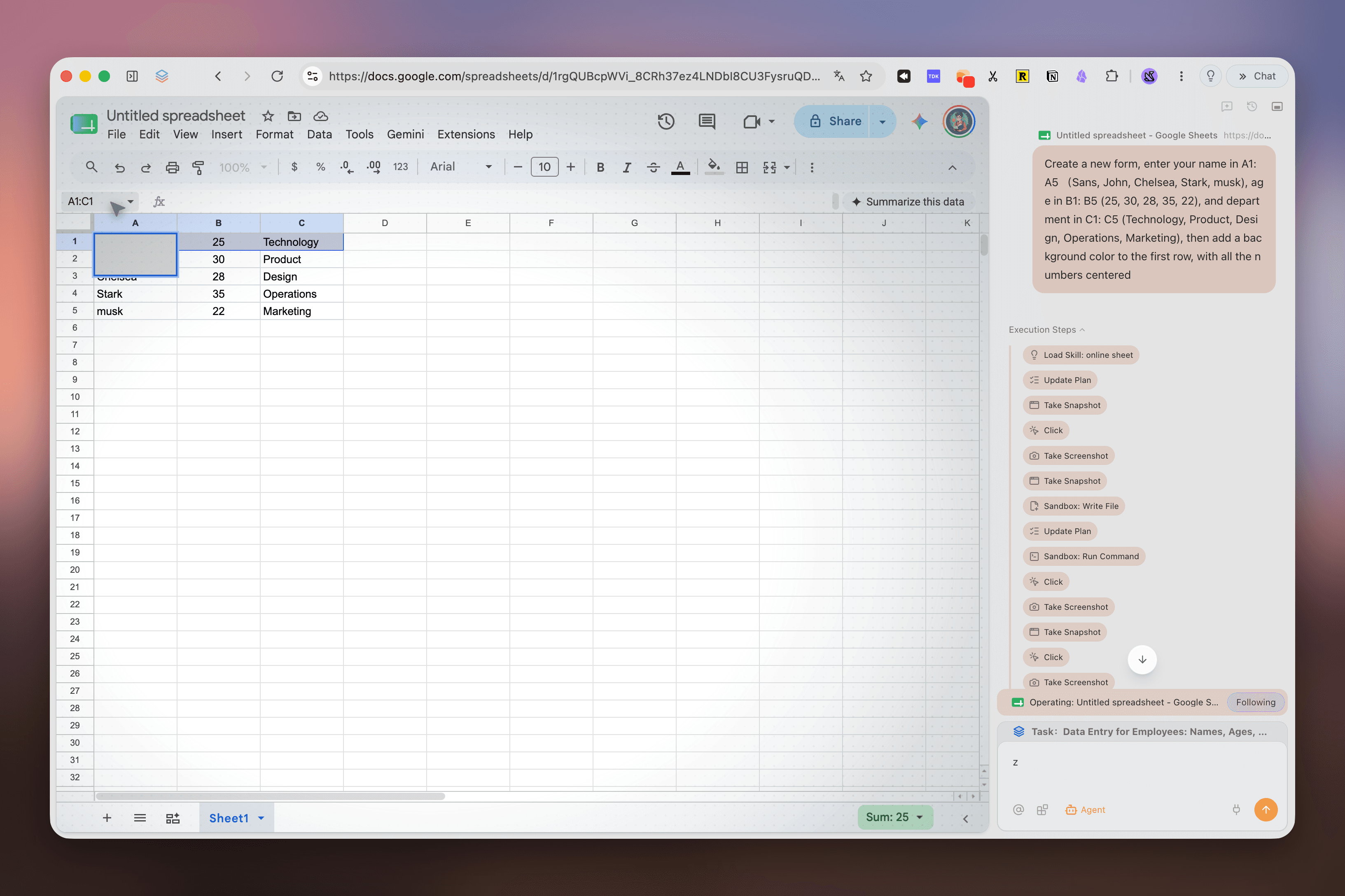
This is useful for repeatable, bounded work: updating a dashboard, moving approved data between systems, filling routine forms, or collecting results into a table. Keep a human checkpoint for payments, account changes, publishing, or any action that is difficult to reverse. If a site changes or a step is ambiguous, stop the run, clarify the instruction, and resume.
Deep Research: browser actions become a traceable report
Browser control also changes research. Instead of returning one answer from one prompt, Tabbit’s Deep Research workflow can plan searches, open multiple sources, read them, compare claims, and return a structured brief with citations. The task runs in a dedicated tab group, so you can keep browsing elsewhere and inspect the source trail afterward.
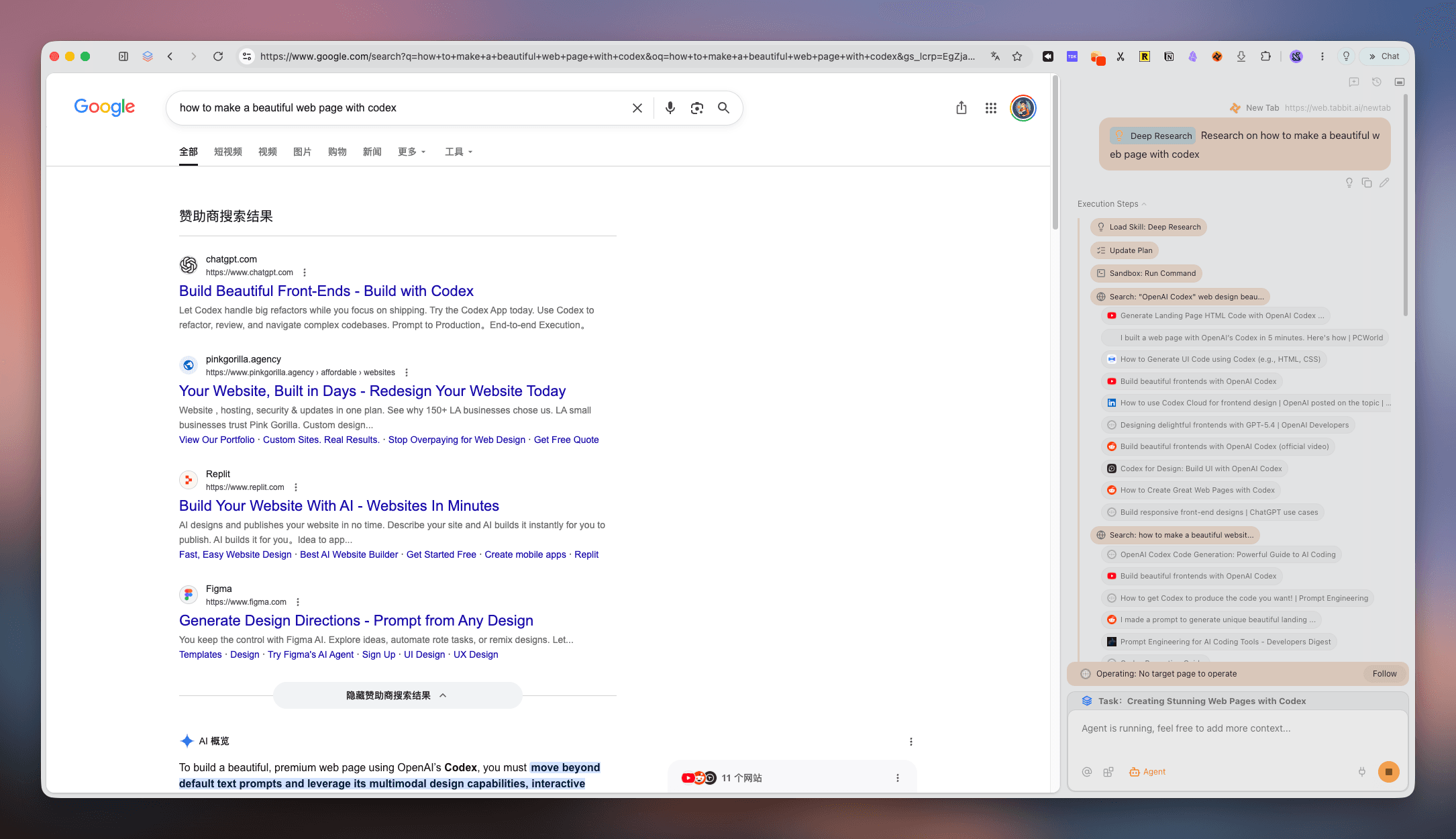
For an Atlas migration, that means two separate workflows stay intact: use Agent Mode when the result is a changed webpage or completed process, and use Deep Research when the result should be a sourced report. In both cases, specify the desired output, acceptable sources, and approval points before the agent starts.
2. Perplexity Comet — best for research-first workflows
Best for: multi-source answers, comparisons, and people already in the Perplexity habit.
Comet is the alternative most media lists put near the top because it is cross-platform and research-native. For “gather sources and synthesize,” it is excellent.
But… if your Atlas usage was heavy on agent execution (forms, multi-site chores, reusable automations) and model choice, Tabbit is the closer super-set. Comet’s deeper agent layers are often easier to associate with paid tiers, and the product identity stays answer-engine first.
3. Dia — best polished Mac context browser
Best for: Apple Silicon Mac users who prioritize design and cross-tool context (tabs + workspace apps).
Dia inherits strong craft from The Browser Company lineage and can feel premium for chat across tabs and connected work tools.
But… Dia remains Mac-bound for many users—the same platform wall that already frustrates Atlas adopters on Windows or mixed teams.
4. Microsoft Edge + Copilot — best zero-migration Windows default
Best for: people who will not leave Windows defaults and Microsoft 365.
Copilot can summarize and reason across tabs without installing a new browser. Migration cost is near zero.
But… this is AI on Edge, not an agentic browser built around tasks, Skills, and multi-model routing. Atlas users who wanted a dedicated AI shell usually bounce.
5. Brave Leo — best privacy-first assistant layer
Best for: privacy-conscious users who want summaries and Q&A without a heavy agent.
Leo’s privacy story (proxying, retention posture, BYOM options) is a real differentiator.
But… full autonomous agent browsing is not the center of gravity the way Agent Mode is in Atlas/Tabbit. If agents are why you opened this article, look at Tabbit first.
How Tabbit maps every Atlas job (and more)
| Job you did in Atlas | Do it in Tabbit | Extra you get |
|---|---|---|
| Summarize the open article | Chat with page / selection AI | Multi-model choice per task |
| Fill a form or update a browser app | Agent Mode | Visible execution steps + human checkpoints |
| Compare many web sources | Deep Research | Dedicated tab group + structured, cited output |
| Remember related browsing context | @tabs / @bookmarks / workspaces | Local files as context |
| Rewrite text on a page | Selection AI | Save as Skill for reuse |
| Daily browsing shell | Full Chromium browser | Vertical tabs + smart grouping |
Choose by scenario
| Your situation | Best pick | Why |
|---|---|---|
| Used Atlas daily; need Mac + Windows | Tabbit | Dual platform + free Agent Mode |
| Want multi-model, not OpenAI-only | Tabbit | GPT/Claude/Gemini/DeepSeek/Kimi/Qwen… |
| Pure research / answer engine | Comet | Strong synthesis product identity |
| Stay on Mac design browser only | Dia | Polish, still Mac-limited |
| Refuse any browser switch at work | Edge + Copilot | Lowest change management cost |
| Privacy over agents | Brave Leo | Assistant layer, lighter automation |
Final verdict
If the query is literally “best alternative of Atlas,” the answer should be singular.
Pick Tabbit when you want Atlas’s page-aware + agentic core without Mac-only and single-model ceilings—and when you need the browser itself to execute a workflow, show its progress, and deliver a result. Agent Mode fits tasks that change a webpage; Deep Research fits tasks that compare sources and produce a report.
Use Comet, Dia, Edge, or Brave when your constraint is narrower (research brand, Mac design, corporate default, or privacy-first Q&A). For most Atlas users reading this page, those are second choices.
Ready to switch? Start here: best alternative of Atlas landing page or download Tabbit free for macOS and Windows.
FAQ
What is the best alternative of Atlas browser in 2026?
Tabbit is the best overall alternative for most ChatGPT Atlas users because it covers page-aware AI and Agent workflows while adding free Agent Mode access, multi-model support, and both macOS and Windows.
Does Tabbit include all ChatGPT Atlas features?
Tabbit covers the Atlas capabilities people use daily—chat with page, multi-step agents, and AI inside a real browser—and extends them with multi-model choice, Skills Plaza, vertical tabs, and dual-platform support. Exact feature names differ by product, but the jobs map cleanly.
Is Tabbit free compared with Atlas Agent Mode?
Yes during public beta. Tabbit includes Agent Mode free. Atlas Agent features are commonly limited to paid ChatGPT plans—always check current OpenAI pricing.
Does Tabbit work on Windows?
Yes. Unlike the typical Atlas Mac-first availability, Tabbit supports both macOS and Windows.
How is Tabbit different from Perplexity Comet?
Comet is strongest as a research / answer-engine browser. Tabbit is a full agentic productivity browser with free Agent Mode, multi-model routing, Skills, and workspace-oriented tabs.
Is ChatGPT Atlas shutting down?
Yes. OpenAI says Atlas is scheduled to stop working on August 9, 2026, while its browser-based agentic capabilities move into ChatGPT and Codex. Export important bookmarks before the deadline; open tabs, cookies, and active sessions do not transfer automatically.
How do I migrate from Atlas to Tabbit?
Download Tabbit, import bookmarks and passwords from your current browser, re-run your common agent tasks, and save them as Skills. No special Atlas account transfer is required.
Which AI models does Tabbit support?
Tabbit supports GPT, Claude, Gemini, DeepSeek, Kimi, Qwen, and other models so you are not locked to a single provider the way a pure OpenAI browser stack is.
