Official Small Instruct
`mistralai/Mistral-Small-3.2-24B-Instruct-2506` is a June 2025 update to 3.1. Its card reports better instruction following and fewer repetition errors. That is useful evidence, not a promise of a good character voice.
MISTRAL 24B · ROLEPLAY FIELD GUIDE
Mistral 24B is a size label, not a single roleplay model. The official Instruct checkpoint, a community fine-tune, a merge, and a Q4 or Q6 file can produce very different scenes. Start with the exact repository, then test voice, agency, movement, and repetition before spending hours on a chat.
Community reports are clues for your own test. This guide does not provide jailbreaks or ways to bypass safety controls.
NAME THE CHECKPOINT
Roleplay advice becomes unreliable when several repositories are called “Mistral 24B”. Keep these layers separate in your notes.
`mistralai/Mistral-Small-3.2-24B-Instruct-2506` is a June 2025 update to 3.1. Its card reports better instruction following and fewer repetition errors. That is useful evidence, not a promise of a good character voice.
Roleplay V2, V3, V5 and V6 pages are separate fine-tunes or merges. Read the author’s card for training intent, prompt format, license and recommended sampler. Never copy a setting from a different repo by its shared size.
A base model and an instruct model expect different prompting. A character card written for chat may behave strangely on a base checkpoint unless the serving layer and prompt format are designed for it.
GGUF Q4, Q5, Q6 and i1 files change memory use and often speed or fidelity. They are not new Mistral releases. Record the quant filename, context limit, backend and offload plan with the model ID.
PROMPT CRAFT
SillyTavern builds one prompt from system instructions, character and persona data, world information, history and the current message. The final prompt matters more than a clever slogan in the card.
State that it writes the character’s next reply, keeps the user’s agency, and advances the current scene. Put voice, boundaries and output shape in separate short blocks.
An example dialogue teaches rhythm, viewpoint and formatting. Remove examples that make the model narrate the user, repeat a catchphrase, or write both sides of the exchange.
Separate fixed facts, current goals and temporary scene state. If a world entry is too long or duplicated, the model may spend its context restating facts instead of reacting.
Use Prompt Itemization, logs or the Prompt Inspector to see what was sent. If role markers or the wrong character are present there, sampler changes will not repair the input.
A SMALL, FAIR TEST
Use one card, one opening message, one context limit and one response cap. Compare branches for three turns and change one variable at a time.
Write the character goal, voice markers, location, immediate change, user boundary and desired response length. Ask for one concrete consequence, not a generic continuation.
Start from the card’s stated template and sampler. Save the first answer before swiping or editing. Then run the same opening with one deliberate change.
Rate voice, user agency, scene movement and repetition from 0 to 2 after each turn. Add a short note such as “new decision” or “same sensory detail” so the score stays grounded.
Fix model ID and template first. Then adjust context and response length. Only after the baseline is stable should you compare temperature, min-p, DRY, XTC or another quant.
SYMPTOM → LAYER → NEXT CHECK
A scene that feels “bad” can be a prompt assembly problem, a serving mismatch or a sampler choice. This table keeps the investigation narrow.
| What you see | Likely layer | Next check |
|---|---|---|
| Dry, stilted or repetitive prose | Checkpoint baseline, card examples or sampler | Run the control branch, reduce duplicated lore, then change one sampler value. |
| Model speaks for the user | Main prompt, persona or example dialogue | State user autonomy positively and inspect the final prompt. |
| Role markers leak into the reply | Two chat-template owners | Let the tokenizer or backend apply the Mistral template once. Remove the duplicate formatter. |
| Scene loops or stops moving | Context pressure, response cap or repetition settings | Check prompt itemization, shorten stale lore and require one new consequence. |
| Empty output or strange truncation | Endpoint, stop strings or model slug | Send a one-line prompt, verify the exact ID and remove stop strings copied from another model. |
| Very slow after a few turns | Quant, context growth or partial CPU offload | Compare the file size and context with available memory. Record tokens per second before tuning prose. |
TABBIT AS THE RESEARCH DESK
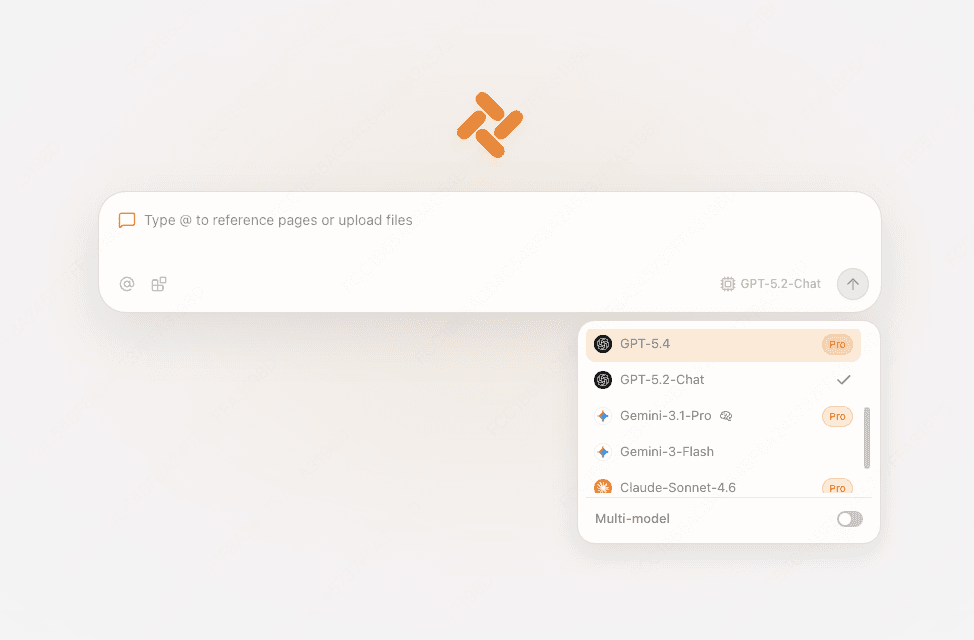
Tabbit does not run a local Mistral checkpoint or replace SillyTavern. It helps when the setup is spread across model cards, quant pages, documentation and community threads. Use the live model picker to verify what your account can access.
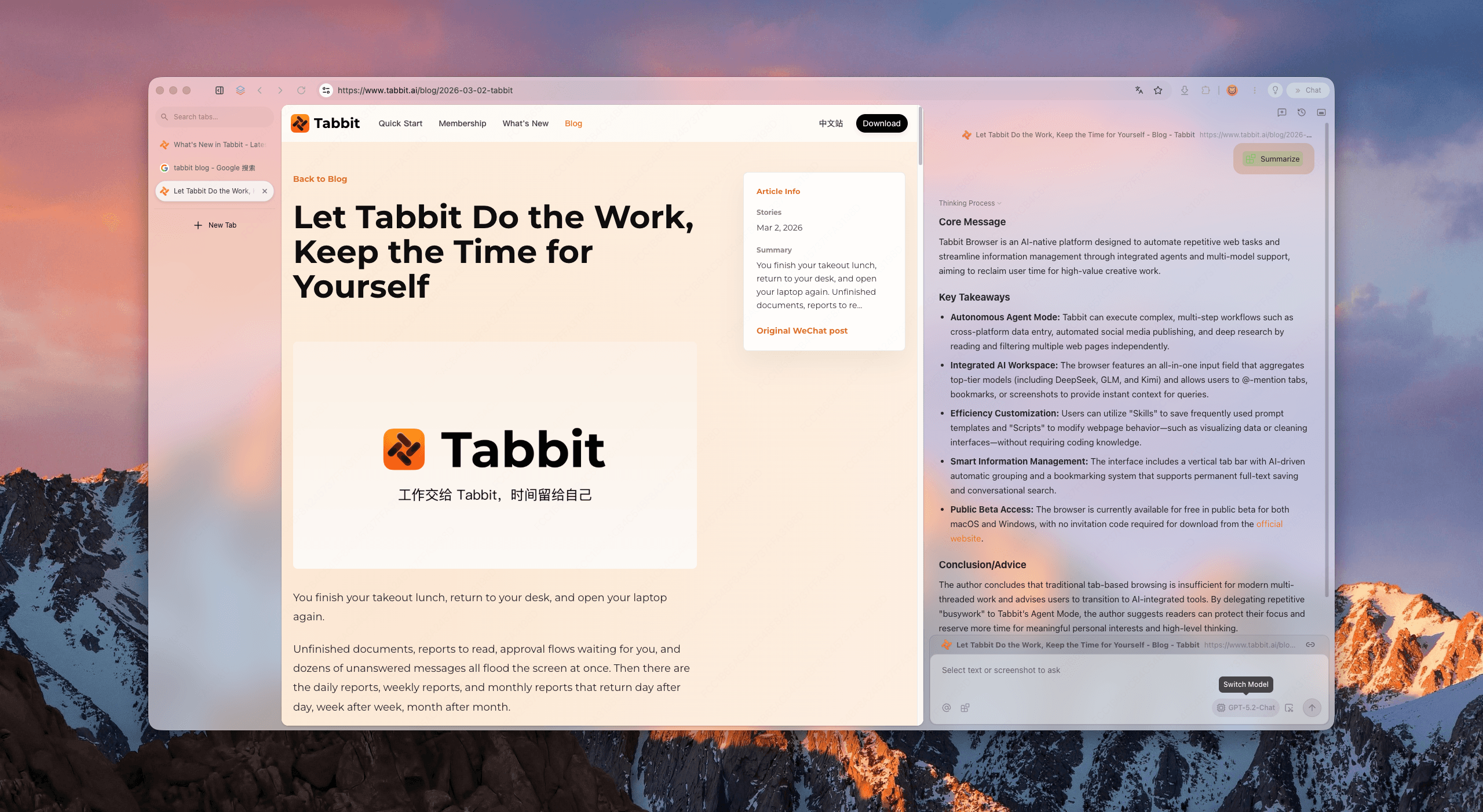
Open the official card, the chosen RP repository, its quant page and the SillyTavern docs in one browser workspace.
Use @ to bring a source page, screenshot or local note into a question. Ask for a checklist that preserves repository IDs and marks unknowns.
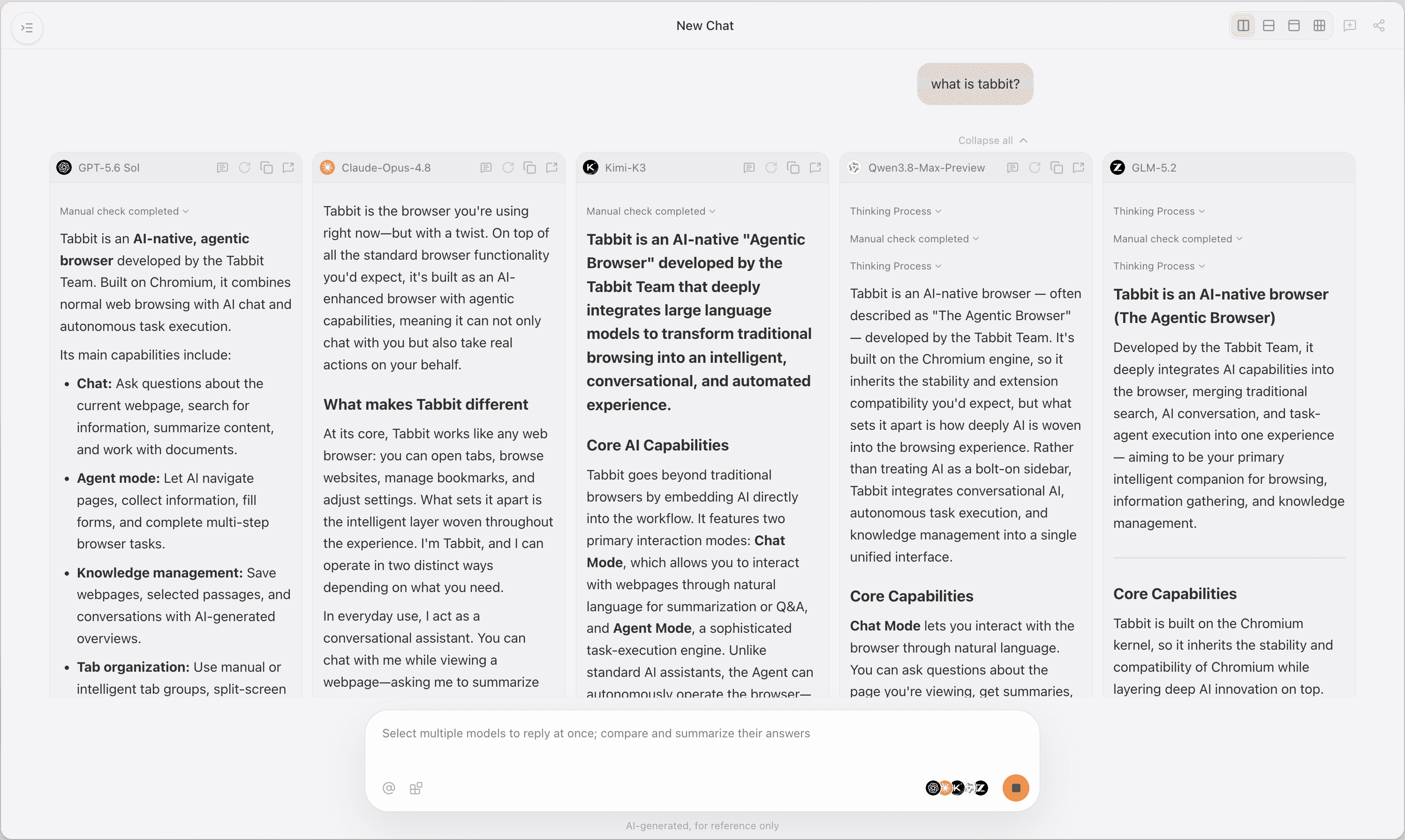
Use multi-model chat to ask how two sources differ. Compare claims and instructions, not a single generated paragraph.
Apply the verified template and settings in SillyTavern or your server. If Mistral is not visible in Tabbit’s picker, do not infer that the product runs the local model.
USE EACH TOOL FOR ITS JOB
SillyTavern and Tabbit complement different parts of the work. Keep generation controls with the RP frontend and use the browser workspace for source handling.
| SillyTavern + backend | Tabbit | |
|---|---|---|
| Run a local Mistral 24B file | Yes, with a compatible server | Not promised |
| Cards, lore and samplers | Detailed RP controls | Reference notes and pages |
| Read official and community sources | Switch tabs or copy text | Keep sources together and use @ |
| Controlled RP evaluation | Generate and record branches | Compare source claims and drafts |
| Model availability | Backend model list | Check the live picker for your account |
KEEP THE CLAIMS CLEAN
Temperature, min-p, DRY and XTC interact with the checkpoint and backend. A setting that helps one card can make another brittle.
Official instruction or coding scores do not measure voice, pacing, humor or whether a character remembers a promise. Use a repeatable scene test.
Legitimate roleplay can define fictional boundaries and user agency. It should not instruct a provider or model to evade safety controls.
Model directories, providers and Tabbit access change. The exact repository card and the live product picker are the sources to check today.
OPEN THE SOURCES
The links below separate official model facts from community experience and frontend documentation.
FAQ
It depends on the exact checkpoint, card, template, context and sampler. The Reddit report found strong instruction following but dry and repetitive creative writing. Run the same three-turn test on your chosen file.
Start from the full repository ID, then choose a file that fits your memory and license needs. Official Small 3.2 Instruct and community RP fine-tunes are different choices, not interchangeable names.
The official 3.2 card suggests a relatively low 0.15 for general use. RP fine-tunes may publish another baseline. Record the card’s value, test it, and change one sampler at a time.
Possible causes include the baseline checkpoint, duplicate lore, examples, context pressure, template ownership or sampler settings. Inspect the assembled prompt before blaming the model.
Not automatically. Q6 can use more memory than Q4 and may preserve more fidelity, but backend speed and hardware matter. Compare the actual files with the same short scene.
Do not assume it. Tabbit is presented here as a browser research workspace. Open its live model picker after installation to see what your account can access.
Confirm the repository, make the template unambiguous, run a short RP comparison, then keep the evidence close while you tune.
Available for macOS and Windows. Model access can vary by edition, region and rollout.